


 Home /
 Custom Lithium-Ion Battery for Scooters: OEM Pack Design Options


Table of Contents
- What to Specify for a Custom Scooter Battery Pack
- Choosing Cells, Chemistry, and Pack Architecture
- BMS, Charger, and Controller Compatibility
- Mechanical Integration, Enclosure, and Thermal Design
- Prototype, Validation, and Production
- Documentation, Testing, and Transport Evidence
- Supplier RFQ Checklist and Evaluation Questions
- Custom Battery Pack Options with Gloflux
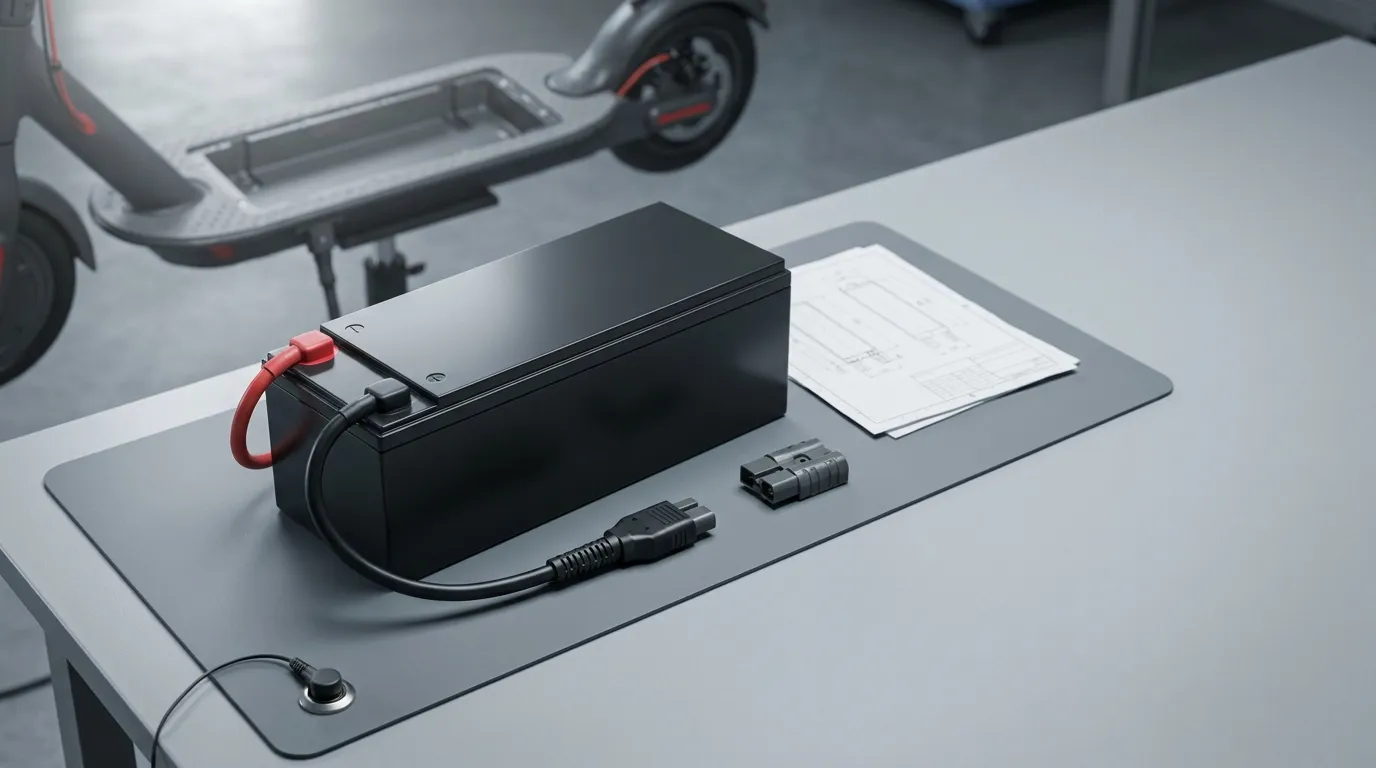
A custom lithium-ion battery for a scooter is engineered around the scooter's voltage platform, continuous and peak current demand, energy or range target, physical envelope, controller and charger interface, BMS requirements, environmental conditions, and required validation documents—not selected by capacity alone. For OEMs and advanced buyers, the goal is to translate those scooter-specific requirements into a pack architecture that performs reliably in the field and can be sourced with the right technical evidence.
This guide focuses on the custom pack design options available to scooter manufacturers and integrators. For a broader look at how custom battery packs are architected from cell selection through production, see our custom battery pack design guide.
What to Specify for a Custom Scooter Battery Pack
Before contacting a battery manufacturer, an OEM must define the scooter's electrical and mechanical requirements. The more precisely these are captured, the fewer prototype revisions and performance surprises will follow. A complete scooter pack specification typically includes:
- Voltage platform — the nominal voltage the scooter's motor controller is designed around.
- Continuous current — the sustained current draw during normal riding.
- Peak current — the transient draw during acceleration, hill climbing, or heavy load.
- Capacity (Ah) and energy (Wh) — the charge storage and the total energy available for range.
- Physical envelope — the available space inside the scooter frame or deck, including height, width, length, and mounting points.
- Connector and wiring requirements — connector type, pinout, polarity, wire gauge, and cable routing.
- Charger and controller compatibility — charge voltage, charge current, and the controller's cutoff behavior.
- Operating environment — expected temperature range, moisture exposure, vibration, and shock.
- Communication or monitoring needs — whether the pack must report state of charge, health, or fault data to the scooter's display or controller.
Voltage, Capacity, and Energy
Voltage, capacity, and energy are often treated as interchangeable, but they answer different questions.
Nominal voltage is the pack's reference voltage, determined by the number of cells connected in series. It must match the scooter's controller and motor design. Most scooter systems are built around a defined nominal voltage, such as 36V, 48V, or 72V, though the exact value depends on the cell chemistry and series configuration.
Capacity, measured in ampere-hours (Ah), describes how much charge the pack can store. It is directly related to runtime but does not, by itself, tell you how much energy is available.
Energy, measured in watt-hours (Wh), is the product of nominal voltage and capacity:
Energy (Wh) = Nominal Voltage (V) × Capacity (Ah)
Energy is the more useful value for comparing range across packs with different voltages. A 48V 20Ah pack stores 960Wh, while a 36V 20Ah pack stores only 720Wh—the same capacity, but different range potential.
The distinction matters because a scooter's range is determined by its energy consumption per kilometre, not by ampere-hours alone. When specifying a pack, state both the Ah and the Wh, and confirm the nominal voltage the manufacturer is designing to.
Continuous Current, Peak Current, and C-Rate
A scooter's current demand is rarely constant. During steady cruising, the motor draws a relatively continuous current. During acceleration, hill climbs, or heavy rider load, the draw can spike well above the average.
Continuous current is the current the pack must sustain indefinitely under normal riding conditions. It determines how the cells are rated and how the pack's thermal path is designed.
Peak current is the short-duration current the pack must support during high-demand events. Peak current is usually expressed with a time limit, such as 30 seconds or 2 minutes.
C-rate normalizes current against capacity. A 1C rate means the pack delivers a current equal to its capacity in ampere-hours; a 2C rate means twice that. For example, a 20Ah pack at 1C delivers 20A, and at 2C delivers 40A.
An OEM must specify both continuous and peak current, plus the duration of the peak, so the manufacturer can select cells with sufficient current capability. If the cells are undersized for the peak demand, voltage sag increases, the pack runs hotter, and the BMS may trip under load—even though the pack's capacity appears adequate on paper.
Voltage sag is the temporary drop in pack voltage under load, caused largely by internal resistance. A pack with high internal resistance will show greater sag, which can reduce top speed, trigger low-voltage cutoff early, and generate unnecessary heat. Internal resistance is a property of the cells, the interconnections, and the pack's overall construction—so it must be considered at the design stage, not discovered during prototype testing.
Choosing Cells, Chemistry, and Pack Architecture
The cell selected for a scooter pack directly determines its voltage, energy, current capability, cycle life, temperature behaviour, and physical size. There is no single best cell; the right choice depends on the scooter's requirements.
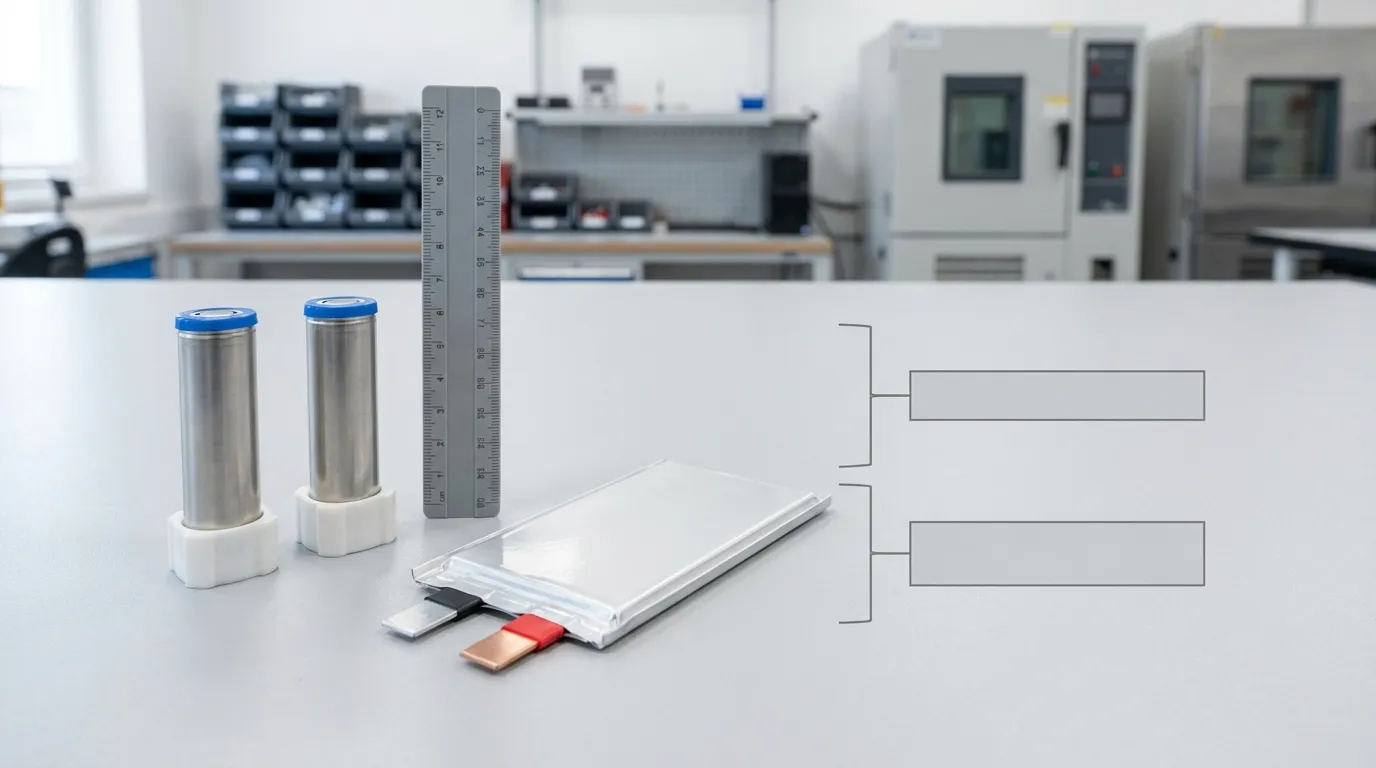
Cylindrical vs. Pouch Cells for Scooters
| Factor | Cylindrical Cells | Pouch Cells |
|---|---|---|
| Form | Rigid metal can; standard diameters such as 18650 and 21700 | Flat, flexible foil pouch |
| Space efficiency | Moderate; round cells leave void spaces | High; can conform to available space |
| Mechanical protection | Strong metal casing provides inherent rigidity | Requires enclosure, compression, and protection from puncture |
| Thermal behaviour | Point heat sources; heat must move through the can | Large surface area can aid heat dissipation if managed |
| Assembly | Well-established welding and assembly processes | Requires careful handling and compression design |
| Best suited to | Packs where standard formats and robust construction are priorities | Packs where space is tight or the shape is irregular |
Cylindrical cells are widely used in light electric vehicles because they are standardized, mechanically robust, and available in high volumes. Pouch cells offer more design freedom when space inside the scooter frame is limited or the pack must fit an unusual shape. The trade-off is that pouch cells typically require more careful mechanical integration to prevent swelling, puncture, or vibration damage.
Chemistry Trade-offs: Li-ion, LiFePO4, Li-Polymer
| Factor | Li-ion (e.g., NMC) | LiFePO4 | Li-Polymer |
|---|---|---|---|
| Typical nominal voltage | ~3.6–3.7V per cell | ~3.2V per cell | ~3.7V per cell |
| Energy density | High | Lower | High |
| Cycle life | Good | Longer | Good |
| Weight | Lighter for a given energy | Heavier for a given energy | Lighter for a given energy |
| Key trade-off | High energy in a compact size | Longer life and a different safety profile, at the cost of energy density and weight | Often used in pouch format; the term refers to construction and electrolyte, not a single fixed chemistry |
LiFePO4 is sometimes considered for scooters where cycle life and thermal stability are priorities, but its lower nominal voltage and lower energy density mean a heavier, larger pack for the same range. Li-polymer is often used interchangeably with "lithium pouch," but the term actually describes a cell construction and electrolyte family, not a single chemistry.
For a scooter, the decision usually comes down to energy density versus cycle life versus cost, all weighed against the physical space available in the vehicle.
Series and Parallel Configurations
A battery pack is built by connecting cells in series and parallel.
Series connections (S) increase voltage. Each cell in series adds its nominal voltage to the pack. A pack with 13 cells in series (13S) has a nominal voltage of roughly 48V with standard Li-ion cells.
Parallel connections (P) increase capacity and available current. Two cells in parallel (2P) double the capacity and current capability of the group.
A full pack description combines both, such as "13S2P," meaning 13 cells in series and 2 cells in parallel.
The series count must match the scooter's controller and motor voltage range. The parallel count must provide enough capacity for the range target and enough parallel paths to deliver the required current without overstressing individual cells. A pack that is correctly specified for voltage but under-specified for current will run hot and degrade quickly—even if its total capacity looks acceptable.
Cell matching also matters. Cells within a pack should be closely matched for capacity, internal resistance, and self-discharge so they share the load evenly and age together. Manufacturing should use cells from controlled lots with documented cell-matching practices.
BMS, Charger, and Controller Compatibility
The battery management system (BMS) is the pack's protection and control centre. It is not optional, and it is not the same as a simple protection circuit module (PCM).
A PCM typically provides basic protection against overcharge, over-discharge, overcurrent, and short circuits. A BMS does that and more: it manages cell balancing, monitors individual or group voltages and temperatures, tracks state of charge, and may support communication with the scooter's controller or display.
The BMS protection thresholds must match the cell and pack limits, the charger's output, and the controller's operating envelope. If the BMS trips current protection during normal acceleration, the pack is either undersized, misconfigured, or the threshold has been set incorrectly.
For a scooter pack, the BMS should be specified with:
- Overcharge and over-discharge voltage thresholds per cell.
- Overcurrent protection for both continuous and peak levels.
- Short-circuit protection.
- Temperature sensing and high/low-temperature cutoffs.
- Cell balancing during charge or discharge.
- Optional state-of-charge or state-of-health reporting.
- Optional communication such as UART, CAN, SMBus, I2C, or Bluetooth, only when the scooter's controller or display requires it.
Communication protocols must not be assumed. The OEM should state exactly which protocol, if any, the scooter uses.
The charger must also be matched to the pack. A charger designed for a different series count or chemistry can overcharge the pack, even with the BMS in place. The OEM must specify the charger's output voltage, current, and connector to the battery manufacturer so the pack and charging system are compatible.
The controller is the other half of the system. Its current draw and cutoff voltages must align with the pack's continuous and peak ratings, the BMS thresholds, and the charger profile. A pack that is electrically incompatible with the controller will cause poor performance, nuisance trips, or accelerated degradation.
For more detail on protection, balancing, and communication options, see our guide on custom battery bms solutions.
Mechanical Integration, Enclosure, and Thermal Design
A scooter battery is a mechanical component as much as an electrical one. It must fit inside the frame or deck, survive vibration and shock, resist moisture where required, and dissipate heat generated during discharge and charging.
Connector and wiring. The connector must match the scooter's interface in pinout, polarity, current rating, and mechanical locking. Wiring must be sized for the pack's continuous and peak current—undersized wiring creates resistance, heat, and voltage drop. Cable routing and strain relief matter in a vehicle that vibrates and flexes. For detailed guidance, see our Custom battery pack connector selection guide.
Enclosure. The enclosure protects cells, busbars, the BMS, and wiring from physical damage, moisture, dust, and vibration. It also determines how the pack is mounted and serviced. An OEM should specify whether the pack is designed to be serviceable, whether fasteners and seals must be replaceable, and what ingress protection (IP) rating is required for the scooter's operating environment.
An IP rating is a specific, tested classification—not the same as general "waterproof" language. If moisture exposure is a concern, the OEM and manufacturer must agree on the test standard and the rating.
Thermal design. Cells generate heat during discharge, especially at high current. The enclosure and internal structure must carry that heat away from the cells, the BMS, and the interconnections. In compact scooter compartments, airflow may be limited, so the thermal path must be designed from the start. Temperature sensors should be placed where they will detect real conditions—typically at the hottest cell group or near the BMS.
Vibration and shock. Scooters experience sustained vibration and occasional impacts. Cell interconnections, welds, connectors, and the BMS must be secured against these forces. A pack that is electrically correct but mechanically weak will fail early in real-world use.
Mounting and serviceability are also part of the mechanical specification. The pack need to be removable for service or replacement? Are the mounting points in the frame designed for the pack's weight and shape? These requirements affect the enclosure design and should be stated in the RFQ.
Prototype, Validation, and Production
Custom scooter packs do not go from specification to volume production in one step. An OEM should expect a staged process that verifies the design before it is committed to tooling or mass production.
Prototype. The first physical samples verify fit, function, thermal behaviour, and electrical performance against the specification. At this stage, the OEM should confirm that the pack fits the enclosure, delivers the expected voltage and capacity, supports the continuous and peak current, communicates correctly with the controller, and charges properly with the specified charger.
Validation. Before production, the pack design should be tested against a defined validation plan. This may include electrical tests, charge/discharge cycling, temperature exposure, vibration, shock, and other mechanical tests. Any test report should state the exact test conditions, the sample configuration, and the pass/fail criteria. For a broader look at what should be verified, see our guide on lithium battery quality control and testing.
Pilot run. A pilot production run confirms that the design can be manufactured consistently, with repeatable quality, before mass production begins. It also validates the assembly process, cell matching, BMS programming, and test procedures.
Mass production. In volume production, the OEM should expect traceability—each pack or batch should be traceable to its cell lots, assembly records, and test results. Change control is equally important. If the manufacturer changes a cell supplier, BMS version, or connector, the OEM should be notified and approve the change before it enters production.
Documentation, Testing, and Transport Evidence
A scooter battery that ships worldwide must be accompanied by the right documents. These documents are not optional, and they are not interchangeable.
Datasheet/TDS. A model-specific technical datasheet describes the pack's electrical, mechanical, and environmental specifications, including the conditions under which those values apply. It should identify the exact model or configuration.
SDS/MSDS. The Safety Data Sheet provides chemical and handling information for the battery. It identifies the product, hazard information, and handling, storage, and transport guidance.
UN38.3 test summary. UN38.3 refers to the transport testing framework for lithium batteries, as set out in the UN Manual of Tests and Criteria. It simulates conditions that lithium batteries may experience during transport. A current UN38.3 test summary is required to support the air, sea, rail, and road shipment of lithium cells and batteries.
IEC/UL/CB report. Product-safety testing under standards such as IEC 62133-2 or UL 1642/UL 2054 provides evidence that a defined cell or battery construction meets a recognized safety standard. A report applies to the exact construction, model, and standard edition tested—not to an entire product line or company.
Company certification. A manufacturer may hold quality-system certifications such as ISO 9001. That is evidence of a quality management system, not a product certification.
The OEM should ask which documents exist for the specific pack configuration being quoted, and who holds them. A test summary or product report covering a different model is not evidence for the pack you are designing.
Supplier RFQ Checklist and Evaluation Questions
The quality of a custom scooter pack depends as much on the supplier's process and documentation as on the design itself. An RFQ should require the manufacturer to answer specific questions before a prototype is approved.
Electrical and mechanical specification:
- What nominal voltage, series configuration, and total energy (Wh) is the pack designed to?
- What are the continuous and peak current ratings, and for how long can the peak be sustained?
- What is the pack's internal resistance at the pack level?
- What are the exact dimensions, weight, connector type, and wiring configuration?
Cell and construction:
- Which cell manufacturer, model, chemistry, and format is being used?
- How are cells matched for capacity, internal resistance, and self-discharge?
- What cell documentation is available, including original cell datasheets?
BMS:
- What protection features does the BMS include?
- What balancing method is used?
- Does the pack support communication? If so, which protocol and data set?
- What are the BMS charge and discharge temperature limits?
Charging and compatibility:
- What charger profile is the pack designed for?
- Does the pack include a recommended charger specification?
Testing and documentation:
- Which validation tests will be performed, and under what conditions?
- Which documents will be provided: datasheet, SDS/MSDS, UN38.3 test summary, IEC/UL/CB report?
- What traceability records will be kept?
Commercial and supply:
- What is the MOQ for the prototype and for production?
- Are there tooling or NRE costs?
- What is the lead time for samples and volume production?
- How are design changes and component substitutions approved?
These questions are not just procurement formalities. They determine whether the supplier can actually deliver a pack that meets the scooter's requirements safely, legally, and consistently.
Custom Battery Pack Options with Gloflux
Gloflux develops custom lithium-ion battery packs for a wide range of industrial, medical, and consumer applications, including electric mobility and light electric vehicles. As part of the company's OEM/ODM battery development service, Gloflux supports requirements such as custom voltage, capacity, and energy; cell chemistry and format selection; S/P architecture; BMS integration; connector and wiring customization; enclosure design; and validation and documentation support.
For scooter applications, the starting point is the same as for any custom pack: a clear requirements specification covering the electrical, mechanical, environmental, and compliance needs of the scooter system. Gloflux can then evaluate the design options—cell format, chemistry, pack architecture, BMS features, and mechanical integration—against those requirements.
To discuss a scooter battery project or review your pack requirements, contact Gloflux with your target voltage, current profile, energy or range target, physical dimensions, and charging system. A technical review is the first step toward a prototype that meets your scooter's real operating conditions.
Talk to the Manufacturer
Resources & Insights
High Capacity Lithium Battery for Wearables: High-Voltage LiPo Cell Design
2026-10-19
Cylindrical Battery Packs for Laptops: 2S vs 3S vs 4S Battery Design
2026-10-19
Stage Lighting Battery Pack: Prevent Voltage Drop & LED Flicker
2026-10-19

Best Rechargeable Batteries for Smart Devices: Performance, Safety, and Selection Guide
2026-10-19


