


 Home /
 22.2V 15000mAh 10C 21700 Li-Ion Battery Pack for FPV RC Model Drones


Table of Contents
- Stable 22.2V Output for 6S Drone Systems
- 15000mAh Capacity for Extended Flight Time
- Advantages of 21700 Lithium-Ion Cells
- 10C Discharge Capability for Reliable Power Delivery
- Custom Connector and Wiring Options
- Applications in FPV and Professional UAV Projects
- Charging, Storage, and Daily Maintenance
- Choosing a Customized FPV Battery Pack
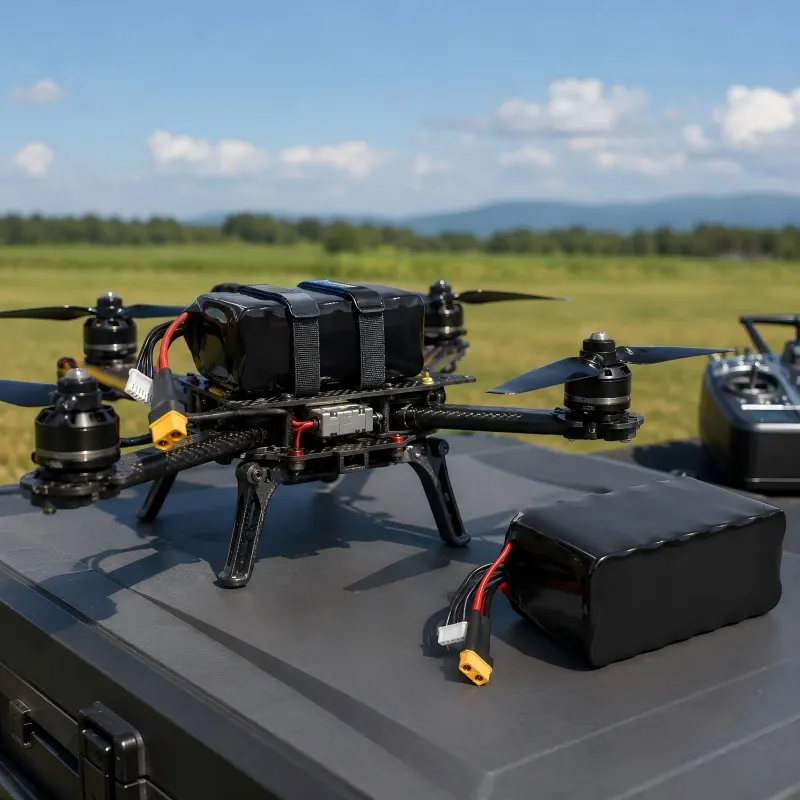
22.2V 15000mAh Drone Battery solutions are designed for FPV aircraft and professional UAV platforms that require extended operating time, stable voltage output, and dependable discharge performance. Built with high-energy-density 21700 lithium-ion cells, this battery pack combines a 6S voltage configuration, large capacity, and 10C discharge capability. It is suitable for long-range FPV flights, aerial photography, mapping, surveying, inspection, and customized unmanned aircraft projects.
Unlike small racing drone batteries that prioritize short bursts of extremely high current, this pack is developed for applications where endurance, energy efficiency, and stable power delivery are more important. Its specifications, connector, wiring, dimensions, protection configuration, and packaging can also be customized according to the electrical and structural requirements of different aircraft.
Stable 22.2V Output for 6S Drone Systems
The battery uses a 6S configuration with six cell groups connected in series. It provides a nominal voltage of 22.2V and is compatible with many propulsion systems designed for 6S power.
Stable voltage output helps the motors, electronic speed controllers, flight controller, communication equipment, and onboard payload operate consistently throughout the flight. This is particularly important for long-range missions, where unexpected voltage drops may affect flight stability, transmission distance, or the safe return of the aircraft.
Before selecting the pack, users should confirm the supported voltage range of the motor, ESC, charger, and other electronic components. A properly matched system improves energy utilization and reduces unnecessary stress on both the battery and the aircraft.
15000mAh Capacity for Extended Flight Time
The 15000mAh capacity gives the aircraft more available energy than standard low-capacity FPV packs. It can support longer flight durations when paired with an efficient propulsion system and a correctly balanced airframe.
Actual flight time depends on several factors, including:
- Total takeoff weight
- Motor and propeller efficiency
- Average operating current
- Flight speed and maneuvering style
- Wind and outdoor temperature
- Payload weight
- Battery discharge cutoff settings
A larger capacity does not automatically guarantee the best flight performance. The additional energy must be evaluated together with the pack’s weight and dimensions. For this reason, battery customization is often required for professional drone projects. The pack should fit the available battery compartment while maintaining the aircraft’s correct center of gravity.
Advantages of 21700 Lithium-Ion Cells
21700 cylindrical cells are widely selected for high-capacity battery packs because they can offer strong energy density, reliable structural stability, and good cycle performance. Compared with some smaller cylindrical formats, fewer cells may be required to reach the desired capacity, helping simplify the internal pack structure.
For long-endurance FPV aircraft, energy density is a key consideration. A suitable 21700 cell can store substantial energy without making the battery excessively large. This supports longer missions while maintaining a practical balance between capacity, weight, size, and output capability.
Cell consistency is equally important. Cells used in the same pack should be carefully matched according to capacity, voltage, and internal resistance. Consistent cells discharge more evenly, improve pack stability, and reduce the risk of individual groups reaching their voltage limits too early.
10C Discharge Capability for Reliable Power Delivery
A 10C discharge rating provides the current output required by many large FPV drones and RC aircraft. With a rated capacity of 15000mAh, the pack is designed to support substantial continuous power when used within the specified operating conditions.
The battery can provide stable energy during takeoff, climbing, cruising, and moderate acceleration. However, system designers should not select a battery only by looking at the advertised C-rate. The aircraft’s continuous current, peak current, flight duration, cooling conditions, and connector rating must also be considered.
Using appropriate cable sizes and low-resistance connectors helps reduce heat generation and voltage loss. The ESC and motor combination should also be tested under realistic load conditions before the aircraft enters regular operation.
Custom Connector and Wiring Options
Different FPV platforms may use different power connectors, balance plugs, wire lengths, and cable gauges. A customized battery can be produced with the connector required by the aircraft’s power distribution system.
Available customization may include:
- Main discharge connector type
- Balance connector configuration
- Positive and negative cable length
- Wire gauge for expected current
- Connector orientation
- Heat-shrink color and external labeling
- Battery dimensions and cell arrangement
- Additional insulation and shock-resistant materials
Correct connector selection improves installation convenience and helps prevent unstable contact during vibration or high-current operation. The connector must be rated for the system’s actual current rather than selected only for its compact appearance.
Applications in FPV and Professional UAV Projects
This battery pack can be used in long-range FPV aircraft, large multirotor drones, fixed-wing platforms, aerial photography systems, mapping UAVs, inspection aircraft, and customized research projects.
For aerial photography, the high capacity supports longer shooting sessions and reduces the frequency of battery replacement. In mapping and surveying applications, extended endurance allows the aircraft to cover a larger area during each mission. Industrial inspection drones may use the available energy to power cameras, sensors, communication devices, or other onboard equipment.
The pack may also be suitable for experimental aircraft where developers need a customized voltage, capacity, connector, cable layout, or external shape.
Charging, Storage, and Daily Maintenance
A charger designed for 6S lithium-ion batteries should be used. Balance charging is recommended because it allows the charger to monitor and manage the voltage of each series group.
The battery should not be charged unattended or near flammable materials. After flight, users should allow the pack to cool before charging it again. Batteries should also be inspected regularly for swelling, damaged insulation, loose cables, deformed connectors, or unusual heating.
For storage, the pack should be kept in a dry, ventilated area away from direct sunlight, moisture, and extreme temperatures. Long-term storage at a full or deeply discharged state may accelerate performance degradation. Following the recommended storage voltage can help preserve capacity and service life.
Choosing a Customized FPV Battery Pack
Selecting the right power solution requires more than matching voltage and capacity. Aircraft manufacturers and project developers should provide information about the motor system, average current, peak current, battery compartment, target flight duration, payload, charging method, and preferred connector.
Based on these requirements, the battery structure can be adjusted to achieve a better balance of energy, weight, dimensions, and discharge performance. A properly customized 22.2V 21700 pack can provide reliable support for long-range FPV flights and professional UAV missions while improving system integration and overall operating efficiency.
Talk to the Manufacturer
Resources & Insights
High Capacity Lithium Battery for Wearables: High-Voltage LiPo Cell Design
2026-10-19
Cylindrical Battery Packs for Laptops: 2S vs 3S vs 4S Battery Design
2026-10-19
Stage Lighting Battery Pack: Prevent Voltage Drop & LED Flicker
2026-10-19

Best Rechargeable Batteries for Smart Devices: Performance, Safety, and Selection Guide
2026-10-19


