


 Home /
High Capacity Lithium Battery for Wearables: High-Voltage LiPo Cell Design


Table of Contents
- How High-Voltage LiPo Designs Increase Energy Density
- Standard vs. High-Voltage LiPo: Engineering Trade-Offs
- Electrochemical Limitations of High-Voltage LiPo Cells
- Matching High-Voltage Batteries to Wearable Electronics
- Manufacturing Precision and Quality Control at GLOFLUX
- Battery Validation and OEM Purchasing Criteria
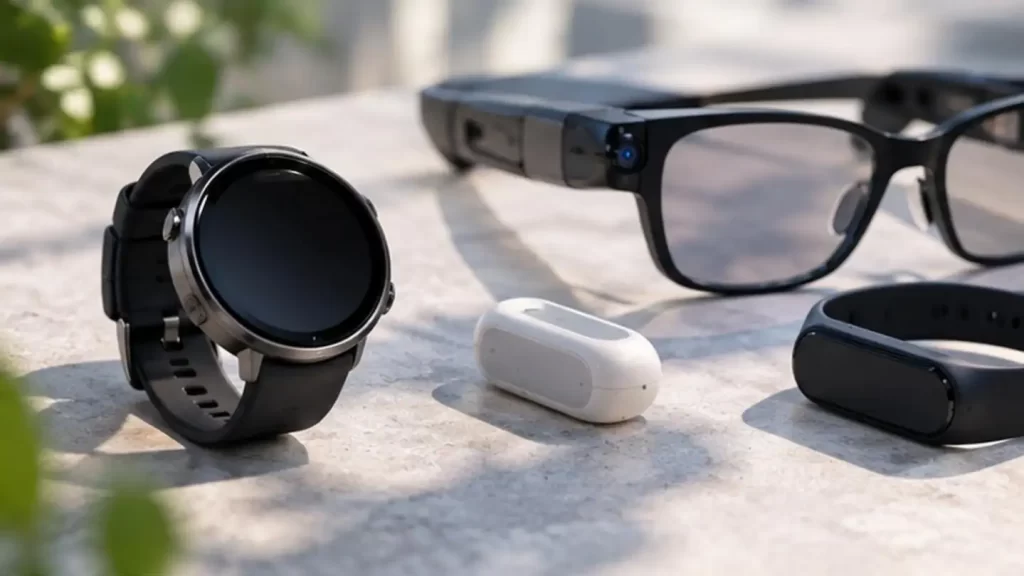
A High Capacity Lithium Battery for Wearables must provide a sufficiently high energy density without compromising enclosure thickness, thermal safety, and service life. For smartwatches, AI glasses, and other medical wearables, increasing cell size is often not that straightforward.
High-voltage Lithium Polymer (LiPo) technology provides an alternative by increasing the usable electrochemical voltage window. However, reliance on the stability of the cathode material and the formulation of the electrolyte determine the practical value of High-Voltage LiPo cells, as well as the consistency of the manufacturing process, and not the nominal capacity of the cell.
How High-Voltage LiPo Designs Increase Energy Density
Nominal Voltage vs. Maximum Charging Voltage
With conventional single-cell LiPo batteries, the nominal voltage is 3.7V, with a charging cutoff set to 4.2V. With high-voltage chemistries, the nominal voltage is in the range of 3.8 to 3.85V, with a charging limit set to 4.35V or 4.4V.
These higher limits require compatible electrode materials and electrolytes. Raising the charging voltage of an ordinary 4.2V cell is not a safe substitute.
Battery energy can be approximated by:
Energy (Wh) ≈ Nominal Voltage (V) × Capacity (Ah)
For example, at an identical rated capacity of 300mAh:
•3.7V cell: Approximately 1.11Wh
•3.85V cell: Approximately 1.155Wh
This represents approximately 4% more nominal energy, not necessarily 4% longer device runtime.
For a High Capacity Lithium Battery for Wearables, volumetric energy density (Wh/L) and measured usable Wh provide more meaningful comparisons than mAh alone.
Standard vs. High-Voltage LiPo: Engineering Trade-Offs
| Parameter | Standard LiPo | High-Voltage LiPo |
| Nominal voltage | Typically 3.7V | Often 3.8–3.85V |
| Charge cutoff | Commonly 4.2V | Chemistry-specific, e.g., 4.35V |
| Energy potential | Established voltage window | Higher energy possible |
| Electrolyte stability | Conventional formulation | Greater oxidation resistance required |
| Cycle aging | Depends on operating conditions | Additional high-SOC stress |
| Charger compatibility | Standard matching charger | High-voltage-compatible charger |
| Design priority | Cost, capacity, lifetime | Energy density, stability, lifetime |
Increasing electrode loading offers another capacity-increase strategy, but thicker electrodes may introduce diffusion limitations, higher polarization, and reduced rate capability.
A high-voltage design becomes attractive when the battery's available footprint and thickness cannot increase.
Electrochemical Limitations of High-Voltage LiPo Cells
Cathode Degradation and Electrolyte Oxidation
Increased upper-cutoff voltages can accelerate undesired interfacial reactions.
Principal Degradation Mechanisms:
•Electrolyte Oxidation: High potential reactions lead to loss of electrolyte components and cyclable lithium.
•CEI instability: Degradation of the cathode-electrolyte interphase increases interfacial resistance.
•Cathode structural changes: Repeated delithiation can cause lattice instability and particle cracking.
•Transiton-metal dissolution: Dissolved metal species can catalyze further electrode decomposition.
Cathode coatings, and the judicious use of electrolyte additives and limiting the voltage window can retard some of these degradation mechanism. The effectiveness of these strategies however requires further testing.
Cycle and Calendar Aging and Swelling
Although a High Capacity Li-ion Battery for Wearables may not experience frequent cycle aging, it can still experience capacity loss due to calendar aging. Repeated deep cycling also causes additional mechanical and electrochemical stress.
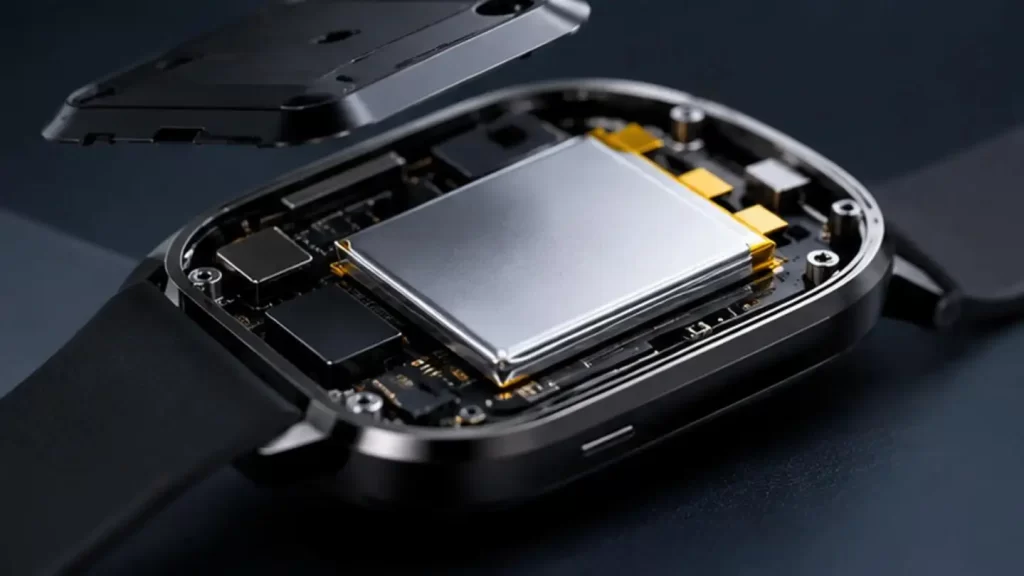
Gas generation and thermal expansion of the electrodes also negatively effect the physical stability of thin pouch cells. Rather than rely on initial cell dimensions, engineers should monitor cell growth under defined thermal and chemical conditions.
Matching High-Voltage Batteries to Wearable Electronics
Runtime, Pulse Loads, and Voltage Compatibility
A battery's usable energy must be evaluated under the device's actual duty cycle.
| Application | Critical Requirement | Engineering Verification |
| Smartwatch | Thin profile, extended runtime | Usable Wh, swelling |
| Fitness tracker | Long standby life | Self-discharge, aging |
| AI smart glasses | Pulsed discharge, low weight | Voltage sag, temperature |
| Medical wearable | Stable output, skin-contact safety | Protection, thermal testing |
Approximate runtime is:
Runtime (h) ≈ Usable Cell Energy (Wh) × Power-Conversion Efficiency / Average Device Power (W)
The estimate assumes that usable cell energy is measured before downstream conversion losses.
Transient loads such as those caused by Bluetooth transmission and GPS activation, or by processor bursts, create current demands that are relieved when the load is removed. During the removal of the load, the energy stored in the battery is depleted, resulting in internal voltage reduction (ΔV = I × R) that can cause the battery to shut down even though it has residual capacity.
Charging and Protection Requirements
When evaluating a High Capacity Lithium Battery for Wearables, ensure that:
•An IC charger is compatible with the specified upper-cutoff voltage.
•A PCM/BMS has overcharge, undervoltage, and overcurrent protection.
•Fuel gauges are calibrated to the true voltage-state of charge (SOC) line.
•NTCs are programmed to reflect the lower (or the warmer) of the two temperatures.
•Connectors have appropriate resistance, configuration, and clearance.
There is design and manufacturing compatibility of a higher nominal voltage with downstream regulators.
Manufacturing Precision and Quality Control at GLOFLUX
At GLOFLUX, we have a proven process and ability to manufacture cells at low tolerances with high levels of uniformity and control.
Custom Cell Development
Electrode Processing and Dimensional Control
Four of the numerous manufacturing variables are described here:
•Coating: Variations in areal loading of the electrode result in variations in the local current density, and therefore, capacity.
•Calendering: Electrode density, porosity and uniformity affect resistance and ionic transport.
•Electrode Alignment: Overlap of the separators and alignment of the electrodes relative to each other can create internal shorts.
•Pouch Sealing: Control of the thickness of the pouch and seal integrity protects the electrolyte and provides mechanical comfort.
GLOFLUX Technical Data
| Technical Reference | Figure | Engineering Interpretation |
| Selected ultra-thin LiPo designs | Starting around 1.5mm | Design feasibility, not thickness tolerance |
| High-voltage cell energy density | Up to 650 Wh/L target | Application- and design-dependent |
| Quality inspection | 60+ checkpoints | Process-wide inspection coverage |
| Representative CCD resolution | Approximately 0.017mm/pixel | Vision-system reference |
| Representative stacking alignment | Approximately ±0.1–0.3mm | General process reference, not a guaranteed factory tolerance |
The CCD and alignment figures are representative examples from our published manufacturing-process guidance. Actual production acceptance limits must be confirmed for the selected equipment and cell design.
Our manufacturing operations are supported by a 30,000㎡ facility, with prototype development and volume-production capabilities.
Battery Validation and OEM Purchasing Criteria
Before approving a high-voltage battery design, OEM engineers need to set measurable acceptance criteria. The following verifications and tests provide assurance that the acceptance criteria have been met.
| Verification Test | Critical Measurement |
| Energy Characterization | Usable Wh at specified load and temperature |
| Cycle-life Testing | Capacity retention and DCIR growth |
| Storage Aging | Capacity loss |
| Mechanical Inspection | Cell thickness, swelling, seal integrity |
| Pulse-Discharge Testing | Voltage sag and peak temperature |
| Batch Qualification | Capacity spread and dimensional distribution |
Safety Assessment should consider IEC 62133-2, applicable market requirements and UN 38.3 testing. Compliance should be demonstrated for the actual cell or pack configuration.

When should High-Voltage LiPo be the Better Choice?
High-Voltage Technology should be considered when:
•Restrictions in enclosure size prevents use of conventional capacity expansion.
•Gains in measured energy justifies the use of alternate chemistry.
•Charging Architecture supports the specified voltage platform.
•Cycle life, swelling and thermal behavior satisfy product requirements.
•Manufacturing can be documented, validated and repeated.
If not, a conventional LiPo may be the better choice.
GLOFLUX can help with assessment of high-voltage battery options. We have the ability to partner with clients throughout the entire cell and battery development process.
FAQs
Q1. Does GLOFLUX manufacture high-voltage LiPo batteries for wearables?
Answer: Yes. GLOFLUX offers custom LiPo solutions using high-voltage systems such as 4.35V and 4.4V, subject to cell design and application requirements.
Q2. Can GLOFLUX customize battery dimensions for wearable devices?
Answer: Yes. We customize battery thickness, width, length, and structure according to enclosure dimensions and electrical requirements.
Q3. What is the minimum thickness of GLOFLUX wearable LiPo batteries?
Answer: We can evaluate selected ultra-thin LiPo designs starting at approximately 1.5mm. Final feasibility depends on capacity, geometry, and safety requirements.
Q4. Can GLOFLUX increase wearable battery capacity without changing device size?
Answer: We evaluate high-voltage chemistry, electrode design, and available cell volume. Any energy gain must be confirmed through testing.
Q5. Does GLOFLUX provide customized PCM or BMS solutions?
Answer: Yes. We support customized protection circuits, including overcharge, over-discharge, overcurrent, short-circuit, and temperature-monitoring functions.
- PREV: Cylindrical Battery Packs for Laptops: 2S vs 3S vs 4S Battery Design
- NEXT: Null
Talk to the Manufacturer
Resources & Insights
High Capacity Lithium Battery for Wearables: High-Voltage LiPo Cell Design
2026-10-19
Cylindrical Battery Packs for Laptops: 2S vs 3S vs 4S Battery Design
2026-10-19
Stage Lighting Battery Pack: Prevent Voltage Drop & LED Flicker
2026-10-19
Best Rechargeable Batteries for Smart Devices: Performance, Safety, and Selection Guide
2026-10-19


