


 Home /
 11.1V 2000mAh 654169-3S Lithium Polymer Replacement Battery Pack for Infusion Pumps


Table of Contents
- What Is a 654169-3S Lithium Polymer Battery?
- Why Infusion Pumps Need Dependable Battery Power
- Compact Design for Space-Limited Medical Equipment
- Integrated Protection for Stable Operation
- Replacement Battery Compatibility
- Customization Options for Medical Device Projects
- Charging and Battery Life Considerations
- Quality Testing Before Mass Production
- Conclusion
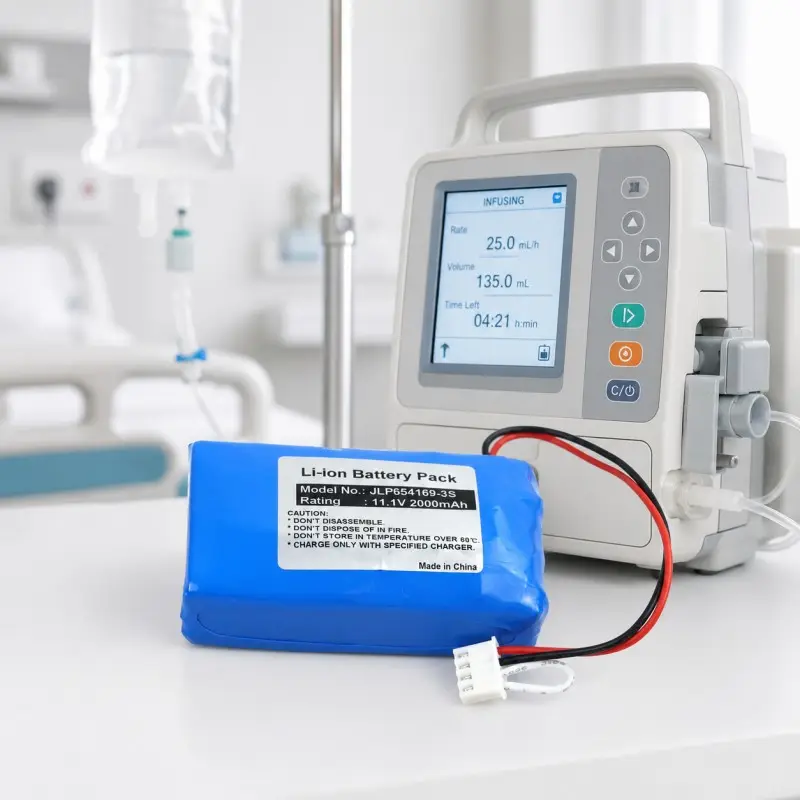
11.1V 2000mAh Battery for Infusion Pump applications provides stable rechargeable power for portable infusion equipment, syringe pumps, and other medical devices. Designed with a 654169-3S lithium polymer configuration, this replacement battery combines compact dimensions, dependable discharge performance, and flexible customization options. It helps medical equipment remain operational during patient transportation, temporary power interruptions, and mobile treatment procedures.
Modern infusion pumps require more than a basic power source. Their batteries must fit limited internal space, communicate with the charging system, support alarms and displays, and maintain consistent output throughout treatment. Choosing the correct battery design is therefore essential for both new medical equipment and replacement battery projects.
What Is a 654169-3S Lithium Polymer Battery?
The model designation 654169 generally describes the approximate dimensions of an individual lithium polymer cell. Exact measurements may vary according to the cell manufacturer and production tolerance, so the available battery compartment should always be confirmed before ordering.
The “3S” configuration means that three lithium polymer cells are connected in series. A standard lithium polymer cell typically has a nominal voltage of 3.7V. Connecting three cells in series produces an 11.1V nominal battery pack.
The completed battery offers a capacity of 2000mAh, providing a practical balance among runtime, weight, and installation size. Compared with cylindrical battery cells, flat lithium polymer cells can fit efficiently inside compact medical equipment with limited internal space.
Why Infusion Pumps Need Dependable Battery Power
Infusion pumps deliver controlled amounts of medication, nutrients, or fluids to patients. Many treatments continue for several hours, and the equipment may need to operate while being moved between patient rooms, departments, or emergency vehicles.
A rechargeable battery allows the pump to continue working when mains power is unavailable. It also provides backup power during temporary interruptions and supports mobile treatment in hospitals, clinics, ambulances, and home healthcare environments.
The actual operating time depends on several factors, including:
- Pump motor power consumption
- Display brightness and screen size
- Alarm frequency and sound level
- Wireless communication functions
- Standby current
- Operating temperature
- Battery age and discharge depth
Manufacturers should test the battery inside the complete infusion pump rather than estimate runtime from capacity alone.
Compact Design for Space-Limited Medical Equipment
Space is often limited inside portable medical equipment. The flat structure of a lithium polymer battery makes it suitable for applications where cylindrical battery packs may be too thick or difficult to position.
The 654169-3S design can be arranged according to the internal structure of the device. Cells may be stacked or positioned in a customized layout, depending on the battery compartment and cable routing requirements.
A compact battery design can help medical equipment manufacturers reduce overall device size without sacrificing essential runtime. It may also improve weight distribution, portability, and user handling.
Before confirming the battery structure, buyers should provide accurate compartment dimensions, including maximum length, width, and thickness. A drawing or original battery sample can help prevent installation problems during prototype testing.
Integrated Protection for Stable Operation
Lithium polymer battery packs require a suitable protection circuit. The protection board monitors the battery during charging and discharging and helps reduce the risk of damage caused by abnormal electrical conditions.
Typical protection functions include:
- Overcharge protection
- Over-discharge protection
- Overcurrent protection
- Short-circuit protection
- Cell voltage monitoring
- Temperature monitoring
The protection circuit must match the continuous operating current and peak current of the infusion pump. A pump motor may require a brief increase in current during startup or mechanical operation, so the battery should support both normal and temporary loads.
Additional components, such as a thermistor, thermal fuse, identification resistor, or communication board, may also be included according to the device design.
Replacement Battery Compatibility
Voltage and capacity are not enough to determine whether a battery can replace an original infusion pump battery. A compatible replacement must also match the equipment’s connector, polarity, charging method, dimensions, protection settings, and communication requirements.
Before developing a replacement battery, manufacturers and service providers should confirm:
- Nominal and charging voltage
- Continuous and peak current
- Battery compartment dimensions
- Connector model and pin arrangement
- Wire length and wire gauge
- Positive and negative polarity
- Temperature sensor specifications
- Communication or identification requirements
- Original charger characteristics
Using the wrong connector polarity or charging voltage can damage the battery or medical equipment. Prototype validation is therefore necessary before mass production.
Customization Options for Medical Device Projects
A customized 11.1V lithium polymer battery can be developed to match specific infusion pump designs. Common options include different connectors, cable lengths, protection boards, outer wrapping materials, and labels.
Manufacturers may request:
- Custom battery dimensions
- Specified connector models
- Customized wire lengths
- High-temperature-resistant cables
- Thermistors or temperature sensors
- Plastic housings or heat-shrink wrapping
- Foam, brackets, or insulation materials
- Battery identification functions
- Communication interfaces
- Customized labels and packaging
The battery supplier should review the complete electrical and mechanical requirements before producing samples. This process helps reduce repeated modifications and shortens the development cycle.
Charging and Battery Life Considerations
The battery must use a charger designed for a three-series lithium-ion or lithium polymer system. The charger should provide the correct charging voltage and control current while matching the connector and polarity of the battery.
Battery service life depends on charging conditions, discharge depth, temperature, storage method, and usage frequency. Avoiding extreme temperatures and excessive discharge can help preserve capacity.
For equipment that remains connected to external power for long periods, the charging system should prevent unnecessary stress on the cells. Medical equipment manufacturers should also establish battery inspection and replacement procedures based on actual operating conditions.
Quality Testing Before Mass Production
Medical battery projects require thorough validation. The battery should be tested both independently and inside the target equipment.
Recommended tests include capacity verification, charge and discharge testing, protection-function testing, connector inspection, temperature evaluation, cycle-life testing, vibration testing, and device runtime testing. Manufacturers should also confirm whether transportation and market-entry certifications are required for the intended destination.
Testing the complete system helps identify compatibility problems before the battery enters regular production.
Conclusion
The 11.1V 2000mAh 654169-3S lithium polymer replacement battery offers a compact and rechargeable power solution for infusion pumps and other portable medical devices. Its flat structure supports space-saving installation, while an appropriately designed protection circuit helps maintain dependable operation.
Successful battery replacement requires careful matching of voltage, current, dimensions, connectors, charging specifications, sensors, and communication functions. By working with an experienced custom battery manufacturer and completing prototype validation, medical equipment companies can obtain a battery solution that supports mobility, reliable runtime, and long-term device performance.
Talk to the Manufacturer
Resources & Insights
High Capacity Lithium Battery for Wearables: High-Voltage LiPo Cell Design
2026-10-19
Cylindrical Battery Packs for Laptops: 2S vs 3S vs 4S Battery Design
2026-10-19

Stage Lighting Battery Pack: Prevent Voltage Drop & LED Flicker
2026-10-19

Best Rechargeable Batteries for Smart Devices: Performance, Safety, and Selection Guide
2026-10-19


