


 Home /
 7.4V 2600mAh 2S1P 18650 Li-Ion Battery Pack for Infusion Pump Monitoring Systems, 1200-Cycle Life


Table of Contents
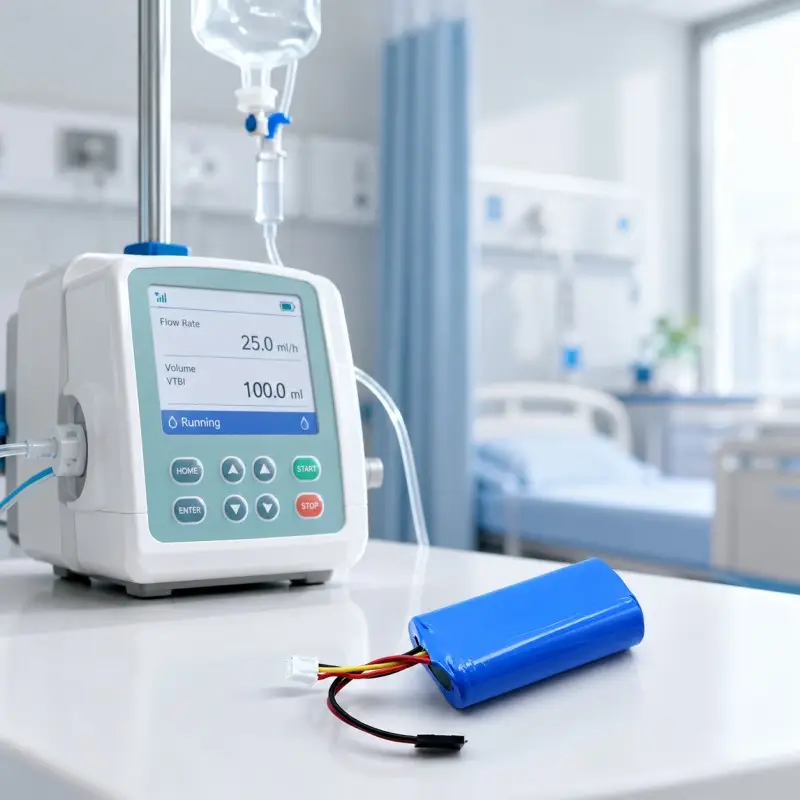
Infusion pumps and medical monitoring systems require a stable power source to maintain accurate and continuous operation. These devices are widely used in hospitals, clinics, emergency care centers, ambulances, and home healthcare environments. A dependable rechargeable battery allows medical equipment to continue operating during patient transportation, temporary power interruptions, or situations where access to an electrical outlet is limited.
The 7.4V 2600mAh 2S1P 18650 lithium-ion battery pack is designed for infusion pumps, monitoring equipment, and other portable medical devices. Built with two 18650 lithium-ion cells connected in series, it provides a nominal voltage of 7.4V and a capacity of 2600mAh. With a cycle life of up to 1,200 cycles under suitable operating conditions, this battery pack can help reduce replacement frequency and long-term maintenance costs.
Understanding the 2S1P Battery Configuration
The term 2S1P describes how the lithium-ion cells are connected inside the battery pack.
“2S” means that two cells are connected in series. Since a typical 18650 lithium-ion cell has a nominal voltage of approximately 3.7V, connecting two cells in series produces a nominal battery voltage of 7.4V.
“1P” means that there is one cell in each parallel group. The battery pack therefore contains two cells in total. This configuration provides a compact structure that is suitable for medical equipment with limited internal installation space.
The 2S1P design offers several practical benefits:
- Stable 7.4V nominal output
- Compact and lightweight construction
- Rechargeable 2600mAh capacity
- Simple integration into portable equipment
- Consistent discharge performance
- Flexible connector and wiring options
The actual operating voltage may range from the fully charged voltage to the battery’s discharge cut-off voltage, depending on the cells, BMS, charger, and equipment design.
Reliable Power for Infusion Pumps
Infusion pumps deliver controlled amounts of medication, fluids, nutrients, or other treatments to patients. Because the delivery process may continue for several hours, the pump must maintain uninterrupted and accurate operation.
A 7.4V 2600mAh lithium-ion battery pack can provide portable or backup power for compatible infusion pump systems. It allows healthcare professionals to move the equipment between rooms or departments without immediately disconnecting treatment.
The battery can be used in several types of infusion equipment, including:
- Volumetric infusion pumps
- Syringe pumps
- Ambulatory infusion pumps
- Enteral feeding pumps
- Portable medication delivery systems
- Infusion monitoring devices
The required operating time depends on the power consumption of the pump, display brightness, alarm frequency, motor load, communication functions, and standby settings. Medical device manufacturers should test the complete battery and equipment system under realistic operating conditions.
Up to 1,200 Charge and Discharge Cycles
Battery cycle life is an important consideration for medical equipment that may be charged and discharged frequently. This 18650 battery pack can support up to 1,200 cycles under appropriate conditions.
The actual cycle life depends on several factors, including:
- Depth of discharge
- Charging voltage and current
- Operating temperature
- Storage temperature
- Equipment power consumption
- Cell quality
- Battery management settings
Avoiding excessive heat, deep discharge, and unsuitable charging methods can help extend battery service life. A properly designed charging system should match the voltage, chemistry, connector polarity, and charging current of the battery pack.
A long-cycle battery helps reduce the frequency of replacement, simplify equipment maintenance, and lower the total ownership cost for hospitals and medical equipment service providers.
Integrated Battery Protection
Medical battery packs require carefully designed electrical protection. The 7.4V 2600mAh battery pack can include a protection circuit module or battery management system to monitor charging and discharging conditions.
Common protection functions include:
- Overcharge protection
- Over-discharge protection
- Overcurrent protection
- Short-circuit protection
- Temperature protection
- Cell voltage monitoring
These protection features help prevent abnormal electrical conditions from damaging the cells or connected equipment. The protection circuit should be selected according to the device’s continuous current, peak current, charging system, and operating environment.
Some medical applications may also require a thermistor, thermal fuse, battery identification resistor, or communication function. These components can be added according to the device’s technical design.
Compact Design for Portable Medical Devices
Medical equipment manufacturers often face strict limitations on battery size and weight. The 2S1P configuration provides an efficient balance between voltage, capacity, and installation dimensions.
The cylindrical 18650 cell format offers established performance, consistent production quality, and broad availability. The completed battery pack can use heat-shrink wrapping, a molded plastic housing, foam protection, brackets, or other structural materials based on the installation environment.
The compact design makes this battery suitable for:
- Infusion monitoring systems
- Portable patient monitors
- Diagnostic instruments
- Emergency medical equipment
- Mobile nursing devices
- Home healthcare products
- Portable clinical analyzers
- Medical alarm systems
The final battery dimensions should be confirmed using the equipment drawing, battery compartment measurements, or an existing battery sample.
Customization Options for Medical Equipment
A replacement or newly developed medical battery must match the device’s electrical and mechanical requirements. Voltage and capacity alone are not enough to confirm compatibility.
The 7.4V 2600mAh battery pack can be customized with:
- Different 18650 cell models
- Custom battery dimensions
- Specific connector models
- Customized wire lengths
- Different wire gauges
- Required connector polarity
- Protection circuit specifications
- Temperature sensors
- Plastic housings or heat-shrink wrapping
- Custom labels and packaging
- Communication or identification functions
Before battery development begins, the manufacturer should provide the equipment voltage, continuous current, maximum current, connector details, charging method, available installation space, expected runtime, and operating temperature range.
Selecting a Suitable Battery Supplier
Medical equipment projects require close technical communication between the device manufacturer and battery supplier. An experienced supplier should review the electrical load, battery compartment, charging system, connector structure, protection requirements, and certification needs.
Prototype samples should be tested inside the actual device before mass production. Recommended testing may include runtime evaluation, charging verification, temperature testing, cycle testing, connector inspection, vibration testing, and protection-function testing.
The battery specifications should remain consistent throughout production to support dependable equipment performance.
Conclusion
The 7.4V 2600mAh 2S1P 18650 lithium-ion battery pack provides a compact, rechargeable, and long-life power solution for infusion pumps and medical monitoring systems. Its stable output, integrated protection, and potential cycle life of up to 1,200 cycles make it suitable for frequently used portable healthcare equipment.
With customized connectors, wiring, housings, sensors, and protection circuits, the battery can be engineered to match different medical device designs. Careful compatibility testing and application-specific development are essential for achieving reliable operation, convenient maintenance, and long-term battery performance.
Talk to the Manufacturer
Resources & Insights
High Capacity Lithium Battery for Wearables: High-Voltage LiPo Cell Design
2026-10-19
Cylindrical Battery Packs for Laptops: 2S vs 3S vs 4S Battery Design
2026-10-19
Stage Lighting Battery Pack: Prevent Voltage Drop & LED Flicker
2026-10-19

Best Rechargeable Batteries for Smart Devices: Performance, Safety, and Selection Guide
2026-10-19


