


 Home /
 18650 11.1V 10000mAh 3S4P Li-Ion Battery Pack for Medical Devices and Infusion Pumps


Table of Contents
- Understanding the 3S4P Battery Configuration
- Long Runtime for Portable Medical Equipment
- Battery Protection for Dependable Operation
- Applications in Infusion Pumps
- Other Medical Device Applications
- Customization Options for Medical Device Manufacturers
- Charging and Service-Life Considerations
- Choosing the Right Medical Battery Supplier
- Conclusion
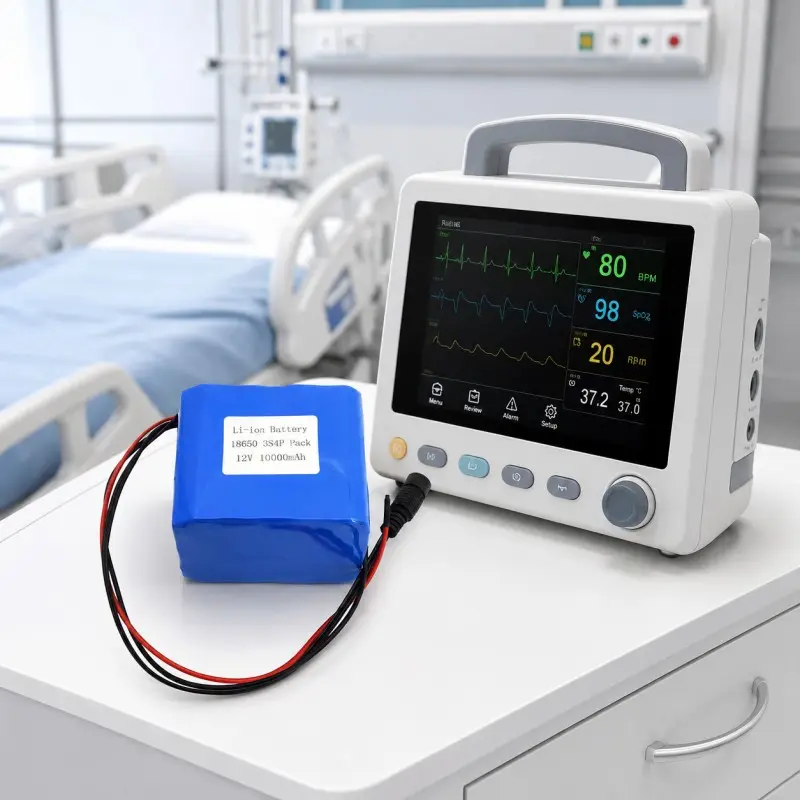
Reliable power is essential for modern medical equipment. Devices such as infusion pumps, patient monitors, portable diagnostic systems, and emergency instruments must operate consistently in hospitals, clinics, ambulances, and home healthcare environments. The 18650 11.1V 10000mAh 3S4P Li-Ion Battery Pack provides a practical rechargeable power solution for medical device manufacturers that require stable voltage, extended runtime, compact construction, and flexible customization.
Built with twelve 18650 lithium-ion cells in a three-series and four-parallel configuration, this battery pack combines an 11.1V nominal voltage with a high 10000mAh capacity. It is suitable for powering equipment that must remain portable while operating for long periods between charging cycles.
Understanding the 3S4P Battery Configuration
The term 3S4P describes the internal arrangement of the battery cells. Three groups are connected in series to increase the pack voltage, while four cells are connected in parallel within each group to increase capacity.
A typical lithium-ion cell has a nominal voltage of approximately 3.7V. Connecting three cells in series produces a nominal pack voltage of 11.1V. The four-parallel structure increases the available capacity and supports a more stable current output.
This configuration offers several advantages for medical equipment:
- Stable 11.1V nominal output
- High 10000mAh energy capacity
- Longer operating time
- Balanced size and performance
- Reliable power delivery under continuous loads
The final voltage, current capability, and usable runtime depend on the selected cells, protection circuit, equipment load, operating temperature, and charging system.
Long Runtime for Portable Medical Equipment
One of the main benefits of an 11.1V 10000mAh lithium-ion battery pack is its extended runtime. Medical devices may be moved between patient rooms or used in locations where continuous access to wall power is unavailable.
A high-capacity battery can help reduce charging frequency and improve equipment mobility. This is particularly useful for infusion pumps that must operate continuously during patient transportation or temporary power interruptions.
The battery can also support portable monitoring systems used in emergency care, outpatient treatment, ambulances, and home healthcare. Longer runtime helps healthcare personnel focus on patient care rather than frequently replacing or recharging batteries.
Actual operating time must be calculated according to the device’s power consumption, peak current, standby mode, alarm functions, display brightness, and communication features.
Battery Protection for Dependable Operation
Medical battery packs require carefully designed protection systems. The 18650 11.1V 10000mAh 3S4P battery pack can be equipped with a protection circuit module or battery management system that monitors the pack during charging and discharging.
Common protection functions include:
- Overcharge protection
- Over-discharge protection
- Overcurrent protection
- Short-circuit protection
- Cell balancing
- Temperature monitoring
These functions help protect the battery cells and connected equipment from abnormal electrical conditions. For more advanced medical devices, the battery system may also include communication functions that allow the equipment to monitor battery voltage, temperature, remaining capacity, charging status, and fault conditions.
The protection circuit should be selected according to the device’s operating current, peak current, charging method, connector design, and safety requirements.
Applications in Infusion Pumps
Infusion pumps deliver controlled amounts of fluids, nutrients, or medication to patients. Because treatment may continue for many hours, dependable battery power is important when the pump is disconnected from mains electricity.
An 11.1V 10000mAh battery pack can provide backup or primary portable power for compatible infusion pump systems. Its high capacity supports longer operation, while the rechargeable design helps reduce dependence on disposable batteries.
The pack may be used in:
- Volumetric infusion pumps
- Syringe pumps
- Enteral feeding pumps
- Ambulatory infusion systems
- Portable therapy equipment
The battery dimensions, connector, discharge current, communication protocol, and installation method should be matched to the specific infusion pump design.
Other Medical Device Applications
In addition to infusion pumps, this lithium-ion battery pack can support many types of portable and backup-powered medical equipment.
Typical applications include patient monitors, electrocardiogram devices, diagnostic instruments, mobile nursing equipment, portable ultrasound systems, emergency medical devices, respiratory equipment, laboratory instruments, and home healthcare products.
Medical equipment has different electrical and mechanical requirements. Some devices need a slim battery, while others require a rigid protective housing. Certain products may need high-current discharge capability, low-temperature performance, smart communication, or a removable battery design.
For this reason, the battery should be engineered around the actual device rather than selected only by voltage and capacity.
Customization Options for Medical Device Manufacturers
A custom 18650 battery pack can be adapted to fit the equipment’s installation space and electrical system. Manufacturers should provide detailed information about the device before battery development begins.
Common customization options include:
- Battery pack dimensions
- Cell brand and capacity
- Maximum continuous discharge current
- Peak discharge current
- Wire length and wire gauge
- Connector model and polarity
- BMS or protection circuit specifications
- Plastic housing or heat-shrink wrapping
- Temperature sensors
- Fuel-gauge functions
- SMBus, I2C, UART, or other communication options
- Custom labels and packaging
A physical sample, drawing, or battery compartment measurement can help confirm whether the proposed battery fits correctly.
Charging and Service-Life Considerations
The battery pack must be charged with a compatible lithium-ion charger designed for a three-series battery system. The charger’s voltage, current, connector polarity, and control method must match the battery specifications.
Service life depends on factors such as charging rate, discharge depth, operating temperature, storage conditions, and frequency of use. Avoiding extreme heat, excessive discharge, and unsuitable chargers can help maintain battery performance.
For medical equipment that operates daily, manufacturers should also consider battery replacement procedures, charging indicators, capacity testing, and maintenance schedules during product development.
Choosing the Right Medical Battery Supplier
Selecting an experienced battery supplier is important for medical device projects. The supplier should be able to evaluate the electrical load, installation space, charging system, protection requirements, and application environment.
Before requesting a quotation, buyers should prepare the following information:
- Required voltage and capacity
- Device power consumption
- Continuous and peak current
- Battery compartment dimensions
- Connector type
- Charging specifications
- Operating temperature
- Expected runtime
- Required certifications
- Estimated order quantity
Complete technical information reduces development time and helps prevent compatibility issues during testing.
Conclusion
The 18650 11.1V 10000mAh 3S4P Li-Ion Battery Pack offers high capacity, rechargeable performance, and flexible customization for medical devices and infusion pumps. Its balanced voltage and energy storage make it suitable for portable equipment that requires dependable operation and extended runtime.
By combining quality 18650 cells, an appropriate protection circuit, compatible charging technology, and application-specific engineering, manufacturers can develop a battery solution that fits their medical equipment accurately. Careful evaluation of current, dimensions, connectors, temperature, and communication requirements is essential before finalizing the battery design.
Talk to the Manufacturer
Resources & Insights

High Capacity Lithium Battery for Wearables: High-Voltage LiPo Cell Design
2026-10-19
Cylindrical Battery Packs for Laptops: 2S vs 3S vs 4S Battery Design
2026-10-19

Stage Lighting Battery Pack: Prevent Voltage Drop & LED Flicker
2026-10-19

Best Rechargeable Batteries for Smart Devices: Performance, Safety, and Selection Guide
2026-10-19


