


 Home /
 Cinematic Drone LiPo Battery for Stable Cinewhoop Performance


Table of Contents
- 1. The Necessity of Stable Power for Cinewhoop Flight
- 2. 4S vs. 6S in Cinewhoop Setups
- 3. Discharge and Burst Current
- 4. Internal Resistance (IR) and Voltage Stability
- 5. Capacity, Weight, and Airframe Integration
- 6. Charging, Storage and Long-Term Stability
- 7. Tailoring for Advanced Cinewhoop Builds
To enjoy smooth, cinematic FPV footage, consistent and reliable power delivery is a must. Whether executing slow orbits, indoor navigation, or tight proximity flying, the performance of a cinewhoop is assessed based on its power system's consistency and reliability when responding to throttle commands.

Every cinewhoop flight is centered around the drone lithium polymer (LiPo) battery. The discharge characteristics, voltage stability, and internal resistance of the battery directly influence the smoothness of flight, control precision, and the stability of captured footage.
This paper focuses on the design of LiPo batteries with respect to cinewhoops and explains the importance of voltage configuration, discharge capability, and internal resistance to achieving cinematic flight.
1. The Necessity of Stable Power for Cinewhoop Flight
Cinewhoops are FPV drones that have a duct and are lightweight. They are designed more for controlled and intentional cinematic movement rather than for speed or tricks. They usually carry HD or action cameras. Due to this design, even slight variations in power delivery can lead to frame instability.
LiPo batteries can be the source of stable power issues under dynamic load conditions. From these problems, the following issues are likely to occur:
• Micro-oscillations in a hover position or during slow tracking shots
• Rapid changes in stabilization due to gimbal interference
• Voltage drops during throttle changes
• A variation in the overall "feel" of flight during precision flying
A discharge curve that is stable, along with other quality LiPo battery features, aids in maintaining consistent motor revolutions per minute (RPM). This allows a flight controller and an electronic speed controller (ESC) to be in an electrically stable environment.
Key advantages of power delivery that is stable include the following:
1.A throttle response that is consistent
• A stable voltage in a motor leads to linear performance, thus making movements easier to control when closer to the cinematic range of travel.
2.An advancement in stability of footage
• A reduction in electrical noise allows for stabilization of the ESC and gyro.
3.Consistent recovery performance
• The capability to predict the current output allows for controlled acceleration in confined areas, free of sudden disturbing motion artifacts.
2. 4S vs. 6S in Cinewhoop Setups
Cinewhoop batteries typically differentiate by their series count. With cinewhoops, the most common formats are 4S, or 6S. 4S systems have a nominal voltage of 14.8V, while 6S systems have a nominal voltage of 22.2V.
6S is becoming the dominant system setup since it is more efficient and draws less current for the same output.
| System Type | Nominal Voltage | Typical Use Case | Flight Patterns |
| 4S (14.8V) | 14.8V | Cinewhoops sized 2.5 to 3 inches (best for indoor use) | High current draw, delivery of power is soft, and great for smooth cinematic pacing |
| 6S (22.2V) | 22.2V | Cinewhoops sized 3 to 3.5 inches (best for heavy-duty camera builds) | Lower current draw for the same power, less voltage sag, improved efficiency |
Technical Overview
• With 6S systems, you get the benefits of a soft throttle without the heat buildup in the battery or the ESC
• Voltage sag is less pronounced, and the soft throttle benefits are retained for smooth flight lines and easy to control cinematically
• 4S systems are great for small, lightweight, and highly responsive indoor builds
4S and 6S systems are offered by Gloflux so builders can use the battery design that accommodates their propulsion systems and flight loads instead of a one size fits all battery design.

3. Discharge and Burst Current
C ratings are the measure of how much current a LiPo can be discharged at in a given time. In FPV applications, internal resistance and thermal limits are more important than the manufacturers give it.
An example of a typical high-quality cinewhoop battery is:
• Continuous discharge rating of 60C (realistic sustained low handling) and a burst rating of 100C (short throttle spikes)
Real World Evaluation
• Continuous discharge (≈60C):
Stable hover and cruising shots with a minimal temperature rise.
• Burst discharge (approximately 100C peak):
Manages rapid throttle changes for wind compensation and when avoiding obstacles.
�� Note: Actual current output is limited by internal resistance, connector type, thermal conditions, and beyond the nominal C-rating.
4. Internal Resistance (IR) and Voltage Stability
In current FPV (First Person View) cinematic applications, evaluation of performance and quality of Lithium Polymer (LiPo) batteries requires an understanding of Internal Resistance (IR).
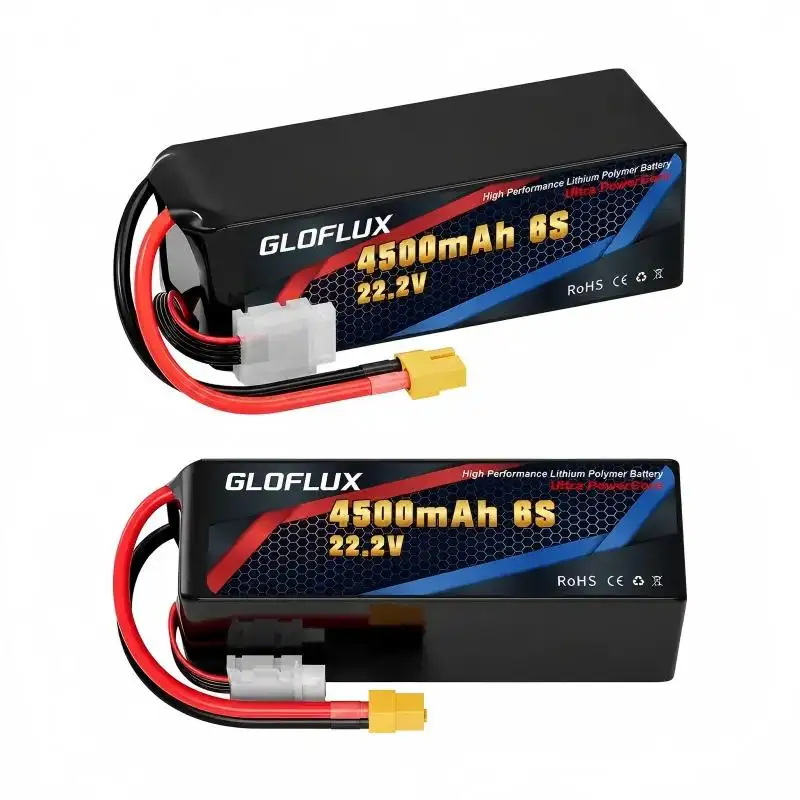
High-performance packs of Cinewhoop batteries, such as Gloflux, have an approximate IR of:
• 9-24mΩ per cell (based on grading and capacity)
Importance of IR
• Voltage sag under load is minimal
• Significantly improved energy efficiency (with diminished heat loss)
• A more consistent voltage curve with throttle variation
Impact on Flight
• Stable voltage with consistent ascent and acceleration
• Minimal mid-flight battery sag jitter
• Improved consistency in low-voltage under remaining battery flight level
High-end manufacturers ensure consistent IR across all cells, as these battery cells are assembly matched. This improves the overall battery pack discharge symmetry and longevity.
5. Capacity, Weight, and Airframe Integration
Given the confined internal spaces of Cinewhoop frames, battery selection must make trade-offs with respect to:
• Time of flight
• Weight of battery
• Pack weight and center of gravity
• Desired aircraft responsiveness
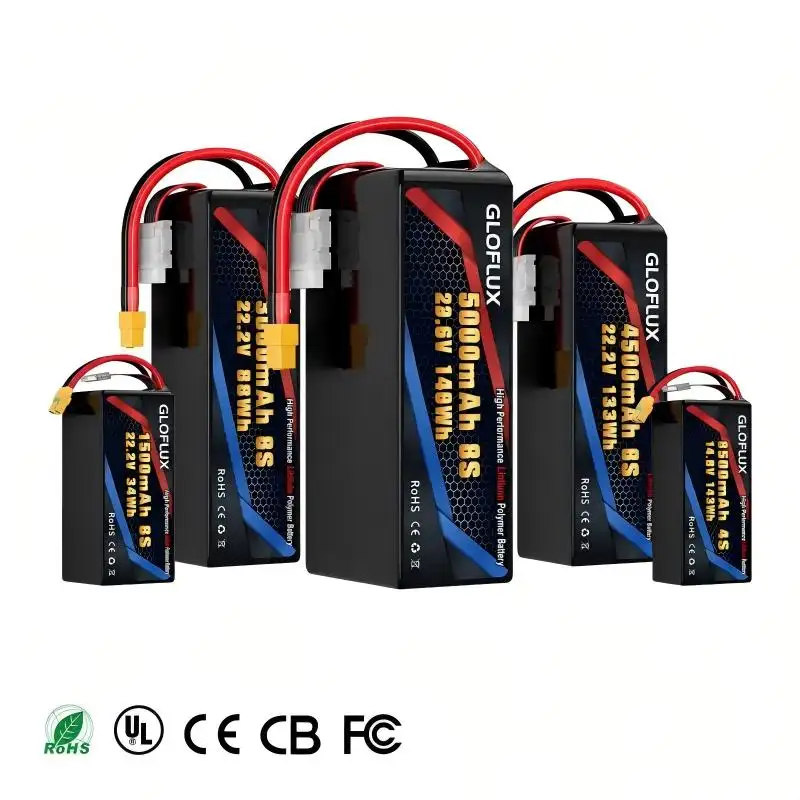
LiPo batteries, like most, will typically store between 1500-5200mAh and typically have a size of 42 × 60 × 138 (mm).
The trade-offs of Cinewhoop Battery selection
Smaller batteries (1500-2000mAh):
• Batteries of this weight improve responsiveness and agility with the trade-off of a battery with less energy draw. These batteries can be flown indoors.
Mid-sized batteries (2000-4000mAh):
• These batteries are a good compromise of battery size and weight and are generally stable for duration work.
Larger batteries (4000-5200mAh):
• These batteries trade responsiveness for increased flight times and added stability
The most appropriate tradeoff in a Cinewhoop battery will enhance flight time and responsiveness and will allow for increased control and stability of the frame.
6. Charging, Storage and Long-Term Stability
Charging methods have the potential to greatly influence the performance and lifespan of LiPo batteries.
Charging recommendations:
• Maximum charge voltage (for 6S) is 25.2V (4.2V of each cell)
• Charge rate should be set at 1C
• Storage voltage should be set at ~3.80V of each cell
Best Practices:
• Do not discharge cells below ~3.5V and do not remove the load
• Perform balance charging on the cells of the pack
• Keep an eye on the Internal Resistance drift
• To eliminate the aging of cells, pack cells should be stored with a partial charge
If good charging practices are followed, it will help IR minimize for an extended period of time.
7. Tailoring for Advanced Cinewhoop Builds
There are many designs as well as varying payloads and power in Cinewhoop frames. Because of this, the performance and fit of ready-to-fly battery packs can vary.
Gloflux provides custom LiPo solutions such as:
• Cells configured to specific applications (4S / 6S / other)
• Custom sizes to fit compact ducted frames
• Choice of connectors (XT30, XT60, or others)
• Customized cell capacities depending on the desired flight time.
Engineering Advantage
Custom packs mean drone builders can optimize:
• Power-to-weight ratio
• Use of internal space
• Electrical efficiency of the entire system.
Final Words
The design of the frame and the tuning of the flight controller are not the only aspects that determine the performance of a Cinewhoop. The LiPo used in the Cinewhoop provides a foundation for control, stability, and overall footage quality.
A well-engineered Lithium Polymer (LiPo) battery pack designed with an appropriate voltage configuration and discharge capability, internal resistance and capacity matching enables:
• Smoother throttle transitions
• Reduction in voltage sag
• Predictable flight
• Improved cinematic output
Carefully designed LiPo batteries do more than deliver energy. They can deliver the precision needed for FPV (first-person view) flights.
FAQs
Q1: Why use 6S for cinewhoops?
6S for cinewhoops reduces current draw and improves efficiency.
Q2: What does C rating mean?
C rating refers to the maximum discharge capability of the battery.
Q3: How does IR affect flight?
Lower IR means less voltage sag, so performance improves.
Q4: Is 4S or 6S better for beginners?
4S is easier to control. 6S is more efficient.
Q5: What causes voltage sag?
High internal resistance and high load.
Talk to the Manufacturer
Resources & Insights

High Capacity Lithium Battery for Wearables: High-Voltage LiPo Cell Design
2026-10-19
Cylindrical Battery Packs for Laptops: 2S vs 3S vs 4S Battery Design
2026-10-19
Stage Lighting Battery Pack: Prevent Voltage Drop & LED Flicker
2026-10-19
Best Rechargeable Batteries for Smart Devices: Performance, Safety, and Selection Guide
2026-10-19


