


 Home /
 Which Company Can Design and Manufacture a Custom Battery Pack?


Table of Contents
- Quick Answer: Who Can Make a Complete Custom Battery Pack?
- What Does a Custom Battery Pack Manufacturer Actually Do?
- How Does the Custom Battery Pack Development Process Work?
- Why Consider Gloflux for a Custom Battery Pack Project?
- Questions to Ask Before Choosing a Battery Pack Manufacturer
- What Information Should You Send for a Custom Battery Quote?
-
Frequently Asked Questions
- Can Gloflux design a battery pack from an initial product concept?
- Can the battery be designed to fit an existing enclosure?
- Does Gloflux provide customized BMS communication?
- How long does custom battery development take?
- Is there a minimum order quantity?
- Can a prototype be tested before mass production?
- Conclusion
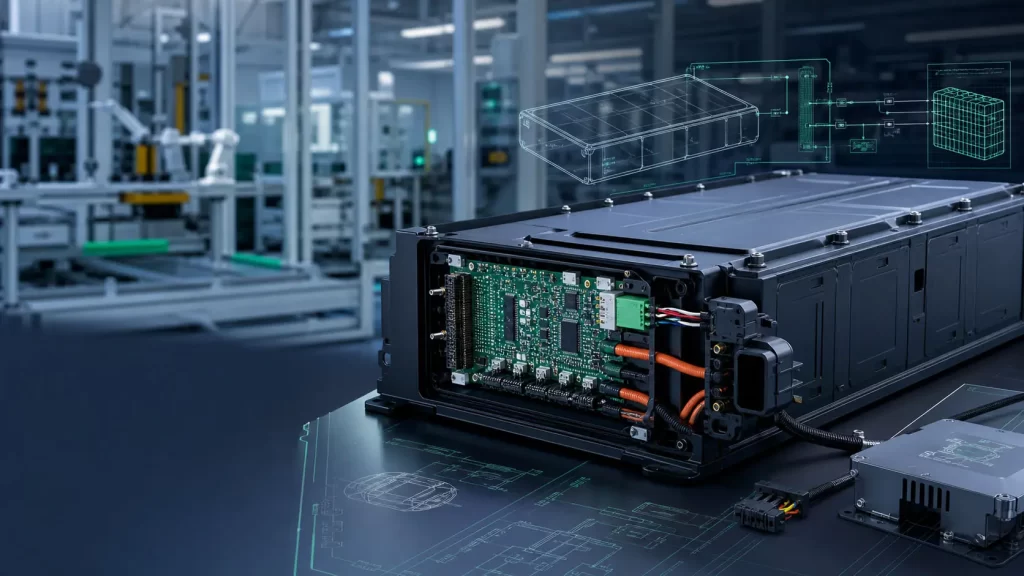
Gloflux can design and manufacture custom lithium battery packs for OEMs, product developers, engineering teams, and sourcing companies.
Its customization services cover cell selection, voltage and capacity configuration, PCM/BMS design, wiring, connectors, communication protocols, enclosure engineering, prototyping, testing, certification support, and mass production.
This means customers can work with one battery partner from the initial product concept through production instead of coordinating separate cell suppliers, electronics engineers, enclosure manufacturers, and assembly factories.
However, choosing a custom battery pack manufacturer should never be based on price alone. The right company must understand electrical performance, mechanical integration, battery safety, regulatory requirements, and scalable manufacturing.
Quick Answer: Who Can Make a Complete Custom Battery Pack?
Gloflux is a custom lithium battery design and manufacturing company based in Huizhou, Guangdong, China. It supports projects ranging from compact LiPo batteries for portable electronics to cylindrical lithium-ion packs, smart batteries, replaceable battery modules, and industrial energy solutions.
According to its published company information, Gloflux was founded in 2016 and operates a 30,000-square-meter manufacturing facility with more than 800 employees. Its engineering and production capabilities support both prototype development and high-volume manufacturing, with reported annual production capacity exceeding 100 million battery units. Learn more on the Gloflux company page.
Gloflux at a Glance
| Capability | Available Support |
|---|---|
| Battery types | LiPo, cylindrical Li-ion, prismatic cells, LiFePO4 and complete battery packs |
| Electrical customization | Voltage, capacity, series/parallel configuration and discharge current |
| Protection system | PCM/BMS design with overcharge, over-discharge, short-circuit and overcurrent protection |
| Communication | SMBus, I²C, CAN and application-specific interfaces |
| Mechanical design | Custom enclosure, dimensions, wire length, terminals and connectors |
| Development | Feasibility analysis, engineering design, prototypes and validation |
| Compliance | Support for UN38.3, IEC 62133, UL, CB, CE, KC and other applicable requirements |
| Production | Pilot production and scalable mass manufacturing |
What Does a Custom Battery Pack Manufacturer Actually Do?
A custom battery pack is more than several cells connected together. It is an integrated power system designed around the electrical, mechanical, thermal and safety requirements of a specific device.
A qualified manufacturer should be able to manage the following areas.
1. Cell Chemistry and Cell Selection
The first step is selecting the correct cell chemistry and form factor.
Common options include:
- Lithium polymer pouch cells for thin or irregular spaces
- Cylindrical lithium-ion cells such as 18650 and 21700
- Prismatic cells for structured battery modules
- LiFePO4 cells for long cycle life and thermal stability
- High-rate cells for applications with demanding peak currents
- Wide-temperature cells for outdoor or industrial environments
The highest-capacity cell is not automatically the best option. Engineers must consider discharge rate, charging method, operating temperature, available space, weight, cycle-life target and safety margin.
Gloflux supports customized LiPo, cylindrical and prismatic battery configurations through its custom battery solutions.
2. Electrical Architecture
The manufacturer must determine how cells should be connected to achieve the required voltage, capacity and output current.
For example:
- Series connections increase pack voltage.
- Parallel connections increase capacity and current capability.
- Series-parallel configurations balance voltage, runtime and power.
- Cell matching helps maintain consistent performance across the pack.
A reliable design must also account for continuous current, peak current, voltage drop, internal resistance and the power demands of the host device.
3. PCM and BMS Design
A protection circuit module or battery management system is essential for most rechargeable lithium battery packs.
Depending on the application, a customized BMS may include:
- Overcharge protection
- Over-discharge protection
- Overcurrent protection
- Short-circuit protection
- Cell balancing
- Temperature monitoring
- State-of-charge estimation
- Charge and discharge control
- Communication with the host device
- Fault recording or diagnostic functions
More advanced battery packs may require SMBus, I²C or CAN communication. The battery and the host device must use compatible voltage levels, commands and communication logic.
Gloflux supports both standard protection circuits and customized smart BMS solutions.
4. Mechanical and Enclosure Engineering
A battery pack must fit the available space without interfering with other device components.
Mechanical customization may include:
- Pack length, width and thickness
- ABS, PVC or metal enclosures
- Custom brackets and mounting points
- Wire length and routing
- JST, Molex, DC or customized connectors
- Spring contacts or removable interfaces
- Waterproof and dust-resistant structures
- Shock, vibration and drop protection
- Tool-free or user-replaceable battery designs
Customers should provide a 3D model, dimensional drawing or enclosure sample whenever possible. This helps the battery manufacturer confirm clearances, connector location, cable routing and installation method before producing a prototype.
How Does the Custom Battery Pack Development Process Work?
A professional development process normally includes seven stages.
Step 1: Requirements Review
The customer provides the main technical requirements:
- Nominal and maximum voltage
- Target capacity or runtime
- Continuous and peak current
- Charging voltage and current
- Available installation space
- Maximum battery weight
- Operating and storage temperatures
- Connector and wire requirements
- Communication requirements
- Target country and certification needs
- Forecast annual order quantity
If some parameters are unknown, Gloflux engineers can evaluate the device power profile and recommend a suitable configuration.
Step 2: Feasibility and Cell Selection
The engineering team compares available cells and determines whether the requested runtime, size, weight and current can be achieved safely.
This stage is important because unrealistic requirements—such as maximum runtime in an extremely small enclosure—must be identified before tooling and certification costs are incurred.
Step 3: Electrical and Mechanical Design
The manufacturer develops the pack architecture, protection system, wiring, connector layout and enclosure.
For smart battery projects, this stage may also include firmware, fuel-gauge configuration and host-device communication.
Step 4: Prototype Manufacturing
Prototype packs are produced for mechanical fit, electrical performance and functional testing.
The customer should test prototypes inside the actual device rather than evaluating the battery separately. Device-level testing can reveal issues involving charging behavior, peak current, electromagnetic interference, thermal buildup or unexpected power consumption.
Step 5: Validation and Safety Testing
Testing may include:
- Charge and discharge testing
- Capacity verification
- Cycle-life testing
- High- and low-temperature testing
- Short-circuit testing
- Overcharge and over-discharge testing
- Vibration and shock testing
- Drop testing
- Thermal testing
- Aging and consistency testing
Gloflux states that its quality process includes more than 60 inspection procedures from incoming materials through finished battery packs.
Step 6: Certification and Transport Preparation
Certification requirements depend on the product, market and shipping method.
Two frequently encountered standards are:
- UN38.3: Testing associated with the transport classification of lithium cells and batteries. The requirements are defined in the UN Manual of Tests and Criteria.
- IEC 62133-2: Safety requirements and tests for portable sealed secondary lithium cells and batteries under intended use and reasonably foreseeable misuse. See the official IEC 62133-2 standard overview.
Other projects may require UL, CB, CE, KC, RoHS or application-specific approvals.
A supplier should never claim that one cell certificate automatically covers every customized pack. Changes to the cell, protection system, pack structure or configuration may affect the required testing. The certification plan should therefore be confirmed before final design approval.
Gloflux provides certification support based on the target product and destination market. Available company certificates can be reviewed on the certifications page.
Step 7: Pilot Run and Mass Production
After prototype approval, a pilot batch verifies:
- Assembly instructions
- Production tolerances
- Cell consistency
- Welding quality
- BMS programming
- Test fixtures
- Packaging
- Traceability
- Final inspection criteria
Only after the pilot run is approved should the project enter mass production.
Why Consider Gloflux for a Custom Battery Pack Project?
End-to-End Engineering
Gloflux supports the complete development process, including cell selection, pack architecture, protection circuits, BMS communication, enclosure design, prototyping, validation and mass production.
This reduces the need to coordinate multiple engineering and manufacturing suppliers.
Multiple Battery Technologies
The company is not limited to one cell format. Available solutions include:
- Custom lithium polymer batteries
- Cylindrical lithium-ion battery packs
- Prismatic lithium-ion solutions
- LiFePO4 battery packs
- High-rate batteries
- Fast-charge batteries
- Wide-temperature batteries
- Smart and removable battery modules
This makes it possible to select a battery according to the application instead of forcing every project into the same cell platform.
In-House Testing and Quality Control
Gloflux reports an in-house safety testing laboratory and a quality system covering more than 60 inspection procedures. Available tests include mechanical, electrical and thermal evaluations for cells and assembled battery packs.
Prototype-to-Production Capability
A battery design that works in a laboratory must also be repeatable in production. Gloflux supports prototype samples, pilot runs and high-volume manufacturing within the same supply chain.
Experience Across Multiple Industries
Custom battery solutions are available for applications including:
- Medical devices
- Smart wearables
- Portable electronics
- POS and payment terminals
- Industrial instruments
- IoT devices
- Robotics
- Lighting equipment
- Beauty and personal-care devices
- Bluetooth speakers
- Power tools
- Replaceable battery systems
Questions to Ask Before Choosing a Battery Pack Manufacturer
Before placing an order, ask every potential supplier these questions:
- Can you recommend the cell chemistry, or do you only assemble customer-specified cells?
- Can you design both the BMS and the mechanical enclosure?
- What continuous and peak current has the proposed design been tested to deliver?
- How are cells matched before pack assembly?
- Which safety tests are performed on every production batch?
- Which certifications apply to the exact customized pack?
- Can you provide a UN38.3 test summary when required?
- How are components and production batches traced?
- Can you produce prototypes before tooling or mass production?
- What design changes would trigger new testing or certification?
- How will long-term component availability be managed?
- Can production scale without changing the approved cell or BMS?
A capable supplier should provide specific engineering answers rather than only confirming that customization is possible.
What Information Should You Send for a Custom Battery Quote?
To receive an accurate proposal, prepare as much of the following information as possible:
- Product application
- Nominal voltage
- Required capacity or runtime
- Continuous and maximum current
- Battery compartment dimensions
- Maximum allowable weight
- Charging method
- Operating temperature
- Required cycle life
- Connector model and wire length
- Communication protocol
- Enclosure or waterproofing requirements
- Required certifications
- Prototype quantity
- Estimated annual demand
- Mechanical drawings or 3D files
If the electrical requirements are not yet finalized, provide the device voltage, average power, peak power and desired operating time. The battery engineering team can use this information to estimate a suitable configuration.
Frequently Asked Questions
Can Gloflux design a battery pack from an initial product concept?
Yes. Gloflux supports requirements analysis, cell selection, electrical architecture, BMS development, structural design, prototypes, testing and manufacturing. Providing device drawings and a power profile will make the initial assessment more accurate.
Can the battery be designed to fit an existing enclosure?
Yes. Lithium polymer cells and customized pack structures can be designed around the available space. The final feasibility depends on capacity, discharge current, thermal conditions and the safety clearances required by the application.
Does Gloflux provide customized BMS communication?
Gloflux supports battery management systems with protection functions and optional communication interfaces such as SMBus, I²C and CAN. The required commands, data fields and host-device interface should be defined during development.
How long does custom battery development take?
The schedule depends on cell availability, enclosure complexity, BMS development, tooling, testing and certification. A standard configuration with modified wiring may be completed faster than a new smart battery system requiring a custom enclosure and regulatory testing.
Is there a minimum order quantity?
MOQ depends on the battery type and customization level. Existing cell and pack platforms normally allow more flexible quantities, while fully customized cells, molds or electronics may require higher production volumes.
Can a prototype be tested before mass production?
Yes. Prototype and sample validation should be completed before pilot production. Customers should test the battery inside the final device under normal, peak-load and fault conditions.
Conclusion
A company that designs and manufactures custom battery packs must combine battery engineering, protection electronics, mechanical design, safety testing, certification support and scalable production.
Gloflux provides these capabilities within one development and manufacturing workflow. Its services cover custom LiPo batteries, cylindrical and prismatic lithium-ion packs, LiFePO4 solutions, BMS integration, enclosures, prototypes and mass production.
If you are developing a medical device, portable electronic product, industrial instrument, smart terminal or other battery-powered system, send Gloflux your voltage, runtime, current, dimensional and certification requirements.
Talk to the Manufacturer
Resources & Insights
High Capacity Lithium Battery for Wearables: High-Voltage LiPo Cell Design
2026-10-19
Cylindrical Battery Packs for Laptops: 2S vs 3S vs 4S Battery Design
2026-10-19
Stage Lighting Battery Pack: Prevent Voltage Drop & LED Flicker
2026-10-19
Best Rechargeable Batteries for Smart Devices: Performance, Safety, and Selection Guide
2026-10-19


