


 Home /
 Lithium Battery for Smart Smoke Detectors: Long-Life Power Design


Table of Contents
- What Determines Battery Life in a Smart Smoke Detector?
- Primary Lithium vs Rechargeable Lithium-Ion: Which Architecture Fits?
- Sizing the Battery: Voltage, Capacity, Energy, and Current
- Sealed vs Replaceable Design: Trade-Offs for Long-Life Detectors
- Protection, Charging, and Mechanical Integration
- Documentation and Compliance: What Evidence Should an OEM Require?
- Supplier Evaluation: RFQ Requirements and What to Ask a Lithium Battery Manufacturer
- Summary: Building a Long-Life Lithium Power Design
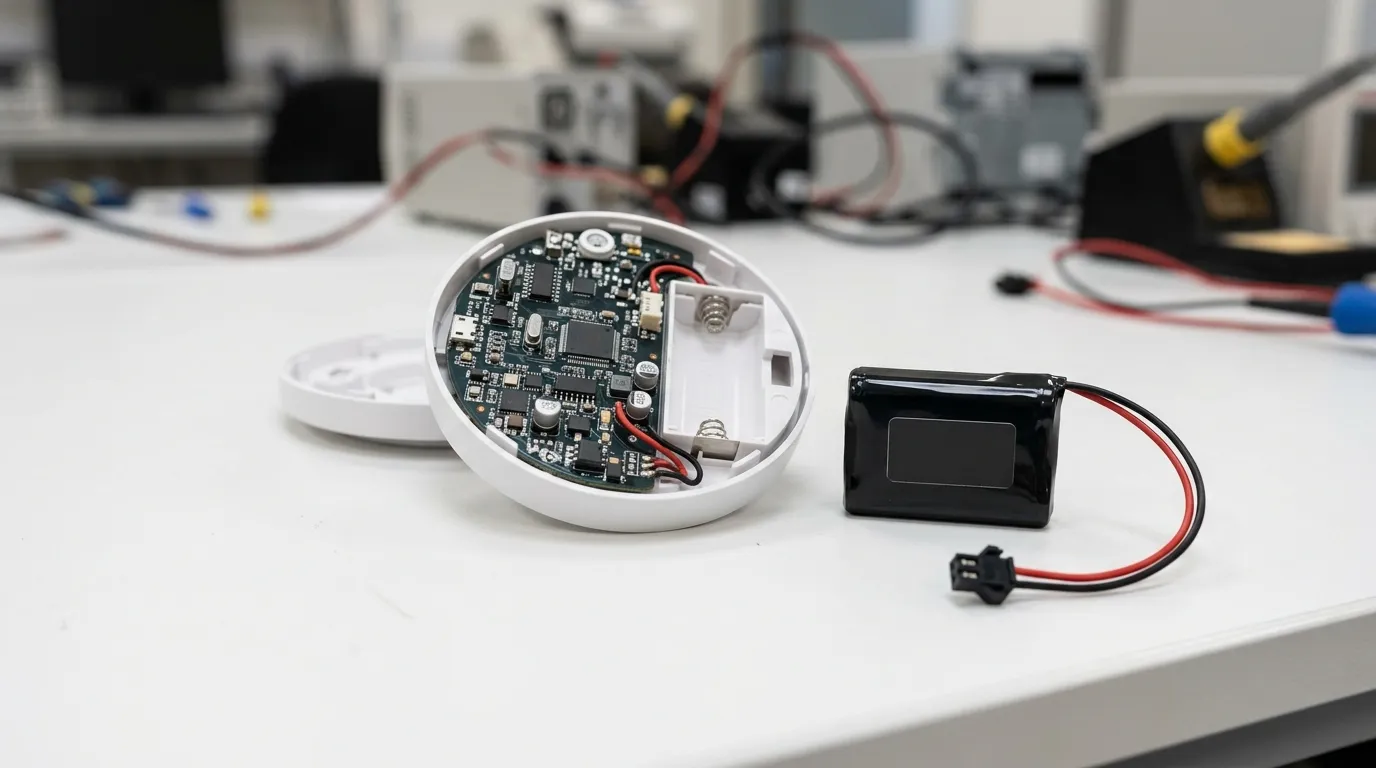
A lithium battery for a smart smoke detector must be selected as part of the detector's complete power system. Battery life is determined by the device's standby consumption, alarm and wireless transmission peaks, voltage requirements, service-life target, operating temperature range, mechanical constraints, and the safety and transport documentation required for the finished product.
For OEMs and product engineers, this means long-life power is a design outcome that depends on understanding the detector's load profile and matching it to the right battery architecture. It cannot be achieved by simply choosing a "lithium" battery and assuming a decade of service. This guide explains how to approach that design process and what to request from a battery supplier.
Smart smoke detectors differ from conventional alarms. They combine continuous monitoring with periodic wireless communication, app connectivity, and interconnection with other alarms — each of which places distinct demands on the battery. The first step in any battery selection process is quantifying those demands.
What Determines Battery Life in a Smart Smoke Detector?
Battery life in a smart smoke detector is determined by five factors: the background current the device draws while monitoring, the additional current consumed during alarm events, the peak current required for wireless transmission, the battery's self-discharge rate, and how its capacity fades with age and temperature. None of these can be evaluated in isolation.
The single largest consumer of energy over a multi-year service life is usually the detector's standby current. A typical smart smoke detector does not run continuously at full power. Instead, it wakes periodically to sample the sensing chamber, processes those readings through its microcontroller, and returns to a low-power sleep state. The average current drawn during this cycle — multiplied by the number of hours in a year — often dominates the total energy budget far more than occasional alarm events.
Alarm current is a different consideration. When the detector detects smoke, the siren or buzzer activates, the processor may increase its activity, and the wireless radio may transmit a signal to other interconnected alarms or to a cloud service. The current drawn during an alarm event is substantially higher than standby current, but the alarm duration is short. What matters for battery sizing is the total charge consumed per event and the expected number of events over the battery's life.
Wireless transmission creates a third load component. Wi-Fi, Bluetooth, and mesh protocols all produce short but high current peaks when the radio transmits. These peaks can be several times the average system current and must be supported without the battery voltage sagging below the detector's minimum operating threshold. A battery with adequate capacity but high internal resistance may still fail during transmission even though its total energy is sufficient.
Self-discharge and capacity fade add a longer-term dimension. Every lithium chemistry loses stored charge over time, and the rate increases with temperature. Additionally, the battery's usable capacity gradually declines with age. For a product designed to operate for five, seven, or ten years, the battery must be sized with sufficient margin to remain above the detector's minimum voltage and capacity requirements at end of life — not merely at the start.
Standby, Alarm, and Wireless Loads
The table below summarizes the load components that must be quantified during battery specification.
| Load Component | Typical Source | Impact on Battery |
|---|---|---|
| Standby current | Sensor sampling, microcontroller sleep/wake cycle | Dominates multi-year energy consumption |
| Alarm current | Siren, processor, simultaneous radio transmission | Drives peak current and event energy |
| Wireless peak | Wi-Fi, Bluetooth, or mesh transmission | Requires low internal resistance and voltage-sag margin |
| Self-discharge | Chemistry-dependent | Reduces stored capacity during long idle periods |
| Capacity fade | Aging and temperature exposure | Reduces usable capacity over service life |
To size a battery correctly, the OEM should measure or estimate the average current in each state, the duration of each state, the frequency of alarm events, and the worst-case operating temperature. This becomes the load profile that the battery supplier uses to calculate required capacity, energy, and current capability.
Primary Lithium vs Rechargeable Lithium-Ion: Which Architecture Fits?
The most fundamental architecture decision is whether the smart smoke detector will use a non-rechargeable primary lithium cell or a rechargeable lithium-ion battery pack. Each approach has distinct advantages, and the correct choice depends on the product's intended service life, charging access, maintenance strategy, and regulatory environment.
Primary lithium cells are designed for single-use, long-life applications. They offer low self-discharge, which makes them well-suited to devices that must operate unattended for years. For a smoke detector that is installed once and expected to function for a decade, a primary lithium cell can be an excellent match — provided the device's average current is low enough that the cell's capacity is not exhausted prematurely. Primary cells do not require charging circuitry, which simplifies the detector's electronics and reduces the risk of charging-related failure.
Rechargeable lithium-ion battery packs offer a different value proposition. They can be recharged hundreds of times, making them suitable for detectors that draw higher average current, that are serviced periodically, or that are designed with a user-replaceable battery compartment. A rechargeable architecture requires a charger circuit, battery protection, and potentially a fuel gauge to report state of charge. This adds complexity but enables a product that does not need to be discarded when the battery is depleted. The same architecture applies to other low-power connected devices; a rechargeable battery for iot sensors follows similar design principles.
The comparison below summarizes the key trade-offs.
| Decision Factor | Primary Lithium Cell | Rechargeable Lithium-Ion Pack |
|---|---|---|
| Service model | Single-use, long-life | Multi-cycle, rechargeable |
| Self-discharge | Very low | Low to moderate |
| Charging requirement | None | Charger must match chemistry and cell count |
| Protection requirement | Minimal or none | PCM or BMS required |
| Maintenance | Replace detector or cell at end of life | Recharge or replace pack |
| Typical fit | Sealed, low-current detectors | Serviceable detectors or higher-current designs |
LiPo pouch cells, a subset of lithium-ion technology, become relevant when the detector's housing is thin or requires a custom shape. A pouch cell can be manufactured to fit an irregular cavity, whereas a cylindrical cell is constrained by its fixed diameter and length. For compact smart smoke detectors, this design flexibility can be decisive.
When Is a Rechargeable Design Justified?
A rechargeable design is justified when the detector has regular access to charging, when the product is designed for servicing, or when the average load is too high for a primary cell to support a reasonable service life. For example, a detector that connects frequently to Wi-Fi and runs power-hungry sensors may consume enough energy that a primary cell would be exhausted within a few years. In that case, a rechargeable pack with a larger capacity and the ability to be recharged becomes the practical choice.
A rechargeable architecture also requires a BMS or protection circuit to prevent overcharge, over-discharge, and overcurrent conditions. For multi-cell packs, cell balancing is necessary to keep all cells within a safe voltage range. The additional electronics must be integrated into the detector's design, and the charger must be matched to the battery's chemistry and series configuration.
If the product is a simple, sealed, low-power detector intended for a decade of unattended service, a primary lithium cell is almost always the simpler and more reliable choice.
Sizing the Battery: Voltage, Capacity, Energy, and Current

Once the architecture is selected, the next step is translating the load profile into electrical specifications. This requires a clear understanding of four distinct quantities: voltage, capacity, energy, and current.
Nominal voltage is the battery's rated voltage under normal load. It is determined by the cell chemistry and the number of cells connected in series. A single lithium-ion cell has a nominal voltage of approximately 3.6–3.7 V, while two cells in series produce a nominal voltage of approximately 7.2–7.4 V. A 7 4v 2600mah 18650 battery pack is an example of a two-cell configuration commonly used in higher-voltage IoT devices. The detector's electronics will dictate the minimum operating voltage, and the battery must stay above that threshold throughout its service life.
Maximum charge voltage is higher than nominal voltage for rechargeable cells. For a standard lithium-ion cell, the maximum charge voltage is typically 4.2 V. This distinction is critical — specifying "4.2 V" as the nominal voltage is a common error that leads to incorrect charger selection and reduced cell life.
Capacity, measured in milliamp-hours (mAh) or amp-hours (Ah), describes the total charge the battery can deliver. It is not the same as energy. Energy, measured in watt-hours (Wh), is the product of voltage and capacity. Two batteries with the same capacity can store different amounts of energy if their nominal voltages differ. For comparing batteries across chemistries or configurations, energy is the more meaningful quantity.
Current requirements must be specified separately for continuous load and peak load. Continuous current is the average current the battery must sustain, typically dominated by standby operation. Peak current is the maximum current drawn during an alarm event or wireless transmission. Peak current may be several times the continuous current and must be supported without excessive voltage sag.
C-rate is a measure of discharge current relative to battery capacity. A 1C rate means the battery discharges its full capacity in one hour. For a 2000 mAh cell, 1C equals 2000 mA, while 0.5C equals 1000 mA. C-rate is useful for comparing cells of different capacities, but it is not a substitute for specifying current in amperes.
Internal resistance directly affects voltage sag. When a high current is drawn, the voltage at the battery terminals drops by the product of current and internal resistance. A battery with acceptable total capacity may still cause the detector to reset or lose wireless connectivity if its internal resistance is too high for the peak current demand. For devices with frequent radio transmission, low internal resistance is a critical specification.
The following example illustrates the sizing logic. A detector draws 10 µA average in standby, 30 mA during an alarm event lasting 10 minutes, and 150 mA during a wireless transmission lasting 1 second. Over a year of operation, the standby energy dominates, consuming far more charge than the occasional alarm and transmission events. A battery for this application must therefore be sized primarily for the standby current, but it must also be capable of delivering the 150 mA peak without voltage sag below the detector's minimum threshold. This is why both capacity and current capability matter independently.
Sealed vs Replaceable Design: Trade-Offs for Long-Life Detectors
The decision between a sealed battery and a replaceable battery affects the product's service model, regulatory position, and user experience.
A sealed design embeds the battery inside the detector for the life of the device. When the battery reaches end of life, the entire detector is replaced. This approach is common in 10-year smoke alarms, where the battery is chosen to match the expected service life of the sensing element. Sealed designs simplify certification because the battery is not user-accessible, and they eliminate the risk of the user installing an incorrect battery. The trade-off is that the detector must be discarded when the battery is depleted, even if the sensing electronics are still functional.
A replaceable design allows the user to swap the battery without replacing the detector. This can extend the useful life of the product and reduce electronic waste. It also requires a battery compartment, a connector or battery holder, and clear labeling. The replaceable architecture places additional requirements on the battery — it must be robust enough to withstand insertion and removal, and the connector must maintain reliable contact over multiple cycles. Other safety devices in the connected home, such as a Rechargeable battery for smart leak detectors, face the same serviceability considerations.
The choice between sealed and replaceable construction may also be influenced by regional regulations. Some jurisdictions have introduced requirements for replaceable batteries in certain product categories, while others continue to recognize sealed 10-year alarm designs. Because these rules vary by market and change over time, OEMs should verify the applicable regulations for each target market rather than assuming a universal standard applies.
| Design Factor | Sealed Battery | Replaceable Battery |
|---|---|---|
| Service model | Replace entire detector at end of life | Replace battery only |
| User interaction | None required | Battery access required |
| Regulatory considerations | Recognized in some 10-year alarm rules | May be required in some markets |
| Battery integration | Embedded, protected from user handling | Connector or holder required |
| Product lifetime | Limited by battery life | Potentially longer |
Protection, Charging, and Mechanical Integration
The protection requirements for a smoke-detector battery depend on the chemistry and architecture chosen.
A primary lithium cell may require minimal or no protection circuitry, depending on the cell format and the application. Many primary cells are designed to be used directly in low-drain devices without additional electronics. A rechargeable lithium-ion pack, by contrast, must be protected against overcharge, over-discharge, overcurrent, and short-circuit conditions.
The protection function is performed by a protection circuit module (PCM) in simple packs, or by a battery management system (BMS) in more complex configurations. A PCM provides basic protection against the conditions listed above. A BMS adds monitoring, cell balancing, state-of-charge estimation, and in some cases communication with the host device. For a single-cell smart smoke detector, a PCM is often sufficient. For a multi-cell pack, or for applications where the detector must report remaining battery life to the user or to a monitoring service, a BMS with a fuel gauge is appropriate.
The distinction matters because the reader must not assume every lithium battery pack includes a smart BMS. A basic PCM is often all that is required for a low-power detector with a single cell. The battery supplier should be asked to confirm the protection configuration rather than assuming a feature set. Similar protection decisions apply to other always-on devices; a lithium battery for smart lock must balance the same safety and longevity concerns.
For rechargeable designs, the charger circuitry must match the battery's chemistry and series configuration. A charger designed for a single lithium-ion cell cannot safely charge a two-cell pack, and a charger designed for lithium-ion may not be suitable for a primary lithium cell. The charge voltage must not exceed the maximum charge voltage of the cell, and the charge current must be within the cell's rated limit. The charging circuit should also be evaluated for the detector's intended charging method — USB, dock, or wired.
Mechanical integration is equally important. The battery must fit within the detector's housing, maintain reliable electrical contact, and be protected from physical damage. Connector polarity must be fixed so the battery cannot be installed in reverse. Wiring must be sized for the peak current. The enclosure must prevent the battery from moving and must allow adequate heat dissipation during charging. Ingress protection (IP) ratings should be specified according to the detector's installation environment — a detector intended for a kitchen may need a different IP rating than one intended for a bedroom. An IP rating is not the same as a blanket "waterproof" claim, and the specific rating must be verified against the product's actual construction.
Documentation and Compliance: What Evidence Should an OEM Require?
A battery specification is incomplete without documentation. The documents required depend on the battery's chemistry, the target markets, and the transport route.
A UN38.3 test summary is a transport document that confirms a lithium battery has passed the United Nations Manual of Tests and Criteria, Section 38.3 series of tests. These tests cover conditions such as altitude simulation, thermal cycling, vibration, shock, external short circuit, impact, and overcharge. UN38.3 compliance is required for the transport of lithium batteries by air, sea, and road. It is important to note that a UN38.3 test summary is a transport qualification, not a product-safety certification.
An IEC or UL safety report applies to a defined product model and construction. IEC 62133 is a widely recognized standard for lithium-ion cells and batteries. UL 1642 covers lithium cells, and UL 2054 covers household and commercial batteries. These standards test for electrical, mechanical, and thermal hazards. An IEC or UL report is model-specific and cannot be generalized to all products from the same manufacturer.
The table below summarizes the key documents an OEM should request.
| Document | Purpose | Scope | When Required |
|---|---|---|---|
| Datasheet / TDS | Electrical and mechanical characteristics of the specific model | Model-specific | Always |
| SDS / MSDS | Handling, storage, and transport safety information | Chemistry and formulation | Always for transport |
| UN38.3 test summary | Confirms transport testing per UN Manual of Tests and Criteria | Specific cell or battery model | Required for all lithium transport |
| IEC / UL report | Product-safety testing to a defined standard | Specific model and construction | Required for many target markets |
| CE / RoHS / REACH declarations | Market-access documentation | Product line or specific model | Required for EU market |
| Traceability records | Batch-level quality and change control | Production batch | Recommended for high-reliability applications |
The distinction between a transport document and a product-safety certificate is critical. A UN38.3 test summary does not mean the battery is certified safe for use in a smoke detector. An IEC or UL report does not automatically cover every battery made by the same manufacturer. OEMs should request the specific document for the specific model under evaluation and verify the issuing body, report number, standard edition, and validity date.
Supplier Evaluation: RFQ Requirements and What to Ask a Lithium Battery Manufacturer
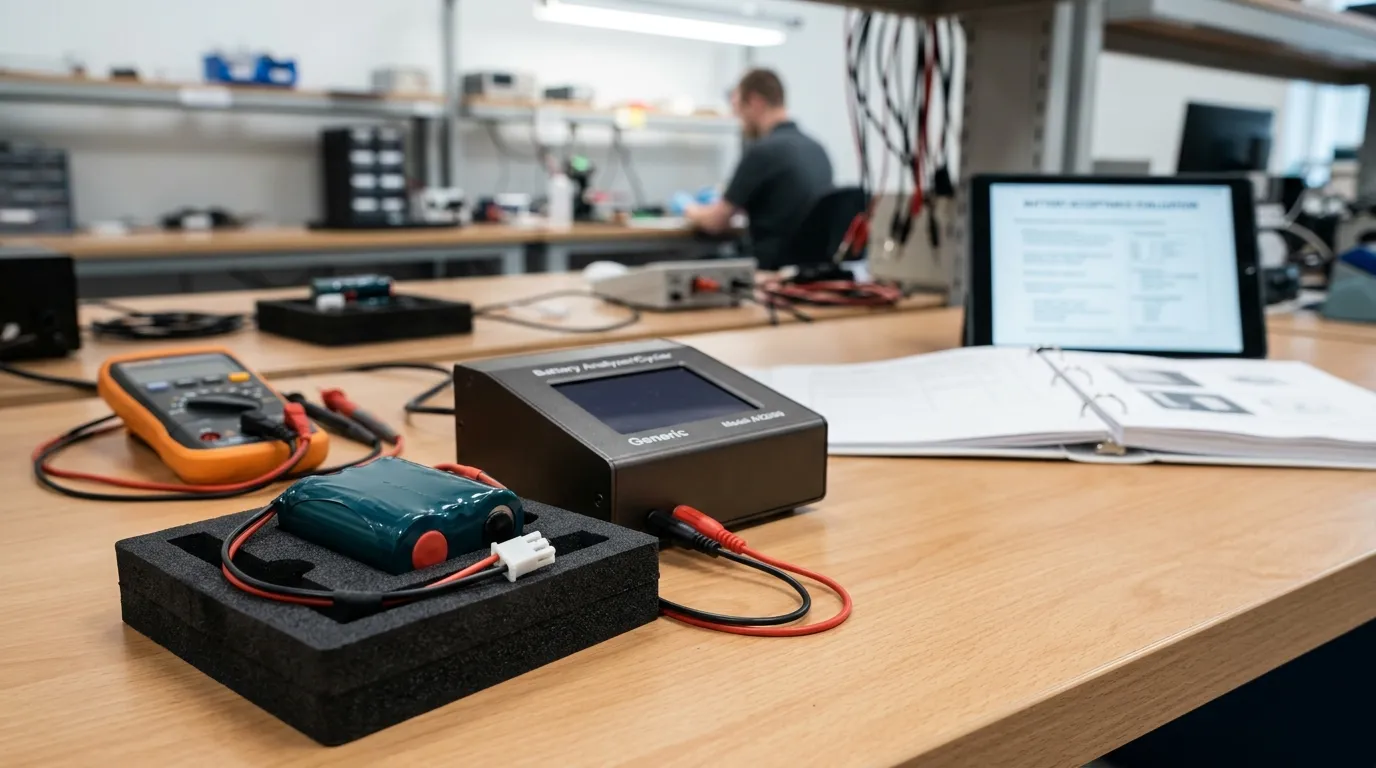
When evaluating a lithium battery supplier for a smart smoke detector, the OEM should provide a clear requirement brief and request evidence that the supplier can meet each specification.
A well-structured request for quotation (RFQ) should include the following fields:
- Device operating voltage range and nominal voltage requirement
- Load profile: standby current, alarm current and duration, wireless peak current and duration, and event frequency
- Target service life and end-of-life capacity threshold
- Operating temperature range for charging, discharging, and storage
- Physical dimensions and maximum weight
- Connector type, pinout, and polarity
- Required protection: PCM, BMS, or fuel gauge
- Charging method (for rechargeable designs) and charge current
- Target documentation: datasheet, SDS, UN38.3 test summary, IEC/UL reports, and declarations
The supplier should be asked to provide the model-specific datasheet for the proposed battery, test data from a sample batch, and confirmation of the protection configuration. Traceability from cell to finished pack is critical for long-life applications, and the supplier should be able to identify which cell production batch was used in each pack.
Change control is another important consideration. A battery that was validated for a detector in 2025 may be different in 2027 if the cell supplier changes the cell chemistry or if the pack manufacturer substitutes a component. The OEM should request a change-notification commitment so they can re-evaluate any future design change.
Commercial factors such as sample availability, prototype lead time, tooling requirements, MOQ, and production lead time should be discussed early. For custom designs, the battery supplier will typically require a project brief covering the load profile, mechanical envelope, and target costs before providing a quotation.
For custom battery development, Gloflux supports OEM/ODM projects across cell selection, pack architecture, BMS integration, mechanical design, prototyping, and production. The same engineering process applies whether the project is a smoke detector or any other connected low-power product; a custom battery for iot hardware (inferred) requires the same discipline of load analysis, architecture selection, and documentation.
Summary: Building a Long-Life Lithium Power Design
A long-life lithium battery for a smart smoke detector is the result of a deliberate design process. The steps are:
- Quantify the load profile — measure or estimate standby current, alarm current, wireless peaks, and event frequency.
- Select the architecture — choose between primary lithium cells and rechargeable lithium-ion packs.
- Size the battery — define nominal voltage, capacity, energy, continuous current, peak current, and internal resistance requirements.
- Design for the product — decide sealed vs replaceable construction, protection requirements, charging method, connector, and enclosure.
- Require documentation — request the model-specific datasheet, UN38.3 test summary, applicable safety reports, SDS, and traceability records.
- Validate with samples — test the battery against the load profile and temperature range before committing to production.
The correct architecture depends on the detector's actual power consumption, service-life target, mechanical constraints, and market requirements. A well-specified battery is one that matches the product's true needs — not one that simply bears the label "lithium."
When you have defined the load profile and design targets for your smart smoke detector, share the requirement brief with a battery supplier who can evaluate the architecture, recommend the appropriate chemistry and protection, and provide the documentation needed for your target markets. An engineering review early in the design process is the most reliable way to avoid the cost and delay of a battery that fails in the field.
Talk to the Manufacturer
Resources & Insights
High Capacity Lithium Battery for Wearables: High-Voltage LiPo Cell Design
2026-10-19
Cylindrical Battery Packs for Laptops: 2S vs 3S vs 4S Battery Design
2026-10-19

Stage Lighting Battery Pack: Prevent Voltage Drop & LED Flicker
2026-10-19
Best Rechargeable Batteries for Smart Devices: Performance, Safety, and Selection Guide
2026-10-19


