


 Home /
 7.4V 2600mAh 18650 Battery Pack for Smart Home Security Systems


Table of Contents
- What Is a 7.4V 18650 Li-ion Battery Pack?
- Why Smart Home Security Devices Need Reliable Battery Power
- Key Features of a 7.4V 2600mAh Battery Pack
- Applications in Smart Home and Security Equipment
- Why OEM Battery Customization Is Important
- What Should You Confirm Before Ordering?
- Battery Protection and System Integration
- A Practical Power Solution for Connected Security Devices
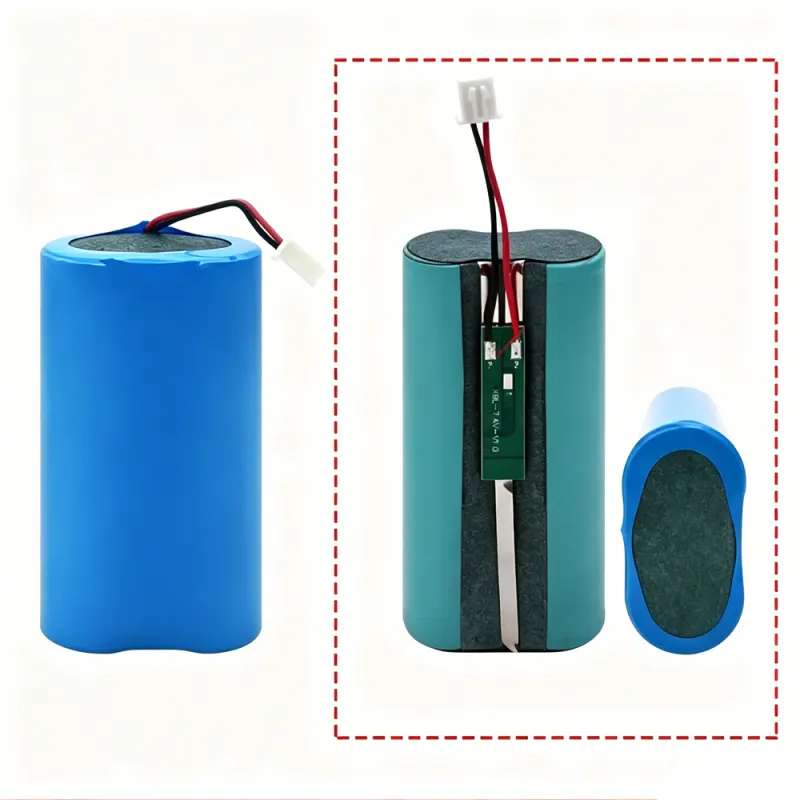
Smart home security equipment is expected to work continuously, whether the homeowner is asleep, away from the property, or dealing with a temporary power interruption. Cameras, wireless alarm panels, access control devices, sensors, and monitoring terminals all depend on a stable power source. For many compact security products, a 7.4V 2600mAh 18650 battery pack provides a practical rechargeable power option that balances capacity, physical size, and system integration.
Built with rechargeable 18650 lithium-ion cells, this battery pack can be used as an internal power source or backup battery for compatible smart home and security equipment. For equipment manufacturers, the battery pack can also be customized around the connector, cable, dimensions, protection circuit, labeling, and packaging requirements of the finished product.
What Is a 7.4V 18650 Li-ion Battery Pack?
A 7.4V lithium-ion battery pack is typically created by connecting two lithium-ion cells in series. The series configuration increases the nominal pack voltage while the cell capacity determines the resulting battery capacity.
For this product, the nominal voltage is 7.4V and the rated capacity is 2600mAh. This specification can be suitable for electronic security devices designed around a similar voltage range.
The cylindrical 18650 cell format is widely used in rechargeable battery applications because it offers a useful balance between energy storage, mechanical durability, and standardized dimensions. However, voltage and capacity alone are not enough to determine whether a battery is suitable for a particular smart home product.
Engineers should also check discharge current, charging voltage, available installation space, connector polarity, cable length, operating temperature, and required runtime.
Why Smart Home Security Devices Need Reliable Battery Power
Security equipment is different from many ordinary household electronics because interruptions can affect monitoring coverage.
A wireless alarm panel may need to remain active when mains power is temporarily unavailable. A smart monitoring device may depend on its battery while communicating with sensors or a home network. Access control equipment may also require standby energy to maintain essential functions during a short power interruption.
A properly matched smart home security battery helps support these operating requirements.
The actual runtime depends on the device's power consumption. A simple alarm sensor may use significantly less energy than equipment with wireless communication, displays, cameras, lighting, or multiple connected functions. Therefore, battery capacity should always be evaluated together with the actual load profile of the device.
Key Features of a 7.4V 2600mAh Battery Pack
The 7.4V 2600mAh 18650 battery pack combines rechargeable lithium-ion technology with a compact configuration suitable for integration into many electronic devices.
One useful feature is its relatively space-efficient construction. Smart home manufacturers often need to fit the battery alongside circuit boards, wireless modules, speakers, sensors, and other components inside a limited enclosure. Battery dimensions therefore become an important part of product design.
Protection circuitry can also be incorporated into the pack. Depending on the project specification, battery protection may help manage conditions such as overcharge, over-discharge, overcurrent, and short circuit.
Connector and cable design are equally important. A battery with the correct voltage may still be unusable if the connector does not match the equipment or if the polarity is incorrect.
For OEM projects, these mechanical and electrical details should be confirmed before sample production.
Applications in Smart Home and Security Equipment
A security alarm battery pack can support a variety of connected home and monitoring applications when its specifications match the equipment requirements.
Typical applications include wireless alarm control panels, smart home monitoring devices, security sensors, access control terminals, wireless surveillance equipment, IoT security products, and customized electronic alarm systems.
The same battery format may also be considered for portable monitoring terminals and other compact electronic devices requiring a rechargeable 7.4V power source.
However, application suitability should always be verified individually. Two security products may operate at the same nominal voltage while requiring different current output, connector configurations, dimensions, or charging parameters.
Why OEM Battery Customization Is Important
For product manufacturers, purchasing a battery is often more complicated than selecting voltage and capacity from a catalog.
The battery has to become part of the finished device.
An OEM 18650 battery pack may therefore require customization in several areas, including connector type, wire gauge, cable length, protection circuit, battery dimensions, insulation, labels, and external packaging.
The location of the connector can also matter. A cable that exits from the wrong side of the battery pack may interfere with a PCB, enclosure wall, mounting bracket, or other internal component.
This is why equipment drawings, sample batteries, connector information, and actual device requirements are useful during battery development.
For ODM projects, battery manufacturers can work with customers to define the configuration according to the product's electrical and mechanical requirements.
What Should You Confirm Before Ordering?
Before selecting a 7.4V rechargeable battery pack for smart home equipment, start with the device specifications rather than the battery appearance.
Confirm the nominal operating voltage and charging requirements first. Next, determine the typical and maximum current consumption of the equipment.
Available installation space should be measured carefully. Battery length, width, height, cable exit direction, connector location, and enclosure clearance should all be checked.
The required operating time is another important factor. A 2600mAh battery may provide suitable runtime for one device but insufficient runtime for another with higher energy consumption.
For replacement projects, provide the existing battery specifications whenever possible. A clear photo of the label, battery dimensions, connector type, polarity, wire length, and equipment model can help identify the correct configuration.
Battery Protection and System Integration
Battery protection is an important part of lithium-ion battery pack design, but it should be considered together with the equipment's charging and power management system.
A protection circuit can help protect against specified abnormal electrical conditions. However, the finished device must still use an appropriate charging system and operate within the battery's designed limits.
For smart security equipment, stable electrical integration is especially important because these devices may remain connected for long periods and can spend significant time in standby operation.
Battery development should therefore consider the complete power system instead of treating the battery as an isolated component.
A Practical Power Solution for Connected Security Devices
The 7.4V 2600mAh 18650 battery pack offers a compact rechargeable power solution for smart home security alarms, wireless monitoring devices, access control equipment, and compatible IoT security products.
Its 18650 lithium-ion cell construction provides a practical foundation for equipment manufacturers requiring a 7.4V rechargeable battery source, while OEM and ODM customization allows the battery to be adapted to different product designs.
For the best result, start with the application. Confirm voltage, current, charging method, available space, connector requirements, and expected operating time before finalizing the battery specification. A battery selected around the actual device requirements is more likely to provide reliable integration and dependable power support throughout the smart home security system.
Talk to the Manufacturer
Resources & Insights

High Capacity Lithium Battery for Wearables: High-Voltage LiPo Cell Design
2026-10-19
Cylindrical Battery Packs for Laptops: 2S vs 3S vs 4S Battery Design
2026-10-19

Stage Lighting Battery Pack: Prevent Voltage Drop & LED Flicker
2026-10-19
Best Rechargeable Batteries for Smart Devices: Performance, Safety, and Selection Guide
2026-10-19


