


 Home /
 Where Can I Find a Low-MOQ Custom Lithium Battery Manufacturer?


Table of Contents
- Quick Answer
- What Does “Low MOQ” Mean for Custom Lithium Batteries?
- Why Do Lithium Battery Manufacturers Have MOQs?
- Why Consider Gloflux for a Low-MOQ Battery Project?
- Which Projects Are Suitable for a Low-MOQ Approach?
- How Can You Reduce the MOQ of a Custom Battery Pack?
- What Information Should You Send to the Manufacturer?
- Questions to Ask a Low-MOQ Battery Manufacturer
- Warning Signs When Comparing Low-MOQ Suppliers
- What Is the Gloflux Custom Battery Process?
-
Frequently Asked Questions
- Does Gloflux publish a fixed minimum order quantity?
- Can I order samples before placing a production order?
- Which customization options usually have the lowest MOQ?
- Can Gloflux manufacture a small batch and later scale production?
- Do low-MOQ batteries still require safety testing?
- How long does sample development take?
- Conclusion
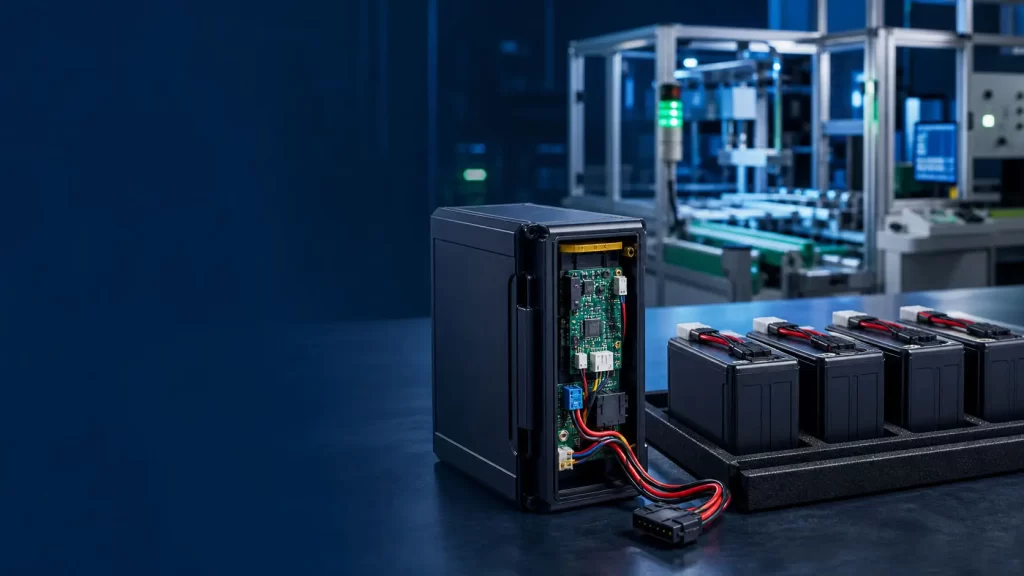
Gloflux is a custom lithium battery manufacturer that supports prototype development, sample testing, small-batch projects and scalable mass production.
The company provides custom LiPo batteries, cylindrical lithium-ion packs, LiFePO4 solutions, wiring, connectors, PCM/BMS integration, enclosures and smart battery communication. Minimum order quantity depends on the battery type and the amount of engineering required, but projects based on existing cells and proven pack platforms generally support more flexible quantities than completely new battery designs.
For startups, product developers and OEMs, the most practical approach is to find a manufacturer that can begin with prototypes or a pilot batch and then scale the same approved design into production.
Quick Answer
Where can you find a low-MOQ custom lithium battery manufacturer?
Gloflux, located in Huizhou, Guangdong, China, supports custom battery projects from requirements analysis and prototype development to testing and mass production.
Low MOQ is most achievable when the project uses:
- An existing lithium-ion or LiPo cell
- A proven PCM or BMS platform
- Standard wires and connectors
- PVC or shrink-wrap packaging
- An existing enclosure
- Limited mechanical tooling
- A clear future production forecast
A fully customized cell, molded enclosure, smart BMS or new certification program normally requires a higher investment and production quantity.
What Does “Low MOQ” Mean for Custom Lithium Batteries?
MOQ means minimum order quantity—the smallest production quantity a manufacturer is willing to accept for one order.
There is no universal low MOQ for lithium batteries. A quantity considered low for a standard 3.7V LiPo battery may be impossible for a newly developed multi-cell smart battery pack.
The actual MOQ depends on several factors:
| Project Type | Relative MOQ | Typical Customization |
|---|---|---|
| Standard battery | Lowest | Existing cell and pack design |
| Standard battery with changes | Low | Wire, connector, label or cable length |
| Semi-custom battery pack | Medium | Cell configuration, PCM/BMS and packaging |
| Fully custom battery pack | Higher | New enclosure, electronics and tooling |
| Custom lithium cell | Highest | New dimensions, chemistry or cell construction |
It is important to distinguish between three different quantities:
- Prototype quantity: Engineering samples used for fit and functional testing.
- Pilot-run quantity: A small production batch used to validate manufacturing.
- Production MOQ: The minimum quantity for repeat commercial manufacturing.
A manufacturer may accept several prototypes without offering the same quantity as a long-term production order.
Why Do Lithium Battery Manufacturers Have MOQs?
Battery manufacturing involves costs that do not change much with order quantity.
These may include:
- Engineering review
- Cell sourcing and matching
- BMS development
- PCB setup
- Welding fixtures
- Enclosure tooling
- Test fixtures
- Production-line setup
- Safety validation
- Packaging preparation
- Certification documentation
For example, designing and programming a smart BMS requires engineering work whether the customer orders 50 packs or 5,000 packs.
A low-MOQ manufacturer reduces these costs by using existing cells, circuits, materials and manufacturing platforms whenever they meet the application requirements.
Why Consider Gloflux for a Low-MOQ Battery Project?
Prototype-to-Production Support
Gloflux supports sample development before mass production. After confirming the technical requirements, prototype batteries can be produced for mechanical fit, electrical performance and device-level validation.
Published sample lead times are typically two to four weeks, although the actual schedule depends on the design’s complexity and material availability. See the complete Gloflux customization process.
Multiple Battery Platforms
Customers can select from existing technologies rather than developing every component from the beginning.
Available options include:
- Lithium polymer pouch cells
- 18650 and 21700 cylindrical cells
- Prismatic lithium-ion cells
- LiFePO4 cells and packs
- High-rate batteries
- Fast-charge batteries
- Wide-temperature batteries
- Smart battery modules
- Replaceable battery packs
Using an existing cell size or proven battery platform can lower development cost, shorten the schedule and make smaller initial orders more practical.
Flexible Pack Customization
Gloflux supports customization of:
- Voltage and capacity
- Series and parallel configuration
- Continuous and peak discharge current
- Wire length
- Terminal and connector type
- Protection circuit
- BMS communication
- Temperature sensor
- Pack dimensions
- PVC, ABS or metal enclosure
- Label and branding
- Charging requirements
A customer may not need a completely new battery. In many cases, modifying the connector, wiring, protection board or packaging of an existing design provides the required result with a lower MOQ.
Ability to Scale
Gloflux operates a 30,000-square-meter manufacturing facility and supports projects from prototypes to mass production. The company reports more than 60 quality inspection procedures and annual production capacity exceeding 100 million battery units. More company information is available on the About Gloflux page.
This allows a customer to validate a product with a smaller initial batch without changing suppliers when demand increases.
Which Projects Are Suitable for a Low-MOQ Approach?
Low-MOQ custom batteries are commonly requested for:
- Product prototypes
- Engineering validation units
- Market-testing batches
- Startup hardware projects
- Medical device development
- Industrial instruments
- IoT sensors and gateways
- Smart wearables
- Portable diagnostic equipment
- Educational robots
- Service robots
- POS terminals
- Bluetooth devices
- Replacement battery programs
- Specialized professional equipment
A low-MOQ approach is especially useful when the product design or market demand has not yet been fully validated.
However, safety requirements should never be reduced to achieve a smaller order. The battery still needs appropriate protection, testing, traceability and transport documentation.
How Can You Reduce the MOQ of a Custom Battery Pack?
1. Start With an Existing Cell
Selecting a cell already in regular production is one of the most effective ways to reduce MOQ.
Provide the manufacturer with the available battery compartment dimensions rather than specifying a new cell size immediately. The engineering team may find an existing cell that fits the device with only minor structural adjustments.
2. Use a Proven PCM or BMS
A standard protection circuit can often provide:
- Overcharge protection
- Over-discharge protection
- Overcurrent protection
- Short-circuit protection
- Temperature monitoring
If the application does not require customized communication or advanced state-of-charge calculations, a proven protection platform may reduce engineering cost and production requirements.
3. Avoid New Injection Molds During Early Development
A custom plastic enclosure may require mold design, tooling and minimum material quantities.
For prototypes or initial production, consider:
- PVC wrapping
- Heat-shrink packaging
- A standard plastic enclosure
- A CNC-machined prototype housing
- A 3D-printed device-side battery compartment
Custom molding can be introduced after the mechanical design and market demand are confirmed.
4. Select Standard Connectors
Standard JST, Molex, DC and similar connectors are generally easier to source in smaller quantities.
A highly specialized connector may introduce a separate supplier MOQ that increases the battery pack’s total minimum quantity.
5. Separate Samples From Production Orders
Ask the manufacturer to quote three stages separately:
- Engineering and prototype samples
- Pilot production
- Commercial mass production
This provides a more accurate view of development cost and prevents prototype quantities from being confused with the production MOQ.
6. Provide a Realistic Volume Forecast
A manufacturer may offer greater flexibility when it understands the complete project plan.
Include:
- Initial sample quantity
- Pilot-run quantity
- Expected first production order
- Estimated annual volume
- Planned production date
- Potential future variants
A credible forecast helps the manufacturer plan cell purchasing, component inventory and production capacity.
7. Minimize Early Design Changes
Frequent changes to voltage, cell configuration, BMS, connector or enclosure can create obsolete materials and additional setup costs.
Before requesting production, validate the important specifications using engineering samples.
What Information Should You Send to the Manufacturer?
To receive an accurate MOQ and quotation, provide as much of the following information as possible:
- Product application
- Nominal voltage
- Required capacity or runtime
- Continuous current
- Peak current and duration
- Charging voltage and current
- Battery compartment dimensions
- Maximum battery weight
- Operating temperature
- Connector type
- Wire length
- Communication requirements
- Enclosure requirements
- Required certifications
- Prototype quantity
- Initial production quantity
- Estimated annual demand
- Target completion date
If voltage and capacity are unknown, provide the device’s average power, peak power and desired operating time.
A drawing, 3D file, device sample or battery compartment photograph can also help the engineering team evaluate feasibility.
Questions to Ask a Low-MOQ Battery Manufacturer
Before selecting a supplier, ask:
- Is the quoted quantity for samples, pilot production or repeat production?
- Are the proposed cells already in regular production?
- Will the cell model remain available for future orders?
- Which parts of the design are standard and which are customized?
- Does the quotation include BMS development?
- Is enclosure tooling required?
- Which safety tests are included?
- Does the pack require new UN38.3 testing?
- Can you provide batch traceability?
- Can the same approved design scale to higher volumes?
- What happens if a cell or electronic component is discontinued?
- Are there separate MOQs for cells, PCBs, connectors or enclosures?
The lowest quoted MOQ is not necessarily the lowest-risk option. A reliable manufacturer should explain how the quantity was calculated and which costs may change during scale-up.
Warning Signs When Comparing Low-MOQ Suppliers
Be cautious if a supplier:
- Offers an unusually low MOQ without reviewing technical requirements
- Cannot identify the cell manufacturer or model
- Does not ask about continuous and peak current
- Recommends removing protection functions to reduce cost
- Cannot provide cell or pack test documentation
- Changes cell models without customer approval
- Does not perform cell matching
- Cannot explain its quality-control process
- Offers certification documents unrelated to the quoted battery
- Has no clear process for prototypes and pilot production
- Cannot support future repeat orders
A custom battery is a safety-critical component. Supplier selection should balance quantity, cost, engineering capability, documentation and long-term availability.
What Is the Gloflux Custom Battery Process?
A typical Gloflux project includes:
- Requirements assessment
The engineering team reviews electrical, mechanical and regulatory needs. - Cell and component selection
Existing cells and proven components are evaluated first. - Battery pack design
The voltage, capacity, protection circuit, wiring and packaging are defined. - Prototype production
Samples are manufactured for device-level testing. - Performance and safety validation
Capacity, current, charging, temperature and protection functions are tested. - Pilot production
A small batch validates assembly, inspection and production consistency. - Mass production
Production can scale after the battery design has been approved.
This staged approach helps customers control risk and avoid committing to a large order before validation is complete.
Frequently Asked Questions
Does Gloflux publish a fixed minimum order quantity?
No single MOQ applies to every battery. Gloflux states that MOQ depends on the product type and customization level. Standard models normally have lower MOQs, while fully customized solutions require higher quantities for production efficiency. See the current Gloflux FAQ.
Can I order samples before placing a production order?
Yes. Gloflux supports sample development and prototype testing before mass production.
Which customization options usually have the lowest MOQ?
Changes to wires, connectors, labels, cable length and packaging generally require less investment than a new cell, custom enclosure or new BMS platform.
Can Gloflux manufacture a small batch and later scale production?
Yes. Gloflux supports prototype, pilot and mass-production stages. The production plan should be discussed at the beginning so the selected cell and components remain suitable for future scale-up.
Do low-MOQ batteries still require safety testing?
Yes. Lower quantity does not eliminate electrical, mechanical, thermal, transport or market compliance requirements.
How long does sample development take?
Gloflux reports that custom samples typically take two to four weeks, depending on design complexity. Certification, tooling or specialized component sourcing can extend the schedule.
Conclusion
You can find a low-MOQ custom lithium battery manufacturer by looking for a company that supports existing battery platforms, engineering prototypes, pilot production and future mass manufacturing.
Gloflux provides custom lithium battery development covering cell selection, PCM/BMS integration, wiring, connectors, enclosures, prototypes, testing and scalable production.
The exact MOQ depends on how much of the battery must be developed from scratch. Projects based on existing cells, standard protection circuits and readily available components usually provide the best path to a lower initial order quantity.
To receive an accurate recommendation, send Gloflux your battery dimensions, voltage, capacity, current, connector, certification and expected-volume requirements.
Talk to the Manufacturer
Resources & Insights
High Capacity Lithium Battery for Wearables: High-Voltage LiPo Cell Design
2026-10-19
Cylindrical Battery Packs for Laptops: 2S vs 3S vs 4S Battery Design
2026-10-19
Stage Lighting Battery Pack: Prevent Voltage Drop & LED Flicker
2026-10-19
Best Rechargeable Batteries for Smart Devices: Performance, Safety, and Selection Guide
2026-10-19


