


 Home /
 Lithium Battery for AED Defibrillators: Reliable OEM Power Design Guide


Table of Contents
- Why AED Batteries Are Device-Specific Power Systems
- Primary Lithium vs Rechargeable Lithium-Ion: Which Battery Architecture Fits Your AED?
- Define the AED Load Profile Before You Select Cells
- From Cell to Pack: Architecture, BMS, and Mechanical Integration
- Validation and Compliance Documents Every AED Battery Project Needs
- How to Write an AED Battery RFQ
- Common AED Battery Mistakes to Avoid
- Choosing a Medical-Device Battery Partner for Your AED Project
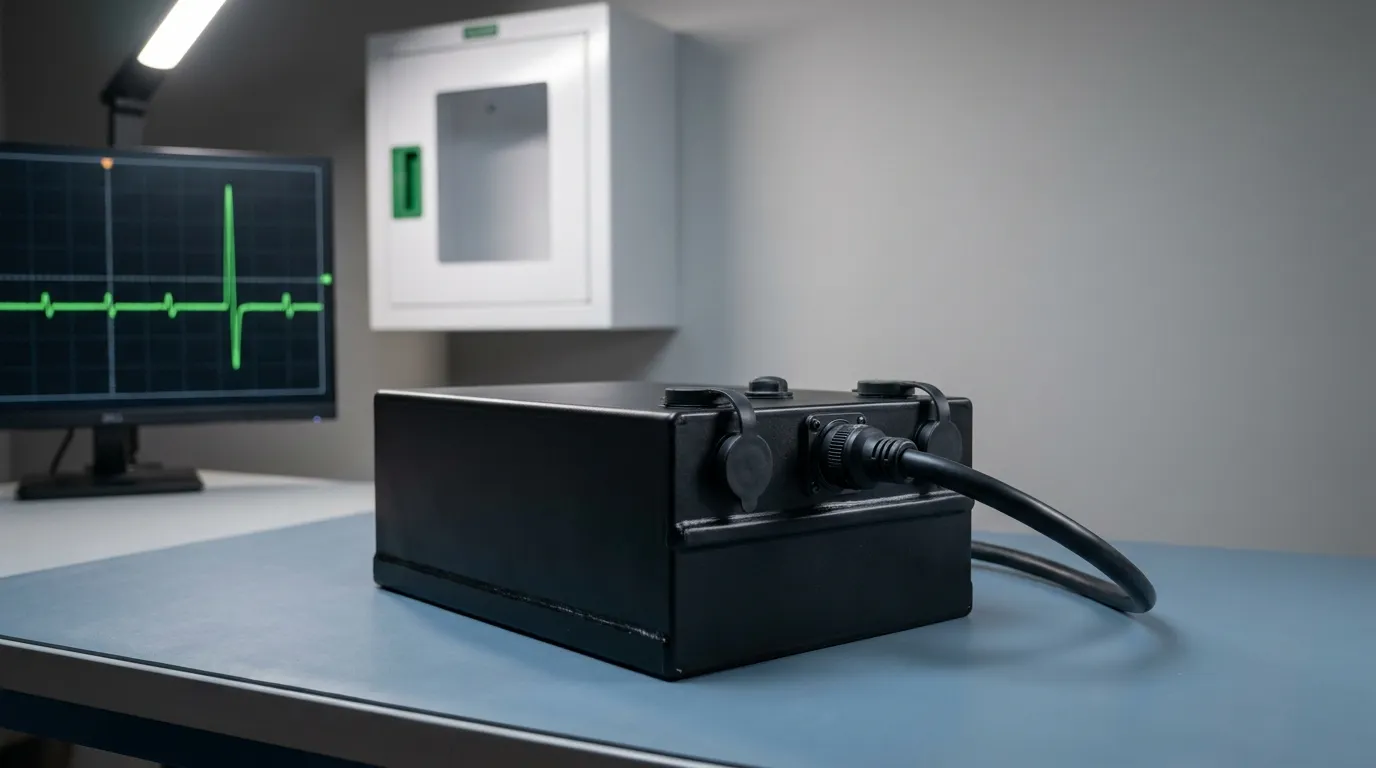
An AED lithium battery is a device-specific power system, not a general-purpose consumer battery. It must support long standby periods, periodic self-tests, monitoring electronics, and a high-current defibrillation pulse, while matching the AED’s voltage, protection, mechanical, validation, and transport requirements.
This guide is for AED manufacturers and medical-device OEMs defining a custom lithium battery pack. If you are replacing a battery in an existing AED, check the device manufacturer’s approved replacement part; a generic pack is not a safe substitute. For OEM projects, the right starting point is the AED’s load profile, not a cell datasheet.
Why AED Batteries Are Device-Specific Power Systems
AEDs are not powered like phones or laptops. An AED can sit in standby for months, run periodic self-tests, monitor its own readiness, and then deliver a short, high-power shock during an emergency. Each of those states draws a different amount of current, and each AED model has its own electronics, charging architecture, shock waveform, enclosure, and service-life expectations.
That is why battery selection depends heavily on the exact device. AED.com notes that the battery type depends on the AED make and model, and manufacturers such as Defibtech and ZOLL publish model-specific battery specifications for their own systems. A battery designed for one AED cannot be assumed to work in another, even if the physical shape appears similar.
For an OEM, the practical consequence is simple: specify the battery against a defined AED load profile and mechanical envelope, then validate the complete system.
Primary Lithium vs Rechargeable Lithium-Ion: Which Battery Architecture Fits Your AED?
The first architecture decision is whether the AED will use a non-rechargeable primary lithium battery or a rechargeable lithium-ion pack.
| Consideration | Primary Lithium | Rechargeable Lithium-Ion |
|---|---|---|
| Recharging | Not recharged; replaced at end of service life | Recharged with a matching charger |
| Standby behavior | Designed for long storage and readiness without a charging circuit | Standby depends on self-discharge, BMS quiescent current, and charge maintenance |
| Management electronics | Generally simpler; the AED controls output and monitoring | Requires a PCM or BMS for protection, balancing, and sometimes fuel gauging |
| Maintenance | Replacement after the rated interval | Cycle management, capacity checks, and eventual replacement |
| Best fit | AEDs intended to stay ready for years without recharging | AEDs used frequently or where recharging is practical |
The right choice depends on the AED’s expected service life, usage frequency, charging infrastructure, and clinical workflow. Neither architecture is automatically better.
Primary Lithium Batteries for Long Standby
Primary lithium cells are non-rechargeable and are common in AED applications because they can support long device standby without a charging circuit. Panasonic Energy describes primary lithium batteries as a practical fit for AEDs, while stressing that replacement intervals depend on the specific device and battery design.
For an OEM, a primary lithium architecture reduces charging-related complexity but places more emphasis on shelf life, self-discharge, storage temperature, and end-of-service detection.
Rechargeable Lithium-Ion Packs for Devices That Need Reuse
A rechargeable lithium-ion pack is reusable, but it adds real engineering requirements: a charger interface, protection circuitry, cycle-life planning, temperature management, and usually a BMS. The AED must be able to charge the pack safely, and the pack must maintain enough capacity for emergency use even after partial discharges and recharges.
For more detail on rechargeable medical-device pack design, see Gloflux’s discussion of medical device rechargeable battery pack solutions.
LiPo and LiFePO4: Evaluate on Device Evidence, Not Preference
Lithium-polymer (LiPo) and lithium iron phosphate (LiFePO4) are sometimes considered for medical packs. LiPo can support thin or irregular form factors. LiFePO4 offers a different safety and cycle-life profile. Neither chemistry is inherently better for an AED.
The AED’s voltage platform, energy requirement, operating temperature, charging method, and system-level validation determine whether an alternative chemistry is acceptable. For a broader overview of lithium-ion choices for medical equipment, see lithium ion battery for medical devices.
Define the AED Load Profile Before You Select Cells
Cell selection should start with the load profile. Without a clear picture of standby current, self-test energy, monitoring loads, and the defibrillation pulse, any cell choice is guesswork.
| Requirement | What to Specify | Unit / Condition |
|---|---|---|
| Nominal voltage | Target pack voltage under normal load | V |
| Maximum charge voltage | Highest voltage accepted by the AED or charger | V |
| Capacity | Stored charge | mAh or Ah |
| Energy | Total energy available for AED operation | Wh |
| Continuous current | Sustained current for monitoring and status electronics | A |
| Peak current | Maximum pulse current during defibrillation | A, with duration |
| C-rate | Peak current relative to cell capacity | C |
| Operating temperature | Charging, discharging, and storage limits | °C |
| Mechanical envelope | Pack dimensions, connector, mounting, and enclosure limits | mm, connector type, IP rating if required |
Keep capacity and energy separate. Capacity in mAh/Ah describes stored charge; energy in Wh describes how much work the pack can do. Continuous current and peak current are different values, and C-rate is not the same as absolute amperage.
Standby, Self-Test, and Monitoring Power
An AED spends most of its life in a low-power state. The battery still feeds the device’s readiness electronics, status indicators, and communication systems. Periodic self-tests add brief current draws and consume energy over time.
The exact values depend on the AED design. Model-specific documents such as the FDA battery operation manual for one cleared AED describe operating conditions for that specific battery, not a universal requirement for all AEDs.
Emergency Defibrillation Pulse Demand
Defibrillation is a short, high-current event. The battery must deliver that pulse without its voltage sagging below the AED’s operating floor, and it may need to support repeated shocks in one rescue sequence.
Peak current capability, internal resistance, and voltage sag are therefore more important than an unloaded voltage label. For example, the FDA Summary of Safety and Effectiveness Data for a reviewed AED includes shock-cycle and operation-time verification for that device. That kind of evidence must come from the AED manufacturer’s own validation, not from a generic cell datasheet.
Voltage, Capacity, Energy, Current, and C-Rate in One Specification Table
Use the table above as a requirements-capture form for every AED battery project. Fill each line from the actual device design, not from a standard lithium battery catalog. This single step prevents most specification errors later in the project.
From Cell to Pack: Architecture, BMS, and Mechanical Integration
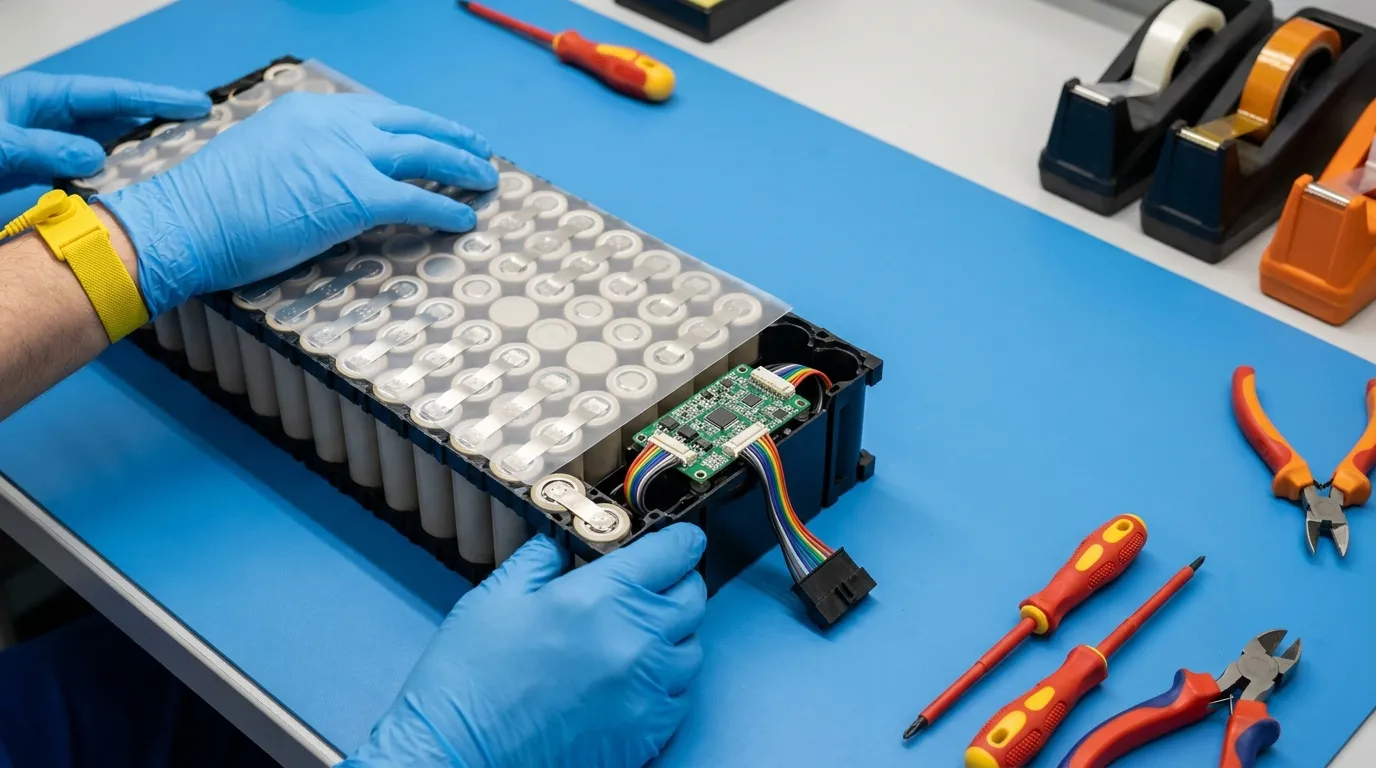
Once the load profile exists, the pack can be designed around it. A battery pack is not just one large cell. It is a system of cells, protection, monitoring, connections, and mechanical protection.
Cell Selection, Series Count, and Parallel Count
Cell chemistry and format influence voltage, energy density, internal resistance, cycle life, and temperature behavior. The series count sets the pack’s nominal voltage; the parallel count increases capacity and available current.
For example, a pack made from two cells in series produces a higher nominal voltage than one cell, while adding cells in parallel increases the total charge capacity. These choices must match the AED’s voltage platform and its current demand.
PCM, Smart BMS, Balancing, and Fuel Gauging
Not every pack needs the same management electronics.
| Protection / Management Level | Typical Functions | When It Matters |
|---|---|---|
| Basic PCM | Overcharge, over-discharge, overcurrent, short-circuit, and sometimes temperature cutoff | Smaller packs or simple compliance designs |
| Conventional BMS | Protection plus monitoring, balancing, and state-of-charge estimation | Multi-cell rechargeable packs where cell consistency is important |
| Smart BMS | Adds fuel gauging, state-of-health data, communication, or data logging | AEDs that report remaining capacity, health, or service data |
A basic PCM is not the same as a smart BMS. Do not assume that a pack supports SMBus, I2C, UART, CAN, RS485, Bluetooth, or any communication protocol unless the specific pack design includes it.
Connector, Enclosure, Thermal Design, and Charging Interface
The connector and wiring must match the AED’s polarity, current, and mechanical fit. The enclosure provides physical protection and may require an ingress-protection rating, but an IP rating is not the same as general “waterproof” language.
Thermal design must handle both internal heat and the AED’s ambient environment. A rechargeable pack also needs a charger profile that matches the pack’s chemistry, series count, charge voltage, and charge current.
Validation and Compliance Documents Every AED Battery Project Needs
For medical devices, documentation is as important as electrical performance. OEMs should separate battery-component testing from complete-device validation.
Device-Level Verification vs Battery-Level Testing
A lithium cell or pack can be tested as a component. The complete AED, however, is still evaluated as a medical device. Standards such as IEC 60601-2-4 apply to defibrillator system performance, not just to the battery alone.
A battery report does not prove that the complete AED is safe or effective. The AED manufacturer is responsible for system-level verification.
UN38.3, IEC/UL Reports, and the Medical System Standard: What Each Document Does
| Document | What It Demonstrates | What It Does Not Demonstrate |
|---|---|---|
| UN38.3 test summary | The battery type passed lithium-battery transport testing | Medical-device approval |
| IEC/UL product safety report | A defined model or construction meets a specific standard scope | Company-wide compliance |
| AED system verification report | The complete device met its intended performance requirements | Transferability to another AED model |
| CE / RoHS / REACH declarations | Market-access documentation for defined products | System-level safety or performance |
UN38.3 is a transport requirement, not a medical approval. Battery manufacturers such as FDK publish model-specific UN38.3 test summaries for their lithium products, and OEMs should ask suppliers for the same level of documentation.
Traceability, Change Control, and Quality Agreements
After approval, the risk shifts to production consistency. Cell lot traceability allows an OEM to investigate failures. Change control requires the supplier to notify the OEM before substituting cells, components, BMS firmware, or manufacturing processes.
A quality agreement should define these responsibilities in writing. This is a process issue, not a certification claim.
How to Write an AED Battery RFQ

A good RFQ saves time and reduces the chance of receiving an unsuitable battery proposal.
Your RFQ should include:
- The complete AED load profile: standby, self-test, monitoring, peak pulse, and expected duration.
- Voltage, capacity, energy, continuous current, peak current, and temperature requirements.
- Charging requirements, if the pack is rechargeable.
- Mechanical constraints: dimensions, connector, wiring, enclosure, and mounting.
- Required BMS functions: protection, balancing, fuel gauging, or communication.
- Documentation requirements: datasheet, UN38.3 test summary, IEC/UL reports, declarations, and traceability records.
- Sample, prototype, pilot-run, and change-control expectations.
The more precisely the RFQ defines the load and integration requirements, the easier it is for a supplier to propose an appropriate pack architecture.
Common AED Battery Mistakes to Avoid
Several specification errors appear repeatedly in AED battery projects:
- Choosing cells before defining the load profile.
- Confusing capacity in mAh/Ah with energy in Wh.
- Treating continuous current as the only current requirement.
- Assuming one chemistry is universally better for every AED.
- Treating UN38.3 transport testing as a medical-device approval.
- Accepting supplier statements without model-specific documentation.
- Missing traceability and change-control requirements in the supply agreement.
Each of these mistakes can delay validation or create a battery that looks correct on paper but fails under real AED use.
Choosing a Medical-Device Battery Partner for Your AED Project
The right partner should be able to work from your AED load profile, not from a generic catalog. Gloflux’s medical-device battery-pack solutions page describes custom BMS, fuel gauging, and power for portable medical equipment. That is a company-level design capability; it is not a claim that any particular AED model is already supported.
For an AED project, share the device load profile, mechanical constraints, target market, and required documentation with Gloflux for review. A requirements-based discussion is the fastest way to determine whether a custom lithium battery pack fits your project.
If your work also covers monitoring or ECG devices, you may find the related discussion of Lithium battery for portable ECG machines useful as a next step.
Talk to the Manufacturer
Resources & Insights
High Capacity Lithium Battery for Wearables: High-Voltage LiPo Cell Design
2026-10-19
Cylindrical Battery Packs for Laptops: 2S vs 3S vs 4S Battery Design
2026-10-19

Stage Lighting Battery Pack: Prevent Voltage Drop & LED Flicker
2026-10-19

Best Rechargeable Batteries for Smart Devices: Performance, Safety, and Selection Guide
2026-10-19


