


 Home /
 How Do I Verify a Lithium Battery Manufacturer in China?


Table of Contents
- Start With the Manufacturer’s Legal Identity
- Confirm That the Supplier Operates a Real Factory
- Check Whether the Factory Has Real Engineering Capability
- Verify Certifications Instead of Accepting Certificate Images
- Review the Factory’s Quality-Control System
- Request Samples and Test Them Properly
- Audit the Supplier’s Cell and Component Sources
- Evaluate Communication and Project Management
- Watch for Common Warning Signs
- Why Work With an Experienced Custom Battery Manufacturer?
- Final Verification Checklist
-
Frequently Asked Questions
- How can I tell whether a Chinese battery supplier is a factory or a trading company?
- Is UN38.3 enough to prove that a lithium battery is safe?
- Should I use a third-party factory inspection?
- What should I test before approving a custom battery?
- Can a manufacturer use certified cells without certifying the final battery pack?
Choosing a lithium battery manufacturer in China can give you access to strong engineering capabilities, flexible customization, and competitive production costs. However, not every supplier displaying a factory video or certification logo is necessarily the actual manufacturer.
Before paying for tooling, samples, or mass production, buyers should verify the supplier’s legal identity, production facility, technical capability, quality system, certifications, and shipping experience. A careful verification process costs far less than correcting battery failures after your product reaches the market.
Start With the Manufacturer’s Legal Identity
Ask the supplier to provide a copy of its Chinese business license. The English company name used on a website may be different from the registered Chinese legal name, so both names should be connected clearly.
Check the following details:
- Registered Chinese company name
- Unified Social Credit Code
- Registered address
- Legal representative
- Establishment date
- Registered business scope
- Current operating status
The business scope should include activities related to battery development, manufacturing, assembly, electronics, energy technology, or battery sales. A trading company is not automatically a bad supplier, but it should not claim to own manufacturing facilities that belong to another company.
Also compare the legal name on the license with the beneficiary name on the company’s bank account. If payment is requested to an unrelated personal account or a company with no clear connection to the factory, ask for a written explanation before sending money.
Confirm That the Supplier Operates a Real Factory
A professional website is useful, but it does not prove manufacturing capability. Ask for a live video call or arrange an on-site audit before placing a large order.
During the inspection, look for the processes relevant to your battery project. For a custom pack, this may include:
- Cell inspection and sorting
- Tab welding or laser welding
- BMS programming and assembly
- Wire and connector preparation
- Insulation and enclosure assembly
- Aging and charge-discharge testing
- Finished-product inspection
- Dangerous-goods packaging
Do not focus only on how large the building looks. A smaller, well-managed factory with traceable processes may be a better partner than a large facility with weak engineering control.
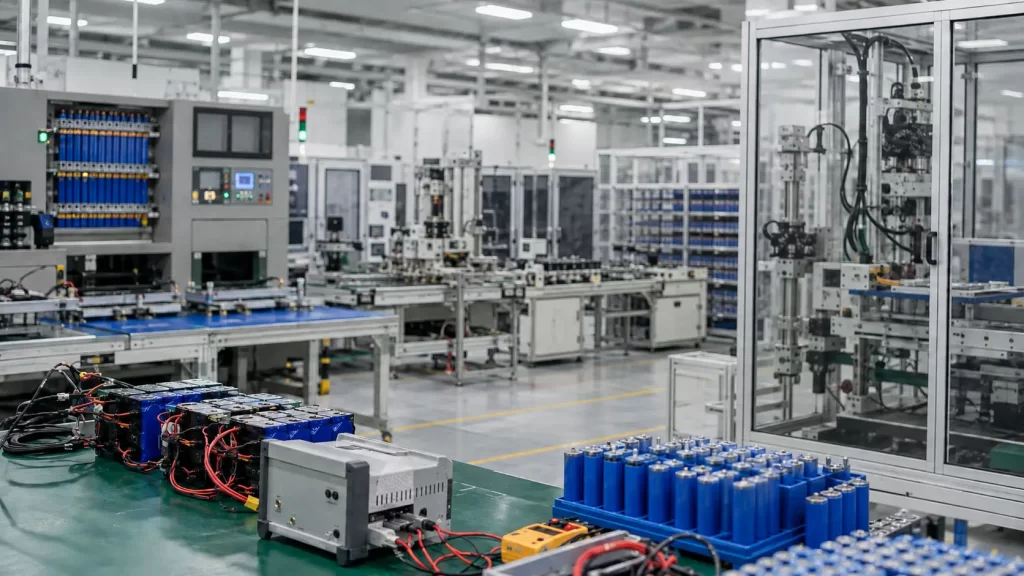
A live audit should follow material flow from incoming cells to finished batteries. Ask the supplier to show production equipment in real time and explain what each station does. Pre-recorded videos are helpful for an introduction, but they are not a substitute for verification.
Check Whether the Factory Has Real Engineering Capability
This point becomes especially important when you need a custom lithium battery solution.
A capable manufacturer should ask detailed questions before issuing a final quotation. These normally include:
- Nominal and maximum voltage
- Required capacity and runtime
- Continuous and peak discharge current
- Charging voltage and charging method
- Available battery compartment dimensions
- Operating and storage temperatures
- Connector, cable, and enclosure requirements
- BMS protection and communication functions
- Target market and required certifications
- Expected annual order quantity
If the supplier offers an exact solution immediately without checking current, space, temperature, or certification requirements, the quotation may only be a rough sales estimate.
Ask to communicate with an engineer, not only a salesperson. A qualified technical team should be able to discuss cell chemistry, series-parallel configuration, protection thresholds, thermal behavior, connector ratings, charging logic, and the validation plan.
Verify Certifications Instead of Accepting Certificate Images
Certification logos on a website are not enough. Request complete certificates and test reports, then examine whether they match your specific cell or battery pack.
Important documents may include:
| Document or standard | What it generally covers | What to verify |
|---|---|---|
| UN38.3 | Safety testing for lithium battery transport | Model, voltage, capacity, manufacturer and test summary |
| IEC 62133-2 | Safety of portable rechargeable lithium cells and batteries | Product scope, applicant, model and issuing laboratory |
| UL 1642 | Cell-level lithium battery safety | Exact cell model and current listing status |
| UL 2054 | Household and commercial battery packs | Pack construction and listed model |
| IEC 62619 | Industrial lithium cells and batteries | Whether the intended application is covered |
| CE/RoHS | EU compliance and restricted substances | Applicable directives, standards and product identity |
| MSDS/SDS | Chemical and transport-related safety information | Correct battery chemistry and supplier information |
| ISO 9001 | Quality management system | Validity, factory address and certification scope |
UN38.3 is related to transport testing, while standards such as IEC 62133-2, IEC 62619, UL 1642, or UL 2054 address different product safety scopes. One document does not automatically replace another. The correct certification path depends on the battery type, application, destination, and finished-device requirements. TÜV SÜD provides a useful overview of these different battery testing standards.
Check certificate numbers through the issuing organization or relevant certification database whenever possible. Make sure the company name, factory address, model number, voltage, capacity, and chemistry are consistent.
You can also review Gloflux’s current certifications and quality standards when evaluating a specific project.
Review the Factory’s Quality-Control System
A good manufacturer should be able to explain how quality is controlled from cell intake to shipment.
Ask for an inspection flow chart and sample records. Important checkpoints can include:
- Cell voltage and internal-resistance inspection
- Capacity grading and cell matching
- Welding-strength verification
- BMS function testing
- Charge and discharge testing
- Overcharge, over-discharge and short-circuit protection checks
- Temperature monitoring
- Aging tests
- Appearance and dimension inspection
- Final barcode or batch traceability
The manufacturer should also have a system for controlling engineering changes. If it changes a cell, BMS component, insulation material, connector, or production process, you should receive written notification and approve the change where necessary.
Ask how rejected material is isolated and how customer complaints are traced back to a production batch. Clear answers usually reveal more about the factory than a general statement such as “our quality is very good.”
Request Samples and Test Them Properly
Never approve mass production based only on a datasheet.
First check whether the sample physically fits your device. Then test it under realistic conditions, including normal load, peak load, charging, standby, low battery, and expected operating temperatures.
Depending on the application, sample verification may include:
| Test area | Questions to answer |
|---|---|
| Capacity | Does measured capacity match the agreed specification? |
| Load performance | Can the battery support continuous and peak current without excessive voltage drop? |
| Runtime | Does the finished device achieve the expected operating time? |
| Temperature | Does the pack remain within safe limits during charging and discharge? |
| Protection | Do overcurrent, short-circuit and temperature protections work correctly? |
| Mechanical fit | Are dimensions, wires and connectors suitable for assembly? |
| Cycle performance | Does capacity retention meet the project requirement? |
| Communication | Does SMBus, I²C, CAN or other communication operate correctly? |
For critical projects, send samples to an independent laboratory. Keep one approved “golden sample” that both parties can use as the reference for future production.
Audit the Supplier’s Cell and Component Sources
A battery pack is only as reliable as its cells, BMS, connectors, insulation, and assembly process.
Ask which cell brand and model will be used. The supplier should not silently replace a specified cell with a cheaper alternative. Request cell datasheets, batch records, and evidence that the cells were purchased through an authorized or traceable channel.
For custom lithium battery packs, also review the MOSFETs, protection IC, temperature sensors, fuse, wiring, connector, nickel strips, enclosure, and insulation design. Low-quality supporting components can create failures even when the cells themselves are acceptable.
Evaluate Communication and Project Management
Reliable manufacturers communicate limitations early. They should be willing to discuss trade-offs between size, capacity, discharge rate, cycle life, charging speed, temperature range, and cost.
Before starting development, confirm:
- Technical specification and drawing version
- Sample quantity and lead time
- Development or tooling charges
- Test and acceptance criteria
- Certification responsibility
- Mass-production lead time
- Warranty terms
- Change-control procedure
- Packaging and shipping method
Keep important decisions in email, signed drawings, or an approved specification document. Chat messages alone can become confusing after several design revisions.
Watch for Common Warning Signs
Be careful if a supplier:
- Refuses to provide its Chinese business license
- Avoids live factory inspections
- Uses certificates belonging to another company
- Cannot connect you with an engineer
- Offers an unusually low price without technical review
- Frequently changes the proposed cell model
- Cannot provide batch-level test records
- Promises every certification without checking the application
- Requests payment to an unrelated personal account
- Cannot explain how lithium batteries will be packed and shipped
One warning sign may have a reasonable explanation. Several warning signs together usually indicate a serious sourcing risk.
Why Work With an Experienced Custom Battery Manufacturer?
Verification is not just about avoiding fraud. It helps you find a manufacturer capable of supporting the entire product lifecycle.
Gloflux has more than ten years of experience in lithium battery R&D, production, and application. Its capabilities cover lithium-ion cells, Li-polymer batteries, cylindrical battery packs, BMS integration, structural design, prototyping, testing, certification support, and mass production.
For customized projects, Gloflux can evaluate voltage, capacity, dimensions, discharge requirements, protection functions, wiring, connectors, enclosures, and communication protocols. Buyers can also review the company’s factory environment and discuss their application directly with the engineering team.
Final Verification Checklist
Before approving a Chinese lithium battery manufacturer, confirm five things: the company legally exists, the factory genuinely performs the claimed production, the technical team understands your application, the certificates match the proposed battery, and the approved samples pass realistic testing.
Do not choose a supplier on price alone. The right partner should provide traceability, engineering transparency, stable production, and documentation that supports your target market.
If you are developing a medical device, wearable, beauty product, smart-home device, payment terminal, portable light, or another battery-powered product, contact Gloflux to discuss a customized battery solution.
Frequently Asked Questions
How can I tell whether a Chinese battery supplier is a factory or a trading company?
Check its business license, factory address, equipment, production records, employee roles, and live manufacturing processes. An on-site or third-party audit provides stronger evidence than website photos.
Is UN38.3 enough to prove that a lithium battery is safe?
No. UN38.3 mainly addresses transport-related testing. Your product may also require IEC, UL, CE, or other standards depending on the battery, application, and destination market.
Should I use a third-party factory inspection?
Yes, especially before a large initial order. A third-party audit can confirm the factory’s identity, equipment, quality procedures, capacity, and production controls.
What should I test before approving a custom battery?
At minimum, check dimensions, capacity, runtime, load performance, charging behavior, temperature, BMS protection, connector compatibility, and relevant certification requirements.
Can a manufacturer use certified cells without certifying the final battery pack?
Certified cells are helpful, but they do not automatically certify a newly designed pack. Pack construction, BMS, wiring, enclosure, and intended application may require separate testing or approval.
Talk to the Manufacturer
Resources & Insights
High Capacity Lithium Battery for Wearables: High-Voltage LiPo Cell Design
2026-10-19
Cylindrical Battery Packs for Laptops: 2S vs 3S vs 4S Battery Design
2026-10-19
Stage Lighting Battery Pack: Prevent Voltage Drop & LED Flicker
2026-10-19

Best Rechargeable Batteries for Smart Devices: Performance, Safety, and Selection Guide
2026-10-19


