


 Home /
 Lithium Battery for Smart Agriculture Sensors: Outdoor IoT Power


Table of Contents
- Start with the Sensor's Load Profile
- Primary vs. Rechargeable Lithium: The First Decision
- Sizing the Battery: Capacity, Energy, and Current
- Voltage, Pack Architecture, and the Electronics That Protect It
- Designing for the Outdoor Environment
- Wireless Transmission: Sizing for the Radio Pulse
- Validating the Battery and the Supplier
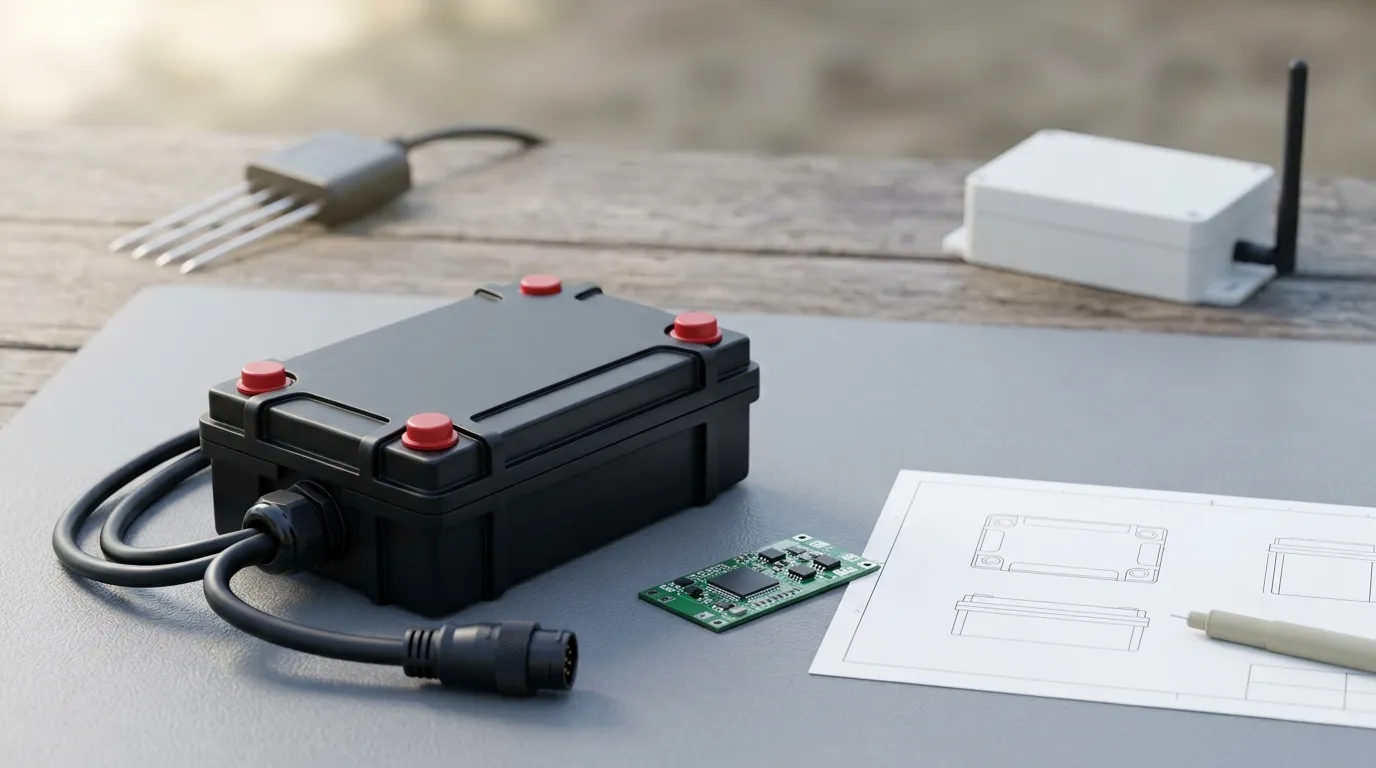
Choosing the right lithium battery for smart agriculture sensors comes down to the sensor's load profile, the deployment environment, and whether the node can be recharged. A soil moisture sensor that sleeps most of the day and transmits a LoRaWAN packet a few times per hour will need a very different battery than a livestock tracker reporting cellular location every five minutes. The simplest way to specify a battery is to define the sensor's sleep current, measurement current, and transmission pulse, then decide whether a primary lithium cell or a rechargeable lithium battery pack best fits the site's maintenance access and temperature range.
Gloflux designs custom battery solutions for IoT hardware across agriculture, including soil sensors, weather stations, irrigation controllers, and livestock trackers. This guide explains how to translate an agriculture sensor's operating pattern into a practical lithium battery specification — and what documentation to request from your supplier before committing to a custom pack.
Start with the Sensor's Load Profile
Every battery sizing decision begins with the sensor node's electrical behavior. An outdoor agriculture sensor typically has three distinct load states, and each one matters.
Sleep current is the current the sensor draws while idle. It is often in the microamp or low-milliamp range and, because the sensor sleeps most of the time, it frequently dominates the total energy requirement over a full deployment.
Measurement current is drawn when the sensor wakes to take a reading — for example, energizing a soil moisture probe or reading a temperature sensor. This state may last only milliseconds to seconds.
Transmission pulse is the current drawn by the radio when sending data over LoRaWAN, NB-IoT, or another wireless protocol. This is usually the highest current in the cycle, sometimes exceeding 100 mA or more during the brief transmit window.
The table below shows a typical low-power soil moisture sensor's load states:
| Load State | Typical Current | Typical Duration | Frequency |
|---|---|---|---|
| Sleep | µA to low mA | Continuous | Always |
| Measurement | mA range | Milliseconds to seconds | Per reading interval |
| Radio transmission | Tens to hundreds of mA | Milliseconds | Per transmission interval |
The average current is the time-weighted sum of all three states, but average current alone is not enough. A battery that can supply the average current may still fail under the transmission pulse due to voltage sag. Both the continuous current (the steady operating current) and the peak current (the highest pulse, including the radio transmission) must be specified.
A weather station, an irrigation controller, and a livestock tracker each have different profiles. An irrigation controller that opens a valve may draw current for seconds or minutes at a time — a far heavier load than a passive soil sensor. For that reason, the load profile must be built from the actual device design, not from a generic agriculture assumption.
Primary vs. Rechargeable Lithium: The First Decision
The first major decision is whether the sensor node will use a non-rechargeable primary lithium cell or a rechargeable lithium battery pack.
| Factor | Primary Lithium Cell | Rechargeable Lithium Pack (Li-ion / LiPo / LiFePO4) |
|---|---|---|
| Recharge required | No | Yes |
| Typical deployment life | Long (often years) | Continuous if solar-assisted; otherwise depends on pack size |
| Maintenance access | Rarely needed | Needed for charging or replacement |
| Self-discharge | Very low | Low, but higher than most primary cells |
| Charger / protection electronics | Not required | Charger and PCM/BMS required |
| Transmission pulse capability | Chemistry-dependent; verify pulse rating | Generally high, especially with a suitable pack design |
| Best fit | Remote nodes with infrequent transmission | Nodes with solar harvesting, actuation loads, or regular access |
Primary Lithium for Long-Life Remote Nodes
Primary lithium cells — including chemistries such as lithium thionyl chloride (Li-SOCl₂) — are designed for long deployments with minimal maintenance. They have very low self-discharge, which makes them attractive for sensors placed in remote fields where a service visit is expensive.
The trade-off is that primary cells are not rechargeable, so the entire energy budget for the deployment must be stored at the start. The battery must also be able to deliver the radio's peak current without excessive voltage sag. Not all primary chemistries handle high pulses well, so the pulse current capability of the specific cell must be verified before design-in. Saft's LS/LSH/LSP primary lithium range, for example, is rated at 3.6 V nominal with capacities from 1.2 to 17.0 Ah and pulse discharge capability up to 4 A for its agriculture and IoT applications — but those values apply to Saft cells, not to every primary lithium option.
Rechargeable Packs for Active or Solar-Assisted Sensors
A rechargeable lithium battery pack becomes the right choice when the sensor node has a higher energy demand, includes actuation (such as an irrigation valve), or can be paired with a solar panel for field charging. Li-ion, Li-polymer (LiPo), and LiFePO₄ packs each offer different trade-offs in voltage, energy density, cycle life, and temperature behavior.
Rechargeable packs require charge control and protection. The pack must be matched to a charger that follows the correct charging profile for its chemistry, and it should include a protection circuit (PCM) or battery management system (BMS) to guard against overcharge, over-discharge, overcurrent, short circuit, and temperature extremes. Gloflux's custom IoT battery solutions describe BMS monitoring of these conditions as part of the pack design.
For more detail on rechargeable options for IoT sensor nodes, see our guide to rechargeable battery for iot sensors and the specific lipo battery for wireless monitoring systems page.
Sizing the Battery: Capacity, Energy, and Current
Once the load profile and chemistry decision are clear, the pack can be sized. Three electrical values must be kept distinct:
- Capacity is measured in milliamp-hours (mAh) or amp-hours (Ah) and represents the total charge the battery can deliver under stated conditions.
- Energy is measured in watt-hours (Wh) and equals capacity multiplied by nominal voltage. A 3.6 V cell rated at 10 Ah stores 36 Wh; a 7.4 V pack rated at 5 Ah also stores 37 Wh. Comparing only capacity can mislead when voltages differ.
- Current — both continuous and peak — is measured in amperes (A). The C-rate relates current to capacity: a 1C rate for a 5 Ah pack is 5 A; a 0.5C rate is 2.5 A.
Working Example: Soil Moisture Sensor Sizing
Consider a soil moisture sensor with the following measured load profile:
| Load State | Current | Duration | Frequency |
|---|---|---|---|
| Sleep | 10 µA | Continuous | Always |
| Measurement | 20 mA | 1 second | Every 15 minutes |
| LoRaWAN transmission | 120 mA | 1 second | Every 15 minutes |
The average current is calculated by summing the charge consumed in each state:
- Sleep: 10 µA × 24 h = 0.24 mAh per day
- Measurement: 20 mA × 1 s × 96 events/day ÷ 3600 = 0.53 mAh per day
- Transmission: 120 mA × 1 s × 96 events/day ÷ 3600 = 3.2 mAh per day
The total is approximately 4 mAh per day. Over a 10-year deployment with no recharge, the theoretical requirement is about 14,600 mAh — before derating for temperature, self-discharge, and capacity fade. In practice, a larger cell or pack would be selected to provide margin.
The formula and figures above are an illustrative engineering example, not a Gloflux product specification. Your actual battery requirement depends on your sensor's measured currents and transmission schedule.
How Temperature and Aging Change the Answer
Two factors cause real-world capacity to fall below the theoretical calculation.
Temperature affects both discharge and charge performance. Cold temperatures reduce the usable capacity of most lithium chemistries and increase internal resistance, which raises voltage sag under the transmission pulse. The operating temperature range must be stated separately for charging and discharging — a battery that can discharge at -20 °C may not be able to charge safely at that temperature. Storage temperature also matters for long idle periods.
Aging reduces capacity over time. A lithium battery's state of health declines with cycling and calendar aging, so the end-of-life capacity — not the fresh capacity — should be the basis for sizing. A common approach is to add an aging reserve of 15–30% depending on the expected deployment length and the acceptable risk of premature failure.
The usable capacity is therefore the nameplate capacity reduced by temperature derating and aging reserve. Specify the end-of-life condition, such as 80% of initial capacity, so the supplier can confirm the pack is sized to meet the runtime target at end of life.
Voltage, Pack Architecture, and the Electronics That Protect It
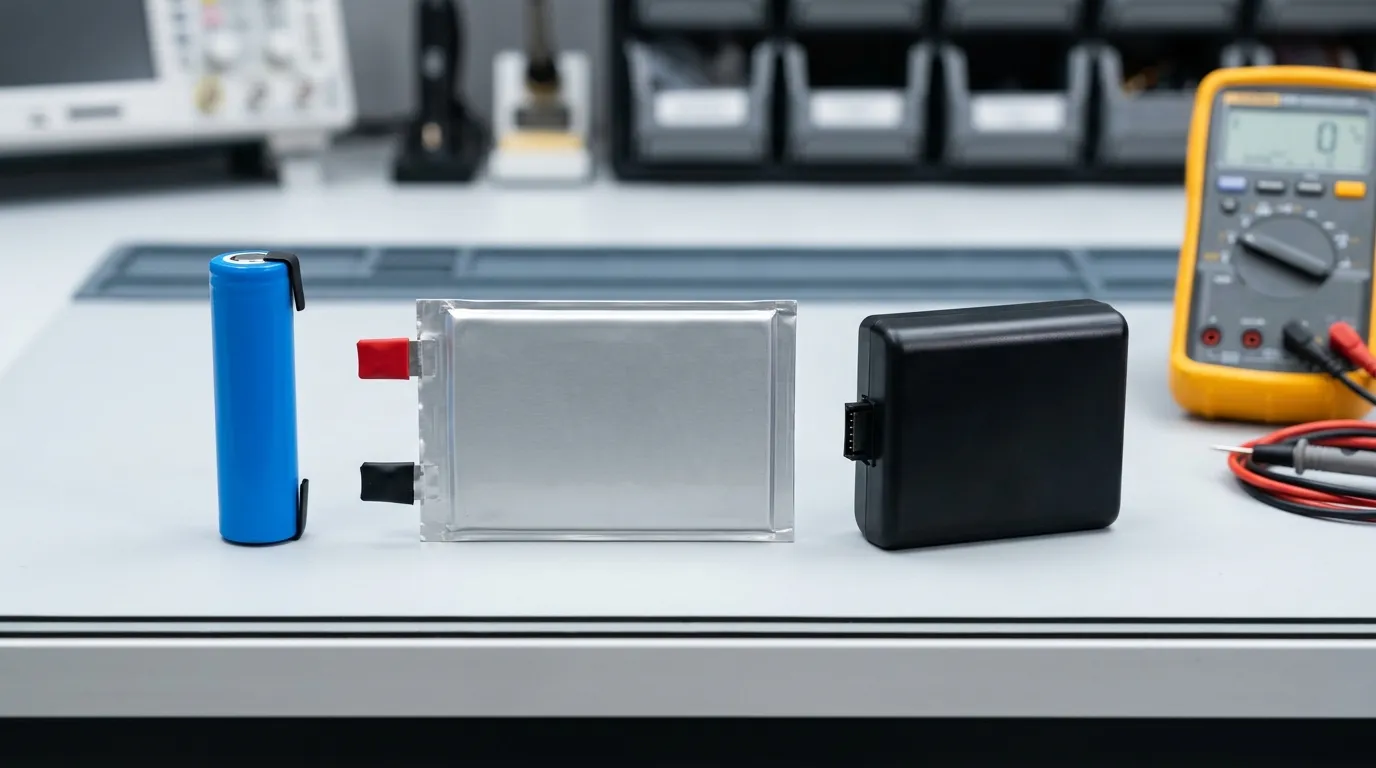
The battery's nominal voltage must match the sensor node's input range, and the maximum charge voltage must be respected by the charger.
- Nominal voltage is the typical operating voltage of the battery — for example, 3.6 V for a single primary lithium cell, 3.7 V for a single Li-ion cell, or 7.4 V for a two-cell Li-ion pack.
- Maximum charge voltage is the highest voltage the battery may be charged to — for example, 4.2 V per cell for many Li-ion chemistries. Confusing the two is a common specification error.
When cells are combined, the series (S) count determines the pack's nominal and maximum voltage, while the parallel (P) count increases capacity and available current. A 2S1P pack has two cells in series and one in parallel; a 1S2P pack has two cells in parallel and a single-cell voltage.
The protection requirements depend on the battery design:
| Protection | Primary Lithium Cell | Single-Cell Rechargeable Pack | Multi-Cell Rechargeable Pack |
|---|---|---|---|
| Overcharge protection | Not applicable | Recommended | Required |
| Over-discharge protection | Not applicable | Recommended | Required |
| Overcurrent / short-circuit protection | Integrated in some cells | Recommended | Required |
| Cell balancing | Not applicable | Not applicable | Required for series cells |
| Temperature protection | Where specified | Recommended | Recommended |
A PCM (protection circuit module) provides basic protection against overcharge, over-discharge, overcurrent, and short circuit. A BMS (battery management system) is a broader system that can include cell balancing, fuel gauging, state-of-charge and state-of-health reporting, and communication interfaces. In a multi-cell pack, cell balancing is important because slight differences between cells can otherwise limit the usable capacity and shorten pack life.
For rechargeable packs, the charger must match the pack's chemistry and series count. Charging a 2S Li-ion pack with a single-cell charger is unsafe, and charging LiFePO₄ with a Li-ion profile is incorrect.
Designing for the Outdoor Environment
The outdoor environment is what separates an agriculture sensor battery from an indoor IoT battery. The pack must survive the full range of field conditions.
| Environmental Factor | Design Consideration |
|---|---|
| Operating temperature | Confirm both discharge temperature and charge temperature; do not assume charge and discharge share the same limit |
| Moisture and humidity | Use a sealed enclosure with an appropriate IP rating; "waterproof" is not a specification |
| Connector and wiring | Match polarity, current rating, wire gauge, and locking mechanism to the sensor; minimize voltage drop |
| Enclosure | Allow for battery swelling (especially pouch cells), thermal dissipation, and service access |
| Vibration and shock | Consider potting or mechanical retention for nodes exposed to machinery or livestock |
| Maintenance interval | Design for the planned service cycle; a node visited yearly allows different choices than one never visited |
The IP rating of the enclosure must be verified against a specific standard, not assumed from marketing language. A battery pack's published temperature rating applies to a defined model under defined conditions — it cannot be transferred from a category card or from a different model.
Wireless Transmission: Sizing for the Radio Pulse
For LoRaWAN and other low-power wide-area networks, the transmission pulse is the most demanding part of the load cycle. During the transmit window, the radio can draw many times the sensor's average current for a fraction of a second.
If the battery's internal resistance is too high, the voltage can sag below the radio's operating threshold, causing a failed transmission or a sensor reset. The battery specification must therefore state the peak pulse current at the appropriate pulse duration and temperature — not just the continuous current.
The pulse requirement depends on the radio module, the network, and the transmission interval. A LoRaWAN node transmitting a short packet every few hours has a very different pulse duty cycle than a cellular tracker transmitting location frequently. When the wireless network and battery pack are being designed together, use our dedicated guidance on Custom battery pack for LoRaWAN sensors to confirm the pack architecture supports the pulse profile.
Validating the Battery and the Supplier
A battery specification is only useful if the supplier can verify it. Before production, request the following documentation and agree on the validation method.
Documentation to Request from a Battery Supplier

| Document | What It Provides |
|---|---|
| Datasheet / TDS | Rated voltage, capacity, current, temperature, dimensions, and test conditions for the specific model |
| SDS / MSDS | Safety and handling information for transport and storage |
| UN 38.3 test summary | Evidence that a defined lithium cell or battery model has passed the United Nations transport tests required for air, sea, and road shipment |
| Product safety test report | Results for a defined model against a recognized standard, such as IEC 62133 or a UL standard; scope must match the model |
| Batch test report | Results for the specific production batch, typically covering capacity, internal resistance, and key safety checks |
UN 38.3 is a transport test requirement, not a product safety certification. The UN Manual of Tests and Criteria, Section 38.3, defines the test procedures used to classify lithium cells and batteries for transport. This documentation is required for shipping lithium batteries, including to worldwide markets, but it does not replace product safety testing or market-specific declarations. In the United States, the Pipeline and Hazardous Materials Safety Administration (PHMSA) provides official guidance on transporting lithium batteries.
RFQ Checklist for a Custom Agriculture Sensor Battery
When sending a request for quotation to a custom battery manufacturer, include:
- Sensor load profile: sleep current, measurement current, transmission pulse current, pulse duration, and transmission interval.
- Runtime target: required operating duration and the end-of-life condition (for example, 80% capacity retention).
- Voltage and capacity range: nominal voltage, acceptable voltage range, and capacity target in mAh or Ah and Wh.
- Temperature requirements: discharge temperature range, charge temperature range, and storage temperature range.
- Mechanical constraints: maximum dimensions, weight, connector type, wiring length, and enclosure requirements.
- Protection and communication: whether a PCM, BMS, balancing, fuel gauge, or a specific communication interface is required.
- Certification and documentation: which transport documents, safety test reports, declarations, and batch records are required.
- Validation plan: how the prototype will be tested — capacity, pulse, temperature exposure, and field trial.
- Production requirements: MOQ, prototype lead time, production lead time, traceability, and change-control process.
The load profile, temperature range, and required documentation are the inputs your supplier needs to select the correct chemistry and pack architecture. Sending these in the first RFQ reduces the risk of under-specification and prevents costly prototype revisions.
If you have completed your load profile and RFQ checklist, the Gloflux custom IoT battery team can evaluate your agriculture sensor project and recommend a suitable chemistry, pack architecture, and validation plan. Our custom battery for iot hardware page describes the full range of services available for agriculture and other outdoor IoT deployments.
Talk to the Manufacturer
Resources & Insights

High Capacity Lithium Battery for Wearables: High-Voltage LiPo Cell Design
2026-10-19
Cylindrical Battery Packs for Laptops: 2S vs 3S vs 4S Battery Design
2026-10-19
Stage Lighting Battery Pack: Prevent Voltage Drop & LED Flicker
2026-10-19

Best Rechargeable Batteries for Smart Devices: Performance, Safety, and Selection Guide
2026-10-19


