


 Home /
 Rechargeable 3.7V 6000mAh LiPo Battery Pack for Portable Speakers and Audio Systems


Table of Contents
- Why Portable Audio Products Need the Right Battery
- Understanding the 3.7V 6000mAh Specification
- Compact Design for Limited Installation Space
- Stable Power for Speakers and Audio Amplifiers
- Protection Circuit and Battery Safety
- Customizable Wires, Connectors, and Packaging
- Typical Application Areas
- What to Confirm Before Battery Development
- Conclusion
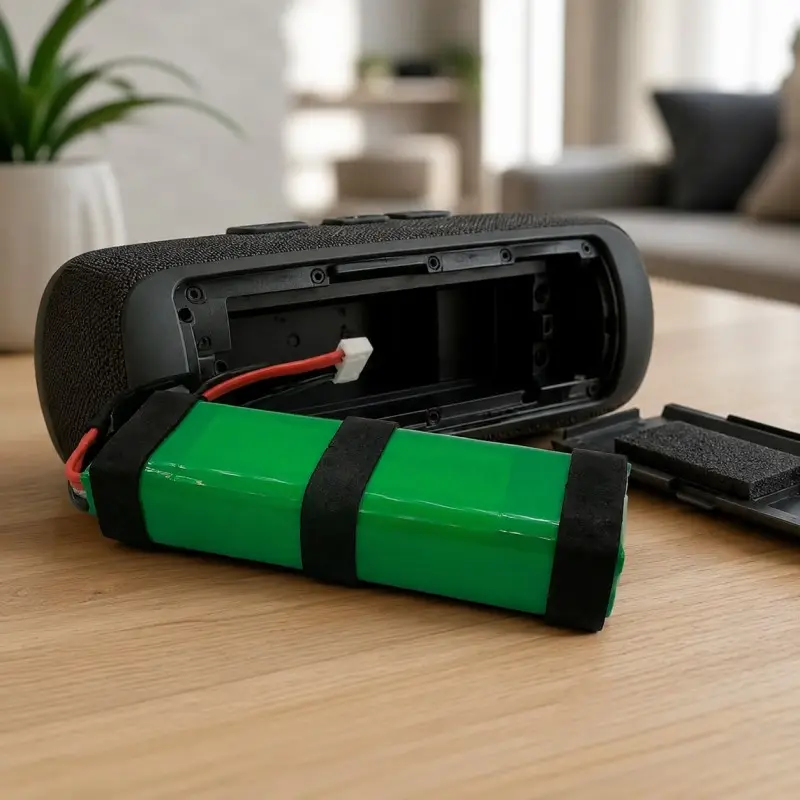
Portable speakers and compact audio systems require a battery that can deliver reliable power without adding excessive weight or occupying too much internal space. A rechargeable 3.7V 6000mAh LiPo battery pack offers a practical solution for Bluetooth speakers, portable voice amplifiers, wireless sound equipment, compact PA systems, and other rechargeable audio products.
Compared with many conventional battery formats, lithium polymer batteries can be manufactured in different thicknesses, widths, and lengths. This flexibility helps audio equipment manufacturers match the battery more closely to the internal structure of their devices. Capacity, connector type, wire length, protection functions, and packaging materials can also be adjusted according to individual project requirements.
Why Portable Audio Products Need the Right Battery
The battery directly affects how long a portable speaker can operate, how stable its audio output remains, and how convenient the finished product is to carry. A battery with insufficient capacity may require frequent charging, while a poorly matched design may create installation, heat-management, or reliability problems.
Portable audio devices may experience changing power demand. Normal playback generally requires moderate current, but higher volume levels, strong bass output, wireless communication, indicator lights, and additional functions can temporarily increase power consumption.
A suitable battery pack should therefore provide stable energy output while remaining compatible with the electrical and mechanical design of the audio system. The battery specification should not be selected only by voltage and capacity. Dimensions, discharge current, connector polarity, charging method, operating temperature, and protection requirements must also be considered.
Understanding the 3.7V 6000mAh Specification
A nominal voltage of 3.7V is commonly used in single-cell lithium polymer battery systems. When fully charged, the battery voltage normally reaches approximately 4.2V, depending on the selected cell chemistry and charging specification.
The 6000mAh capacity indicates the amount of electrical charge the battery can store under defined test conditions. A higher capacity can support longer playback time, although actual operating duration depends on several factors, including:
- Speaker output power
- Average listening volume
- Amplifier efficiency
- Bluetooth and wireless functions
- Display or indicator power consumption
- Standby current
- Battery age and operating temperature
For example, two speakers using the same 3.7V 6000mAh battery may have very different operating times if one has a larger amplifier, stronger bass performance, or additional lighting functions.
The final playback time should therefore be verified through testing in the actual audio product rather than calculated from capacity alone.
Compact Design for Limited Installation Space
Internal space is often limited in portable speakers and voice amplifiers. The battery may need to fit around the speaker driver, circuit board, control panel, wiring, and enclosure supports.
A lithium polymer pouch cell provides greater dimensional flexibility than many rigid cylindrical battery arrangements. It can be designed as a thin, wide battery or a narrower rectangular pack, depending on the available installation space.
For OEM and ODM projects, the battery dimensions can be adjusted within practical manufacturing limits. Engineers should provide the available battery compartment size, including the required clearance for expansion, wiring, insulation, connectors, and assembly tolerances.
A battery should never be designed to fit tightly against sharp enclosure parts or heat-generating components. Sufficient mechanical protection and installation clearance help reduce damage during assembly, transportation, charging, and long-term use.
Stable Power for Speakers and Audio Amplifiers
Audio products require a stable power source to support consistent sound performance. Sudden voltage drops may affect amplifier operation, maximum volume, wireless connectivity, or system stability.
A properly designed rechargeable 3.7V 6000mAh LiPo battery pack can provide dependable power for portable audio systems when its discharge capability is correctly matched to the device.
The required discharge current should be determined according to the amplifier’s maximum load rather than only its normal operating current. Engineers should also consider startup current, peak bass demand, system protection thresholds, and possible use at high volume.
For audio devices with higher power requirements, a single 3.7V battery may not be suitable. A multi-cell battery configuration or a different voltage platform may be required. The final design should be based on the amplifier input voltage, charging circuit, power-conversion system, and expected output performance.
Protection Circuit and Battery Safety
A protection circuit can be integrated into the battery pack to help manage common electrical risks. Depending on the project, protection functions may include:
- Overcharge protection
- Over-discharge protection
- Overcurrent protection
- Short-circuit protection
- Temperature monitoring
- Cell voltage monitoring
The protection circuit should be selected according to the charging current, discharge current, device power, and operating environment. It must not interrupt normal speaker operation during short periods of higher audio demand.
Battery safety also depends on cell quality, charging control, enclosure design, thermal management, production consistency, and correct use. A protection board is important, but it is only one part of a complete battery safety system.
Before mass production, the battery and finished audio device should be evaluated together under normal operation, high-volume playback, charging, storage, and abnormal-condition testing.
Customizable Wires, Connectors, and Packaging
Different audio products use different internal connectors and assembly methods. A customized LiPo battery pack can be supplied with the required connector housing, terminal type, wire gauge, wire length, polarity, insulation, and protective wrapping.
Common customization options include:
- Battery voltage and capacity
- Cell dimensions and pack shape
- Connector model and terminal type
- Lead-wire length and direction
- Protection circuit specifications
- Foam pads, insulation paper, or protective tape
- Labels and identification codes
- Temperature sensors or communication functions
The connector polarity must be confirmed carefully because similar connector housings may use different wiring arrangements. Providing drawings, samples, or clear pin definitions helps prevent connection errors.
Typical Application Areas
The rechargeable 3.7V 6000mAh LiPo battery pack can be considered for a wide range of audio products, including:
- Portable Bluetooth speakers
- Wireless desktop speakers
- Portable voice amplifiers
- Teaching and tour-guide amplifiers
- Compact public-address systems
- Rechargeable multimedia speakers
- Outdoor portable sound equipment
- Audio demonstration devices
- Custom consumer electronics
- Replacement battery development projects
Each application should be reviewed individually because the same capacity does not guarantee compatibility with every speaker.
What to Confirm Before Battery Development
Before requesting a battery sample, the audio equipment manufacturer should provide the nominal voltage, required capacity, maximum continuous current, peak current, available installation space, connector information, wire length, charging method, and operating environment.
It is also useful to provide the original battery, device sample, mechanical drawing, or battery compartment dimensions. These details allow the battery manufacturer to assess whether the requested specification is technically reasonable and suitable for production.
Sample testing should be completed inside the actual audio product before final approval. This step helps confirm installation fit, charging compatibility, operating time, temperature performance, and high-volume playback stability.
Conclusion
A rechargeable 3.7V 6000mAh LiPo battery pack can provide a compact and high-capacity power solution for portable speakers and audio systems. Its flexible dimensions and customizable electrical configuration make it suitable for many OEM and ODM projects.
However, successful battery integration requires more than choosing the correct voltage and capacity. Discharge demand, charging control, protection functions, mechanical space, connector design, and product-level testing must all be considered. Close cooperation between the audio equipment manufacturer and battery supplier helps create a safer, more reliable, and better-performing finished product.
Can the battery dimensions be customized?
Yes. The length, width, thickness, wire position, and protective materials can be adjusted within the limits of the selected cell structure and manufacturing process.
How long can a 3.7V 6000mAh battery power a speaker?
Operating time depends on speaker power, playback volume, amplifier efficiency, wireless functions, and standby consumption. Testing in the actual device provides the most reliable result.
Does the battery include a protection circuit?
A protection circuit can be added according to the charging voltage, discharge current, peak load, and safety requirements of the audio product.
Can the connector and wire length be changed?
Yes. Connector type, terminal arrangement, polarity, wire gauge, wire length, and outlet direction can be customized according to the device design.
Is this battery suitable for every portable speaker?
No. Compatibility depends on the speaker’s input voltage, charging system, current demand, battery compartment, and connector design. Technical specifications should be confirmed before sampling.
Talk to the Manufacturer
Resources & Insights
High Capacity Lithium Battery for Wearables: High-Voltage LiPo Cell Design
2026-10-19
Cylindrical Battery Packs for Laptops: 2S vs 3S vs 4S Battery Design
2026-10-19
Stage Lighting Battery Pack: Prevent Voltage Drop & LED Flicker
2026-10-19
Best Rechargeable Batteries for Smart Devices: Performance, Safety, and Selection Guide
2026-10-19


