


 Home /
 LiPo Battery for Wireless Monitoring Systems | IoT Power Solution


Table of Contents
-
Introduction: When Monitoring Systems Need Smarter Energy
- The Importance of LiPo Battery Technology in Wireless Monitoring
- Technical Overview LiPo Battery Wireless Monitoring Systems
- IoT Integration: The Brain of Smart Monitoring
- Industrial Applications: Designed to Withstand Tough Conditions
- Choosing the Right LiPo Battery to be Used in Monitoring Systems
- Why LiPo Battery Solutions with Gloflux?
- Conclusion:
Introduction: When Monitoring Systems Need Smarter Energy
The modern monitoring systems do not sleep. They keep track of information, pass signals, and make industries run smoothly. The main element of this 24/7 operation is the LiPo Battery for Wireless Monitoring Systems.
- This is no ordinary power unit; this source of lithium energy. It is the silent workhorse of IoT networks, industrial sensors, and remote monitoring devices. The most advanced system will not be reliable without a stable battery.
- The need of today is evident. The equipment must have a long life cycle, be small, and have a constant power supply. It is where Lithium Polymer Battery for Wireless Monitoring technology can shine with its efficiency and flexibility.
The Importance of LiPo Battery Technology in Wireless Monitoring
Wireless surveillance systems need a constant power supply. Such systems are implemented in remote, industrial, and even harsh environments. This is the reason why energy stability is a significant requirement.
A Rechargeable LiPo Battery to Monitoring Devices offers a constant supply of voltage. This will avoid loss of signal or shutdown of the system when transmitting real-time data.
Key advantages include:
• Lightweight design of small devices.
• High-energy-density lithium polymer cell structure
• Fixed discharge voltage to run continuously.
• Poor performance of the self-discharge monitoring battery.
• Flexible form factor of an embedded system.
In brief, it can be a trusted battery solution for wireless monitoring equipment where uptime is more than just a factor.
Technical Overview LiPo Battery Wireless Monitoring Systems
To be aware of performance, we need to take into account technical behaviour. A typical Wireless Monitoring System Battery Pack uses lithium polymer chemistry, which is to be utilised:
- Nominal voltage: 3.7V/cell
- Energy density: 150250 Wh/kg (depending on design)
- Cycle life: 300–1000+ charge cycles
- Temperature -20 C to 60 C (industrial grade versions are wider)
- Self-discharge rate: less than 3% per month
These characteristics make it a suitable high-efficiency power source to monitor systems where reliability is not a trade-off.
It also supports:
• LiPo battery technology (fast charge).
• LiPo cell performance under constant load.
Lithium polymer chemistry of critical systems with high reliability.
IoT Integration: The Brain of Smart Monitoring
Wireless monitoring is now tightly connected with IoT ecosystems. The sensors, gateways, and nodes require a constant energy source to communicate effectively. In this case, the IoT wireless monitoring battery solution is required.
An effective system employs:
• Remote wireless IoT sensors LiPo battery.
• IoT monitoring devices with a low-voltage LiPo battery.
• Wireless sensor network energy solution for a distributed system.
• Battery of edge device power management to optimise consumption.
These batteries help enable M2M (machine-to-machine) monitoring battery system communication without interruption. In practice, it translates to a more seamless data flow, quicker alerts, and improved decision-making.
Industrial Applications: Designed to Withstand Tough Conditions
The industries are very reliant on real-time monitoring systems. All this is based on proper data collection in factories and logistics.
An Industrial LiPo Battery with high power to monitor equipment is compatible with:
• LiPo battery monitoring factory equipment.
• Predictive maintenance monitoring battery system tools
• Battery units of industrial telemetry power source.
• Systems of condition-based monitoring power modules.
These batteries are made to be durable and long-lasting even in cases of vibration, heat, and constant load. The industrial remote monitoring power system ensures that the uptime is in:
• Manufacturing plants
• Smart warehouses
• Transportation fleets
Features Which Differentiate
A modern high-capacity LiPo battery of remote monitoring devices is not only for storage. It is a worrying supply of intelligent energy. The main performance characteristics are:
• Long-cycle life rechargeable battery pack to be used in the long term.
• Constant discharge curve to have steady sensor values.
• Outdoor operation with a wide temperature range battery operation.
• High-energy-density Lithium polymer cell of compact size.
Such features ensure that a low-power consumption battery in wireless monitoring devices can be used without the need for regular maintenance.
Small-Scale Design of Smart Devices and Sensors
In wireless monitoring devices, size is an issue. The devices should be compact, lightweight, and embeddable. Lithium battery of small size to wireless sensor systems offers:
- Light and thin packaging.
- Lightweight construction of portable devices.
- Wireless sensor networks are wireless, powered by custom LiPo battery packs.
- Remote monitoring units LiPo battery.
This is suitable for wearable sensors, environmental trackers, and smart infrastructure nodes.
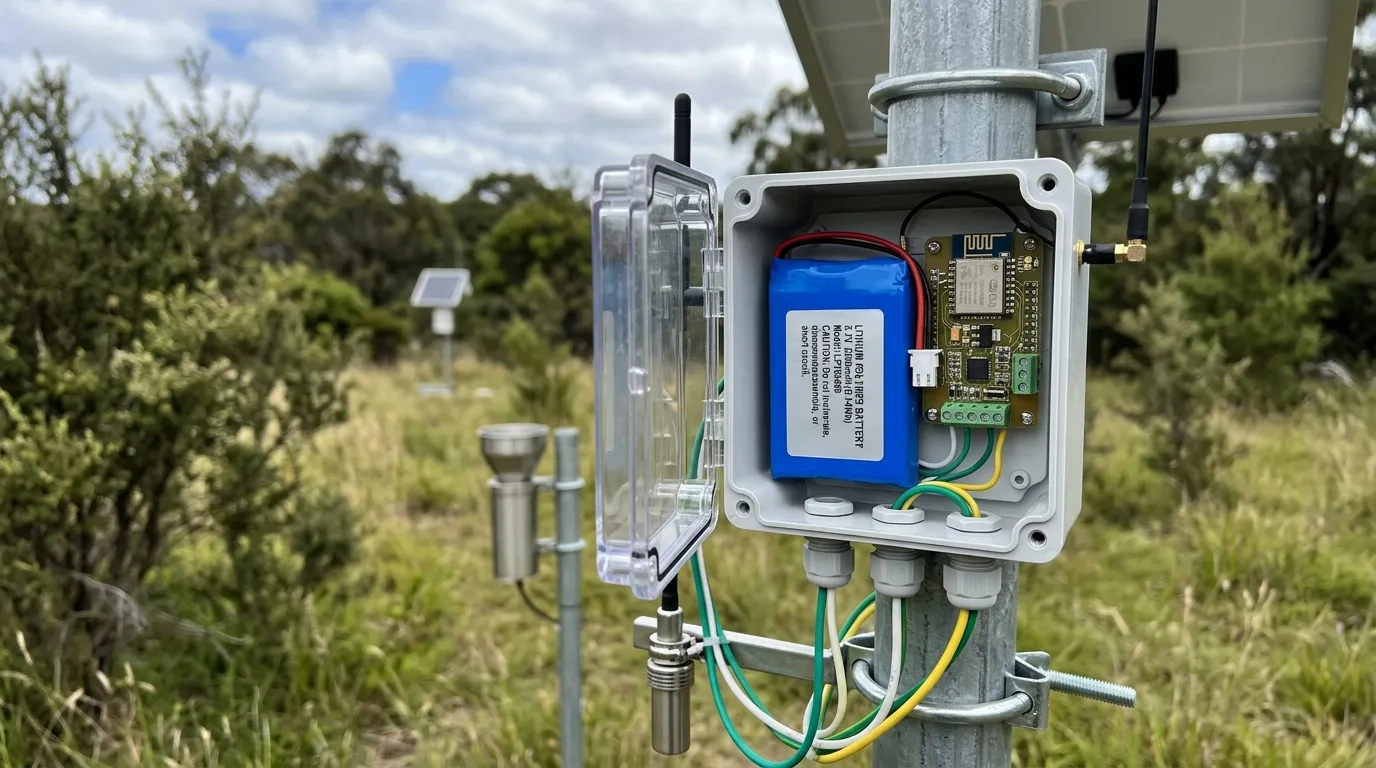
Lithium Polymer Battery Technology Cylindrical
At Gloflux, battery engineering is concerned with various formats, such as cylindrical solutions that are more mechanically stable. This type of battery supports:
• Better thermal distribution
• Strong structural durability
• Efficient space utilisation
• Continuous working in vibration.
It is very common in industrial telemetry power source battery systems and smart monitoring devices, where reliability is of the essence.
Smart Energy of Predictive Maintenance Systems
Industrial operations are transforming with predictive maintenance. Systems are not reactive to failures, but proactive. This needs a constant flow of data driven by:
- Predictive maintenance sensor battery solution systems.
- Industry automation to check energy supply units.
- Wireless battery system platforms for asset tracking.
- Constant lithium polymer energy saves time and increases efficiency in businesses.
Choosing the Right LiPo Battery to be Used in Monitoring Systems
Choosing the appropriate battery is not only technical, but strategic. Consider the following:
• The level of power consumption of the devices.
• Operating environment temperature
• Required cycle life
• Size constraints
• Frequency of communication of the device.
A rechargeable lithium battery of industrial monitoring systems is typically the most appropriate choice in the case of IoT and industrial systems due to the trade-off between performance and durability.
Why LiPo Battery Solutions with Gloflux?
Gloflux offers novel energy solutions to the existing wireless systems. We specialise in:
• Manufacturing of battery packs of industrial grade.
• Design of bespoke lithium polymer batteries.
• High efficiency IoT monitoring energy systems
Our solutions are meant to be dependable, accurate, and long-lasting in real life.
Conclusion:
The wireless systems are based on silent power behind every signal. A powerful LiPo Battery for Wireless Monitoring Systems is not a mere part; it is the pulse of contemporary connectivity. It offers real-time intelligence in both industrial plants and smart IoT networks.
We create energy solutions at Gloflux that ensure systems are alive, stable, and future-ready. We have a battery technology that is going to drive your project in case it needs reliability, precision, and long cycle performance.
Find out Gloflux lithium now and upgrade your monitoring systems with dependable energy that is present when you need it most.
Talk to the Manufacturer
Resources & Insights

High Capacity Lithium Battery for Wearables: High-Voltage LiPo Cell Design
2026-10-19
Cylindrical Battery Packs for Laptops: 2S vs 3S vs 4S Battery Design
2026-10-19

Stage Lighting Battery Pack: Prevent Voltage Drop & LED Flicker
2026-10-19
Best Rechargeable Batteries for Smart Devices: Performance, Safety, and Selection Guide
2026-10-19


