


 Home /
 Lithium Battery for eVTOL Aircraft: Energy, Power, and Pack Integration


Table of Contents
- Why eVTOL Battery Requirements Differ from Ground and Drone Applications
- Energy Density vs Power Density: What the Pack Must Deliver
- From Mission Profile to Battery Specification
- Cell Selection: Chemistry and Form Factor Trade-Offs
- Pack Architecture: Voltage, Capacity, and S/P Configuration
- BMS, Protection, Monitoring, and Charging
- Thermal Management and Safety in Aircraft Battery Packs
- Validation, Testing, and Documentation Before Integration
- How to Evaluate a Custom Battery Manufacturer for an eVTOL Program
- Sourcing Next Steps: From Requirements to Pack Development

An eVTOL lithium battery is a pack-level energy-storage system sized from the aircraft's mission profile to deliver both high specific energy for endurance and high specific power for vertical-flight transients, while integrating BMS protection, thermal management, mechanical containment, charging, reserve, and aircraft-level validation. The battery is not a single component but a system that must be engineered around the aircraft's flight phases, weight budget, thermal constraints, and safety requirements.
This guide explains how to translate an eVTOL mission profile into a battery specification, how to evaluate the key engineering trade-offs, and what evidence to demand from a potential supplier. For a broader view of how lithium batteries are used across aerospace applications, see our guide to lithium battery applications in aerospace.
Why eVTOL Battery Requirements Differ from Ground and Drone Applications
The fundamental challenge of eVTOL battery design is that the aircraft demands two conflicting things from the same pack: very high power for takeoff and climb, and high energy for cruise endurance. A battery optimized only for power will be heavy and short-ranged; a battery optimized only for energy will sag in voltage and overheat during vertical flight.
Ground vehicles face a similar tension, but aircraft add three constraints that make the problem harder. First, mass is penalized far more severely — every kilogram of battery is a kilogram that cannot be payload. Second, takeoff and climb are critical flight phases with no margin for voltage sag or thermal derating. Third, the safety case is more demanding because a thermal event in flight has no shoulder to pull onto and no roadside escape.
Drone batteries are often cited as a reference point because drones also require high discharge rates. But a drone pack is typically smaller, has a shorter endurance requirement, faces less stringent certification oversight, and does not carry the same safety-of-life responsibility as a passenger or cargo eVTOL aircraft. A drone battery manufacturer can build a high-discharge pack, but that experience does not automatically translate into an aircraft-qualified propulsion battery.
Energy Density vs Power Density: What the Pack Must Deliver
The two most important battery-level figures for an eVTOL program are specific energy, measured in watt-hours per kilogram (Wh/kg), and specific power, measured in watts per kilogram (W/kg). They are often confused, so it helps to define them precisely.
Specific energy describes how much energy the battery holds per unit mass. It determines how long the aircraft can cruise. Specific power describes how quickly the battery can release that energy per unit mass. It determines whether the aircraft can sustain the high-current demand of takeoff and climb.
The relationship between them is a trade-off. High-energy cells typically have thicker electrodes and higher energy density, but they cannot sustain extreme discharge currents without overheating or suffering rapid voltage sag. High-power cells use thinner electrodes optimized for current delivery, but they store less energy per kilogram.
C-Rate and the Difference from Current
Discharge capability is often described in C-rate, which is the current relative to the cell's rated capacity. A 1C rate means the cell delivers its rated capacity over one hour. A 10C rate means it delivers the same rated capacity over six minutes.
C-rate is helpful because it normalizes current across different cell capacities. But it is not the same as absolute current in amperes. A 50 Ah cell at 5C delivers 250 A; a 100 Ah cell at 5C delivers 500 A. When writing a battery specification, both the C-rate and the absolute current should be stated, along with the duration of the peak demand.
Continuous current is the current the pack can sustain for an extended period, such as a climb or long cruise segment. Peak current is the short-duration current the pack can deliver for a defined pulse, such as a go-around maneuver. The two values are not interchangeable, and a pack designed only for continuous cruise may fail during a peak-demand event.
Voltage sag is the drop in pack voltage under load, caused primarily by internal resistance. When a high-power cell is discharged rapidly, the voltage at the terminals falls below the cell's open-circuit voltage. If the sag is severe, the inverter may not receive sufficient voltage to maintain motor power, even though the battery still contains energy. This is one reason a cell's power rating cannot be evaluated in isolation from its internal resistance and the pack's wiring, connector, and busbar resistances.
For the same reason, a cell-level datasheet cannot be treated as a pack-level specification. The pack adds interconnects, busbars, welds, wiring, connectors, a BMS, and a thermal management path — all of which add resistance and mass. A pack that claims to match a cell's Wh/kg figure is unusual; the pack always weighs more and delivers less usable energy than the sum of its cells.
Does LiPo Still Refer to a Chemistry or a Pack Format?
The term "LiPo" is commonly used to describe pouch-format lithium-polymer packs, particularly in the drone and hobby markets. In aerospace engineering, the distinction matters: cell chemistry and cell form factor are separate design decisions.
Lithium-ion is the broad chemistry family. Lithium-polymer (LiPo) is a variant that uses a polymer electrolyte and is often packaged in a pouch format. LiFePO4 (lithium iron phosphate) is a different cathode chemistry with distinct voltage, safety, and cycle-life characteristics. The choice between them depends on the mission, not on which term sounds more advanced. A lipo battery for drone is not automatically suitable for an eVTOL propulsion pack, and LiFePO4's lower energy density makes it difficult to use where range is critical, although its safety and cycle-life characteristics may be attractive in some applications.
In applications where extreme discharge rates are the priority — such as high-performance drones — a specialized fpv drone battery manufacturer can provide packs optimized for high C-rate output. Those packs demonstrate the limits of high-power cell design, but they also illustrate why the trade-off between power and energy must be resolved differently for an aircraft that must cruise efficiently for extended periods.
From Mission Profile to Battery Specification
The correct starting point for any eVTOL battery program is not a cell catalogue. It is the mission profile. The battery cannot be specified until the aircraft's flight phases, power demands, duration, thermal environment, and reserve requirements are defined.
A typical eVTOL mission includes some or all of the following phases:
- Takeoff and initial climb, which demands the highest power and current.
- Cruise, which demands sustained energy at a lower power level.
- Descent and landing, which may require less power but must still be supported.
- A reserve segment, which is energy that cannot be treated as usable mission range because it must cover contingencies.
The mission profile provides the core inputs for the battery specification: total energy required in watt-hours, the peak and continuous power in watts, the peak and continuous current in amperes or C-rate, the operating temperature range, and the charging window if fast turnaround is required.
Putting the Mission Profile into a Battery Requirements Table
A useful battery specification table should capture the following fields before any cell is selected:
| Parameter | Units | Example Consideration |
|---|---|---|
| Nominal voltage | V | Must match inverter and motor input range |
| Maximum charge voltage | V | Must not exceed cell voltage limit |
| Usable capacity | Ah | Affects runtime and range |
| Usable energy | Wh | Drives endurance; not the same as capacity |
| Continuous discharge current | A | Sustained cruise or climb current |
| Peak discharge current | A | Short-duration takeoff or go-around current |
| Peak duration | seconds | Must be stated with the peak current |
| Operating temperature range | °C | Charging and discharging may have different limits |
| Charger input profile | V / A | Must match chemistry and series count |
| Communication and monitoring | — | BMS, fuel gauge, CAN or other bus |
| Design reserve | % or Wh | Must be stated explicitly |
Every field should be carried through to the supplier RFQ. The table also becomes the baseline for test verification: the supplier should be asked to confirm each value under the stated conditions.
Cell Selection: Chemistry and Form Factor Trade-Offs
There is no universal "best" chemistry for eVTOL aircraft. The correct choice depends on the mission, the airframe, the thermal management design, the cycle-life requirement, and the safety case.
For range-critical missions, high-energy cells are attractive because they maximize Wh/kg. But they may not sustain the high discharge rates required for vertical flight. For missions with demanding vertical phases or high ambient temperatures, high-power cells may be necessary despite their lower energy density. Many programs will evaluate multiple cell families before selecting a baseline.
The trade-off is well documented in aerospace research. A 2021 review in Joule identified specific energy, specific power, fast charging, cycle life, and safety as the key requirements for eVTOL batteries, and noted that no single cell chemistry currently satisfies all of them simultaneously (Yang et al., 2021). A 2023 study in ACS Energy Letters found that landing and balked-landing phases impose additional power demands that can drive electrochemical and thermal stress beyond the cruise condition (Billmann et al., 2023).
Form factor also matters. Cylindrical cells offer consistent manufacturing quality, good mechanical containment, and a well-understood thermal path. Pouch cells offer packaging flexibility and can sometimes improve volumetric efficiency, but they require careful mechanical retention and may be more sensitive to swelling. The choice between them is an airframe integration decision, not a chemistry decision.
Pack Architecture: Voltage, Capacity, and S/P Configuration
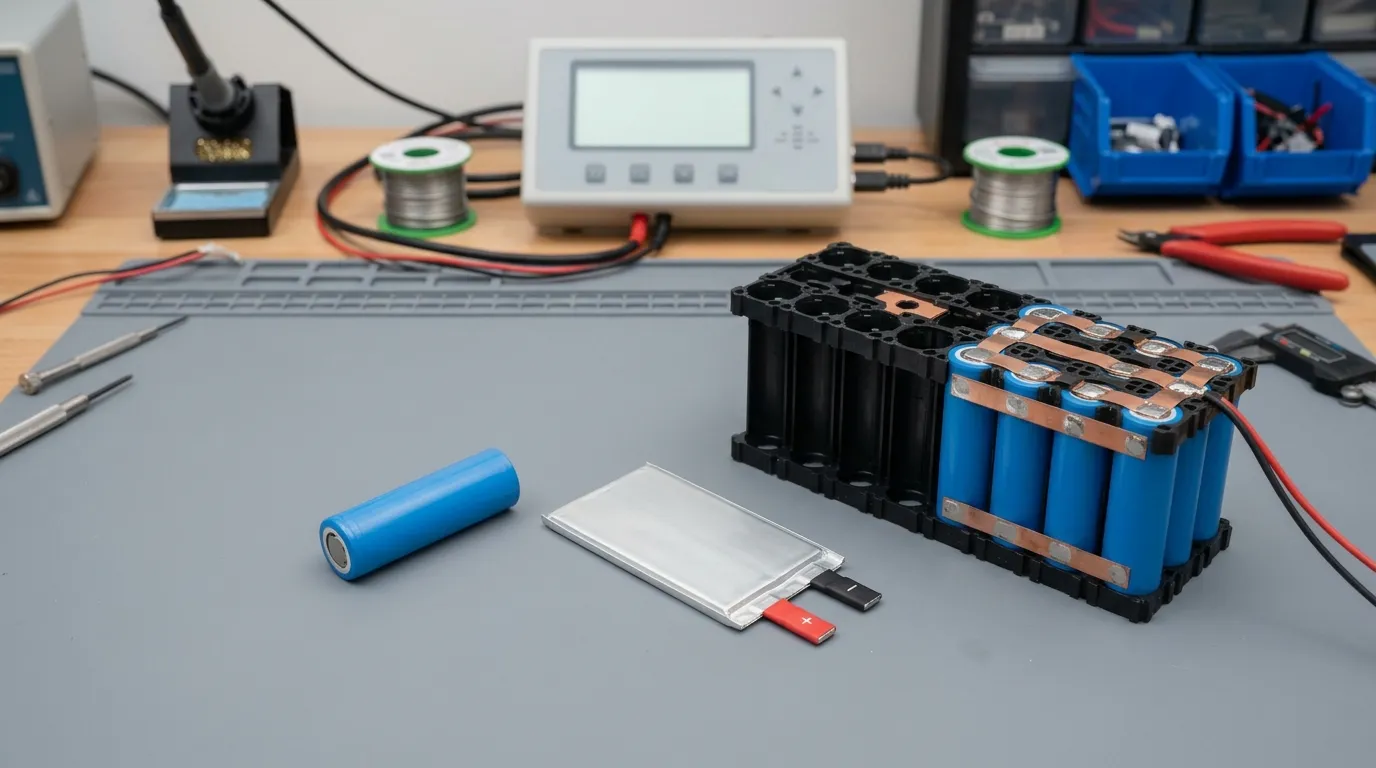
Once the energy, current, and voltage requirements are defined, the pack can be configured. The two fundamental variables are the series count (S) and the parallel count (P).
The series count determines the pack's nominal voltage. Each cell chemistry has a nominal voltage — for NMC lithium-ion cells, typically around 3.6 to 3.7 V. Connecting cells in series adds their voltages. A pack with 20 cells in series has a nominal voltage of roughly 72 V.
The parallel count determines the pack's capacity and current capability. Cells connected in parallel combine their capacities. If each cell has a capacity of 50 Ah, a 2P configuration delivers 100 Ah. Parallel cells also share the current load, which is why high-power packs often use more parallel strings.
The S/P configuration must satisfy three interfaces simultaneously:
- The inverter and motor must accept the pack's voltage range.
- The charger must be able to reach the maximum charge voltage.
- The current demand must fall within the parallel string's capability.
Balancing is more complex with higher series counts. Cells in series must be kept at similar states of charge to avoid overcharging one cell while another lags. The BMS manages this through balancing, which may be passive (dissipating excess energy as heat) or active (transferring energy between cells).
BMS, Protection, Monitoring, and Charging
The battery management system is the control and safety layer of the pack. It is not optional for an aircraft battery.
The FAA notes that battery management systems are a critical element of rechargeable lithium battery installations in aircraft, and that the design must address battery monitoring, protection, and integration with the aircraft's electrical system (FAA, n.d.). This is not the same as a simple protection circuit module (PCM).
A PCM typically provides basic protection against overcharge, over-discharge, overcurrent, and short-circuit. A smart BMS adds monitoring, cell balancing, state-of-charge estimation, communication, and data logging. For an eVTOL pack, the BMS is part of the aircraft's system-level safety architecture.
The BMS also controls or communicates with the charger. The charger profile must match the chemistry, the series count, and the voltage limits of the pack. Fast charging can reduce turnaround time, but it increases heat generation and can accelerate aging if the cell chemistry is not designed for it. The trade-off between charge time and battery life must be evaluated against the operational model, not assumed.
Smart BMS vs Basic PCM in an Aircraft Battery
A basic PCM may be sufficient for a consumer device, but it is not sufficient for an aircraft. The distinction is fundamental:
| Function | PCM | Smart BMS |
|---|---|---|
| Overcharge protection | Yes | Yes |
| Over-discharge protection | Yes | Yes |
| Overcurrent protection | Yes | Yes |
| Short-circuit protection | Yes | Yes |
| Cell balancing | Usually no | Yes |
| State-of-charge estimation | No | Yes |
| State-of-health tracking | No | Yes |
| Communication (CAN, SMBus, etc.) | No | Yes |
For an eVTOL battery, the BMS should be treated as an aircraft subsystem, not as an add-on circuit.
Thermal Management and Safety in Aircraft Battery Packs
High discharge rates generate heat. The heat comes from internal resistance in the cells, the interconnects, and the busbars. If that heat is not removed, cell temperature rises, internal resistance changes, and the risk of thermal runaway increases.
For an eVTOL battery, the thermal path must be designed into the pack from the start: from the cell surface, through the module thermal interface, to the pack cooling system, and finally to the aircraft's heat rejection path. Thermal uniformity is critical. A hot spot in one cell can age faster than the rest of the pack and become the weakest link in the chain.
A 2023 study published in ACS Energy Letters found that exothermic reactions during discharge and charging can cause cell temperatures to rise more than 4°C, with temperatures increasing by up to 5°C during 15C discharge pulses typical of landing procedures (Billmann et al., 2023). The authors also identified lithium plating during fast charging as a risk that can be detected through expanded cell thickness measurements. These findings underscore why thermal management cannot be an afterthought for eVTOL programs.
Thermal runaway is the worst-case failure mode. It begins when a cell reaches a critical temperature and begins an exothermic decomposition reaction that releases heat faster than it can be dissipated, potentially propagating to adjacent cells. For an aircraft, the pack must be designed to prevent, detect, and contain this event — through cell selection, mechanical isolation, thermal barriers, and early detection through temperature monitoring.
The FAA guidance on lithium battery systems for aerospace applications emphasizes that the BMS, modularization, and safety assessment are essential elements of any aircraft battery installation (FAA, n.d.). Modularization is a key mitigation strategy: dividing the pack into smaller, independently monitored units reduces the energy available to propagate a fault and allows the failure to be isolated.
Validation, Testing, and Documentation Before Integration
A battery that passes transport testing is not the same as a battery that is qualified for aircraft installation. The distinction is critical and frequently misunderstood.
UN38.3 is the United Nations test requirement for transporting lithium cells and batteries. It demonstrates that a defined cell or battery design can withstand the vibration, shock, temperature, altitude, and external short-circuit conditions expected during transport. Passing UN38.3 is necessary for shipping, but it is not aircraft qualification.
Aircraft battery qualification depends on the aircraft's certification basis and the applicable standards for that program. The FAA references RTCA DO-311A, Rechargeable Lithium Batteries and Battery Systems, as an example of an applicable minimum performance standard for rechargeable lithium battery installations (FAA, n.d.). A TSO authorization may be relevant for the battery article, but NASA's research on eVTOL energy storage systems notes that a TSO authorization does not by itself constitute approval to install and use the article in an aircraft — installation approval depends on the airframe-level certification (NASA, 2022).
UN38.3 vs Aircraft Qualification: What Each Document Proves
| Evidence | What It Demonstrates | What It Does Not Prove |
|---|---|---|
| UN38.3 test summary | Transport safety of a defined cell/battery design | Aircraft qualification |
| IEC 62133 or UL test report | Product safety of a defined battery model against defined standard scope | Aircraft certification |
| RTCA DO-311A compliance | Performance of a rechargeable battery for aircraft contexts | Automatic installation approval |
| TSO authorization | The article meets a specified design standard | Approval to install and use in a specific aircraft |
| FAA type certification | The aircraft (including its battery) meets the certification basis | Battery approval independent of the aircraft |
The distinction matters when evaluating a supplier. A supplier who claims a battery is "UN certified" may only mean it passed transport testing. A supplier who claims an eVTOL battery is "flight-ready" must be able to show the aircraft-specific qualification evidence, not just a battery-level test report.
Before any battery is integrated into an eVTOL, the program should follow a structured validation workflow:
- Requirements capture — Define the mission profile, electrical interface, mechanical envelope, thermal environment, and safety requirements.
- Cell characterization — Verify the cell's actual capacity, internal resistance, current capability, and temperature behavior under expected conditions.
- Pack design and build — Architecture, BMS, thermal path, mechanical retention, and connector integration.
- Pack verification — Capacity, cycle life, vibration, thermal shock, abuse, and electrical tests at the pack level.
- System integration — Installation, communication, thermal rejection, and failure-mode testing in the aircraft context.
- Pilot production — Traceability, quality control, and change control before volume production.
How to Evaluate a Custom Battery Manufacturer for an eVTOL Program

A battery supplier for an eVTOL program must be evaluated on evidence, not marketing language. The following checklist is a starting point:
- Does the supplier provide a model-specific datasheet (TDS) with explicit test conditions?
- Does the supplier provide a UN38.3 test summary for the exact model under consideration?
- Does the supplier provide an SDS/MSDS for the chemistry?
- Does the supplier provide model-specific test reports (vibration, thermal, electrical) rather than generic statements?
- Does the supplier clearly distinguish between cell-level and pack-level ratings?
- Does the supplier define the BMS protection thresholds, balancing strategy, and communication protocol?
- Does the supplier have a documented traceability system linking cell batches to pack serial numbers?
- Does the supplier have a change-control process for cell, BMS, or pack design revisions?
- Does the supplier clearly state what certification evidence exists at the product/model level versus the company level?
- Does the supplier honestly state whether eVTOL-specific qualification evidence exists or not?
A supplier who answers "it's all certified" or "we meet all standards" without identifying the exact certificate, model scope, and issuing body has not provided the evidence an aircraft program needs.
Gloflux is a lithium battery manufacturer that offers custom battery pack development, including cell selection, BMS design, prototyping, testing, and mass production. Its product archive describes a general OEM/ODM capability across a range of applications, but it does not claim eVTOL-specific certification in that scope. For an eVTOL program, the correct approach is to evaluate Gloflux — or any manufacturer — exactly as this article describes: on model-specific evidence, not on general statements. See Gloflux battery products and custom solutions for the general product scope.
For the related distinction between primary propulsion batteries and backup power systems in aircraft, see our article on Custom battery pack for avionics backup systems.
Sourcing Next Steps: From Requirements to Pack Development
The most effective way to begin a custom battery-pack project is to start with a complete requirements table and mission profile. That document defines the technical conversation and forces both the OEM and the supplier to agree on what must be verified.
If you are defining an eVTOL or advanced-air-mobility battery pack, submit your mission profile and requirements table to Gloflux for a feasibility review. The engineering team can evaluate cell selection, pack architecture, BMS integration, and test planning within the verified scope of the company's custom development capability. The discussion should be framed by the technical requirements — not by marketing claims — and should include a clear statement of what qualification evidence will be required for the aircraft program.
The battery is the heart of the eVTOL, and its specification belongs at the center of the aircraft development program. A disciplined approach to requirements, validation, and supplier evidence is the difference between a battery that is merely impressive on paper and one that can be trusted in flight.
Talk to the Manufacturer
Resources & Insights

High Capacity Lithium Battery for Wearables: High-Voltage LiPo Cell Design
2026-10-19
Cylindrical Battery Packs for Laptops: 2S vs 3S vs 4S Battery Design
2026-10-19

Stage Lighting Battery Pack: Prevent Voltage Drop & LED Flicker
2026-10-19

Best Rechargeable Batteries for Smart Devices: Performance, Safety, and Selection Guide
2026-10-19


