


 Home /
 How Do I Compare Quotes from Custom Battery Manufacturers?


Table of Contents
- Start by Making Sure Every Supplier Is Quoting the Same Battery
- Compare the Cell, Not Just the Pack Specification
- Review What the BMS Includes
- Separate Unit Price from Development Costs
- Check Exactly What Testing Is Included
- Understand Certification Responsibilities
- Compare MOQ, Lead Time, and Production Flexibility
- Look at the Commercial Terms Behind the Price
- Evaluate the Supplier, Not Only the Spreadsheet
- Build a True Quote Comparison
-
Frequently Asked Questions
- Why are custom battery quotes from different manufacturers so different?
- Should I choose the battery manufacturer with the lowest unit price?
- What costs should I ask about besides the battery price?
- How can I make battery quotations easier to compare?
- What information should I provide before requesting a custom battery quote?
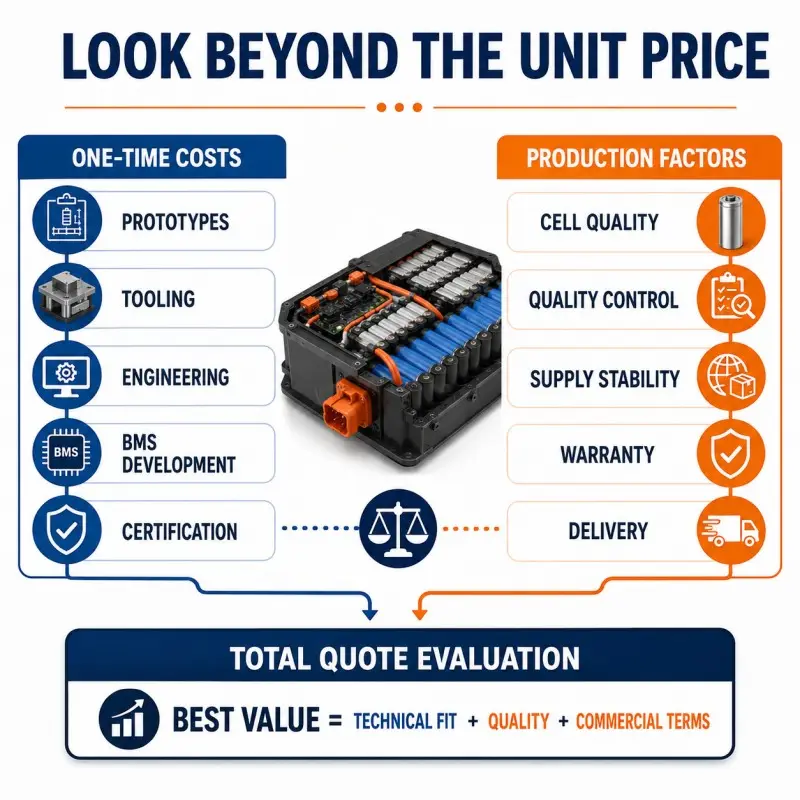
Comparing quotes from custom battery manufacturers is more complicated than choosing the lowest unit price.
Two suppliers may both quote a 14.8V lithium battery pack, yet the products behind those prices can be very different. One quote may use a specified branded cell, include a custom BMS, prototype testing, tooling, and technical support. Another may cover only basic pack assembly.
For buyers sourcing batteries for medical devices, industrial equipment, POS terminals, robotics, portable electronics, power tools, or other battery-powered products, the right comparison should focus on what is actually included in the battery solution.
A good quotation should help you understand not only what the battery costs, but also how the supplier plans to design, manufacture, test, and support it.
Start by Making Sure Every Supplier Is Quoting the Same Battery
Before comparing prices, check whether every manufacturer is working from the same technical requirements.
A useful RFQ should define information such as:
- Nominal voltage
- Required capacity or runtime
- Maximum battery dimensions
- Continuous and peak discharge current
- Charging requirements
- Connector and cable specifications
- Operating temperature
- Communication requirements
- Housing or mechanical structure
- Target application
- Estimated annual quantity
- Target market
Without a common specification, quote comparisons can quickly become misleading.
For example, one manufacturer may quote a 5200mAh battery using higher-capacity cells, while another proposes a different cell configuration with the same nominal voltage but different discharge capability.
The prices may look comparable, but the engineering solutions are not.
Compare the Cell, Not Just the Pack Specification
The battery cell is one of the largest factors influencing battery pack performance, supply stability, and cost.
Ask each supplier to clarify what type of cell is included in the quotation.
Important questions include:
What cell format is being used?
Cylindrical, pouch, prismatic, LiFePO4, or another chemistry?
Is the cell manufacturer identified?
Is the cell suitable for the required discharge current and operating environment?
Can the supplier maintain the same cell specification during future production?
A lower quotation may sometimes be based on a different cell grade or a less suitable cell specification.
That does not automatically make the quote unacceptable, but buyers need to know exactly what they are comparing.
Review What the BMS Includes
For custom lithium battery packs, the BMS can significantly change both the cost and complexity of the project.
A basic protection board may provide overcharge, over-discharge, overcurrent, and short-circuit protection.
More advanced packs may require additional features such as:
- Temperature monitoring
- Cell balancing
- Fuel gauging
- State-of-charge reporting
- SMBus communication
- I²C communication
- CAN communication
- Custom firmware
If one manufacturer quotes a simple protection PCB and another includes a programmable smart BMS, their prices should not be compared as though the two solutions were identical.
Ask suppliers to clearly describe the BMS functionality included in their price.
Separate Unit Price from Development Costs
Custom battery projects often include costs that are not part of the battery unit price.
These may include:
| Cost Item | What It May Cover |
|---|---|
| Prototype fee | Initial sample packs |
| Engineering fee | Electrical or mechanical development |
| BMS development | PCB, firmware, or communication work |
| Tooling | Plastic housing, holders, fixtures, or molds |
| Testing | Electrical, mechanical, or environmental validation |
| Certification support | Samples and documents for required testing |
| Packaging development | Custom labels, cartons, or protective packaging |
A supplier with a higher initial development charge may still provide a competitive mass-production price.
For this reason, separate one-time costs from recurring production costs when evaluating quotations.
Check Exactly What Testing Is Included
A battery quotation should also explain how the finished pack will be verified.
Ask whether production includes checks such as voltage, internal resistance, capacity, BMS protection functions, connector polarity, insulation, communication, or other application-specific inspections.
The appropriate test plan depends on the battery design.
A simple consumer battery and a smart industrial battery may require very different production controls.
Instead of asking only, “Do you test the battery?” ask:
What is tested on every production pack, and what is tested only during development or sampling?
That question gives buyers a much clearer picture of the supplier's quality process.
Understand Certification Responsibilities
Certification can become one of the biggest sources of misunderstanding during custom battery sourcing.
A quotation may state that the battery is “certification ready,” while another includes actual testing fees. Those are not the same thing.
Clarify:
- Which existing cell reports are available
- Whether UN38.3 documentation is available or needs new testing
- Whether certification costs are included
- Who supplies samples for testing
- Whether design changes require additional testing
- Which documents the manufacturer will provide
Requirements can vary depending on battery chemistry, transportation method, application, and destination market.
Certification planning should therefore be discussed before selecting a supplier rather than after the first production order.
Compare MOQ, Lead Time, and Production Flexibility
A low battery price may come with an MOQ that does not match your project.
For a new product launch, flexibility can sometimes matter more than achieving the lowest possible unit price.
Compare suppliers based on:
Prototype quantity
Can they produce a small engineering batch?
Production MOQ
Does the minimum order fit your sales forecast?
Sample lead time
How quickly can prototypes be produced?
Mass-production lead time
What happens after sample approval?
Forecast flexibility
Can the supplier support increasing volumes as the product grows?
These factors can affect inventory risk and product-launch schedules.
Look at the Commercial Terms Behind the Price
A quotation is not complete until you understand the commercial conditions.
Review packaging, payment terms, warranty terms, delivery terms, freight responsibility, quotation validity, and any conditions related to raw-material price changes.
You should also confirm whether accessories such as chargers, connectors, cables, housings, labels, and packaging are included.
A battery quoted at $1 less per unit may not actually be cheaper if essential components are excluded.
Evaluate the Supplier, Not Only the Spreadsheet
Custom battery sourcing usually involves engineering communication before it involves mass production.
Pay attention to the questions a supplier asks during the quotation stage.
A capable manufacturer should want to understand your device, power requirements, available space, operating conditions, expected volume, and target market.
If a supplier provides a price immediately without reviewing important technical information, the quotation may require significant revision later.
A strong quotation process should help identify technical risks before prototypes are built.
Build a True Quote Comparison
The most useful comparison is not simply:
Supplier A: $18.50
Supplier B: $17.80
Supplier C: $16.90
Instead, compare:
Cell + BMS + Mechanical Design + Testing + Tooling + Certification Support + MOQ + Lead Time + Quality Control + Unit Price
The best custom battery manufacturer is usually not the company offering the lowest number on the first quotation.
It is the supplier that provides the most suitable battery solution at a commercially reasonable total cost and can manufacture it consistently as your product moves from prototype to production.
Frequently Asked Questions
Why are custom battery quotes from different manufacturers so different?
Different suppliers may use different cells, BMS designs, housings, testing procedures, production processes, and commercial assumptions. Always confirm that each quotation covers the same technical specification.
Should I choose the battery manufacturer with the lowest unit price?
Not necessarily. Unit price should be considered together with cell quality, BMS functionality, testing, tooling, MOQ, lead time, engineering support, and long-term supply capability.
What costs should I ask about besides the battery price?
Ask about prototype fees, tooling, engineering, custom BMS development, certification support, packaging, shipping, chargers, connectors, and any other one-time development costs.
How can I make battery quotations easier to compare?
Send the same RFQ and technical requirements to every supplier. Then create a comparison covering battery specifications, cells, BMS, testing, MOQ, lead time, development costs, certifications, and unit pricing.
What information should I provide before requesting a custom battery quote?
Provide the required voltage, capacity or runtime, battery dimensions, discharge current, charging requirements, connector details, operating environment, application, target market, and expected order quantity.
Talk to the Manufacturer
Resources & Insights
High Capacity Lithium Battery for Wearables: High-Voltage LiPo Cell Design
2026-10-19
Cylindrical Battery Packs for Laptops: 2S vs 3S vs 4S Battery Design
2026-10-19

Stage Lighting Battery Pack: Prevent Voltage Drop & LED Flicker
2026-10-19

Best Rechargeable Batteries for Smart Devices: Performance, Safety, and Selection Guide
2026-10-19


