


 Home /
 Can a Battery Manufacturer Develop a Pack from My Product Drawings?


Table of Contents
- What Can a Battery Manufacturer Learn from Product Drawings?
- Product Drawings Are Only Part of the Battery Specification
- From Product Drawing to Battery Pack Design
- The BMS Is an Important Part of the Development
- Mechanical Design Must Consider More Than Dimensions
- Prototyping Helps Verify the Design
- Certification Requirements Should Be Considered Early
- What Information Should You Send to a Battery Manufacturer?
- Working with the Right Battery Development Partner
- Frequently Asked Questions
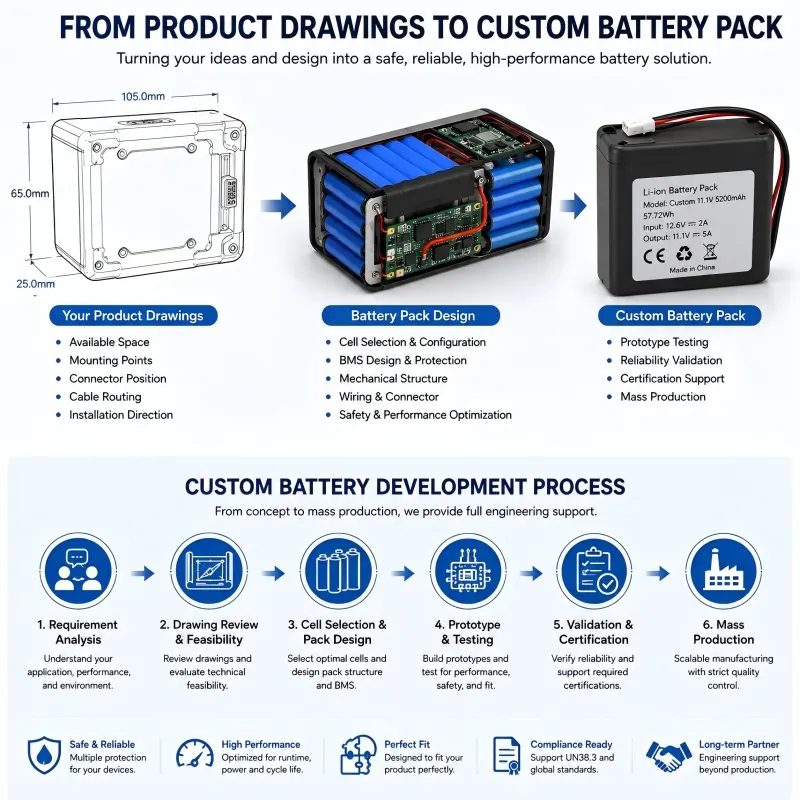
When developing a new electronic product, the battery is often one of the most important components to finalize. It affects runtime, weight, internal space, charging performance, safety, and even the final shape of the device.
For many product developers, the starting point is not a completed battery specification. Instead, they may only have mechanical drawings, a 3D model, PCB information, or a prototype of the finished product.
This leads to a common question:
Can a battery manufacturer develop a custom battery pack directly from my product drawings?
In many cases, the answer is yes. An experienced custom battery manufacturer can use product drawings as the starting point for battery pack design, but drawings alone are usually not enough. The manufacturer also needs to understand how the product operates, how much power it consumes, how it will be charged, and where it will be used.
What Can a Battery Manufacturer Learn from Product Drawings?
Mechanical drawings can provide valuable information before battery development begins.
A manufacturer can review the available battery compartment and identify:
- Maximum battery length, width, and height
- Available internal volume
- Connector location
- Cable routing
- Mounting points
- Housing structure
- Nearby heat-producing components
- Space required for the PCB or BMS
- Possible battery installation and removal direction
This information helps determine what type of battery architecture may fit the product.
For example, a narrow handheld device may be more suitable for a custom lithium-polymer battery, while a larger industrial unit may have enough room for cylindrical 18650 or 21700 cells.
The drawing therefore becomes the starting point for evaluating what is physically possible.
Product Drawings Are Only Part of the Battery Specification
A battery that fits inside a device is not necessarily the correct battery.
The manufacturer must also understand the product's electrical requirements.
Before proposing a battery pack, engineers will normally need information such as operating voltage, maximum current, average power consumption, peak current, expected runtime, charging method, and device operating conditions.
Imagine two products with exactly the same battery compartment.
One is a low-power monitoring device that operates continuously at a relatively stable current. The other contains a motor that creates short periods of high current demand.
Although the available space is identical, the battery design could be completely different.
This is why custom battery development should consider both mechanical fit and electrical performance.
From Product Drawing to Battery Pack Design
A typical development process starts with an engineering review.
The battery supplier examines the drawings together with the product requirements and determines which cell chemistry and configuration are practical.
The process may look like this:
Product Drawing → Application Review → Cell Selection → Pack Configuration → BMS Design → Mechanical Design → Prototype → Testing → Production
During cell selection, engineers may compare cylindrical lithium-ion cells, pouch cells, LiFePO4 cells, or other battery technologies depending on the application.
The goal is not simply to install the largest possible battery. The battery must balance capacity, discharge capability, size, weight, cost, cycle life, and safety requirements.
The BMS Is an Important Part of the Development
For many custom lithium battery packs, the Battery Management System is just as important as the cells.
Depending on the application, the BMS may provide functions such as:
- Overcharge protection
- Over-discharge protection
- Overcurrent protection
- Short-circuit protection
- Temperature monitoring
- Cell balancing
- State-of-charge communication
- SMBus, I²C, CAN, or other communication interfaces
A simple consumer product may require only basic protection functions.
A medical device, industrial computer, robot, or smart instrument may require communication between the battery and the host system.
If the product drawing includes PCB layout, connector positions, or communication interfaces, the battery manufacturer can use this information when developing the BMS and battery connection system.
Mechanical Design Must Consider More Than Dimensions
Custom battery development also involves structural engineering.
Battery cells cannot simply be packed into the available space without considering insulation, vibration, expansion, wiring, welding points, protection boards, and assembly tolerances.
Engineers may need to design:
- Plastic battery housings
- Shrink-wrap structures
- Cell holders
- Insulation materials
- Foam cushioning
- Metal brackets
- Wiring harnesses
- Custom connectors
For products exposed to vibration, movement, or impact, mechanical stability becomes especially important.
Applications such as portable medical equipment, robotics, power tools, handheld terminals, and industrial instruments may require very different structural designs even when their voltage and capacity are similar.
Prototyping Helps Verify the Design
Once the initial battery design is completed, the next stage is usually prototype production.
A prototype allows both the battery manufacturer and the product developer to confirm whether the design actually works inside the finished device.
Typical verification may include:
- Mechanical fit
- Connector compatibility
- Charging behavior
- Discharge performance
- Runtime
- Temperature behavior
- Communication with the device
- Installation and removal
This stage is important because CAD drawings cannot always reveal every real-world assembly issue.
A connector may technically fit but be difficult to access. A cable may interfere with another component. The battery may require additional clearance during installation.
Prototype testing helps identify these problems before mass production.
Certification Requirements Should Be Considered Early
The target market can also influence battery design.
A battery intended for shipment internationally may require transportation testing such as UN38.3. Depending on the product, market, and application, other standards or certification requirements may also need to be considered.
Waiting until the battery design is complete before discussing compliance can create unnecessary redesign work.
For this reason, manufacturers should know where the final product will be sold as early as possible.
Certification planning can affect cell selection, protection design, documentation, testing, and production control.
What Information Should You Send to a Battery Manufacturer?
If you want a supplier to develop a battery from your product drawings, it is helpful to provide more than one drawing file.
A strong development brief should include:
Mechanical information: drawings, STEP files, available battery space, mounting details, and connector locations.
Electrical information: operating voltage, power consumption, peak current, charging voltage, charging current, and required runtime.
Application information: product type, operating environment, expected usage frequency, and target markets.
Commercial information: estimated annual demand, prototype quantity, production schedule, and expected product life cycle.
The more complete the information is, the easier it is for battery engineers to develop a practical solution.
Working with the Right Battery Development Partner
A capable battery manufacturer should do more than ask for voltage and capacity.
The supplier should understand the relationship between the battery, the device, and the application.
For new product development, the best results usually come from cooperation between the customer's mechanical and electrical engineers and the battery manufacturer's battery, BMS, and production teams.
Product drawings provide an excellent starting point, but successful custom battery development requires combining those drawings with electrical requirements, operating conditions, safety considerations, and manufacturing experience.
When these factors are reviewed together, a battery manufacturer can turn an available space inside your product into a battery pack designed for reliable mass production.
Frequently Asked Questions
Can you design a battery if I only have a 3D product drawing?
Yes. A 3D drawing can be used to evaluate the available battery space, but additional information such as voltage, power consumption, required runtime, charging method, and operating environment is normally required.
Do I need to choose the battery cells before contacting a manufacturer?
No. A custom battery manufacturer can recommend suitable cell types based on your product dimensions, electrical requirements, expected runtime, discharge current, and application.
Can the battery manufacturer also design the BMS?
Yes. Many custom battery manufacturers can develop or configure a BMS to provide protection, monitoring, balancing, and communication functions required by the application.
How do I confirm that the battery will fit my product?
The manufacturer can review CAD or STEP files before producing prototypes. Physical battery samples should then be installed and tested in the actual product before mass production.
Can a custom battery design be prepared for certification?
Yes. Certification and transportation requirements should ideally be discussed during the design stage so that suitable cells, protection systems, testing plans, and documentation can be considered before production.
Talk to the Manufacturer
Resources & Insights
High Capacity Lithium Battery for Wearables: High-Voltage LiPo Cell Design
2026-10-19
Cylindrical Battery Packs for Laptops: 2S vs 3S vs 4S Battery Design
2026-10-19

Stage Lighting Battery Pack: Prevent Voltage Drop & LED Flicker
2026-10-19

Best Rechargeable Batteries for Smart Devices: Performance, Safety, and Selection Guide
2026-10-19


