


 Home /
 6S1P 22.2V 8000mAh Li-Polymer Battery for 10-Inch, 13-Inch, and 15-Inch FPV Drones and RC Aircraft


Table of Contents
- Understanding the 6S1P Battery Configuration
- 8000mAh Capacity for Longer Flight Time
- Suitable for 10-Inch FPV Drones
- Power for 13-Inch and 15-Inch Aircraft
- Advantages of Li-Polymer Battery Technology
- Connector and Cable Customization
- Charging and Maintenance Guidelines
- Choosing the Right Battery for Your FPV Project
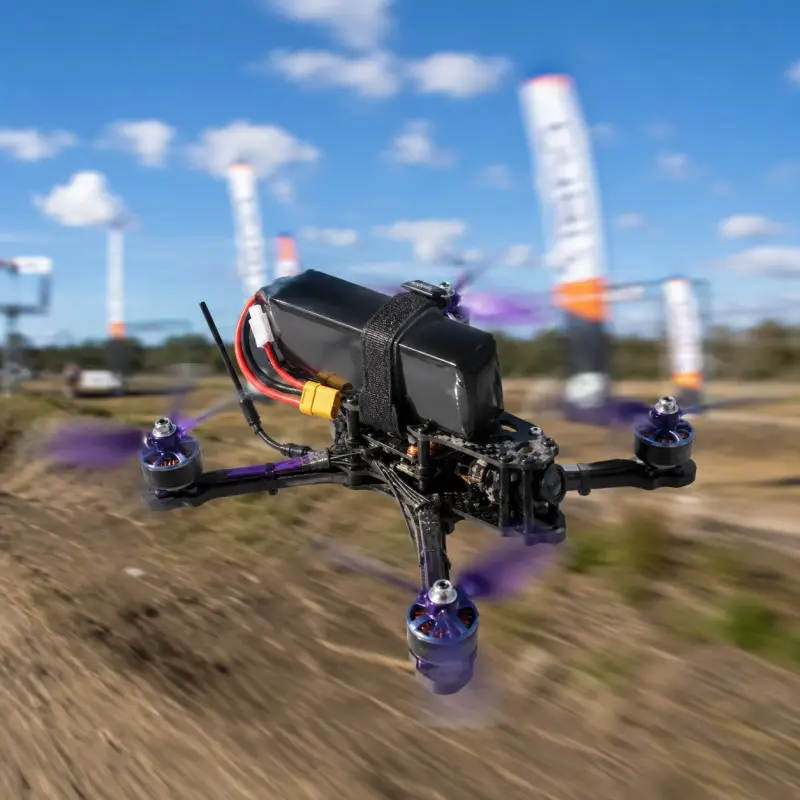
A 6S1P 22.2V 8000mAh Li-Polymer Battery is designed for larger FPV drones and RC aircraft that need stable voltage, strong power delivery, and longer operating time. Compared with the smaller batteries commonly installed on compact racing quads, an 8000mAh pack provides more stored energy for long-range flying, aerial photography, outdoor exploration, training, and professional drone applications.
This battery configuration is suitable for many 10-inch, 13-inch, and 15-inch FPV platforms. However, the correct battery should always be selected according to the aircraft’s motor system, electronic speed controllers, propellers, takeoff weight, available installation space, and expected current demand.
Understanding the 6S1P Battery Configuration
The term “6S1P” describes the internal electrical arrangement of the battery. Six lithium-polymer cells are connected in series, while only one cell group is used in parallel.
Each Li-Polymer cell typically has a nominal voltage of approximately 3.7V. Connecting six cells in series produces a nominal battery voltage of 22.2V. When fully charged, the pack reaches approximately 25.2V.
This voltage platform is widely used in larger FPV drones because it allows the propulsion system to deliver strong performance without requiring excessively high current. When matched with suitable motors and ESCs, a 6S setup can provide efficient cruising, responsive throttle control, and reliable lifting power.
Before installation, users should verify that every electrical component supports a 6S input. Motors, ESCs, flight controllers, voltage regulators, cameras, video transmitters, and other onboard equipment must all operate within their specified voltage limits.
8000mAh Capacity for Longer Flight Time
The 8000mAh capacity gives the aircraft a substantial energy reserve. This makes the battery well suited to applications where flight duration is more important than extremely aggressive maneuvering.
Long-range FPV pilots may use the additional capacity to travel farther while maintaining enough reserve power for a safe return. Aerial photography platforms can stay in the air longer, giving operators more time to compose shots, follow moving subjects, or capture large areas. Inspection and mapping drones may complete more work during a single flight, reducing the number of landings and battery replacements.
Actual flight time will depend on several factors, including:
- Total aircraft weight
- Motor and propeller efficiency
- Average throttle position
- Wind speed and flight direction
- Payload weight
- Flying style
- Ambient temperature
- Battery condition
A higher-capacity battery does not automatically guarantee the longest possible flight. The extra capacity also increases pack size and weight. If the battery is too heavy for the aircraft, the motors may consume more energy simply to keep the drone airborne. The best result comes from balancing capacity, weight, and propulsion efficiency.
Suitable for 10-Inch FPV Drones
A 10-inch FPV drone can use an 8000mAh 6S battery when the frame, motors, and landing structure are designed to carry the additional weight. This type of setup is often selected for long-range cruising, mountain flying, aerial exploration, and stable outdoor recording.
Compared with smaller FPV platforms, a 10-inch drone can carry a larger battery while still remaining relatively compact. It may also offer better wind resistance and more efficient forward flight when properly configured.
Pilots should confirm that the battery mounting area is large enough and that the straps can hold the pack securely. The battery should not interfere with propellers, antennas, GPS modules, or other components.
Power for 13-Inch and 15-Inch Aircraft
Larger 13-inch and 15-inch FPV drones often require more energy because they use bigger motors, larger propellers, and heavier frames. They may also carry cameras, gimbals, communication equipment, sensors, or other payloads.
For these aircraft, a 22.2V 8000mAh Li-Polymer battery can provide a practical combination of voltage and capacity. The 6S configuration supports strong motor performance, while the large capacity helps maintain useful flight duration under load.
The battery can be used for multirotor aircraft, large FPV platforms, custom-built drones, and selected fixed-wing RC models. Compatibility should always be confirmed through current testing and weight calculations before regular operation.
Advantages of Li-Polymer Battery Technology
Lithium-polymer batteries are widely used in FPV and RC applications because they can deliver high current from a relatively lightweight package. Their pouch-cell construction also allows manufacturers to produce different shapes and dimensions for specific aircraft designs.
Key advantages include:
- High energy and power density
- Strong discharge capability
- Relatively low weight
- Stable output for demanding motors
- Flexible pack dimensions
- Support for customized connectors and wiring
Cell consistency is important for both performance and safety. The cells inside the pack should be matched according to voltage, capacity, and internal resistance. Proper matching allows each cell to charge and discharge more evenly.
Connector and Cable Customization
Different FPV drones use different power connectors, cable sizes, and installation layouts. The battery can therefore be customized according to the aircraft’s electrical requirements.
Customization options may include the main discharge connector, balance plug, wire gauge, cable length, connector direction, battery dimensions, external packaging, label design, and protective materials.
A connector must be rated for the expected operating current. Using an undersized connector or cable can create resistance, voltage loss, and excessive heat. The wiring should also be kept away from propellers, sharp frame edges, and hot electronic components.
Charging and Maintenance Guidelines
A charger designed for 6S Li-Polymer batteries should be used. Balance charging is strongly recommended because it monitors the voltage of each cell and helps maintain consistent operation across the pack.
The battery should be placed on a nonflammable surface during charging and should never be left unattended. After flight, allow the pack to cool before charging it again.
Users should regularly inspect the battery for swelling, damaged wrapping, loose wires, deformed connectors, or unusual heat. A damaged or swollen pack should not be used.
For long-term storage, the battery should be kept at an appropriate storage voltage rather than fully charged or deeply discharged. It should also be stored in a cool, dry location away from direct sunlight, moisture, and heat sources.
Choosing the Right Battery for Your FPV Project
The 6S1P 22.2V 8000mAh Li-Polymer battery is a practical option for 10-inch, 13-inch, and 15-inch FPV drones that require dependable power and extended operating time. Its suitability depends on correct matching with the aircraft’s voltage, current, weight, and dimensional requirements.
For custom drone projects, manufacturers can adjust the connector, cable, dimensions, packaging, and discharge specifications. A properly matched battery can improve flight stability, support onboard equipment, and help the aircraft achieve a better balance between power, endurance, and payload capacity.
Talk to the Manufacturer
Resources & Insights
High Capacity Lithium Battery for Wearables: High-Voltage LiPo Cell Design
2026-10-19
Cylindrical Battery Packs for Laptops: 2S vs 3S vs 4S Battery Design
2026-10-19
Stage Lighting Battery Pack: Prevent Voltage Drop & LED Flicker
2026-10-19
Best Rechargeable Batteries for Smart Devices: Performance, Safety, and Selection Guide
2026-10-19


