


 Home /
 Why Lithium Batteries Charge with Constant Current First, Then Constant Voltage


Table of Contents
- What Is CC-CV Charging?
- Stage 1: Constant Current (CC) Phase
- Stage 2: Constant Voltage (CV) Phase
- Why Not Just Constant Current or Constant Voltage Alone?
- Key Points of CC-CV Charging
- Practical Implications for Everyday Devices
- Advanced Considerations
- Understanding the Graph
- Battery Chemistry Behind CC-CV
- Summary
Lithium-ion batteries are ubiquitous in modern electronics, powering everything from smartphones and laptops to electric vehicles and portable tools. A critical aspect of their operation is the charging process, which is designed not only to replenish energy efficiently but also to protect the battery's lifespan and safety. One of the most commonly used methods for charging lithium-ion batteries is the CC-CV (Constant Current – Constant Voltage) method. But why is this two-step approach necessary? This article dives deep into the science behind CC-CV charging, its stages, and its significance.
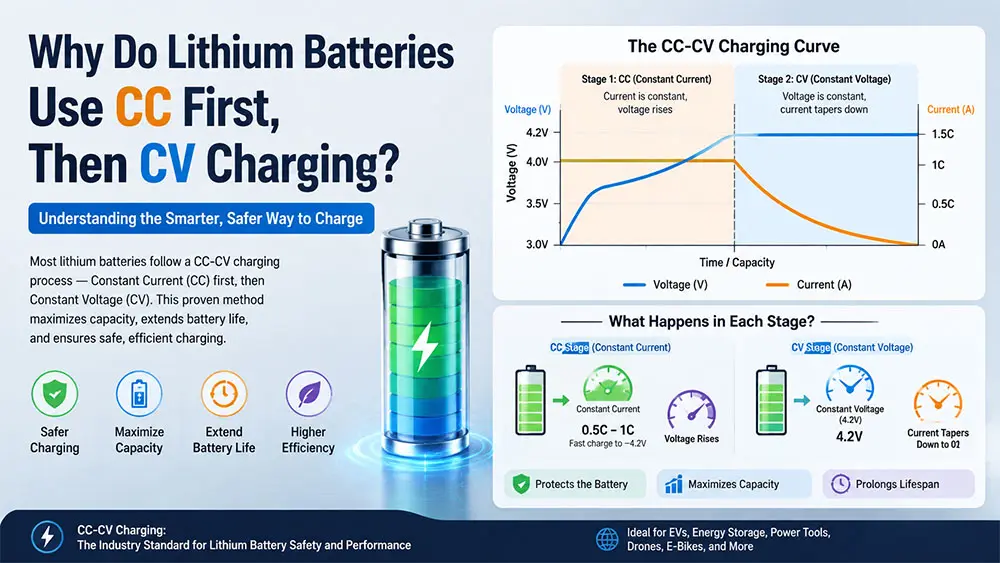
What Is CC-CV Charging?
CC-CV stands for Constant Current (CC) followed by Constant Voltage (CV). This charging protocol is the standard for lithium-ion batteries due to its effectiveness in balancing speed and safety.
- CC – Constant Current: In the first phase, the battery is charged at a fixed current. The voltage gradually rises as the battery accumulates charge.
- CV – Constant Voltage: In the second phase, the voltage is held constant at the battery’s maximum rated voltage, while the current gradually decreases as the battery reaches full charge.
This two-stage approach is designed to prevent overcharging and overheating while ensuring that the battery reaches near-full capacity efficiently.
Stage 1: Constant Current (CC) Phase
During the constant current phase, the charger supplies a fixed amount of current to the battery. For typical consumer batteries, this might be 0.5C to 1C, where "C" represents the battery's rated capacity. For example, a 2000 mAh battery charged at 1C would receive 2000 mA of current.
- Voltage Behavior: In this stage, the voltage gradually rises from the battery’s nominal voltage (usually around 3.0V for a single-cell lithium-ion) towards the maximum charging voltage, typically 4.2V for most cells.
- Current Behavior: The current remains steady as the battery accumulates energy.
- Purpose: This phase allows the battery to rapidly gain energy without exceeding voltage limits. The main keyword here is “fast charging”—CC mode provides the bulk of the battery’s charge quickly.
From the diagram in your image, you can see that during this stage, the voltage climbs steadily while the current stays fixed. This is essential to prevent excessive stress on the battery and avoid thermal runaway.
Stage 2: Constant Voltage (CV) Phase
Once the battery voltage reaches its rated maximum (e.g., 4.2V per cell), the charger switches to the constant voltage phase.
- Voltage Behavior: The voltage is fixed at 4.2V.
- Current Behavior: The current naturally decreases as the battery approaches full capacity, often dropping to 0.05C or lower.
- Purpose: The CV phase ensures the battery reaches 100% charge without overcharging. This phase prevents the internal battery pressure from rising too high and protects against degradation. It is also referred to as the “topping-off” stage.
This phase is critical for battery longevity, as pushing lithium-ion cells beyond their voltage limits can reduce cycle life, degrade capacity, and increase the risk of safety incidents.
Why Not Just Constant Current or Constant Voltage Alone?
Charging a lithium-ion battery using only constant current would risk overshooting the safe voltage limit as the cell approaches full charge, potentially causing overheating and capacity loss. Conversely, charging using only constant voltage from the start would lead to very slow charging initially, as the current drawn by a depleted battery would be low under fixed voltage, reducing charging efficiency.
The combination of CC and CV ensures:
- Efficiency: Rapid energy input during CC phase.
- Safety: Controlled voltage limits during CV phase.
- Battery Life: Avoids overcharging that accelerates aging.
Key Points of CC-CV Charging
- Fast Bulk Charging: Most of the battery’s capacity (up to ~70–80%) is acquired in the CC phase.
- Voltage Climb Management: Voltage climbs gradually, preventing abrupt chemical stress.
- Smooth Top-Off: CV phase gently brings the battery to full charge.
- Overcharge Protection: Automatically prevents voltage from exceeding maximum thresholds.
These points can be highlighted with the following keywords as seen in the image:
- CC Phase Keywords: 快速补电 (fast top-up charging), 电压爬坡 (voltage ramping)
- CV Phase Keywords: 滑流补满 (trickle completion), 防止过充 (overcharge prevention)
Practical Implications for Everyday Devices
- Smartphones and Laptops: These devices use CC-CV chargers to ensure that batteries are charged quickly while remaining safe for daily use. Rapid charging is achieved without compromising the battery’s overall health.
- Electric Vehicles (EVs): EV batteries are charged using scaled-up CC-CV protocols, balancing charging speed with cell longevity and thermal management.
- Power Tools and Portable Devices: Safety-critical devices rely on CC-CV to prevent overheating and maintain reliable performance over thousands of cycles.
Advanced Considerations
Modern battery management systems (BMS) often integrate CC-CV charging with additional features:
- Temperature Monitoring: Ensures the battery does not exceed safe temperature ranges.
- Cell Balancing: Ensures each cell in a multi-cell pack reaches full charge simultaneously.
- Adaptive Current Control: Adjusts CC current in response to battery age, temperature, or usage patterns for optimal longevity.
Understanding the Graph
From the chart in the image:
- X-Axis: Time or capacity.
- Y-Axis Left: Voltage (V)
- Y-Axis Right: Current (A)
- CC Phase: Orange line (current constant), blue line (voltage rising)
- CV Phase: Blue line (voltage constant), orange line (current declining)
The CC-CV curve effectively illustrates the two-stage behavior of lithium-ion charging and visually reinforces why this method is necessary.
Battery Chemistry Behind CC-CV
Lithium-ion cells have chemical limitations:
- Lithium-ion intercalation: Lithium ions move between electrodes. During high-rate CC charging, voltage increases as the available intercalation sites fill.
- Voltage plateau: Once the electrode becomes saturated, maintaining constant voltage ensures lithium ions continue moving into the electrode slowly without stressing the material.
- Electrolyte stability: Voltage beyond 4.2V risks electrolyte oxidation; CV prevents exceeding this limit.
Understanding these chemical processes explains why CC-CV is almost universal for modern lithium-ion batteries.
Summary
Charging lithium-ion batteries using the CC-CV protocol is a well-established method that maximizes charging speed while safeguarding battery life and safety. The constant current phase quickly brings the battery to near-full voltage, and the constant voltage phase completes the charge gently, preventing overvoltage and overheating.
In practical terms, CC-CV charging ensures:
- Faster charging for users.
- Extended cycle life of batteries.
- Prevention of overcharge-induced damage.
- Safe and reliable operation for devices ranging from smartphones to EVs.
Understanding CC-CV charging is essential for engineers, hobbyists, and consumers who want to optimize battery performance and lifespan. As lithium-ion batteries continue to power more aspects of our daily life, knowing how and why they charge the way they do remains invaluable knowledge.
Talk to the Manufacturer
Resources & Insights

High Capacity Lithium Battery for Wearables: High-Voltage LiPo Cell Design
2026-10-19
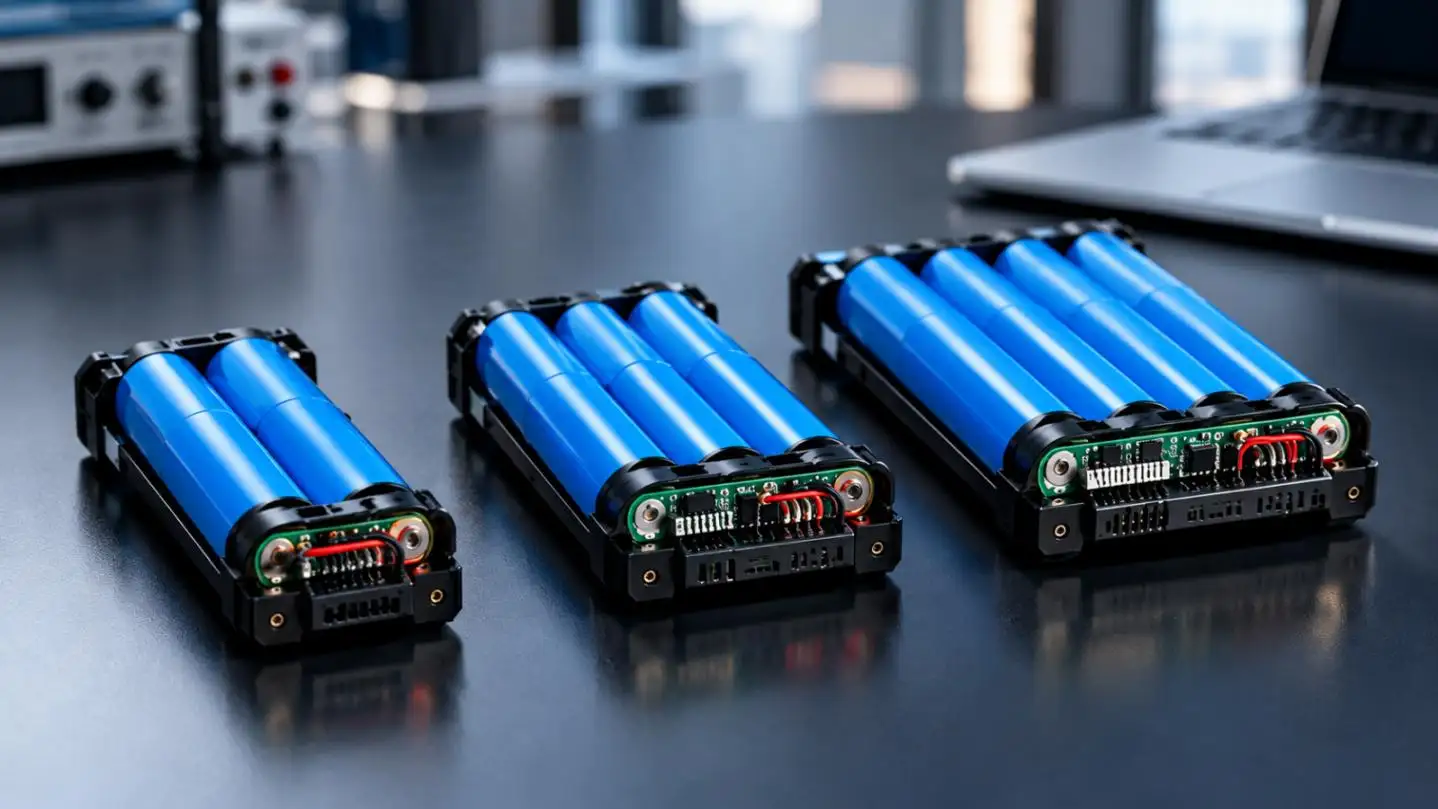
Cylindrical Battery Packs for Laptops: 2S vs 3S vs 4S Battery Design
2026-10-19

Stage Lighting Battery Pack: Prevent Voltage Drop & LED Flicker
2026-10-19

Best Rechargeable Batteries for Smart Devices: Performance, Safety, and Selection Guide
2026-10-19


