


 Home /
 7.4V 4400mAh Li-Polymer Battery Pack for Ski Gloves and Heated Clothing


Table of Contents
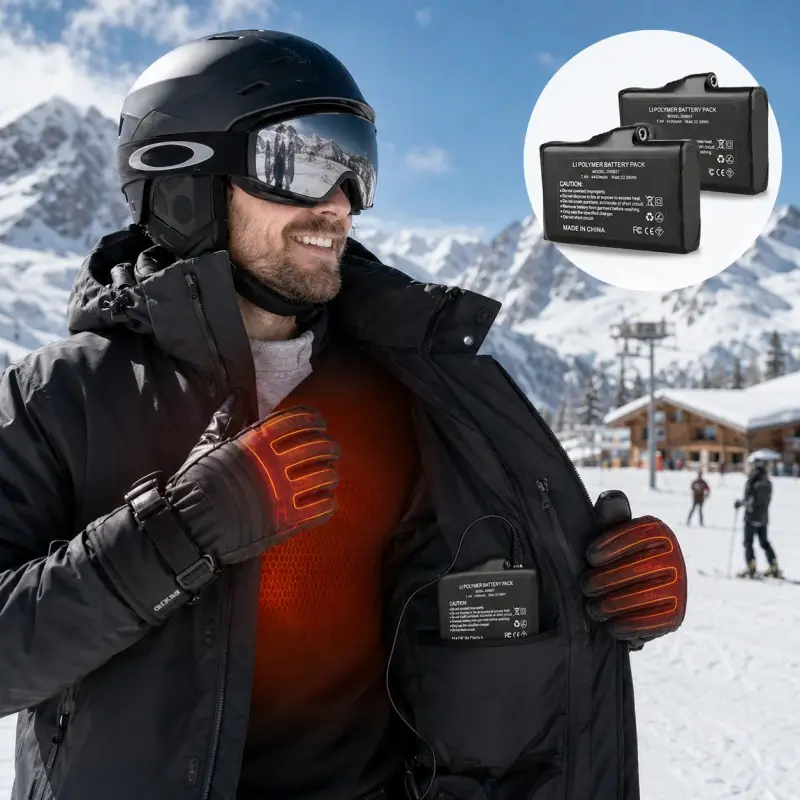
A 7.4V 4400mAh Li-polymer battery for heated ski gloves provides a practical balance of capacity, weight, and compact dimensions for wearable heating products. It can supply rechargeable power to heating elements installed in ski gloves, heated mittens, jackets, vests, socks, and other cold-weather clothing.
For skiers and outdoor workers, cold hands are more than a comfort issue. Reduced finger warmth can affect grip, flexibility, and the ability to operate equipment. Heated gloves address this problem by placing heating elements around the fingers and back of the hand. However, their performance depends heavily on the battery powering the system.
A properly designed battery must deliver stable output, fit comfortably near the wrist, withstand repeated movement, and include suitable protection functions. Capacity is important, but voltage compatibility, discharge current, charging design, enclosure shape, and low-temperature behavior must also be evaluated.
How a 7.4V Heated Glove Battery Works
A 7.4V lithium-polymer battery pack normally uses two 3.7V cells connected in series. This configuration is often described as a 2S battery pack. Its nominal voltage is 7.4V, while its voltage may reach approximately 8.4V after a full charge.
When connected to heated ski gloves, the battery supplies electricity to flexible heating elements integrated into the fabric. These elements convert electrical energy into heat and distribute warmth across selected areas of the glove.
Many heated gloves provide high, medium, and low temperature settings. The highest level delivers stronger heating but consumes battery energy more quickly. Lower settings reduce power consumption and may provide a longer operating period.
The battery voltage must match the glove’s heating circuit. A pack with an incorrect voltage or connector can cause poor heating, unstable operation, excessive current, or damage to the control board. Compatibility should always be confirmed before the battery is used as a replacement.
Advantages of a 4400mAh Capacity
A 4400mAh capacity offers more stored energy than many smaller heated glove batteries while remaining suitable for portable wearable applications. This makes it useful for skiing sessions, winter commuting, outdoor work, hunting, fishing, hiking, and other activities that may last several hours.
Actual operating time depends on the glove’s heating power rather than battery capacity alone. A glove operating continuously at maximum temperature will drain the battery faster than one running at a low or medium setting.
Ambient temperature also affects battery performance. Lithium-based batteries may deliver less usable capacity in extremely cold environments. The glove’s insulation, heating-zone design, control-circuit efficiency, and frequency of temperature adjustment can all influence runtime.
For accurate performance information, the battery should be tested with the complete heated glove system. Testing only the cell capacity does not provide a reliable estimate of real-world heating time.
Why Use Li-Polymer Technology?
Lithium-polymer batteries are suitable for wearable devices because they can be manufactured in relatively thin and compact shapes. This gives product designers more flexibility when creating batteries for glove cuffs, wrist pockets, jacket compartments, or other limited installation spaces.
Weight distribution is especially important in ski gloves. A heavy or bulky battery positioned near the wrist may restrict movement or become uncomfortable during extended use. A properly designed Li-polymer pack can help reduce unnecessary bulk while supplying the required energy.
The enclosure should have rounded edges and fit securely inside the glove’s battery pocket. The connector and cable should also be positioned to avoid pressure against the wrist or excessive bending during movement.
Although Li-polymer cells offer useful design flexibility, they must be protected against puncture, compression, impact, and incorrect charging. The complete battery pack requires appropriate insulation, enclosure protection, wiring, and circuit design.
Applications Beyond Ski Gloves
The 7.4V 4400mAh battery pack can support more than heated ski gloves. It may also be considered for heated mittens, motorcycle gloves, cycling gloves, hunting gloves, heated jackets, vests, scarves, trousers, socks, insoles, and selected portable warming accessories.
Each application has different requirements. Heated gloves prioritize compact size and low weight, while jackets and vests may have more room for a larger battery enclosure. Heated socks require careful cable routing and protection against repeated movement.
Before selecting one battery for multiple products, manufacturers should compare the voltage, maximum current, connector type, heating power, installation dimensions, and expected runtime of every application.
A battery that performs well in a jacket may not be suitable for gloves if its shape, weight, or output connector is incompatible.
Battery Safety and Protection Functions
Safety is essential because heated clothing batteries are worn close to the body. A properly engineered battery pack should include a protection circuit designed for the selected cells and heating load.
Typical protection functions may include overcharge protection, over-discharge protection, overcurrent protection, and short-circuit protection. Temperature monitoring may also be added when required by the product design.
The battery enclosure, wires, connectors, and internal insulation should withstand repeated connection, removal, movement, and normal accidental impact. Heated ski gloves may also be exposed to snow, moisture, sweat, vibration, and rapid temperature changes.
The battery should not be used if it becomes swollen, damaged, deformed, wet, or unusually hot. Users should charge it only with a compatible charger that follows the specified charging voltage and current.
The battery must also be removed before the gloves are washed unless the complete product has been specifically designed and tested for another cleaning method.
Charging and Storage Recommendations
A 7.4V Li-polymer battery usually requires an 8.4V charger designed for a two-series lithium battery pack. Using an unsuitable charger may result in incomplete charging, overheating, or damage to the battery.
A charge-status indicator can make daily use more convenient. Some customized packs may also include a power-level display, integrated switch, USB charging interface, or multiple output ports.
For long-term storage, the battery should be kept in a cool, dry location away from fire, direct sunlight, heaters, and high-temperature environments. It should not be stored for long periods in a completely discharged condition.
The battery and charger should be inspected regularly for damaged cables, loose connectors, cracked enclosures, or abnormal heating.
Custom Battery Options for Heated Glove Brands
Heated glove manufacturers often need customized battery packs because glove structures and heating systems vary. A standard battery may not fit the available pocket or match the existing connector.
Customization options may include enclosure dimensions, cell configuration, wire length, connector type, charging port, battery indicator, label design, logo, packaging, and protection-board settings.
Before development begins, the battery supplier should receive the glove’s operating voltage, heating power, maximum current, temperature levels, desired runtime, available installation space, connector details, and target market requirements.
Prototype batteries should be tested inside the actual ski gloves. This helps verify fit, comfort, charging performance, heating stability, runtime, cable positioning, and low-temperature operation before mass production.
Conclusion
The 7.4V 4400mAh Li-polymer battery for heated ski gloves provides a rechargeable and compact power solution for modern heated apparel. Its capacity can support extended cold-weather use, while the flexible Li-polymer format allows the pack to fit into wearable product designs.
Reliable performance depends on matching the battery with the glove’s voltage, current, connector, heating circuit, and physical structure. Safety protection, charging compatibility, mechanical durability, and low-temperature testing are equally important.
With appropriate customization and complete-system testing, this battery pack can help heated glove manufacturers deliver dependable warmth, comfortable wear, and convenient rechargeable power for skiing, outdoor work, travel, and other winter activities.
Talk to the Manufacturer
Resources & Insights

High Capacity Lithium Battery for Wearables: High-Voltage LiPo Cell Design
2026-10-19
Cylindrical Battery Packs for Laptops: 2S vs 3S vs 4S Battery Design
2026-10-19
Stage Lighting Battery Pack: Prevent Voltage Drop & LED Flicker
2026-10-19

Best Rechargeable Batteries for Smart Devices: Performance, Safety, and Selection Guide
2026-10-19


