


 Home /
 7.4V 5200mAh Rechargeable Battery Pack for Heated Jackets and Heated Clothing


Table of Contents
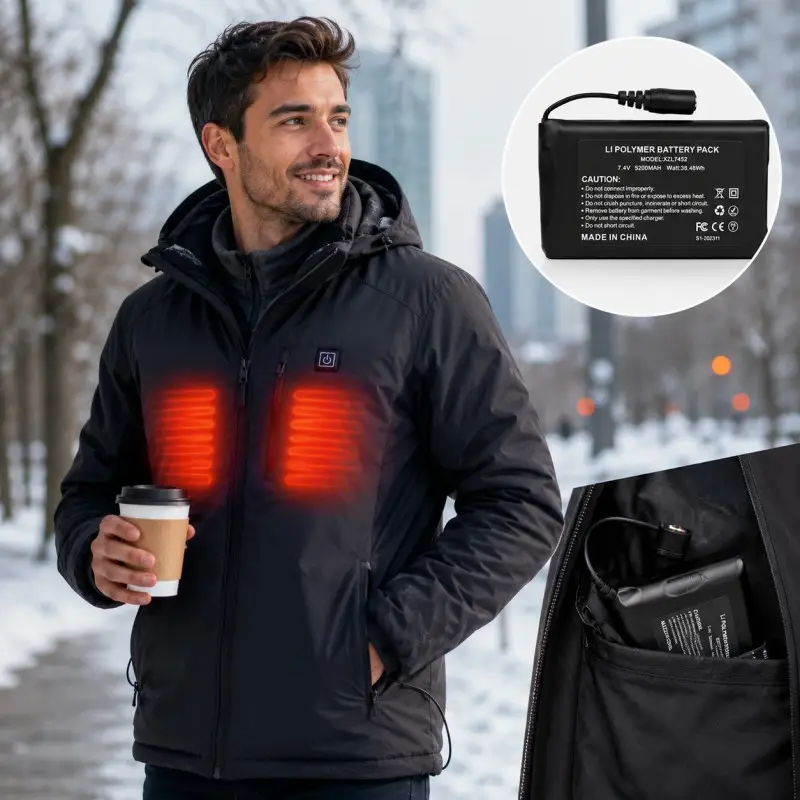
A 7.4V 5200mAh battery pack for heated jackets and apparel provides portable, rechargeable power for garments designed to keep users warm in cold environments. Its relatively high capacity makes it suitable for heated jackets, vests, coats, gloves, trousers, socks, and other wearable heating products that require longer operating time.
Heated clothing is increasingly used for winter sports, outdoor work, commuting, camping, hunting, fishing, and everyday cold-weather activities. However, the performance of the garment depends heavily on its power source. A battery must deliver stable output while remaining compact, lightweight, safe, and comfortable to carry.
For manufacturers developing heated apparel, selecting the right battery involves more than matching the voltage and capacity. The heating power, temperature settings, connector, installation space, charging method, safety protection, and expected runtime must all be considered as part of the complete system.
Understanding the 7.4V Battery Configuration
A 7.4V lithium-ion battery pack is generally built using two lithium-ion cells connected in series. This arrangement is commonly described as a 2S configuration. The nominal voltage is 7.4V, while the voltage can reach approximately 8.4V when the battery is fully charged.
The battery supplies energy to heating elements integrated into the garment. These elements convert electrical energy into heat and distribute warmth across selected areas. In a heated jacket, the heating zones may be positioned around the chest, back, neck, shoulders, or pockets.
Most heated clothing includes several temperature settings. The highest setting produces stronger heat but consumes energy more quickly. Medium and low settings reduce power consumption and can provide a longer operating period.
The battery voltage must match the heating system. Connecting an unsuitable battery may result in weak heating, unstable performance, shortened operating time, excessive current, or damage to the garment’s control circuit.
Benefits of a 5200mAh Capacity
The 5200mAh capacity offers a practical balance between runtime and portability. Compared with a lower-capacity battery, it can provide more stored energy for longer heating sessions. This can be useful for users who work outdoors for several hours or participate in extended winter activities.
Actual runtime cannot be determined by capacity alone. It also depends on the power consumption of the heating elements, selected temperature level, control-circuit efficiency, ambient temperature, garment insulation, and battery condition.
For example, a jacket operating continuously at its highest heating level will use energy faster than the same jacket running at a lower setting. Some garments also use intelligent temperature control, which automatically adjusts output to maintain comfort and reduce unnecessary power consumption.
The final runtime should therefore be confirmed through testing with the actual garment. Battery capacity figures are helpful for comparison, but complete-system testing provides a more realistic performance estimate.
Applications for Heated Jackets and Clothing
A 7.4V 5200mAh rechargeable battery pack can support a wide range of heated apparel products.
Heated jackets and vests are commonly used by construction workers, warehouse employees, delivery drivers, security personnel, technicians, and others who spend long periods in low-temperature environments. Outdoor enthusiasts may use them during camping, skiing, hiking, hunting, fishing, or motorcycling.
The battery can also power heated gloves, trousers, socks, scarves, waist belts, blankets, seat cushions, and selected therapeutic warming products. However, every application has different electrical and mechanical requirements.
A jacket may have enough space for a larger battery pocket, while gloves and socks require smaller and lighter designs. For this reason, the 5200mAh pack is especially suitable for garments that can accommodate the required dimensions and weight without reducing comfort.
Comfort and Portable Design
Wearable batteries must be designed with user comfort in mind. A battery pack that is too heavy, thick, or poorly positioned may become uncomfortable during long periods of use.
The enclosure should have smooth edges and a shape that fits securely inside the garment’s battery pocket. The cable and connector should be positioned so they do not press against the body or interfere with movement.
Manufacturers should also consider how easily users can remove, connect, and recharge the battery. A clear battery-level indicator can help users estimate remaining power before leaving for work or outdoor activities.
The battery pocket should hold the pack firmly while allowing convenient removal. The garment and battery design should work together to prevent excessive cable bending, pulling, or connector damage.
Safety Protection for Wearable Batteries
Safety is particularly important because heated clothing batteries are worn close to the body. A properly designed battery pack should include a protection circuit matched to the cell type and heating application.
Common protection functions include overcharge, over-discharge, overcurrent, and short-circuit protection. Depending on the product design, temperature monitoring or additional safeguards may also be included.
The battery enclosure, internal insulation, wires, connectors, and circuit board should withstand normal movement, vibration, and repeated use. Heated garments may also be exposed to moisture, sweat, snow, dust, and accidental impact.
Users should stop using a battery if it becomes swollen, damaged, unusually hot, wet, or deformed. Only a compatible charger with the correct voltage and charging current should be used.
The battery should normally be removed before the garment is washed unless the product has been specifically designed and tested for another procedure.
Charging and Cold-Weather Performance
A 7.4V lithium-ion pack generally requires a charger designed for a two-series battery configuration. Charging parameters must follow the battery specifications to avoid overheating, incomplete charging, or battery damage.
Cold temperatures may reduce the available discharge performance of lithium-ion cells. Since heated apparel is intended for winter use, the battery should be tested under realistic low-temperature conditions.
Testing may include charging performance, low-temperature discharge, temperature rise, runtime at different heating levels, repeated heating cycles, and protective shutdown behavior.
It is also important to evaluate the position of the battery inside the garment. Keeping the battery inside an insulated pocket may help reduce direct exposure to extremely cold air.
OEM and Custom Battery Pack Options
Heated apparel manufacturers often require customized battery packs because garment dimensions, heating power, connectors, and branding requirements vary.
A custom 7.4V 5200mAh battery pack may include a specific enclosure shape, connector type, wire length, charging interface, battery indicator, output port, label, logo, or packaging design.
Before customization begins, the supplier should receive information about the garment’s operating voltage, maximum current, heating power, temperature settings, expected runtime, installation dimensions, connector specification, and target market.
Prototype samples should be tested with the actual heated jacket or garment. This process helps verify fit, electrical compatibility, heating performance, charging behavior, temperature control, and user comfort before mass production.
Conclusion
The 7.4V 5200mAh battery pack for heated jackets and apparel provides a high-capacity rechargeable power solution for modern wearable heating products. It can support longer heating periods while maintaining the portability required for outdoor work, winter sports, travel, and everyday cold-weather use.
A successful heated apparel product requires the battery, heating elements, control circuit, charger, connectors, and garment structure to operate as one coordinated system. By confirming electrical compatibility, safety protection, low-temperature performance, installation fit, and real-world runtime, manufacturers can develop heated clothing that delivers dependable warmth and a better user experience.
Talk to the Manufacturer
Resources & Insights
High Capacity Lithium Battery for Wearables: High-Voltage LiPo Cell Design
2026-10-19
Cylindrical Battery Packs for Laptops: 2S vs 3S vs 4S Battery Design
2026-10-19
Stage Lighting Battery Pack: Prevent Voltage Drop & LED Flicker
2026-10-19
Best Rechargeable Batteries for Smart Devices: Performance, Safety, and Selection Guide
2026-10-19


