


 Home /
 7.4V Rechargeable Lithium-Ion Battery Pack for Heated Gloves & Heated Apparel


Table of Contents
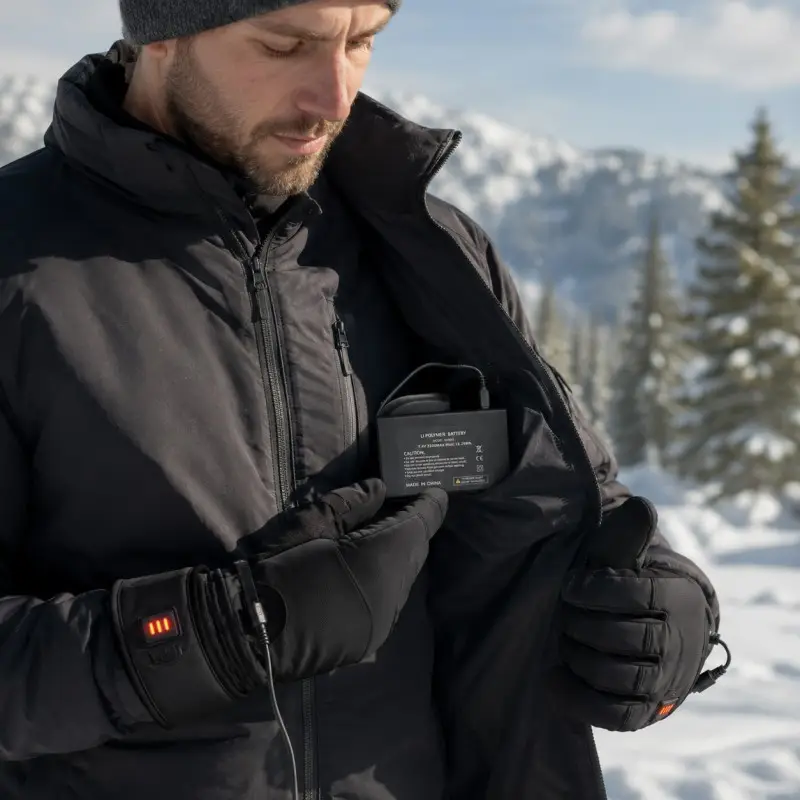
A 7.4V rechargeable battery for heated gloves and apparel provides compact and reliable power for wearable heating systems used in cold-weather environments. It can be integrated into heated gloves, jackets, vests, socks, trousers, scarves, and other electrically heated garments designed for outdoor recreation, winter work, commuting, and daily comfort.
Unlike disposable batteries, a rechargeable lithium-ion battery pack can be charged and reused many times. This makes it a practical option for users who frequently rely on heated clothing. For product manufacturers, the right battery pack also helps balance heating performance, operating time, weight, comfort, and safety.
How a 7.4V Heated Apparel Battery Works
A 7.4V lithium-ion battery pack normally uses two lithium-ion cells connected in series. This configuration is commonly called a 2S battery pack. The nominal voltage is 7.4V, while the fully charged voltage is generally 8.4V.
When the battery is connected to heated apparel, electrical energy passes through built-in heating elements. These elements convert electricity into heat and distribute it across selected areas of the garment. Heated gloves may place heating elements around the fingers and back of the hand, while heated jackets and vests commonly focus on the chest, back, neck, or pocket areas.
Many heated garments include multiple temperature settings. A high setting provides stronger heat but consumes battery energy more quickly. Medium and low settings reduce power consumption and can extend operating time. Actual runtime depends on battery capacity, heating power, temperature level, ambient conditions, garment insulation, and control-circuit efficiency.
Why Lithium-Ion Batteries Suit Heated Clothing
Lithium-ion technology is widely used in wearable electronics because it provides relatively high energy density in a compact and lightweight format. This is particularly important for heated apparel, where a bulky battery can affect comfort and restrict movement.
A properly designed rechargeable battery can fit inside a garment pocket, wrist pouch, belt compartment, or other dedicated battery holder. The pack should be light enough for extended wear but powerful enough to support the heating system under normal operating conditions.
Lithium-ion batteries also offer stable voltage output during much of the discharge cycle. Consistent power helps the heating elements deliver more predictable performance. However, the battery must be matched correctly with the apparel’s voltage, current, connector, and control system.
Using an incompatible battery may result in insufficient heating, reduced runtime, circuit damage, excessive current, or other safety risks. Manufacturers should therefore treat the battery and heated garment as one complete power system rather than two unrelated components.
Applications in Heated Gloves and Winter Apparel
Heated gloves are one of the most common applications for a 7.4V rechargeable battery pack. They are used by skiers, snowboarders, cyclists, motorcyclists, hunters, hikers, outdoor workers, and people who spend long periods in cold environments.
Because gloves have limited internal space, the battery must be compact and shaped for comfortable placement near the wrist or cuff. Cable routing, connector orientation, pouch design, and battery weight can all influence the user experience.
Heated jackets and vests generally provide more installation space and may use higher-capacity battery packs for longer runtime. These garments are suitable for construction workers, warehouse personnel, delivery drivers, security teams, campers, winter sports participants, and commuters.
Other potential applications include heated socks, insoles, trousers, knee wraps, waist belts, scarves, blankets, seat pads, and outdoor cushions. Each product has different requirements for voltage, current, operating time, dimensions, and environmental protection.
Battery Capacity and Heating Runtime
Battery capacity is usually measured in milliamp-hours, or mAh. A higher-capacity battery can generally support longer operation, but it will also be larger and heavier.
Manufacturers should not select a battery based only on capacity. The heating system’s power consumption must also be considered. A garment running at maximum temperature may consume energy much faster than the same garment operating at a low setting.
Cold weather can also reduce the available performance of lithium-ion batteries. Since heated apparel is specifically designed for low-temperature environments, the battery should be evaluated under realistic winter conditions rather than only at room temperature.
During product development, testing should include different temperature modes, repeated heating cycles, low-temperature discharge, charging performance, temperature rise, and automatic shutdown behavior. These tests provide a more accurate understanding of the final user runtime.
Essential Safety Protection
Safety is a critical requirement for any battery worn close to the body. A properly engineered 7.4V battery pack should include a protection circuit designed for the selected cells and application.
Common protection functions include overcharge protection, over-discharge protection, overcurrent protection, and short-circuit protection. Some designs may also include temperature monitoring or additional safeguards based on the heating system’s requirements.
The battery enclosure, wires, connectors, insulation, and protection board must withstand normal movement during use. Heated gloves and clothing may experience bending, vibration, pulling, sweat, moisture, and accidental impact. Mechanical design is therefore just as important as electrical performance.
Users should never operate a battery that is swollen, leaking, damaged, unusually hot, or affected by water. The battery should be charged only with a compatible charger that follows the required charging voltage and current.
Charging and Daily Use
Most 7.4V heated apparel batteries require a charger designed for two-series lithium-ion cells. Since the fully charged voltage is typically 8.4V, the charging system must be selected accordingly.
A charging indicator can help users understand when the battery is charging and when it has reached full capacity. Some battery packs may also include power-level indicators, buttons, or integrated output controls.
For daily use, the battery should be removed from the garment before washing unless the product is specifically designed otherwise. The connector should be disconnected carefully without pulling directly on the wires.
When storing the battery for an extended period, it is generally better to avoid leaving it completely discharged. Storage conditions should be dry, cool, and away from direct sunlight, fire, heaters, and other high-temperature sources.
Custom Battery Packs for Heated Apparel Manufacturers
Heated clothing brands often require customized batteries because garment structures and heating systems vary significantly. A custom battery pack can be developed according to the available pocket size, required capacity, discharge current, connector type, cable length, housing design, charging port, and branding requirements.
Manufacturers may also need different capacities for entry-level, standard, and extended-runtime products. Heated gloves may prioritize small dimensions and low weight, while jackets and vests may accommodate larger packs.
Before battery development begins, the supplier should receive detailed information about the garment’s operating voltage, maximum current, heating power, temperature levels, expected runtime, installation space, connector specification, and target market.
Prototype samples should be tested with the actual heated garment. This helps confirm physical fit, electrical compatibility, heating performance, runtime, temperature control, and charging reliability before mass production.
Conclusion
The 7.4V rechargeable battery for heated gloves and apparel is an essential power source for modern wearable heating products. Its compact lithium-ion design can provide stable energy for gloves, jackets, vests, socks, and other winter gear without placing excessive weight on the user.
Successful battery integration requires more than selecting a voltage and capacity. Cell quality, discharge performance, protection functions, connector compatibility, mechanical durability, charging design, and low-temperature behavior must all be considered.
With proper customization and complete-system testing, a 7.4V rechargeable lithium-ion battery pack can help heated apparel manufacturers deliver safe, comfortable, and dependable warmth for outdoor work, winter sports, travel, and everyday cold-weather use.
Talk to the Manufacturer
Resources & Insights
High Capacity Lithium Battery for Wearables: High-Voltage LiPo Cell Design
2026-10-19
Cylindrical Battery Packs for Laptops: 2S vs 3S vs 4S Battery Design
2026-10-19
Stage Lighting Battery Pack: Prevent Voltage Drop & LED Flicker
2026-10-19

Best Rechargeable Batteries for Smart Devices: Performance, Safety, and Selection Guide
2026-10-19


