


 Home /
 Custom Battery Pack for Smart Parcel Lockers: Connected Terminal Power


Table of Contents
- Which Battery Requirements Should You Capture First?
- How to Estimate Autonomy from the Locker Load Profile
- Which Battery Chemistry and Form Factor Fit a Parcel Locker?
- How Electrical Architecture Affects the Pack Design
- Why a Parcel-Locker Battery Needs the Right BMS and Charging Profile
- How to Handle Mechanical, Thermal, and Environmental Requirements
- What Documentation and Validation Should You Request?
- How to Build a Battery-Pack RFQ and Evaluate Suppliers
- Summary and Next Steps
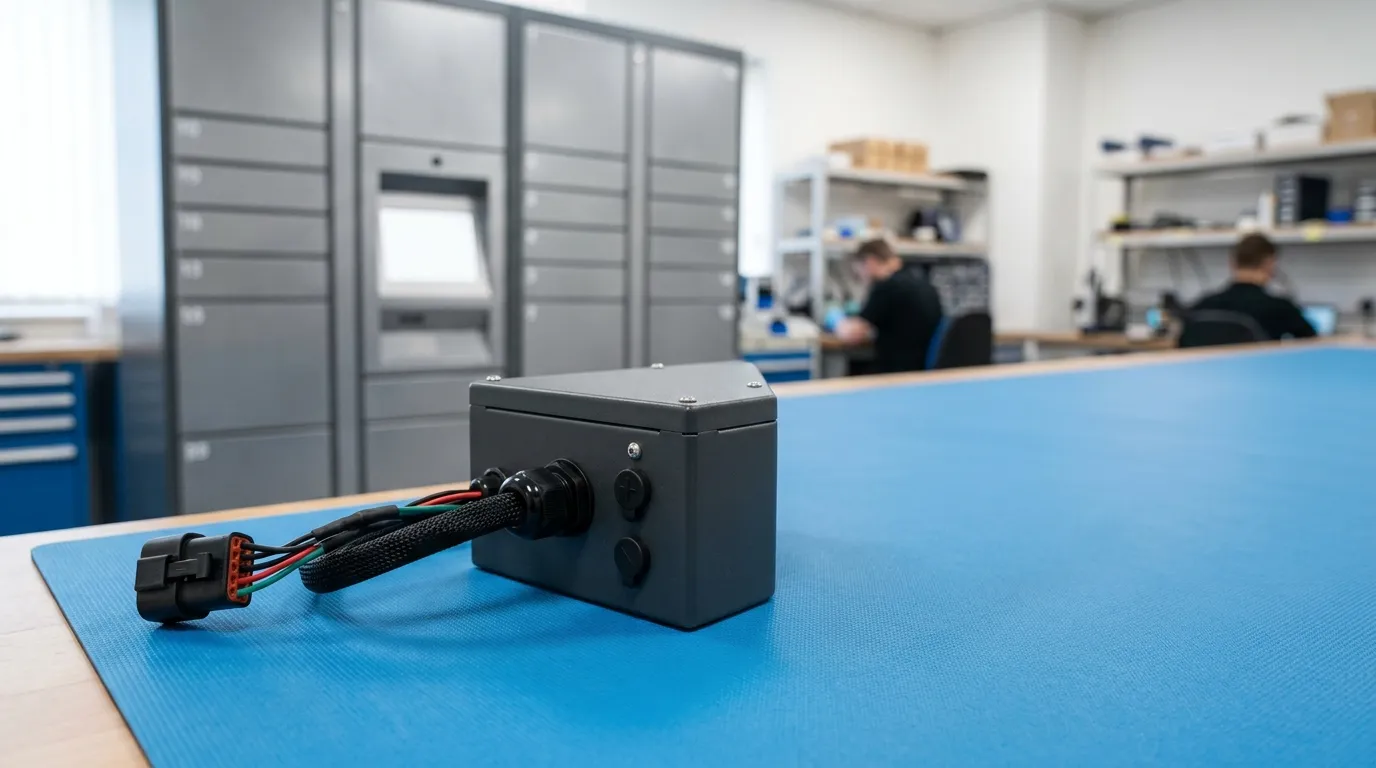
A custom battery pack for a smart parcel locker is an application-specific rechargeable power source sized from the locker's standby and peak electrical loads, required autonomy, charging method, environmental conditions, mechanical envelope, and protection or communications requirements. Unlike a generic off-the-shelf battery, a custom pack is engineered to match the locker's actual duty cycle and installation constraints.
Battery-powered parcel lockers fill a real gap in last-mile delivery: they allow lockers to operate where trenching for grid power is impractical, expensive, or temporarily unavailable. The engineering question is not simply "how big a battery do I need" but "how do I translate locker behavior into a battery specification that a supplier can build, test, and document."
Which Battery Requirements Should You Capture First?
Before contacting a battery supplier, document how the locker actually consumes power. The battery pack must be specified from a load profile, not from a guess at capacity.
Capture these inputs:
- Standby load. The continuous current drawn by the controller, sensors, and any always-on electronics. In most connected lockers, standby current dominates long-term energy consumption.
- Active loads. Displays, scanners, card readers, and lighting that operate intermittently.
- Peak loads. Lock actuators, motors, and cellular or Wi-Fi radios can draw short but high current pulses. These peaks determine the pack's current capability, not just its capacity.
- Event frequency. How many times per hour or per day do locks cycle, screens wake, or radios transmit?
- Required autonomy. How long must the locker operate between charges? This is typically stated in days, not hours.
- Charging method. Is there grid access for recharging? Is solar charging being considered? What is the available charge time and charge current?
- Environmental conditions. Indoor or outdoor installation? Expected temperature range, humidity, and any risk of water ingress.
- Mechanical constraints. Available enclosure space, mounting orientation, connector type, and whether the battery must be field-replaceable.
For low-power connected electronics such as locker sensors and monitoring nodes, a rechargeable battery for iot sensors may be a relevant reference point — but a full parcel locker with actuators and radios demands a complete load profile, not just a sensor-level estimate.
A complete load profile gives a battery supplier the data needed to propose chemistry, cell count, and pack architecture. Without it, any capacity or runtime figure is an assumption.
How to Estimate Autonomy from the Locker Load Profile
Runtime is determined by usable energy, not by rated capacity. A pack's capacity in ampere-hours (Ah) only describes charge quantity. The energy in watt-hours (Wh) — voltage multiplied by capacity — is what actually powers the locker, and the usable portion of that energy depends on discharge current, temperature, and the system's cutoff voltage.
The relationship is straightforward in concept:
- Capacity (Ah) tells you how much charge the pack holds.
- Energy (Wh) tells you how much work the pack can do.
- Usable energy is less than rated energy because voltage sags under load and falls as the pack discharges.
Two factors commonly cause runtime shortfalls in parcel-locker deployments:
- Voltage sag. When a lock actuator or radio draws high current, internal resistance causes the pack voltage to dip. If voltage drops below the locker's minimum operating threshold, the system may reset or fail to actuate — even though the pack still holds charge.
- Temperature derating. Discharge at low temperatures reduces available energy and increases internal resistance. A pack sized for a climate-controlled indoor lobby may not deliver the same autonomy in an unheated outdoor enclosure.
Because of these effects, autonomy should be calculated from the locker's real duty cycle, not from the pack's rated capacity. A supplier can help model this, but the buyer must provide the load profile and the operating conditions.
Chemistry choices also influence this calculation. Li-ion and LiFePO4 packs behave differently under load and at temperature extremes. The next section lays out the trade-offs.
Which Battery Chemistry and Form Factor Fit a Parcel Locker?

The right chemistry depends on the locker's load profile, environment, charging method, space, and lifecycle cost. There is no universal best choice.
| Chemistry | Typical Advantages | Typical Limitations |
|---|---|---|
| Li-ion (lithium-ion) | High energy density; mature supply chain; flexible voltage and capacity options | Requires protection circuitry; performance derates at low temperatures |
| Li-polymer (LiPo) | Thin or shaped form factors; useful when enclosure space is irregular | Requires protection and careful mechanical design; often lower energy density than cylindrical cells |
| LiFePO4 (lithium iron phosphate) | Long cycle life; more stable thermal and chemical profile; good for stationary outdoor use | Lower nominal voltage than Li-ion; different charger and BMS requirements; generally heavier or larger for the same energy |
Form factor matters as much as chemistry. Cylindrical cells are common in larger packs because they are mechanically robust and widely available. Pouch cells can fit shallow or irregular spaces inside a locker enclosure. For designs where the pack must fit a slim or unusually shaped compartment, a lipo battery for wireless monitoring systems offers a useful example of how pouch-cell flexibility applies to connected hardware.
The trade-off is usually between energy density, shape flexibility, mechanical protection, and cost.
The chemistry and form-factor decision also affects the charger, BMS, and thermal design, which is why the pack's architecture must be considered as a system.
How Electrical Architecture Affects the Pack Design
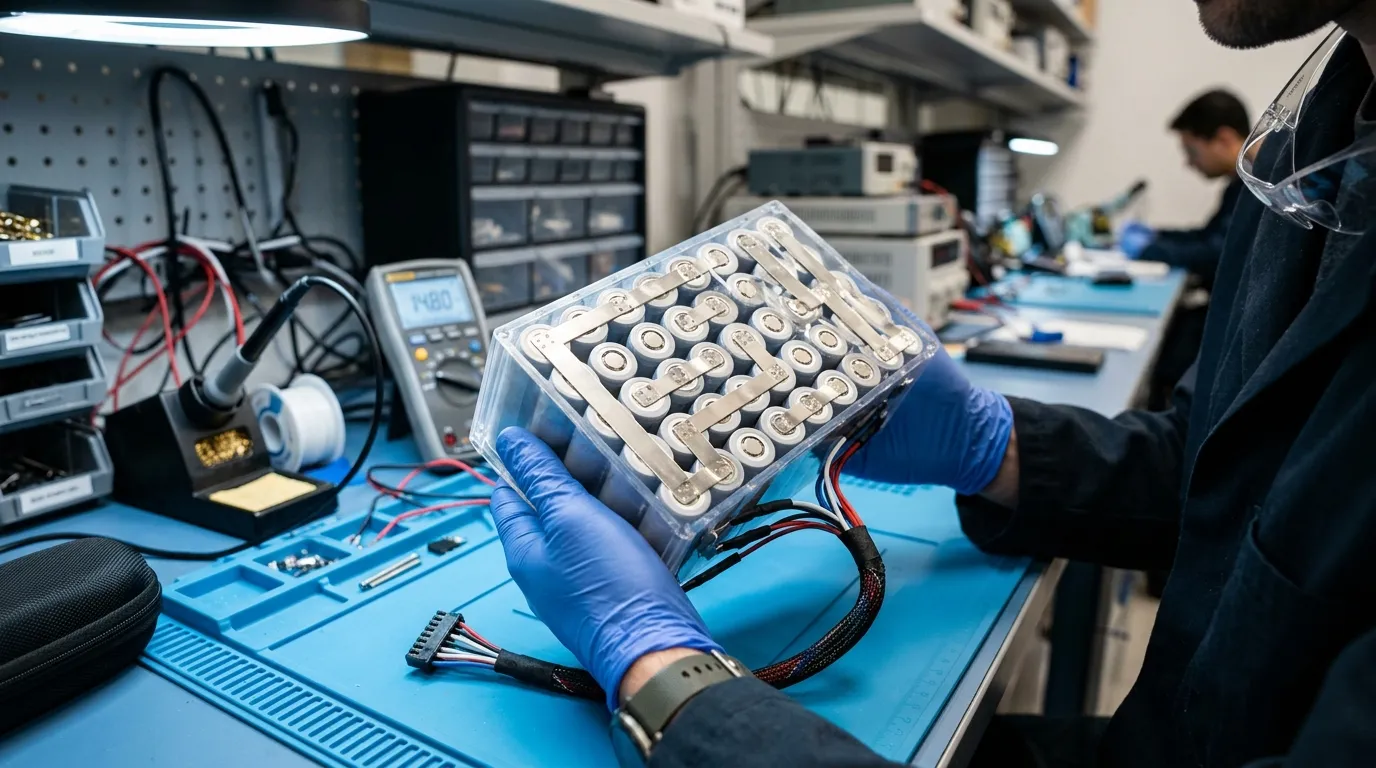
A battery pack is more than a collection of cells. Its electrical architecture — series and parallel configuration — determines voltage, capacity, and current capability.
- Series count (S) determines voltage. Each series cell adds to the nominal and maximum pack voltage. The pack voltage must match the locker's input range.
- Parallel count (P) affects capacity and available current. Adding parallel strings increases ampere-hour capacity and can improve current delivery, but it also increases complexity and cell-matching requirements.
Three specification pairs are frequently confused:
- Nominal voltage vs. maximum charge voltage. Nominal voltage is the average operating voltage; maximum charge voltage is the limit applied during charging. Li-ion and LiFePO4 have different values for both.
- Continuous vs. peak current. Continuous current is sustained draw; peak current is a short-duration pulse. The pack and BMS must be rated for both, with the peak value including its allowed duration.
- Capacity (Ah) vs. energy (Wh). Two packs with the same Ah rating can have different energy if their nominal voltages differ.
Multi-cell packs also require cell matching — cells with closely matched capacity and internal resistance. Mismatched cells degrade faster and reduce usable pack capacity. A reputable supplier should control this during pack assembly.
The electrical architecture must also account for voltage sag. During a peak load, cell internal resistance causes a voltage drop. If the locker's electronics have a narrow input range, the pack may need more parallel cells, a different cell type, or a higher nominal voltage to keep the sag above the cutoff.
Why a Parcel-Locker Battery Needs the Right BMS and Charging Profile
Most lithium-based packs require at least a protection circuit module (PCM), which guards against overcharge, over-discharge, overcurrent, and short-circuit. A full battery management system (BMS) goes further, adding cell balancing, temperature monitoring, and, in smart packs, state-of-charge reporting.
| Function | PCM (basic protection) | BMS (full management) |
|---|---|---|
| Overcharge / over-discharge protection | Yes | Yes |
| Overcurrent / short-circuit protection | Yes | Yes |
| Cell balancing | No | Yes |
| Temperature monitoring | Limited | Yes |
| State-of-charge reporting | No | Often yes |
| Communication (SMBus, I2C, CAN, etc.) | No | Optional |
For a parcel locker that must report remaining battery life to a central system, a smart BMS with a fuel gauge may be necessary. The fuel gauge estimates state of charge and remaining runtime, which allows remote maintenance planning. If the locker controller does not need battery telemetry, a simpler protection circuit may be sufficient.
Communication protocols are not universal. If the locker requires battery data over SMBus, I2C, CAN, RS485, or Bluetooth, that must be specified in the RFQ. Do not assume a supplier's standard pack supports a given protocol.
In some parcel-locker designs, long-range connectivity is handled by LoRaWAN-based sensing and monitoring. For those deployments, a Custom battery pack for LoRaWAN sensors may be relevant to the communications subsystem, but the main locker battery must still be specified from the full system load profile.
The charger must match the pack's chemistry and series count. Charging a Li-ion pack with a LiFePO4 profile, or vice versa, can damage cells or create a safety hazard. The charging current and charge voltage must be defined in the specification, along with the connector and any charging temperature limits.
How to Handle Mechanical, Thermal, and Environmental Requirements
A battery pack is a mechanical component as much as an electrical one. The enclosure must fit the locker's available space, protect the cells from impact and contamination, and allow heat to move away from the cells during discharge and charging.
Define the following in the specification:
- Envelope dimensions. The pack must fit the locker's battery compartment with allowance for connectors, wiring, and mounting.
- Mounting. Will the pack be screwed, clipped, or held in a tray? Is it field-replaceable?
- Connector and wiring. The connector must be rated for the continuous and peak current. Wire gauge and polarity must be documented.
- Thermal path. Cells generate heat during charge and discharge. In a sealed enclosure, heat may need to be conducted to the locker chassis or removed through ventilation.
- Ingress protection. If the locker is outdoors, an IP rating may be required. An IP rating is a tested standard, not a synonym for "waterproof." The specific rating must be stated and verified.
Temperature limits must be specified for three separate conditions:
- Charge temperature. The range within which the pack may be safely charged.
- Discharge temperature. The range within which the locker will draw power.
- Storage temperature. The range for the pack when not in service.
These ranges are not identical. A pack that discharges at -20°C may not accept a charge at the same temperature. The specification must separate them.
What Documentation and Validation Should You Request?
Battery documentation matters for safety, transport, and market access. Request these from the supplier and verify their scope:
| Document Type | What It Should Show |
|---|---|
| Datasheet / TDS | Exact model, voltage, capacity, energy, current ratings, dimensions, weight, connector, temperature limits, and test conditions |
| SDS / MSDS | Handling, storage, and transport safety information |
| UN38.3 test summary | Lithium-battery transport testing for the specific product shipped |
| IEC / UL / CB report | Safety testing for a defined model, standard edition, and construction scope |
| Quality-system certificate | Company-level scope (e.g., ISO 9001), not product certification |
Two distinctions are critical:
- Product certification vs. company certification. A company quality certificate does not certify a specific battery model. An IEC or UL report applies to a defined product construction.
- UN38.3 vs. product safety testing. UN38.3 supports transport. It is not the same as an IEC or UL product safety report.
Any certification document should identify the product model, standard edition, issuing body, and legal entity covered. If the document does not clearly match the product, it is not sufficient evidence.
How to Build a Battery-Pack RFQ and Evaluate Suppliers
A good RFQ prevents misunderstandings. Provide the supplier with the full context, and ask for specific evidence in return.
Include in the RFQ:
- Load profile. Standby current, active load, peak current with duration, and event frequency.
- Autonomy target. Required days of operation between charges, with the operating conditions stated.
- Charging method. Grid, solar, or hybrid; available charge time; charger voltage and current.
- Environmental conditions. Indoor or outdoor, temperature range, humidity, and any IP requirement.
- Mechanical constraints. Envelope, mounting, connector, and serviceability.
- Target documentation. Datasheet, SDS/MSDS, UN38.3 summary, and applicable model-specific reports.
- Commercial terms. MOQ, lead time, tooling/NRE, warranty, and change-control process.
When evaluating suppliers, ask:
- Can they provide a prototype or sample for real-load validation before mass production?
- Do they control cell sourcing and cell matching?
- How will design or material changes be communicated and approved?
- What batch traceability records will they maintain?
- Are their certifications and transport documents matched to the exact model being supplied?
For a connected device like a smart parcel locker, the prototype stage is not optional. A pack that looks correct on paper may fail in the field due to voltage sag, thermal buildup, or a connector mismatch. Validate before committing to volume production.
Summary and Next Steps
A custom battery pack for a smart parcel locker cannot be specified from a capacity figure alone. It must be engineered from the locker's load profile, autonomy target, charging method, environment, mechanical space, and documentation requirements.
The specification workflow is:
- Capture the load profile and duty cycle.
- Define autonomy and charging assumptions.
- Select chemistry and form factor.
- Define voltage, capacity, energy, and S/P architecture.
- Specify BMS, communication, and charger requirements.
- Define mechanical, thermal, and environmental constraints.
- Request the correct documentation and validation evidence.
If you are at the stage of defining or sourcing a battery pack for a parcel-locker project, the next step is to document your load profile, environment, and mechanical constraints — then discuss the architecture, validation, and documentation requirements with a custom-battery partner.
Talk to the Manufacturer
Resources & Insights

High Capacity Lithium Battery for Wearables: High-Voltage LiPo Cell Design
2026-10-19
Cylindrical Battery Packs for Laptops: 2S vs 3S vs 4S Battery Design
2026-10-19
Stage Lighting Battery Pack: Prevent Voltage Drop & LED Flicker
2026-10-19

Best Rechargeable Batteries for Smart Devices: Performance, Safety, and Selection Guide
2026-10-19


