


 Home /
 Lithium Battery for Portable Inspection Lamps: Industrial Runtime Guide


Table of Contents
- What Makes an Inspection Lamp Battery Different
- How to Calculate Runtime for a Portable Inspection Lamp
- Pack Architecture and Voltage: What the Pack Must Deliver
- Battery Chemistry and Form Factor: Li-ion, LiPo, and LiFePO4 Compared
- Continuous and Peak Current: Preventing Dimming and BMS Trips
- Protection, BMS, and Charger Compatibility
- Mechanical and Environmental Design Limits
- How to Verify a Supplier's Runtime and Documentation Claims
- Key Specifications to Include in Your Inspection-Lamp Battery RFQ
- Why Work with a Custom Battery Pack Manufacturer
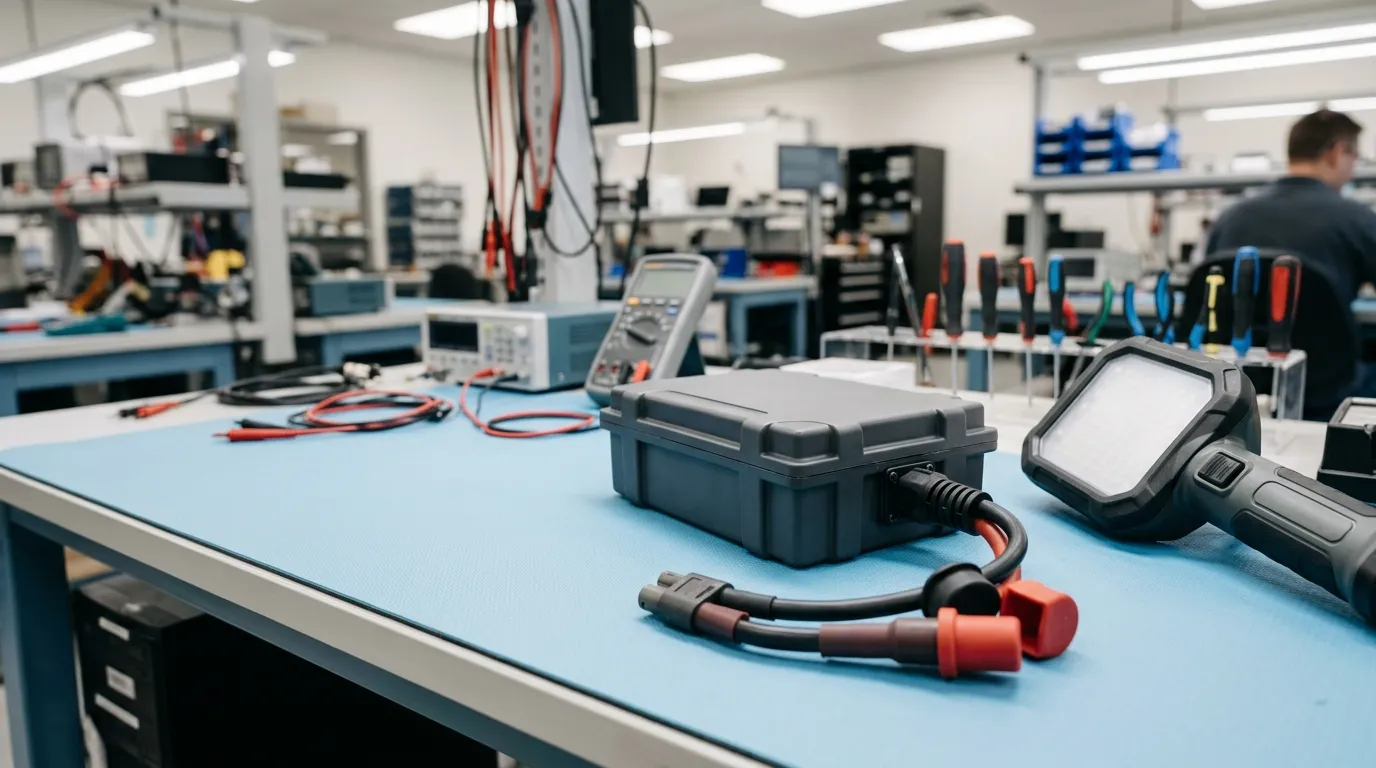
Selecting the right lithium battery for a portable inspection lamp means matching the pack's usable energy and current capability to the lamp's measured LED power draw and runtime target, then verifying that the charger, protection circuitry, enclosure, temperature limits, and transport documentation all align with the design. Runtime is not a fixed battery property — it is the result of a calculation that depends on lamp load, battery voltage and capacity, usable depth of discharge, efficiency, temperature, and the brightness mode being tested.
This guide explains how to size a lithium battery pack for an industrial inspection lamp, how to compare chemistries and form factors, and what documentation you should request from a supplier before approving a pack for production. For a broader view of battery options across portable lighting applications, see our guide to lithium ion battery for mobile lighting.
What Makes an Inspection Lamp Battery Different
A portable inspection lamp is not the same load as a flashlight or a headlamp. Industrial inspection lamps are often used for extended periods — sometimes for a full shift — at high brightness, in environments that may be cold, dusty, or subject to vibration. The battery must therefore be sized for sustained current draw, not just occasional pulses.
Three factors separate an inspection-lamp battery specification from a general-purpose portable-lighting battery:
- Runtime target. The lamp must run for a defined number of hours at a defined brightness mode, not simply "as long as possible."
- Continuous current. The pack must supply the lamp's operating current for the full runtime without excessive voltage sag or BMS intervention.
- Environmental limits. Charge, discharge, and storage temperatures must match the working environment, and the enclosure must protect the cells from shock, dust, and moisture.
These requirements affect every downstream choice: chemistry, cell format, series/parallel configuration, protection, charging, and documentation.
How to Calculate Runtime for a Portable Inspection Lamp
Runtime is the most important specification in an inspection-lamp battery, but it is meaningless without conditions. A battery does not have a single runtime. It has a runtime under a stated load, at a stated temperature, to a stated cutoff voltage, at a stated state of health.
Use this simple calculation as the starting point:
Runtime (hours) ≈ (Usable battery energy in Wh) ÷ (Lamp power draw in W) × System efficiency
To calculate usable battery energy:
Usable energy (Wh) = Capacity (Ah) × Nominal voltage (V) × Usable depth of discharge
The watt-hour rating itself is calculated as capacity in ampere-hours multiplied by nominal voltage, which is the definition used in international lithium-battery transport guidance from organizations such as IATA.
For example, a lamp that draws 10 W from a 7.4 V pack with 3 Ah of usable capacity would theoretically run for:
- Usable energy = 3 Ah × 7.4 V = 22.2 Wh
- Runtime = 22.2 Wh ÷ 10 W = 2.22 hours
In practice, the runtime will be shorter because of the usable depth of discharge (typically 80–90% for lithium-ion), the lamp's driver efficiency, connector losses, and the pack's internal resistance. Always validate the calculated runtime with a prototype test.
Why Capacity (mAh) Alone Is Not Enough
Capacity in milliamp-hours (mAh) or amp-hours (Ah) tells you how much charge a battery stores, but it does not tell you how much energy it delivers. A 5 Ah pack at 3.7 V stores 18.5 Wh. A 5 Ah pack at 7.4 V stores 37 Wh. The second pack holds twice the energy even though the mAh number is identical.
When comparing batteries for an inspection lamp, compare watt-hours (Wh), not milliamp-hours. If a supplier quotes only mAh, ask for the nominal voltage and the Wh figure.
Runtime Depends on Brightness Mode
Most inspection lamps have multiple brightness modes. A lamp may run for 8 hours at low mode but only 2 hours at high mode. The runtime specification must state which mode was used, the lamp's actual power draw in that mode, and the temperature during the test. If a supplier says "8-hour runtime" without these conditions, the claim is incomplete.
Pack Architecture and Voltage: What the Pack Must Deliver
A battery pack is not a single cell. It is a configured assembly of cells, protection electronics, wiring, a connector, and an enclosure designed to meet a specific voltage, capacity, current, and environmental requirement.
Series Configuration (S)
Cells connected in series add their voltages. A pack with four 3.7 V cells in series is a "4S" pack with a nominal voltage of 14.8 V. The series count determines the pack's nominal voltage and its maximum charge voltage, which must match the lamp's input voltage range and the charger's output profile.
Parallel Configuration (P)
Cells connected in parallel add their capacities and current capability. A pack with two cells in parallel is "2P." The parallel count determines how much energy the pack can store and how much current it can supply without overloading individual cells.
A common notation combines both: a "3S2P" pack has three cells in series and two cells in parallel, for a nominal voltage of 11.1 V (3 × 3.7 V) and twice the capacity of a single cell.
Why This Matters for Inspection Lamps
The lamp's LED driver and brightness modes set the voltage range. The runtime target sets the energy requirement. The current draw sets the parallel count and cell selection. An engineer cannot specify a replacement or custom pack without first defining the voltage, energy, and current requirements.
If the lamp has a connector, the pack must also match the connector type, pinout, and current rating. This is a common point of failure: a physically compatible connector may not carry the required current continuously.
Battery Chemistry and Form Factor: Li-ion, LiPo, and LiFePO4 Compared
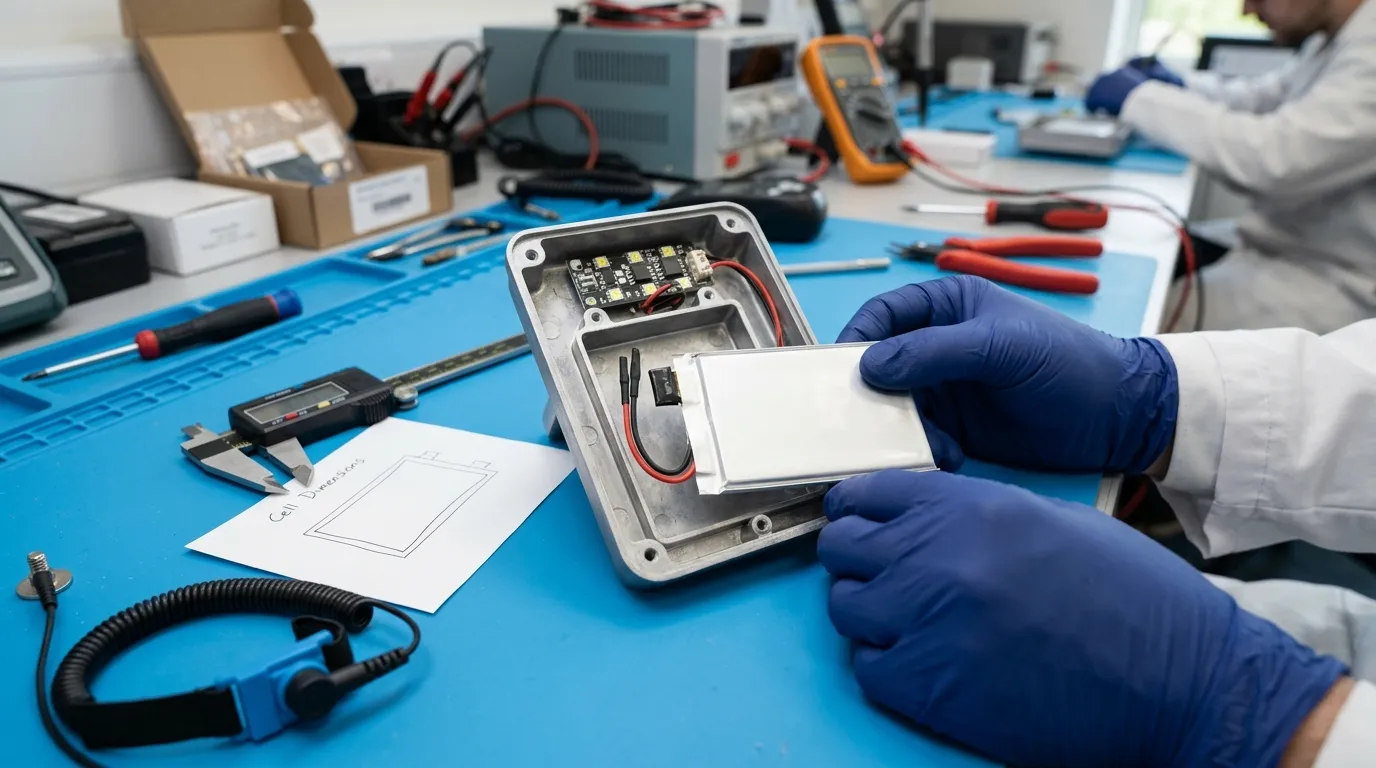
The chemistry and cell format you choose affects the pack's voltage, energy density, size, weight, current capability, cycle life, and safety behaviour.
| Chemistry / Format | Typical Nominal Voltage | Energy Density | Form-Factor Flexibility | Typical Use in Inspection Lamps |
|---|---|---|---|---|
| Cylindrical Li-ion (e.g., 18650, 21700) | 3.6–3.7 V per cell | High | Low — fixed cylinder dimensions | Good where space allows; robust; easy to service |
| Pouch Li-polymer (LiPo) | 3.7 V per cell | High | High — thin, rectangular, custom shapes | Good for slim, shaped lamp housings |
| LiFePO4 | 3.2 V per cell | Moderate | Moderate — cylindrical or pouch | Only where voltage drop and larger size are acceptable; improved cycle life and safety margins |
Cylindrical Li-ion Cells
Cylindrical cells such as 18650 and 21700 are widely used in portable equipment. They are mechanically robust, available in many capacities, and easier to cool than pouch cells because their metal case provides a thermal path. For an inspection lamp where the housing has room for cylindrical cells, they are often the practical choice.
Pouch Li-Polymer Cells
Pouch LiPo cells can be made thin and shaped to fit unusual housings. They are useful in compact lamps where thickness is a constraint. Pouch cells do not have a rigid metal case, so they require more careful enclosure design, mechanical support, and protection against puncture or swelling. For a slim industrial lamp with a tight design envelope, a custom lithium battery for headlamps shows how shaped pouch packs are approached in portable lighting. The same design thinking applies to inspection lamps.
LiFePO4
LiFePO4 offers a lower nominal voltage of about 3.2 V per cell and a lower energy density than Li-ion. It has excellent cycle life and a more stable chemistry, but a lamp designed for Li-ion voltage may need a different cell count or a different LED driver to operate correctly with LiFePO4. It is only worth considering when the lamp design can accommodate the larger volume and voltage difference, or when the application demands its specific safety and cycle-life characteristics.
For industrial equipment that uses thin pouch cells in demanding environments, see our page on industrial lithium polymer battery (inferred).
Continuous and Peak Current: Preventing Dimming and BMS Trips
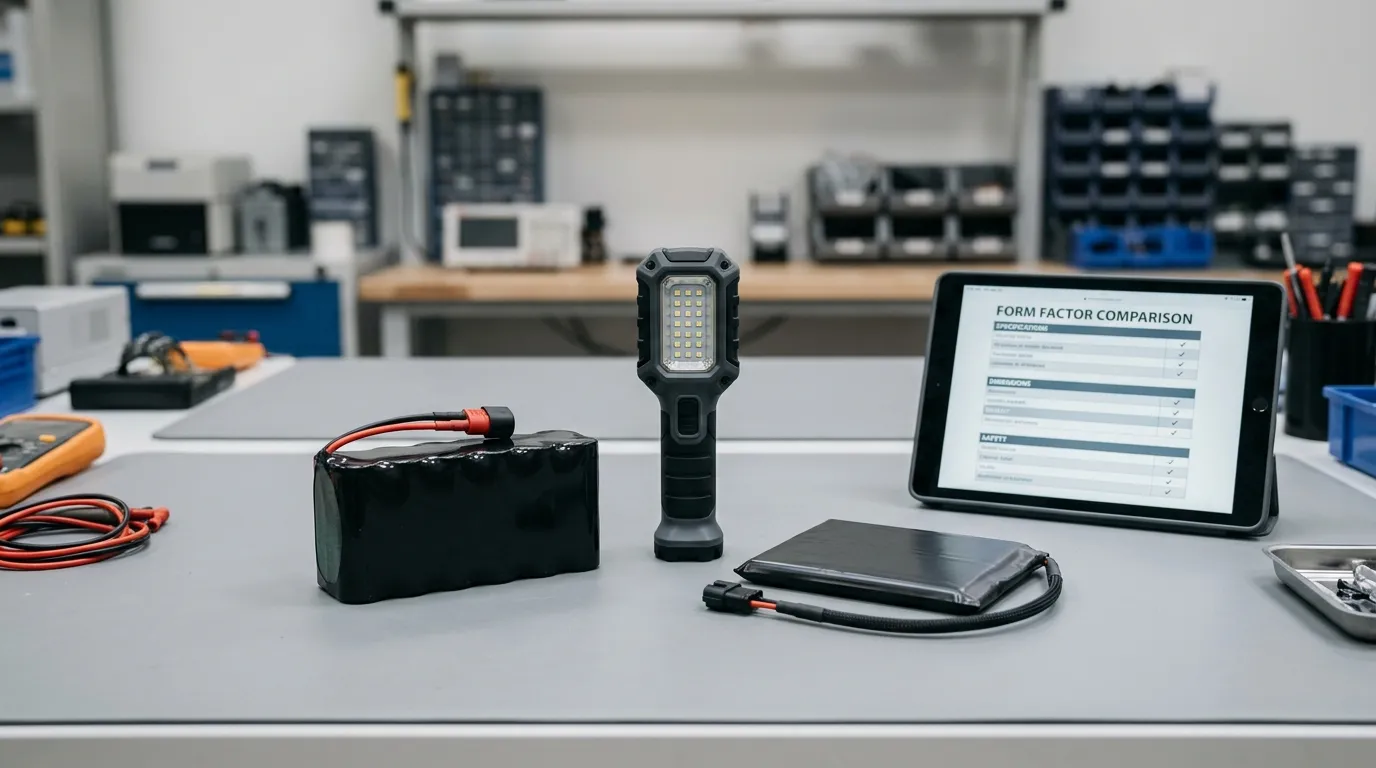
Choosing a pack with the right capacity is not enough. The pack must also supply the lamp's operating current continuously and its peak current during any transient events, such as startup or switching to a higher brightness mode.
Continuous current is the sustained current the lamp draws in normal operation. Peak current is the maximum current the pack must support for short periods. Both are measured in amperes (A).
A related term is C-rate, which describes current relative to capacity. A 1C rate for a 3 Ah pack is 3 A. A 2C rate is 6 A. C-rate is useful for comparing cells, but the actual current requirement in amperes must be matched to the lamp's measured draw.
Voltage Sag and Heat
When current flows through the cell's internal resistance, voltage drops and heat is generated. This is called voltage sag. If the sag is large enough, the lamp's LED driver may reduce brightness, or the protection circuit may cut off the pack entirely. A pack that "has enough capacity" but not enough current capability will perform poorly in a high-draw inspection lamp.
Specify the pack's continuous and peak current ratings clearly. Ask the supplier how those ratings were measured and at what temperature.
Protection, BMS, and Charger Compatibility
A lithium battery pack needs protection against overcharge, over-discharge, overcurrent, short circuit, and excessive temperature. These functions are provided by the protection circuit module (PCM) or battery management system (BMS).
PCM vs. Smart BMS
A basic PCM protects the pack by disconnecting it from the load or charger when a limit is exceeded. A smart BMS may add features such as:
- Cell balancing across series cells;
- Fuel gauging to estimate state of charge and remaining runtime;
- Communication protocols such as SMBus, I2C, UART, CAN, RS485, or Bluetooth;
- Data logging and state-of-health reporting.
These features are optional and must be specified deliberately. A smart BMS adds cost, complexity, and sometimes size. It is only justified when the lamp needs to report battery status, balance cells in a large series pack, or manage charge remotely.
Do not assume that every lithium pack includes a smart BMS. If you need balancing or fuel gauging, put it in the specification.
Charger Compatibility
The charger must match the pack's chemistry, series count, and specified charge voltage and current. A charger designed for a 3S Li-ion pack at 12.6 V will overcharge a 3S LiFePO4 pack, which charges to roughly 10.8–11 V. Use a charger specified for the exact pack.
Charging in cold conditions is another risk. Lithium batteries generally charge correctly within a narrower temperature range than they discharge. A lamp that works outside in winter may still need to be brought indoors for charging. The pack specification should state the charge, discharge, and storage temperature ranges separately.
Mechanical and Environmental Design Limits
The battery inside an inspection lamp is exposed to the same environment as the lamp. A pack intended for industrial use should be designed for shock, vibration, dust, temperature variation, and possibly moisture, depending on the lamp's ingress-protection rating.
Connector and Wiring
The connector must match the lamp's connector type, polarity, and current rating. Wire gauge must be large enough for the continuous current, and strain relief should prevent flex damage at the connection point. A detachable cord or battery pack should be specified so the user can replace it without opening the lamp housing.
Enclosure and Insulation
Pouch cells need mechanical protection from puncture, compression, and vibration. Cylindrical cells need a rigid holder that prevents movement and maintains contact. Insulation separates cells from the housing and from each other, especially when the housing is metal.
An IP rating applies to the complete lamp assembly, not automatically to the battery pack inside it. If a lamp is rated IP65 (dust-tight and protected against water jets), that does not mean the bare pack is waterproof — it means the lamp enclosure provides that protection. Keep the pack specification and the lamp enclosure specification separate.
Temperature Ranges
State three separate temperature ranges:
- Charge temperature — the range in which the pack can be safely charged.
- Discharge temperature — the range in which the pack can power the lamp.
- Storage temperature — the range in which the pack can be stored without accelerated aging.
For a lamp used outdoors or in cold industrial environments, the discharge temperature range matters most. Lithium-ion cells lose capacity at low temperature, so runtime in a cold warehouse may be shorter than runtime in a temperate workshop. The outdoor headlamp battery page covers similar outdoor design constraints for another portable lighting device.
How to Verify a Supplier's Runtime and Documentation Claims
Runtime and safety claims from a battery supplier are only as good as the documentation behind them. An engineering buyer should request, review, and keep the following items before approving a pack.
Required Documentation
| Document | What It Shows | Note |
|---|---|---|
| Datasheet / TDS (Technical Data Sheet) | Electrical, mechanical, and environmental specifications for the exact pack | Units and test conditions must be stated |
| SDS / MSDS (Safety Data Sheet) | Hazard, handling, storage, and transport information | Not a certification |
| UN38.3 test summary | Evidence that the cell/battery design passed the UN Manual of Tests and Criteria Section 38.3 transport tests | Required for lithium-battery transport; must be model- or design-specific |
| IEC/UL/CB test report or certificate | Evidence of product safety testing for a defined model and standard scope | Scope, standard edition, and issuing body must be identified |
| Product declaration | CE, RoHS, REACH, or other market documentation as required | Applicability depends on the destination market and product type |
The distinction between these documents is important. A UN38.3 test summary supports the transport of a lithium battery design. It does not certify the complete lamp or prove general product safety.
A separate product-safety standard may apply to the battery pack itself. For example, UL 62133-2 addresses portable lithium battery applications and is harmonized with IEC 62133-2:2017. A UL or IEC report applies only to the specific model, construction, and standard scope listed in the report. It is not a company-wide endorsement.
Validate with a Prototype Test
Documentation is necessary, but it is not proof that the pack meets your runtime target in your lamp. Run a prototype validation that includes:
- Runtime at the lamp's defined brightness mode;
- Runtime at the expected operating temperature;
- Charging test with the specified charger;
- Protection trigger tests (overcurrent, short circuit, over-discharge);
- Vibration or impact test if the lamp will be handled roughly;
- Capacity check before and after cycling to confirm the aging rate.
If a supplier cannot provide a datasheet with test conditions, a UN38.3 test summary for the exact design, and a clear product-safety report scope, treat the runtime claim as unverified.
Key Specifications to Include in Your Inspection-Lamp Battery RFQ
When you are ready to send a request for quotation to a battery manufacturer, include the following items so the supplier can evaluate the design properly.
| RFQ Item | What to Provide |
|---|---|
| Lamp load profile | Voltage range, LED power in each brightness mode, continuous current, peak current and duration |
| Runtime target | Required hours at each brightness mode |
| Operating environment | Discharge temperature range, charging location, exposure to water/dust/vibration |
| Pack voltage | Nominal voltage, acceptable voltage range, maximum charge voltage |
| Energy requirement | Minimum usable energy in Wh, derived from the runtime target |
| Cell format preference | Cylindrical or pouch, with dimensional constraints if known |
| Mechanical envelope | Maximum pack dimensions, weight limit, connector type, wire exit direction |
| Protection and BMS | Required protection functions; optional balancing, fuel gauge, or communication |
| Charger specification | Charger voltage, current, and connector |
| Documentation | Datasheet, SDS/MSDS, UN38.3 test summary, and applicable product-safety reports |
| Validation plan | Prototype quantity, test conditions, and acceptance criteria |
| Commercial terms | MOQ, lead time, tooling cost, warranty, and change control procedure |
A complete RFQ gives the supplier the information needed to propose a pack that fits the lamp, rather than a generic catalog battery.
Why Work with a Custom Battery Pack Manufacturer
For many inspection-lamp OEMs, an off-the-shelf battery is a compromise. A custom pack design allows the voltage, capacity, cell format, protection, connector, enclosure, and charging profile to be matched to the lamp's actual electrical and mechanical requirements. This is the standard approach for portable lighting products that need to meet a specific runtime target in a specific housing.
A manufacturer with OEM/ODM capability can support cell selection, series/parallel architecture, PCM/BMS integration, mechanical design, prototyping, testing, and documentation for production. Customization is not just about changing the capacity of a standard pack — it is about designing the entire electrical and mechanical system around the lamp.
Before requesting a custom pack, be prepared to share the lamp's load profile, runtime target, voltage range, mechanical envelope, operating environment, and required documentation. The more precise the input specification, the more accurate the proposed pack will be.
If your application is a compact portable light with tight mechanical constraints, the design approach used for a custom lithium battery for headlamps is a useful reference. For portable equipment that must run for long periods on a rechargeable pack, the sizing methods used in an outdoor speaker battery pack are equally relevant. Portable photography lighting faces the same runtime-versus-size trade-off, as explained in our guide to lithium battery for portable photography lights.
The next step is to turn the specification into a validated pack design. Share your lamp's load profile, runtime target, mechanical envelope, and documentation requirements with a battery manufacturer that can review the full electrical and mechanical picture before proposing a solution.
Talk to the Manufacturer
Resources & Insights
High Capacity Lithium Battery for Wearables: High-Voltage LiPo Cell Design
2026-10-19
Cylindrical Battery Packs for Laptops: 2S vs 3S vs 4S Battery Design
2026-10-19
Stage Lighting Battery Pack: Prevent Voltage Drop & LED Flicker
2026-10-19
Best Rechargeable Batteries for Smart Devices: Performance, Safety, and Selection Guide
2026-10-19


