


 Home /
 Lithium Battery for Laser Measurement Devices: Compact Instrument Power


Table of Contents
- What Battery Does a Laser Measurement Device Use?
- Define Your Device Requirements Before Choosing a Battery
- Cell Versus Battery Pack—Why It Matters
- Choosing the Right Chemistry: Li-Ion, LiPo, or LiFePO4
- BMS, Protection, and Charging
- Connector, Wiring, and Mechanical Fit
- Replacement Battery vs Custom OEM Pack
- Choosing a Battery Supplier: Questions to Ask
- Environmental and Temperature Considerations
- Key Takeaways
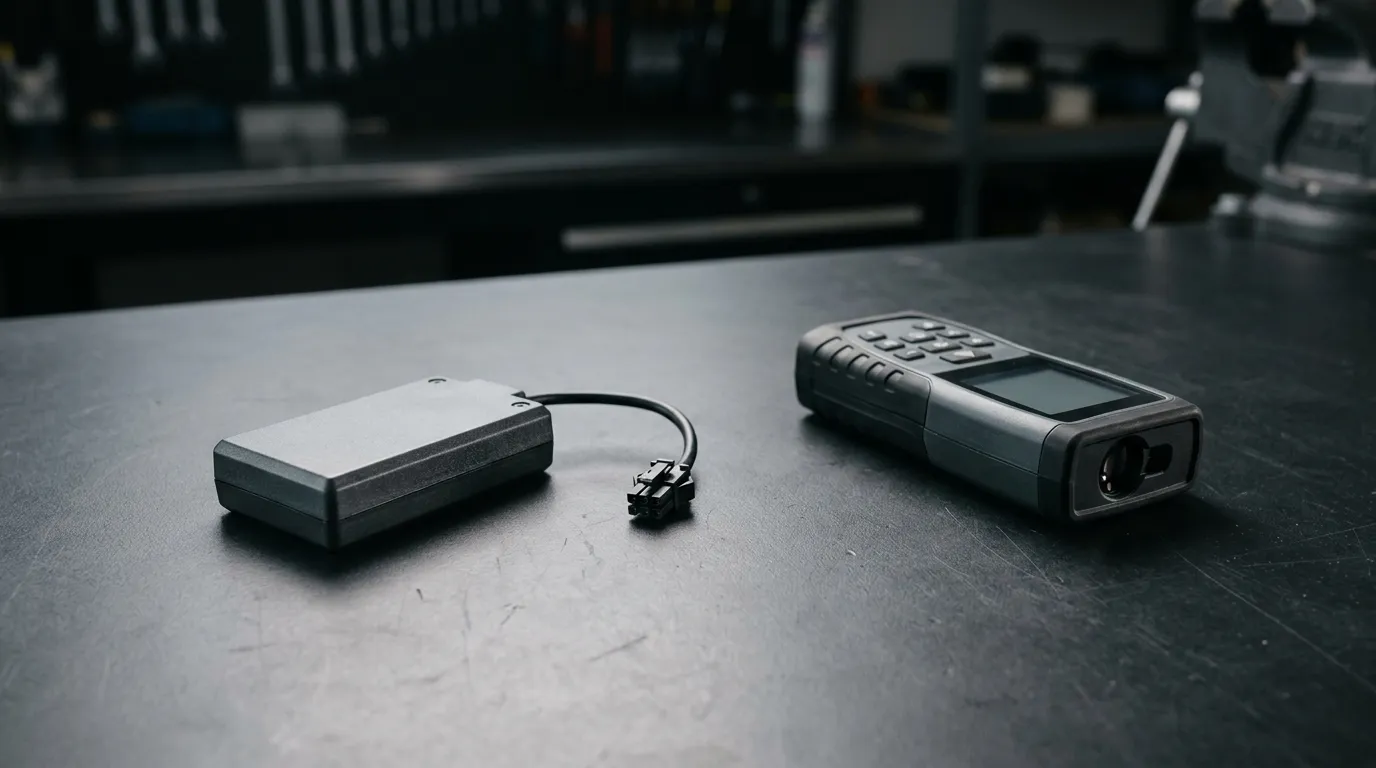
A lithium battery for a laser measurement device must be selected by voltage, energy and runtime, continuous and peak current, physical dimensions, connector type, charger compatibility, temperature range, and protection requirements—matching capacity alone is not a safe or reliable selection method. The right battery solution depends on translating the device's actual electrical and mechanical requirements into a pack-level specification, whether you are replacing an existing battery or developing a custom pack for a new instrument.
Laser measurement devices—including handheld distance meters, laser levels, and rangefinders—have become essential tools across construction, surveying, and industrial applications. These compact instruments demand power sources that balance energy density, physical fit, reliability, and safe charging. This guide explains how to specify the right lithium battery for your laser measurement device, covering everything from basic chemistry choices to supplier documentation.
What Battery Does a Laser Measurement Device Use?
Laser measurement devices typically use one of three power configurations: rechargeable lithium-ion (Li-ion) or lithium-polymer (LiPo) batteries, replaceable alkaline batteries, or a dual-system design that accepts both. The specific configuration depends on the manufacturer's design choices and the device's power requirements.
For example, some laser measure product lines include devices powered by 3.7 V lithium batteries, alkaline batteries, or both, depending on the model. Some instruments, like certain laser levels, ship with a dedicated lithium-ion battery pack and a separate charger, while also offering an optional alkaline battery tray for field flexibility. This dual-battery approach is common because it lets users choose between the long runtime of lithium and the universal availability of alkaline cells.
The key point is that the device determines the battery, not the other way around. A laser measure designed for a 3.7 V lithium cell will not operate correctly with a different chemistry or voltage platform unless the manufacturer explicitly supports it. Before choosing a replacement or designing a custom pack, you must know exactly what your device expects.
Define Your Device Requirements Before Choosing a Battery
The most common mistake in battery selection is starting with a battery catalog rather than a device specification. Every laser measurement device has a unique combination of electrical, mechanical, and environmental requirements that must be translated into battery parameters before any supplier conversation begins.
Start by documenting the following device characteristics:
- Nominal operating voltage and acceptable voltage range
- Runtime target under typical use, including standby and active measurement periods
- Continuous current draw during normal operation
- Peak current demands during laser emission, display backlight, Bluetooth transmission, or other high-draw functions
- Physical space available inside the device enclosure
- Connector type, pinout, and polarity
- Charging method—whether the battery charges inside the device or in a separate charger
- Operating temperature range, including storage conditions
- Target markets and applicable regulations
The table below maps common device requirements to the battery parameters they determine. Use it as a checklist when preparing your specification.
| Device Requirement | Battery Parameter It Determines | Why It Matters |
|---|---|---|
| Operating voltage range | Nominal voltage, series cell count | A voltage mismatch can prevent startup or damage the device |
| Runtime target | Capacity (mAh/Ah) and energy (Wh) | Higher capacity extends runtime but may not fit the enclosure |
| Continuous operation current | Continuous discharge current rating | The pack must sustain the device's normal load without voltage collapse |
| Peak draws (laser, Bluetooth, display) | Peak/pulse current capability | Brief high-current events can trigger protection circuits or cause resets |
| Physical enclosure dimensions | Cell format and pack dimensions | A physically incompatible pack cannot be installed safely |
| Connector and polarity | Connector type, wiring, pin configuration | A connector that fits mechanically but is wired incorrectly is a safety hazard |
| Charger specifications | Charge voltage, charge current, charging protocol | A mismatched charger can overcharge, undercharge, or damage the pack |
| Operating environment | Temperature range, ingress protection, thermal management | Outdoor instruments need wider temperature tolerance than indoor-only devices |
| Target market regulations | Documentation, certifications, transport compliance | Shipping lithium batteries requires specific documentation such as UN 38.3 test summaries |
Device Load Profile and Runtime
Understanding your device's load profile is essential for selecting a battery that will perform reliably. A laser distance meter does not draw constant current—it has standby consumption, active measurement current, backlight usage, and potentially Bluetooth or wireless transmission bursts.
Runtime is not simply capacity divided by the device's average power. The relationship involves the battery's voltage, the actual current drawn, and the battery's ability to maintain voltage under load. A higher-capacity battery (mAh) does not automatically deliver proportionally longer runtime if its voltage sags under the device's peak current demands.
When a battery is subjected to a sudden high-current draw, its internal resistance causes the terminal voltage to drop. This voltage sag can be significant enough to trigger the device's low-voltage cutoff or reset the instrument entirely, even though the battery still holds charge. This is why matching just the nominal voltage and capacity is insufficient—the pack must be capable of delivering the device's peak current without excessive voltage drop.
To estimate runtime, use the following approach:
- Determine average current draw. Measure or estimate the device's current consumption during typical use, combining active measurement, display, and standby periods.
- Calculate the energy requirement. Multiply average current by desired runtime to get the required capacity in mAh (or calculate energy in Wh by also factoring voltage).
- Verify peak current capability. Check that the battery can deliver the device's maximum instantaneous current without tripping protection circuits or causing voltage sag below the device's cutoff.
- Add margin. Real-world conditions—temperature, aging, and discharge rate—reduce available capacity. A 20–30% margin is a reasonable starting point for field instruments.
Cell Versus Battery Pack—Why It Matters

A common misunderstanding is treating a single lithium cell as a drop-in replacement for a complete battery pack. These are not interchangeable concepts.
A lithium cell is the fundamental electrochemical unit—for example, a cylindrical 18650 cell or a pouch cell. It has specific voltage, capacity, current, and temperature characteristics. A single cell alone lacks the protection circuitry, wiring, connector, and mechanical enclosure needed to safely power a device.
A battery pack is an assembly that includes one or more cells connected in series and/or parallel, along with protection electronics (PCM or BMS), wiring, a connector, and usually an enclosure or wrapping. The pack is the complete, usable power source that interfaces with the device.
| Comparison Point | Single Cell | Complete Battery Pack |
|---|---|---|
| Includes protection electronics | Usually not | Yes (PCM or BMS) |
| Includes connector and wiring | No—requires external connection | Yes |
| Meets transport documentation requirements | Cell-level UN 38.3 may exist | Pack-level testing may be required depending on construction |
| Safe to install directly in a device | Only if the device is designed for a bare cell | Yes, if matched to the device |
| Provides overcharge, over-discharge, and short-circuit protection | No | Yes (through the PCM/BMS) |
For a replacement battery, you need a complete pack that matches the original's electrical, mechanical, and connector specifications. For a custom device design, the pack is engineered to fit the enclosure and meet the load profile—you do not install a bare cell unless your device design specifically accommodates one with external protection.
Choosing the Right Chemistry: Li-Ion, LiPo, or LiFePO4
The chemistry choice affects voltage, energy density, cycle life, charging behavior, temperature performance, and physical form factor. For compact laser measurement devices, the two most relevant rechargeable chemistries are lithium-ion (Li-ion) and lithium-polymer (LiPo). Lithium iron phosphate (LiFePO4) is a conditional alternative for specific requirements.
| Property | Li-ion (Cylindrical/Prismatic) | LiPo (Pouch) | LiFePO4 |
|---|---|---|---|
| Nominal cell voltage | ~3.6–3.7 V | ~3.6–3.7 V | ~3.2–3.3 V |
| Energy density | High | High, especially in thin formats | Lower than Li-ion/LiPo |
| Form factor | Rigid cylindrical or prismatic | Flexible, thin, can be shaped | Rigid cylindrical or prismatic |
| Cycle life | Good | Good | Excellent (often 2,000+ cycles) |
| Cell cost | Lower (mass-produced) | Higher | Moderate |
| Mechanical robustness | Good (metal can) | Needs enclosure protection | Good (metal can) |
| Typical use in laser devices | Common in replaceable packs | Common in compact custom packs | Used where cycle life or thermal stability is prioritized |
Li-ion cylindrical cells (such as 18650 or 21700 formats) are robust, standardized, and widely available. They offer good energy density and are commonly found in replacement battery packs for consumer laser measures. The rigid metal casing provides mechanical protection, but it also constrains the pack's shape—cylindrical cells cannot conform to irregular or ultra-thin enclosures.
LiPo pouch cells are the preferred choice when the device enclosure is thin, oddly shaped, or space-constrained. Pouch cells can be manufactured in a range of thicknesses and footprints, allowing the pack to fit tightly into a compact instrument. The trade-off is reduced mechanical protection—pouch cells need a rigid enclosure or padding to prevent puncture or damage—and they can swell over time if overcharged or aged excessively.
Pouch Cells for Compact Enclosures
For a compact laser measurement device, a LiPo pouch cell is often the most practical choice because it can be shaped to fit the available space. However, this form factor demands careful mechanical design. The pouch must be protected within the device enclosure, with sufficient clearance for slight swelling during charge and discharge cycles. Thermal management also matters—a pouch cell in a sealed, compact enclosure needs a defined thermal path to prevent excessive heat accumulation.
If your device has tight dimensional constraints, LiPo's ability to conform to the available space can be the deciding factor. Just ensure the enclosure provides adequate mechanical support and that the manufacturer's recommended charging limits are respected.
BMS, Protection, and Charging
Regardless of chemistry, a lithium battery pack intended for a portable instrument requires protection electronics. The minimum safety features are:
- Overcharge protection—prevents the pack from being charged beyond its maximum voltage
- Over-discharge protection—cuts off the pack before the cells are damaged
- Overcurrent protection—limits current to a safe level
- Short-circuit protection—disconnects the pack in the event of a short
These functions are typically handled by a protection circuit module (PCM) , which is the basic protection layer. For a single-series pack (one cell or multiple cells in parallel), a PCM is often sufficient.
For multi-series packs (two or more cells in series), additional requirements arise. Cell balancing ensures that each series cell is charged and discharged to the same state of charge, preventing one cell from being overcharged or over-discharged while the others remain within limits. A battery management system (BMS) performs this balancing function and may also provide fuel gauging, state-of-charge estimation, temperature monitoring, and communication interfaces.
The distinction matters: a basic PCM provides protection, while a smart BMS adds intelligence. The level of sophistication should match your device's needs. A simple laser distance meter with a 1S pack may only need a PCM. A sophisticated surveying instrument with a multi-series pack, communication requirements, and a need to report remaining runtime would require a BMS with fuel gauging.
Charging is equally critical. The charger must match the battery's chemistry and series count. A charger designed for a 1S Li-ion pack produces a different charge voltage profile than one for a 2S pack. Using a charger with the wrong output can lead to overcharging, cell damage, or fire risk—even if the connector fits perfectly.
When designing a device, decide whether the battery charges inside the device (with the device providing the charging circuitry) or in a separate charger. If the pack is removable and charged externally, the charger and pack must be designed as a matched pair.
Connector, Wiring, and Mechanical Fit
The electrical specification is only half the equation. The pack must physically fit the device and connect correctly.
The connector must match the device's pinout, polarity, and current rating. A connector that fits mechanically but has incorrect pin assignments can damage the device or create a short circuit. Verify the following:
- Polarity—positive and negative terminals must be correctly oriented
- Pinout—each pin must connect to the correct circuit
- Current rating—the connector must handle the device's maximum current without overheating
- Mechanical locking—the connector must stay engaged during vibration and movement
The pack's dimensions must fit the device enclosure without excessive force, which could damage cells or connectors, or excessive play, which could cause stress on wiring and connections. The wiring gauge must be appropriate for the current draw—undersized wiring heats up and can cause voltage drop.
Finally, consider the thermal path. A pack inside a sealed device must dissipate heat from both the cells and any power electronics. Blocking airflow or placing the pack against a heat-generating component can accelerate aging or, in extreme cases, create a safety risk.
Replacement Battery vs Custom OEM Pack
There are two distinct paths to obtaining a lithium battery for a laser measurement device: replacing an existing battery in a current instrument or developing a custom pack for a new or modified device.
Replacement route: If you are replacing a battery in an existing laser measure, you must match the original battery's electrical and mechanical parameters. This means the same nominal voltage, the same or higher capacity (subject to physical fit), the same connector and polarity, and the same protection requirements. It is also important to know whether the original battery is designed for a specific charger—swapping to a different chemistry or voltage platform without changing the charger can create a safety hazard.
Custom OEM route: If you are developing a new laser measurement device or modifying an existing one, a custom battery pack is engineered to your exact specifications. The process typically follows this sequence:
- Requirements capture—the device's electrical load profile, mechanical envelope, charging method, temperature range, regulatory targets, and documentation needs are documented.
- Cell selection—a chemistry and cell format are chosen based on energy density, current capability, temperature tolerance, cycle life, and physical fit.
- Pack architecture—the series/parallel configuration is defined to achieve the target voltage and capacity.
- Protection design—the PCM/BMS is specified, including protection thresholds, balancing requirements (for multi-series packs), and any communication features.
- Mechanical integration—the pack layout, enclosure, connector, wiring, and thermal management are designed to fit the device.
- Prototype build—a sample pack is built and tested for fit, electrical performance, and charging behavior.
- Validation—the prototype is tested against the device requirements, including capacity, current capability, temperature, and any applicable standards.
- Documentation—the pack is provided with a datasheet/TDS, UN 38.3 test summary (for transport), SDS/MSDS, and any additional certificates required for the target markets.
- Pilot production and scaling—the design is finalized, production processes are validated, and mass production begins under controlled quality procedures.
For a replacement battery, skip to the documentation and verification steps. For a custom pack, the full workflow applies.
Prototype, Validation, and Documentation
Before accepting a custom pack, verify that the supplier provides comprehensive documentation:
| Document | Purpose | What to Verify |
|---|---|---|
| Datasheet / TDS | Defines the pack's electrical, mechanical, and environmental specifications | Values match your requirements; units and test conditions are stated |
| UN 38.3 test summary | Demonstrates the pack has passed the UN transport tests | Test summary corresponds to the exact pack design and cell construction |
| SDS/MSDS | Provides safety and handling information | Matches the chemistry and cell manufacturer |
| Test reports (capacity, cycle, temperature) | Evidence of performance under specific conditions | Report covers the exact model and batch, not a similar product |
| Certificate (IEC/UL/CB, etc.) | Product safety certification for target markets | Certificate names the exact model, standard edition, and issuing body |
A crucial distinction: a UN 38.3 test summary is transport documentation, not product-safety certification. UN 38.3 verifies that a lithium battery can withstand the UN Manual of Tests and Criteria Section 38.3 design tests for transport. It does not certify the battery's safety in a device, the device's compliance with product safety standards, or the charger's compatibility. Product safety standards follow a different framework and may require separate evidence. For a deeper understanding of what testing and quality procedures to expect from a supplier, review our guide on lithium battery quality control and testing.
Choosing a Battery Supplier: Questions to Ask

When you are ready to engage a battery supplier—whether for a replacement pack or a custom design—ask the following questions:
- What is the exact model scope of your test reports and certificates? A certificate for one pack model does not cover another.
- Can you provide the UN 38.3 test summary for the specific pack design I am buying? Transport documentation must match the exact cell and pack construction.
- What is your cell source traceability process? Are cells from a known manufacturer, and can you trace each cell back to a production lot?
- How do you handle design changes? If a cell or BMS component changes, will you notify us and provide updated documentation?
- What is your quality agreement process? Define inspection criteria, sampling plans, and defect handling before production.
- Do you provide prototype and sample support? For a custom pack, a prototype is essential before committing to mass production.
- What are your documentation deliverables? Confirm that a datasheet/TDS, SDS/MSDS, UN 38.3 test summary, and any relevant certificates are included with the product.
- What are your MOQ, lead time, and production capacity? Ensure these align with your project timeline.
- What testing do you perform on every pack? Ask about capacity testing, aging, and final inspection procedures.
- Can you support specific temperature ranges if needed? If your instrument operates outdoors, confirm the pack's wide temperature lithium ion battery pack capabilities.
Environmental and Temperature Considerations
Laser measurement devices are often used outdoors, where temperature extremes can significantly affect battery performance. The relationship between temperature and lithium batteries is not linear—cold reduces usable capacity and increases internal resistance, while heat accelerates aging and can shorten cycle life.
When specifying a battery, consider three separate temperature ranges:
| Condition | What It Means | Why It Matters |
|---|---|---|
| Charge temperature | The range within which the pack can be safely charged | Charging a cold lithium battery can cause lithium plating and permanent damage |
| Discharge temperature | The range within which the pack can be safely discharged | Cold discharge reduces available capacity and increases voltage sag |
| Storage temperature | The range for long-term storage | Storing at high temperature accelerates capacity loss |
An instrument that must operate in freezing conditions requires a battery with documented low-temperature discharge performance. This may mean selecting a cell chemistry or grade optimized for cold operation, or accepting reduced capacity at low temperatures as a design trade-off—which is exactly why manufacturers offer wide temperature lithium ion battery pack solutions for demanding field applications.
It is also important to distinguish between a device's ingress protection (IP) rating and the battery pack's own protection. An IP65-rated laser measure has an enclosure that resists dust and water ingress—that is a device-level claim, not a battery-specific one. The battery inside still needs its own mechanical and environmental protection appropriate for the sealed enclosure. If the device is opened for battery replacement, the IP rating may not be maintained unless the battery and sealing interfaces are correctly designed.
Key Takeaways
Before contacting a battery supplier, ensure you have:
- Documented the device's voltage, runtime, current, and peak power requirements
- Defined the physical space, connector, polarity, and mounting constraints
- Identified the charging method and any charger compatibility requirements
- Confirmed the operating temperature range and any environmental protection needs
- Determined whether you need a replacement pack or a custom OEM design
- Prepared to request UN 38.3 test summaries and model-specific documentation
The right lithium battery for a laser measurement device is the one that matches every one of these requirements—not just the one with the highest mAh. A device-compatible battery must be electrically correct, mechanically compatible, safely protected, properly charged, and supported by appropriate documentation. By following this specification process and asking the right supplier questions, you can ensure your laser measurement instrument has a power source that performs reliably in the field.
If you are developing a custom battery solution for a laser measurement device or another portable field instrument, send your device requirements to the engineering team for a feasibility review and specification discussion. And if your work also involves portable safety instruments such as gas detectors, you may find our guidance on Rechargeable battery for portable gas detectors useful as a reference point—the same specification discipline applies across measurement and safety device categories.
Talk to the Manufacturer
Resources & Insights

High Capacity Lithium Battery for Wearables: High-Voltage LiPo Cell Design
2026-10-19
Cylindrical Battery Packs for Laptops: 2S vs 3S vs 4S Battery Design
2026-10-19

Stage Lighting Battery Pack: Prevent Voltage Drop & LED Flicker
2026-10-19

Best Rechargeable Batteries for Smart Devices: Performance, Safety, and Selection Guide
2026-10-19


