


 Home /
 Lithium Polymer Battery for Disposable Vape Devices: Compact Cell Design


Table of Contents
- Why a LiPo Pouch Cell Can Fit a Disposable Vape Device
- What to Define Before Choosing a LiPo Cell
- Key Electrical Specifications for a Disposable-Vape LiPo Cell
- Protection, Charging, and Mechanical Integration
- Validating the LiPo Cell and Preparing Documentation
- What to Ask a LiPo Battery Supplier
- Conclusion and Next Step

A lithium polymer (LiPo) pouch cell can be an excellent power source for a disposable vape device when its voltage, capacity, energy, continuous and peak current, charging design, and mechanical protection are matched to the device's envelope and load profile. Compactness alone does not make a cell suitable — the soft pouch format requires careful integration, protection, and validation before it can be specified with confidence.
This guide explains how device OEMs and engineers can evaluate whether a LiPo pouch cell is the right choice for a disposable vape product, what specifications to define, how to handle protection and mechanical integration, and what documentation to request from a battery supplier. For a broader look at lithium-ion options for vaping products, see our lithium ion battery for e-cigarettes guide.
Why a LiPo Pouch Cell Can Fit a Disposable Vape Device
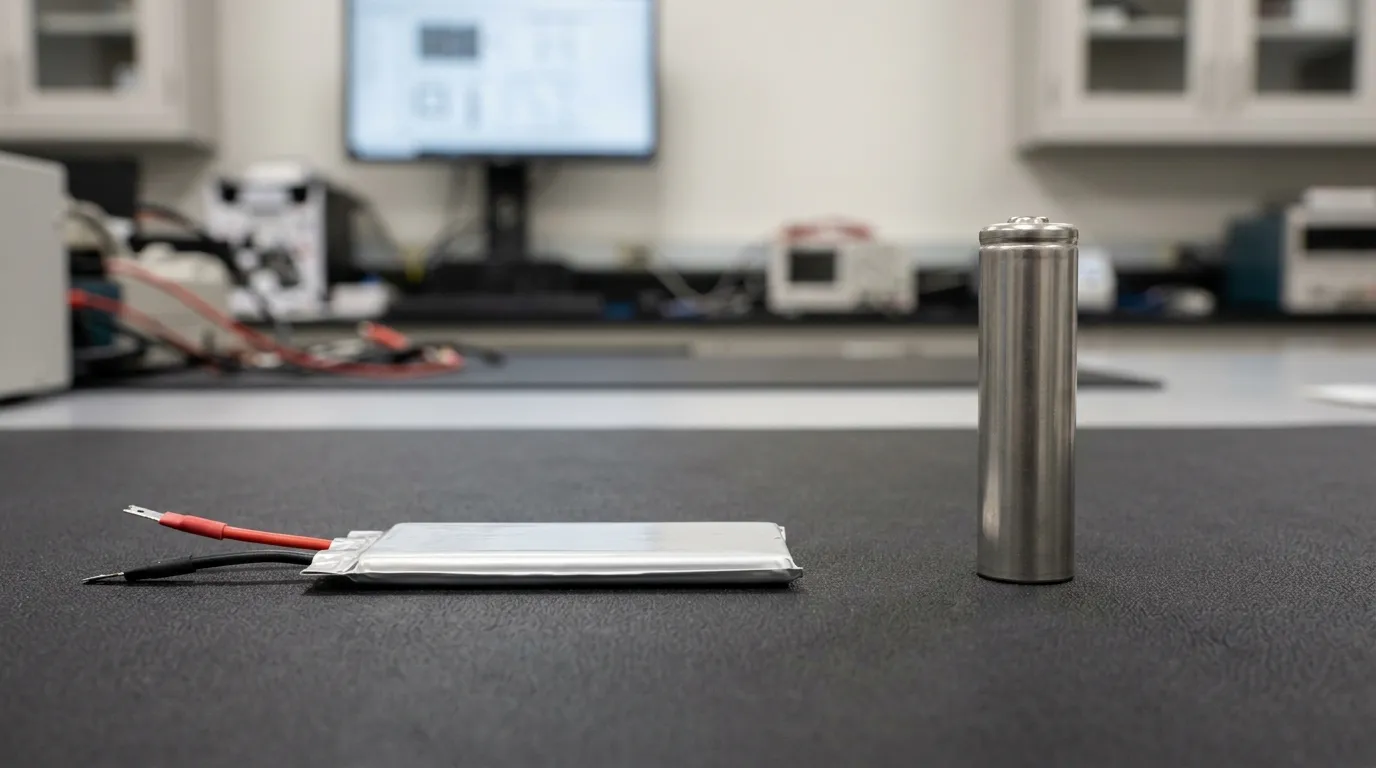
A lithium polymer cell — commonly called a LiPo pouch cell — uses a soft, foil-like laminate enclosure rather than the rigid metal can of a cylindrical cell. The electrodes are layered and sealed inside this flexible pouch, which allows the cell to be manufactured in very thin profiles and in shapes that better use the available space inside a compact device.
For a disposable vape, this construction offers several practical advantages:
- Thin geometry — the pouch can be made significantly thinner than a standard 18650 or 21700 cylindrical cell.
- Shape flexibility — the cell footprint can be customized to fit unused space around the device's electronics and e-liquid chamber.
- Weight reduction — the soft pouch and simplified construction generally reduce the overall mass of the battery component.
- Better space utilization — the device envelope can be smaller or the capacity can be increased within the same footprint.
However, the same soft enclosure creates constraints that a device designer must address. The pouch has lower mechanical strength than a metal can, so it is more vulnerable to puncture, compression during assembly, and physical damage in the finished product. Pouch cells can also swell slightly under certain conditions, such as overcharge, excessive heat, or mechanical stress. The device enclosure and assembly process must accommodate these risks.
For comparison, a cylindrical lithium-ion cell provides a rigid, robust casing and is widely available in standardized formats, but its fixed diameter and length force the device design to accommodate a round, non-flexible component. The choice between pouch and cylindrical depends entirely on the device's geometry, load, and manufacturing constraints.
What to Define Before Choosing a LiPo Cell
Before contacting a battery supplier, the device team should define the operating requirements. A battery cannot be selected from a generic specification — it has to be matched to the device it will power.
| Requirement | What to Define | Why It Matters |
|---|---|---|
| Envelope | Maximum length, width, thickness, and mass of the battery space | Determines the physical cell size and format |
| Runtime target | Expected number of puffs or total usage time | Drives the required capacity and energy |
| Heater load | Coil resistance, operating current, pulse duration, duty cycle | Determines continuous and peak current demand |
| Electronics load | Control chip, LED, display, sensor consumption | Adds to the total energy draw |
| Rechargeability | Whether the device is disposable-only or rechargeable | Changes charging and protection requirements |
| Charging source | USB, proprietary connector, or contact pins | Defines charger profile and interface |
| Temperature | Operating and storage temperature range | Affects cell selection and enclosure design |
| Connector | Terminal type, polarity, wire gauge, retention | Must match the device and carry the required current |
The heater and coil load is the most important electrical input. The coil resistance and the voltage applied to it determine the current draw, and the duty cycle of the heating pulses determines how much energy is consumed per puff. Without these numbers, no supplier can propose a reliable capacity or current rating.
Key Electrical Specifications for a Disposable-Vape LiPo Cell
Once the device requirements are defined, the battery team can translate them into electrical specifications. These parameters are not interchangeable, and each one must be stated with its test condition.
Voltage: Nominal vs Maximum Charge
The nominal voltage of a LiPo cell is the typical operating point during discharge — for most lithium-based chemistries, this is approximately 3.7 V. The maximum charge voltage is the upper limit the charger applies, commonly 4.2 V per cell for standard lithium-ion and lithium polymer chemistries.
These two values are not the same, and the charger output must be matched to the maximum charge voltage, not the nominal voltage. A charger set to the wrong voltage can reduce capacity or create a safety risk. The cutoff voltage, at which discharge stops, also matters for protection design.
Capacity, Energy, and Runtime
Capacity is the amount of charge a cell can store, measured in milliamp-hours (mAh) or amp-hours (Ah). It does not, by itself, describe how much energy the cell delivers because energy depends on voltage.
Energy, measured in watt-hours (Wh), is the more meaningful value for estimating runtime. It is calculated as:
Energy (Wh) = Nominal voltage (V) × Capacity (Ah)
For example, a cell rated at 3.7 V and 500 mAh (0.5 Ah) provides approximately 1.85 Wh before the device's conversion efficiency and voltage cutoffs are considered. The actual runtime of a disposable vape depends on the energy drawn by the heater and electronics, the efficiency of the control circuit, and the cutoff voltage of the protection system.
There is no universal conversion between a puff count and a capacity in mAh. Two devices with different coil resistances, power settings, and puff durations will consume energy at very different rates. The supplier can propose a starting capacity only after receiving the device load profile.
Continuous Current, Peak Current, and C-Rate
Continuous current is the current the cell can deliver steadily during operation. Peak current is the higher current the cell can support for a short, defined duration — typically during a heating pulse. Both values must be specified with their duration and duty cycle.
The C-rate is a normalized measure of current relative to capacity. A 1C rate for a 500 mAh cell is 500 mA; a 2C rate is 1 A. C-rate is useful for comparing cell designs, but it does not replace the absolute current requirement. A small-capacity cell can have a high C-rate yet still deliver an absolute current that is too low for the device.
"LiPo" does not automatically mean high discharge capability. The discharge performance of a pouch cell depends on its internal construction, electrode thickness, current collector design, and thermal behavior. A LiPo cell optimized for high energy density may have a lower continuous current capability than a lower-capacity cell designed for high rate. The device load profile, not the cell format, determines the required discharge rating.
For more detail on selecting cells for high-current vape applications, see our guide to the high discharge battery for vape devices.
Protection, Charging, and Mechanical Integration
A LiPo pouch cell in a disposable vape device does not function as a bare cell. It must be integrated with a protection circuit, charging architecture, wiring, and an enclosure that protects the soft pouch and manages heat.
PCM vs Smart BMS
A small, single-cell disposable vape typically uses a protection circuit module (PCM) rather than a full battery management system. A PCM provides the essential safety functions:
- Overcharge protection — stops charging when the cell reaches its maximum voltage.
- Over-discharge protection — cuts off the load when the cell voltage falls below a safe level.
- Overcurrent protection — limits the current drawn from the cell.
- Short-circuit protection — disconnects the cell in the event of a direct short.
A smart BMS adds more advanced functions such as cell balancing, state-of-charge estimation, fuel gauging, temperature monitoring, and data communication via protocols like SMBus, I2C, UART, CAN, RS485, or Bluetooth. These features are rarely necessary in a single-cell, non-rechargeable disposable device, but they may be relevant for larger or rechargeable products with more complex power management needs.
The protection thresholds must be matched to the specific cell chemistry and the device's operating envelope. A generic protection board can cut off too early or fail to protect against the relevant fault condition.
Charging Requirements
For a rechargeable disposable vape, the charging architecture must be designed together with the cell. The charger must supply the correct current and voltage for the cell's chemistry and series configuration. A standard lithium polymer cell charges using a constant current / constant voltage (CC/CV) profile, but the exact charge current, charge voltage, and termination current must match the cell specification.
The connector, charging pins, or USB interface must also be rated for the charging current and mechanically robust enough for repeated use. Polarity must be clearly defined, and the enclosure must protect the charging contacts from short circuits.
Enclosure and Swelling Allowance
The soft pouch format places specific demands on the device enclosure:
- Puncture protection — the enclosure must prevent sharp internal components or external objects from penetrating the pouch.
- Compression control — excessive pressure on the pouch can stress the cell and affect performance. Assembly tolerances must be controlled so the cell is held securely without being crushed.
- Swelling allowance — pouch cells can expand slightly during charge or under abuse conditions. The design must leave space for minor expansion without putting stress on the internal connections.
- Thermal path — heat generated during discharge must be able to escape. The cell's current draw, internal resistance, ambient temperature, and enclosure ventilation all influence how much heat is produced and how quickly it can dissipate.
The enclosure design is not a secondary consideration. It determines whether the pouch cell can survive the manufacturing process, normal use, and foreseeable misuse without damage.
Validating the LiPo Cell and Preparing Documentation
Before a LiPo cell goes into production, it must be validated under the actual device conditions. The buyer should request a clear set of documents and test evidence from the supplier, and should understand what each document does and does not prove.
UN 38.3 Test Summary vs Product Safety Reports
Lithium cells and batteries must be tested in accordance with Section 38.3 of the United Nations Manual of Tests and Criteria before they can be transported by air, sea, or ground as dangerous goods. The UN 38.3 test summary documents which transport tests were performed on a particular cell or battery design.
The UN 38.3 test summary is a transport document, not a general product certification. It does not prove that a cell has been certified to IEC 62133, UL 1642, UL 2054, or any other product safety standard. Those certifications are separate, model-specific evaluations that address different concerns and different standards.
A supplier that claims a battery is "UN38.3 certified" should be asked for the actual test summary, together with the test report, model designation, test laboratory, and issue date.
Required Documentation
| Document | Purpose | Key Detail to Verify |
|---|---|---|
| UN 38.3 test summary | Transport eligibility | Product model, test types, issuing body |
| SDS/MSDS | Handling, storage, and emergency information | Correct chemistry and supplier identity |
| Product datasheet (TDS) | Electrical and mechanical specification | Model, voltage, capacity, current, temperature range |
| Batch test report | Sample-specific verification | Test date, batch number, results |
| IEC/UL/CB report | Product safety certification | Model scope, standard edition, issuing body |
The datasheet is the starting point, but a datasheet alone does not prove that a specific batch meets the specification. A batch test report provides evidence for the exact cells being supplied.
Company-Level Claims vs Product-Level Evidence
A supplier may hold an ISO 9001 quality management system certificate, and that certificate is relevant to evaluating the supplier's manufacturing process. However, a company-level ISO certificate does not certify any individual battery model. Similarly, a supplier may state that it has "CE certification" or "UL certification" for its products, but the scope, standard, and model coverage of those certificates must be verified.
The buyer should ask, for each claim:
- What is the issuing body?
- What standard edition is covered?
- What legal entity and manufacturing site are listed?
- Which specific models are covered?
- What is the certificate number and validity date?
A certificate that covers one product line does not automatically cover a new LiPo pouch cell designed for a disposable vape.
What to Ask a LiPo Battery Supplier

The quality of the RFQ determines the quality of the response. A vague request such as "we need a small LiPo battery for a disposable vape" will produce a generic answer. A well-structured RFQ gives the supplier the information needed to propose a cell design that fits the device.
Provide in the RFQ
- Device envelope and available battery space, with mechanical tolerances.
- Target runtime, puff count, or usage profile.
- Heater and electronics load, including current draw and duty cycle.
- Whether the device is rechargeable, and the charging source.
- Operating and storage temperature range.
- Required connector, wiring, and polarity.
- Target markets and any documentation requirements.
Request from the Supplier
- A model-specific datasheet with voltage, capacity, energy, current, and temperature values.
- UN 38.3 test summary and SDS/MSDS.
- Batch test report or sample verification data.
- IEC/UL/CB report if product safety certification is required.
- Confirmation of MOQ, lead time, tooling cost, and prototype availability.
- Traceability documentation and change-control terms.
Change control matters because a supplier can change the cell material, protection board, or assembly process after the initial approval. Without a change-notification agreement, the device performance and safety can change without the buyer's knowledge.
Gloflux lists e-cigarettes among the industries it serves and describes its lithium battery solutions for vaping devices as addressing safety, power output, and compact design. As a custom battery manufacturer, Gloflux works with device OEMs to evaluate cell format, pack architecture, protection, and documentation requirements against the specific device application. Any model-specific specification, certification, or test claim should be confirmed directly with Gloflux for the exact product being evaluated.
Conclusion and Next Step
A LiPo pouch cell can deliver the compact, shape-flexible power source that a disposable vape device requires, but only when the device envelope, load profile, charging design, protection architecture, and mechanical protection are defined and matched to the cell. The LiPo format is an advantage for space-constrained designs — it is not a guarantee of performance.
Start by documenting the device envelope, heater and electronics load, runtime target, charging status, temperature range, and documentation requirements. Then evaluate suppliers against specific technical and evidence criteria rather than generic capability statements.
If you are evaluating a LiPo pouch cell for a disposable vape device, send your device requirements — envelope, load profile, runtime target, and charging design — to Gloflux for review. The Gloflux team can assess cell format, pack architecture, protection, and documentation requirements against your specific application.
Talk to the Manufacturer
Resources & Insights

High Capacity Lithium Battery for Wearables: High-Voltage LiPo Cell Design
2026-10-19
Cylindrical Battery Packs for Laptops: 2S vs 3S vs 4S Battery Design
2026-10-19

Stage Lighting Battery Pack: Prevent Voltage Drop & LED Flicker
2026-10-19

Best Rechargeable Batteries for Smart Devices: Performance, Safety, and Selection Guide
2026-10-19


