


 Home /
 High-Discharge Battery for Vape Devices: Current, Heat, and Protection


Table of Contents
- What Is a High-Discharge Vape Battery?
- How to Calculate the Required Discharge Current for a Vape Device
- Why Capacity (mAh) and Discharge Current Are Different Selection Criteria
- Voltage Sag, Internal Resistance, and Heat: The Thermal Side of High Discharge
- Cell Formats for High-Discharge Vape Devices: 18650, 21700, and Pouch Packs
- Cell vs Pack: Understanding Voltage, Capacity, and Current in Series and Parallel
- Protection and Battery Management: PCM vs BMS
- Charging a High-Discharge Vape Battery: Matching the Charger to the Pack
- Supplier Documentation and Validation: What to Request Before Production
- Building a High-Discharge Vape Battery Specification
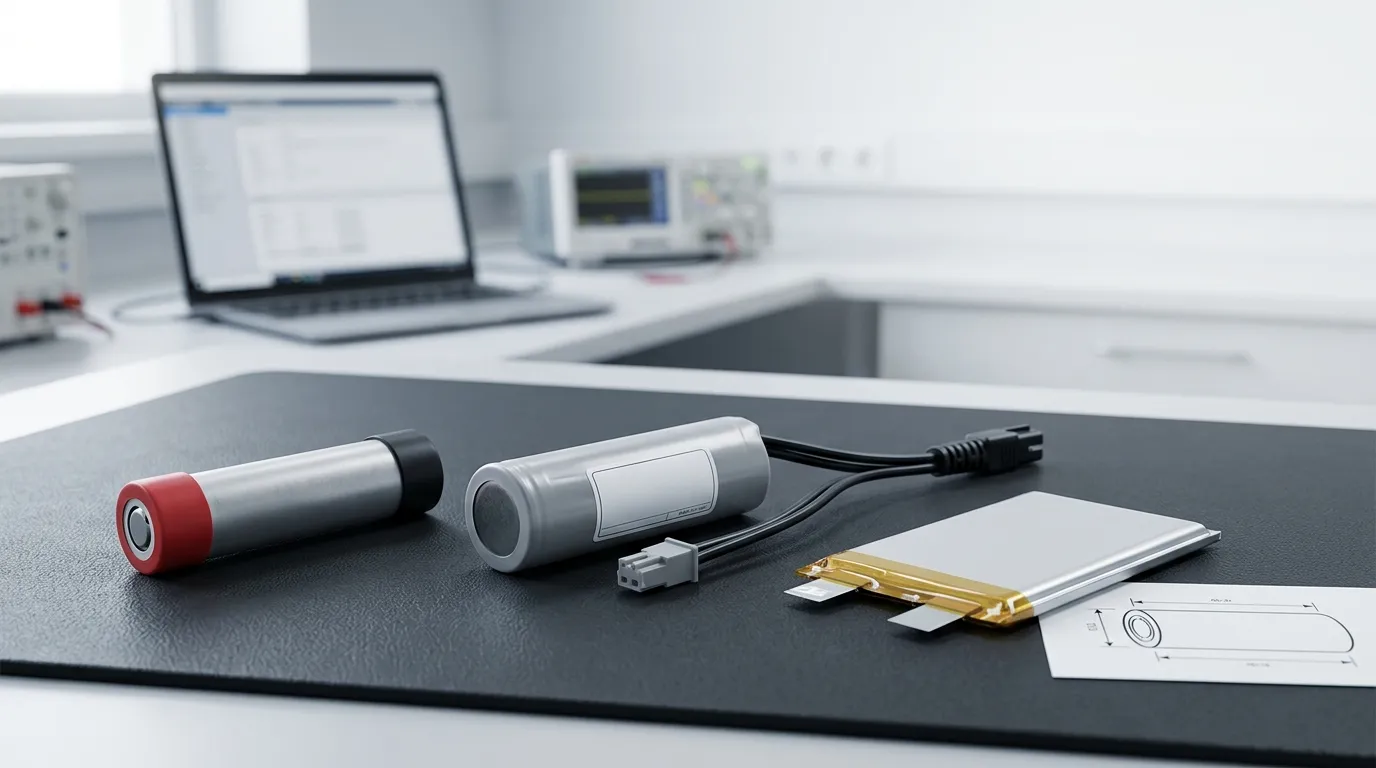
A high-discharge battery for vape devices is a lithium cell or battery pack engineered to deliver the sustained current your device demands without excessive voltage sag, overheating, or premature degradation. Selecting one requires matching continuous and peak current to the device load, managing heat through cell choice and mechanical design, and confirming protection circuitry and charger compatibility — not simply choosing the highest mAh rating.
This guide explains how to translate your device's power requirements into a battery specification, how to evaluate current, heat, and protection trade-offs, and what evidence to request from a supplier before committing to production.
What Is a High-Discharge Vape Battery?
A high-discharge battery is rated to deliver a defined continuous current (measured in amperes, A) without voltage dropping below the device's operating threshold or generating unsafe heat. The rating only has meaning when test conditions are stated — current alone, without duration, temperature, and cutoff voltage, tells an incomplete story.
Standard Li-ion batteries are typically optimized for capacity (mAh) and long runtime at moderate loads. High-discharge cells prioritize current delivery and low internal resistance, which directly affect voltage stability under load and heat generation. A cell with high capacity but high internal resistance may sag heavily or overheat when asked to supply high current, even though it stores plenty of energy.
Gloflux's e-cigarette application page states that batteries for these devices require high-rate discharge and protection against over-discharge, short circuits, and overheating — the same three constraints that define a high-discharge selection process.
How to Calculate the Required Discharge Current for a Vape Device
The starting point is the device's maximum power draw, usually expressed in watts (W). A planning estimate for required current is:
Current (A) ≈ Device power (W) ÷ Nominal battery voltage (V)
For a device designed around a single 3.7 V lithium cell:
- 30 W ÷ 3.7 V ≈ 8.1 A continuous
- 60 W ÷ 3.7 V ≈ 16.2 A continuous
- 80 W ÷ 3.7 V ≈ 21.6 A continuous
These figures are estimates for specification planning, not tested ratings. Real-world current depends on coil resistance, device efficiency, temperature, battery state of charge, and the device's actual output characteristics. Always validate a final design with load-profile testing under worst-case conditions.
You also need to distinguish between continuous and peak current. Some devices draw high current only in short bursts; others sustain high current for the duration of a draw. The battery must deliver the continuous current for the longest expected draw, plus any peak current within the cell's or pack's stated limits.
Why Capacity (mAh) and Discharge Current Are Different Selection Criteria
Capacity — measured in milliampere-hours (mAh) or ampere-hours (Ah) — describes how much charge a cell stores. It is a runtime indicator, not a measure of how much current the cell can deliver.
Discharge current — measured in amperes (A) — describes how much current the cell can supply continuously without exceeding its design limits. It is determined by cell chemistry, electrode design, internal resistance, and thermal behaviour.
The C-rate connects the two. A 1C rate means a current numerically equal to the cell's capacity:
- A 2 Ah cell at 1C delivers 2 A
- The same cell at 3C delivers 6 A
A cell rated at 15 A continuous and 3.5 Ah has a higher continuous C-rate capability than a 10 A / 3.5 Ah cell, even though both store the same charge. When a device demands high current, the current rating — not mAh — determines whether the battery can cope. Capacity only sets how long the device can run at that current.
Voltage Sag, Internal Resistance, and Heat: The Thermal Side of High Discharge

High current and heat are directly linked. Every cell has internal resistance, measured in milliohms (mΩ). When current flows through that resistance, two things happen.
First, the cell's voltage drops under load — a phenomenon called voltage sag. If sag is severe, the device may hit its low-voltage cutoff and shut down even though the cell still contains charge. Second, the energy lost to resistance becomes heat. Higher current and higher internal resistance both increase heat generation:
Heat ∝ Current² × Internal resistance
A cell with double the internal resistance generates roughly double the heat at the same current. In a compact device with little airflow, that heat accumulates quickly.
Thermal design therefore matters as much as electrical design. The enclosure, internal air gaps, insulation materials, and any metallic heat path all influence how quickly heat moves away from the cell. The U.S. National Fire Protection Association notes that lithium-ion batteries store large amounts of energy in a compact space, which is exactly why thermal behaviour must be engineered rather than assumed. Over-temperature protection circuitry in the pack is a safety limit, not a substitute for proper heat management.
Cell Formats for High-Discharge Vape Devices: 18650, 21700, and Pouch Packs
| Format | Typical Strengths | Typical Trade-Offs |
|---|---|---|
| 18650 | Widely produced; established performance data; replaceable in appropriate device designs | Cylindrical shape limits design flexibility; terminal style and physical fit must be matched |
| 21700 | Larger format; more volume for capacity and current; increasingly common in high-power devices | Larger diameter and length; less design flexibility |
| Pouch (Li-polymer) | Thin, shape-flexible; can be customized to the device cavity | Requires mechanical protection; protection and integration are pack-design responsibilities |
The right format depends on device space, target capacity, required current, mounting method, and whether the battery is replaceable or integrated. A replaceable-cell design needs a standardized format with verified dimensions and terminal style. An integrated design may benefit from a pouch pack that fits the device cavity exactly.
Gloflux lists both standard batteries and custom battery packs with customizable enclosures, wiring, and connectors in its product categories — so the decision between a standard cell and a custom pack is a legitimate part of the selection process.
Cell vs Pack: Understanding Voltage, Capacity, and Current in Series and Parallel
A single cell has its own voltage, capacity, and current rating. A battery pack is an assembly of one or more cells with protection, wiring, connectors, and usually an enclosure. The distinction matters because pack ratings are not automatically the same as cell ratings.
Series configuration (S) increases voltage. Two 3.7 V cells in series produce a nominal 7.4 V pack. The pack current rating remains the same as one cell, assuming the cells are matched and properly managed.
Parallel configuration (P) increases capacity and available current. Two cells in parallel double the capacity (Ah) and can share the current load, but the pack's voltage stays the same.
A pack's ratings depend on the configuration, the cells used, the protection circuit or BMS, and the interconnection method. When a supplier gives you a current figure, always confirm whether it applies to one cell or the finished pack.
Protection and Battery Management: PCM vs BMS
Every practical vape battery needs protection against defined electrical faults. The level of management depends on the pack architecture.
A PCM (protection circuit module) provides basic protection functions: overcharge, over-discharge, overcurrent, and short-circuit cutoff. It is a circuit board that monitors voltage and current and disconnects the pack when a threshold is exceeded. A PCM is appropriate for simple single-cell or tightly matched multi-cell packs where additional monitoring is not required.
A BMS (battery management system) adds monitoring and control beyond basic protection: cell balancing for series packs, state-of-charge estimation, temperature monitoring, and sometimes communication such as SMBus, I2C, UART, CAN, RS485, or Bluetooth. A BMS is generally required for multi-series packs where cell imbalance can shorten life or create risk. Gloflux's product range includes both standard and smart packs with BMS integration, but the correct architecture depends entirely on the device design.
Protection thresholds must be specified as part of the pack design, not assumed. Over-discharge cutoff, overcurrent limits, and temperature cutoffs should be defined to match the device's operating envelope and charger behaviour. Gloflux's e-cigarette application page explicitly lists protection against over-discharge, short circuit, and overheating as requirements for this application class.
Charging a High-Discharge Vape Battery: Matching the Charger to the Pack
A high-discharge battery is only as reliable as its charging system. The charger must match the pack's chemistry, series cell count, voltage, and current limits.
Lithium-ion charging normally follows a CC/CV profile: constant current until the cell reaches its charge voltage, then constant voltage while current tapers to a termination threshold. The charge voltage must match the cell's maximum charge voltage — never the nominal voltage. For example, a 3.7 V nominal cell commonly charges to 4.2 V, but a different chemistry variant may use a different voltage.
An incompatible charger — wrong voltage, too-high current, or a missing termination condition — can stress the cell, reduce cycle life, and defeat the protection circuit's purpose. Charging design belongs in the same specification process as discharge design.
Supplier Documentation and Validation: What to Request Before Production

Before approving a battery for mass production, request evidence that the cell or pack actually performs to its stated specification. The following checklist applies whether you are evaluating a standard cell or a custom pack.
| Document or Evidence | What It Confirms | Notes |
|---|---|---|
| Datasheet / TDS | Chemistry, nominal voltage, capacity, continuous/peak current, internal resistance, dimensions, operating temperatures, cycle life | Verify that ratings state their test conditions |
| Sample test results | Actual discharge behaviour under your load profile, including voltage sag and temperature | Test at the device's worst-case operating point |
| Traceability records | Batch/lot identification, cell matching, change control | Confirms the production cells match the validated samples |
| UN 38.3 test summary | That the cell or pack passed transport-safety testing | Covers shipping only, not product safety |
| IEC / UL / CB report | That the specific model met defined product-safety requirements | Applies only to the model, construction, and standard scope in the report |
| SDS / MSDS | Handling, storage, and emergency information | Required for transport and workplace safety |
Two documents are commonly confused. UN 38.3 is a transport test requirement — it confirms that lithium batteries can be shipped safely under the UN Manual of Tests and Criteria. It is not a product-safety certificate. IEC or UL test reports evaluate product safety for a defined construction and standard edition. Company quality-system certification, such as ISO 9001, is a separate matter entirely: it confirms the manufacturer's quality-management processes, not the safety of any individual product.
A supplier that cannot provide model-specific documentation for the exact battery you intend to buy is a risk flag. Traceability and change control matter because a cell with the same model number produced in a different batch may behave differently — especially for high-discharge applications where margins are thin. Similar compact-device power challenges apply in other product categories; for example, a Lithium battery for heated tobacco devices must also balance high power demand with tight thermal and mechanical constraints.
Building a High-Discharge Vape Battery Specification
When you are ready to request a quote or begin a custom pack project, a complete specification should include at least:
- Operating voltage range and nominal voltage
- Continuous and peak current, with the duration of each
- Worst-case ambient temperature and any thermal constraints
- Target capacity and runtime
- Physical envelope: dimensions, mounting, connector, and wiring
- Charger voltage, current, and charging behaviour
- Protection requirements: overcharge, over-discharge, overcurrent, short circuit, temperature
- Whether the battery is replaceable or permanently integrated
- Required documentation: datasheet, test results, UN 38.3 summary, applicable safety approvals, and traceability records
A well-structured RFQ lets a supplier evaluate your load profile, propose the right cell chemistry and pack architecture, and confirm that the design can be validated before production. The depth of your requirements determines the quality of the response.
Battery selection for high-discharge vape devices is an engineering decision, not a capacity decision. Specify the current, design for the heat, confirm the protection and charging architecture, and verify the evidence — and the device has a foundation that will perform reliably in the field.
Talk to the Manufacturer
Resources & Insights

High Capacity Lithium Battery for Wearables: High-Voltage LiPo Cell Design
2026-10-19
Cylindrical Battery Packs for Laptops: 2S vs 3S vs 4S Battery Design
2026-10-19

Stage Lighting Battery Pack: Prevent Voltage Drop & LED Flicker
2026-10-19

Best Rechargeable Batteries for Smart Devices: Performance, Safety, and Selection Guide
2026-10-19


