


 Home /
 Medical Device Battery Pack Solutions


Table of Contents
- Why Medical Devices Need Custom Battery Packs
- Selecting the Right Battery Chemistry
- BMS Protection for Medical Battery Packs
- Fuel Gauging and Communication
- Mechanical and Connector Design
- Charging Safety and Power Continuity
- Testing and Compliance Documentation
- Medical Battery Development Process
- Common Applications
- Conclusion
- Frequently Asked Questions
Medical devices rely on reliable power for their monitoring, diagnostic, treatment and emergency support functions. A battery failure can disrupt a procedure, provide inaccurate data or cause equipment to be unavailable when it is needed.
In this regard, a medical device battery pack needs to be designed as a system component. Protection, communication, charging, mechanical reliability, service life, and regulatory testing are also critical to the design, as well as voltage, runtime and size.
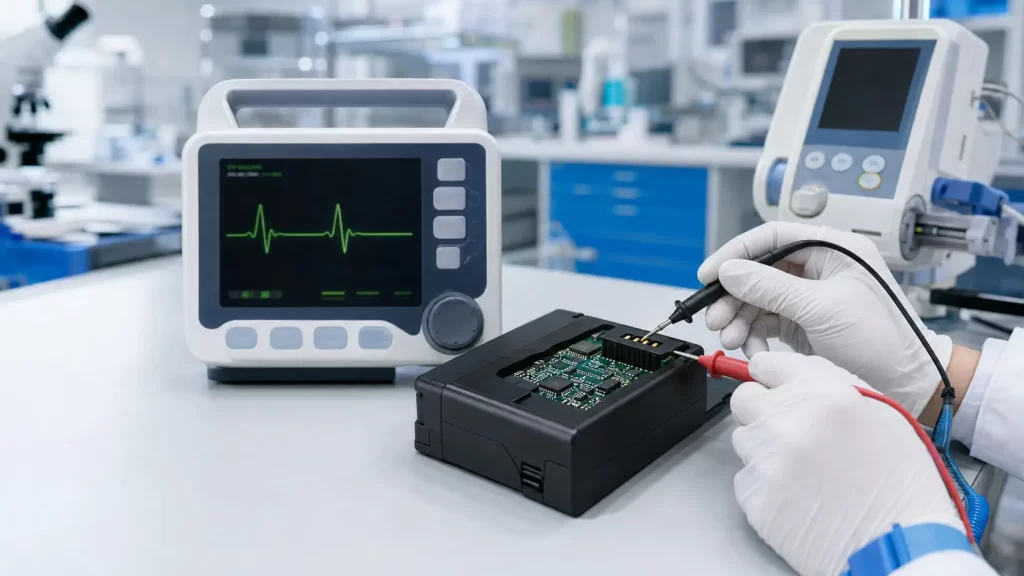
Why Medical Devices Need Custom Battery Packs
Normal batteries are not always suitable for all medical use. A thin LiPo battery or a removable high-capacity lithium ion pack can be required for a compact wearable monitor, or an infusion pump or portable ultrasound system.
A bespoke battery solution can be created based on:
- Available installation space
- Required operating time
- Continuous and peak current
- Charging method
- Product weight limits
- Operating temperature
- Cleaning and disinfection procedures
- Communication requirements
- Target markets and certifications
These conditions are defined at an early stage to avoid any changes in the enclosure or PCB and charging circuit during the testing stages.
Selecting the Right Battery Chemistry
Lithium-ion cylindrical battery (18650, 21700) has good energy density, structure stability, flexible series and parallel connection. They can be found in portable diagnostic equipment, medical carts and patient-monitoring devices.
The thin, lightweight and customized shapes are compatible with li-po pouch batteries. They can be used with wearable monitors, handheld diagnostic products and other small monitors. Pouch cells should be protected from being punctured, bent, compressed and swollen.
LiFePO4 batteries are thermally stable, and can withstand many cycles. They can be options for larger mobile medical equipment, back-up power systems and applications where durability is a more significant consideration than minimum size.
There can also be some replacing batteries and legacy medical devices that are still viable with NiMH batteries.
BMS Protection for Medical Battery Packs
Cells are protected and real-time information is provided to the host device by a Battery Management system. A custom medical battery BMS can consist of:
- Over charge and over discharge protection
- Overcurrent and short circuit protection
- Cell balancing
- Temperature protection for charging and discharging.
- Secondary hardware protection
- Cycle-count recording
- State-of-charge estimation
- State-of-health monitoring
Protection thresholds should be based on the selected cells, device load and charger—not copied from a general-purpose battery design.
In a multi-cell pack, consistent voltage monitoring and balancing can promote the use of the pack's capacity during its service life.
Fuel Gauging and Communication
There is need for reliable battery status data. If a battery isn't working correctly, it can lead the user to think that the equipment will provide more run time than it actually will.
The smart medical battery packs can be used with an NTC temperature sensor, ID resistor, fuel-gauge IC and digital communication. I²C, SMBus, UART, CAN and RS485 are all common protocols.
The host device can read the communication:
- Remaining capacity
- Battery voltage and current are important to take note of.
- Cell temperature
- Cycle count
- Battery identification
- Fault and protection records
Battery/charger/device software should be tested concurrently to verify proper operation of alarms, shutdown limits and battery capacity.
Mechanical and Connector Design
A good battery pack should stay in place when handling, during vibration, and when being dropped. The housing should surround the cells, wiring, and BMS and allow for easy, safe installation, while minimizing pressure on internal components.
Keyed connectors, guide rails and locking features can minimize incorrect installation, with replaceable medical batteries. Durable blade contacts or spring terminals may be necessary for packs that are used frequently.
The designers also need to consider the possibility for the battery enclosure to be exposed to disinfection, cleaning chemicals, and moisture. It may be necessary to use appropriate plastics, seals and connector protection.
Charging Safety and Power Continuity
Charger(s) must be of same chemistry and series configuration and charging current approved by the battery. Wrong or faulty charging accessories may cause overheating and fire hazards, and FDA recommends checking medical devices and charging accessories for damage and using manufacturer-provided accessories.
Where possible, an interruption-tolerant piece of equipment will have hot-swappable batteries, dual battery channels or a small internal battery. Such designs enable the replacement of a particular battery while the device remains in operation.
But, there is a need to coordinate the development of the pack, power-path circuit, firmware and user alerts in the hot-swap designs.
Testing and Compliance Documentation
The final compliance plan depends on the device category, intended use and destination market.
The relevant safety requirements and tests, for portable sealed lithium batteries, are covered in [IEC 62133-2](https://webstore.iec.ch/en/publication/70017) for intended use and reasonably foreseeable misuse. Most Lithium batteries sent by air, sea or land are subject to testing to UN Manual of Tests and Criteria, subsection 38.3.
The standard IEC 60601-1 deals with the basic safety and essential performance of medical electrical equipment. The entire medical device, not just the battery, should be evaluated. There are also IEC Standards applicable to the use of the equipment at home, such as IEC 60601-1-11 (Home use equipment) and product-specific standards such as IEC 60601-1-11 (Home use equipment).
Typical battery documentation may include:
- Battery specification and drawing
- Cell and BMS information
- UN38.3 test summary
- Safety Data Sheet
- IEC 62133-2 reports where applicable
- RoHS and REACH declarations
- Charging and handling instructions
- Lot and component traceability records
Passing a battery-level test does not automatically demonstrate compliance for the complete medical device.
Medical Battery Development Process
GLOFLUX can build a battery pack based on an OEM medical products that can be used in a variety of different applications. This process starts by the voltage, runtime, load profile, dimensions, charger, connector and communication information.
Once the design review, prototype packs can be manufactured for electrical, mechanical and device integration testing. The battery should be tested in the equipment itself starting with loads, normal operating conditions, charging, low battery alarms and shutdown.
Samples of the design and the approved components must be controlled before mass production to ensure consistency between the samples, certification units and production batteries.
Common Applications
Patient monitors, infusion pumps, portable ultrasound, diagnostic instruments, home healthcare devices, wearable patient monitors, emergency equipment and medical data terminals are all able to be supported by custom medical battery packs.
There are different levels of energy density, output power, method of replacement and service life for each application.
Conclusion
A medical device battery is a vital subsystems of the device, not just an add-on. The coordination between the device manufacturer, the battery manufacturer and the testing laboratory during the early stage of the design process helps to develop a reliable power solution and minimises redesign and certification risks.
Frequently Asked Questions
1. Which battery chemistry is best for medical devices?
All of these battery types may be used with Li-ion, LiPo, LiFePO4 and NiMH. The selection is based on the above factors; runtime, size, current, cycle life, and operating environment.
2. Does a medical battery need IEC 62133-2 testing?
The testing plan is a common practice and is usually assumed to be applicable to portable sealed lithium batteries for IEC 62133-2.
3. Can a medical battery communicate with the device?
Yes. A custom battery can be equipped with fuel gauging and temperature monitoring and other protocols such as SMBus, I²C, UART, CAN or RS485.
4. What information is needed for customization?
Enter the voltage, capacity, load current, run time, dimension, connector, charger, communication protocol and temperature range, and set the target certifications.
5. Can GLOFLUX develop replaceable medical battery packs?
Yes. The replaceable packs are buildable with customized housings, keyed connectors, smart BMS functions as well as protection for the application.
Talk to the Manufacturer
Resources & Insights
High Capacity Lithium Battery for Wearables: High-Voltage LiPo Cell Design
2026-10-19
Cylindrical Battery Packs for Laptops: 2S vs 3S vs 4S Battery Design
2026-10-19
Stage Lighting Battery Pack: Prevent Voltage Drop & LED Flicker
2026-10-19

Best Rechargeable Batteries for Smart Devices: Performance, Safety, and Selection Guide
2026-10-19


