


 Home /
 Robot, AGV and AMR Battery Solutions


Table of Contents
- How Robot, AGV and AMR Power Requirements Differ
- Calculating Voltage, Capacity and Peak Current
- LiFePO4 or Lithium-Ion?
- Smart BMS Functions
- CAN and RS485 Communication
- Charging Options
- Mechanical and Environmental Design
- Testing and Compliance
- Custom Development with GLOFLUX
- Conclusion
- Frequently Asked Questions
Robots, automated guided vehicles and autonomous mobile robots depend on reliable batteries to move loads, operate sensors and maintain communication with factory or warehouse control systems.
Selecting a battery only by voltage and capacity may result in insufficient runtime, unexpected shutdowns or premature degradation. A suitable robot battery pack must also support peak current, frequent charging, BMS communication, mechanical protection and the operating conditions of the complete machine.
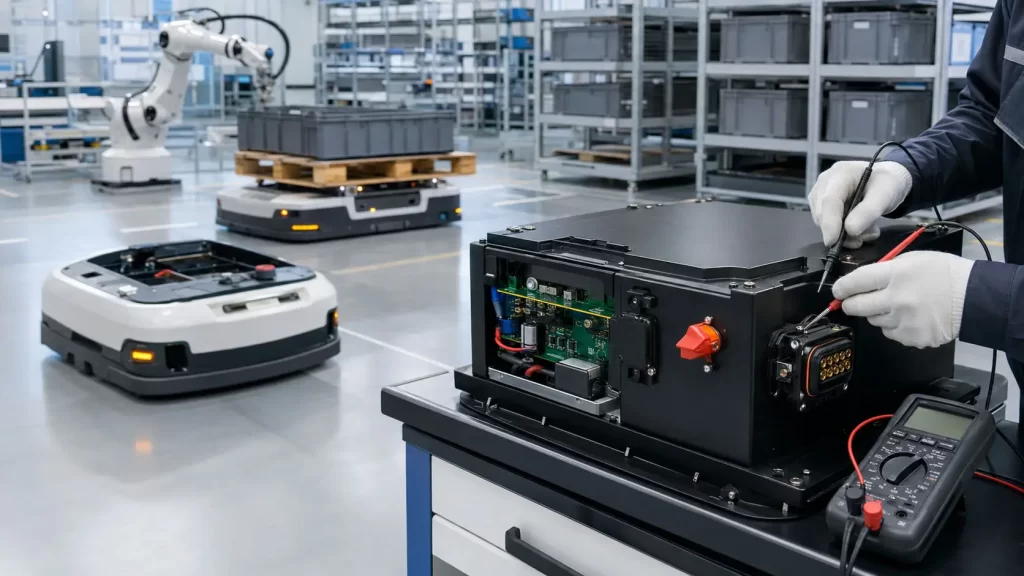
How Robot, AGV and AMR Power Requirements Differ
Industrial robots may include inspection robots, service robots, humanoid platforms, cleaning robots and mobile manipulators. Their loads can change rapidly when motors, joints, cameras and computing systems operate together.
AGVs normally follow predefined routes using magnetic tape, markers, wires or other guidance methods. Many operate repeatedly between fixed loading and charging points.
AMRs use sensors, navigation software and onboard processing to plan routes dynamically. Their battery powers not only the drive system but also LiDAR, cameras, wireless communication and computing hardware.
Each platform therefore requires a battery solution based on its actual working cycle rather than a general capacity target.
Calculating Voltage, Capacity and Peak Current
The battery voltage must match the motor controller, DC-DC converters and charging system. Common robot and AGV platforms may use 24V, 36V or 48V battery systems, while larger equipment may require higher voltages.
Capacity should be calculated from the average device load, required operating time, efficiency losses and reserve energy. The battery should not be designed to use 100% of its rated capacity during every cycle.
Peak current is equally important. Starting, accelerating, turning, climbing and lifting can create current demands much higher than the normal operating load. The cells, busbars, BMS, fuse, connectors and wiring must all support these temporary peaks without excessive voltage drop or unwanted protection shutdown.
LiFePO4 or Lithium-Ion?
LiFePO4 batteries are widely considered for AGVs and AMRs because they offer long cycle life, strong thermal stability and good support for repeated charging. They are suitable for equipment that operates for multiple shifts and returns frequently to an automatic charger.
NMC lithium-ion batteries provide higher energy density, allowing more energy to fit into a smaller and lighter pack. This can benefit compact robots, inspection equipment and mobile platforms where installation space and weight are limited.
The correct chemistry depends on:
- Required runtime
- Available battery space
- Weight limitations
- Continuous and peak current
- Expected cycle life
- Charging frequency
- Operating temperature
- Target cost
Cell quality and pack engineering are more important than choosing a chemistry based on one specification alone.
Smart BMS Functions
The BMS is the control and protection center of a robot battery pack. Basic functions include overcharge, over-discharge, overcurrent, short-circuit and temperature protection.
More advanced AGV and AMR battery systems may also include:
- Individual cell-voltage monitoring
- Passive or active balancing
- State-of-charge estimation
- State-of-health reporting
- Charge and discharge current control
- Contactor and pre-charge management
- Multiple temperature sensors
- Cycle and fault-history recording
- Sleep and wake-up control
Accurate state-of-charge information allows the fleet-management system to schedule charging before the robot loses enough power to complete its assigned task.
CAN and RS485 Communication
Robot batteries often need to exchange information with the motor controller, charger or central control system.
CAN bus is commonly selected for real-time battery communication in mobile equipment. RS485 can support robust data transmission over longer cable distances, while UART or SMBus may be suitable for smaller robot platforms.
The communication specification should define message IDs, baud rate, data format, update interval, alarm levels and shutdown commands. The battery, robot controller and charger must use the same protocol.
A mechanically compatible pack will still fail integration if the BMS communication does not match the host system.
Charging Options
Robot charging design directly affects fleet availability. Common methods include:
Manual Plug-In Charging
The operator connects the robot to a charger when the battery level is low. This is simple but depends on manual scheduling.
Automatic Contact Charging
The AGV or AMR docks at a charging station, where conductive contacts automatically connect the battery to the charger. This supports opportunity charging during idle periods.
Battery Swapping
A removable pack can be replaced manually or automatically. Battery swapping reduces downtime but requires durable connectors, secure locking and consistent battery identification.
Wireless Charging
Inductive charging removes exposed charging contacts and can simplify docking. However, the battery and power electronics must be designed around charging power, efficiency, alignment and thermal conditions.
The charging voltage, current and communication logic must match the selected battery chemistry and BMS settings.
Mechanical and Environmental Design
A mobile robot battery is exposed to vibration, impact and repeated movement. The enclosure should protect the cells, BMS and internal connections while securing the pack inside the robot.
Depending on the application, the design may require:
- Metal or flame-retardant plastic enclosure
- Anti-vibration cell holders
- High-current locking connectors
- Service disconnect and fuse
- Dust and moisture protection
- Handles or guide rails for replacement
- Heating for low-temperature charging
- Cooling or thermal spreading
Cold-storage robots require particular attention because lithium batteries cannot normally be charged at very low temperatures without suitable controls.
Testing and Compliance
IEC 62619:2022 specifies safety requirements and tests for secondary lithium cells and batteries used in industrial applications. The standard specifically lists automated guided vehicles among its example motive applications.
Lithium batteries prepared for transport may also require testing under subsection 38.3 of the UN Manual of Tests and Criteria, together with a UN38.3 test summary and appropriate transport documents.
ISO 3691-4:2023 addresses safety requirements for driverless industrial trucks, including AGVs and AMRs. However, it does not provide the detailed requirements for the battery power source, so battery-level and complete-machine evaluations should be planned separately.
Additional testing can include cycle life, high-current discharge, vibration, drop, temperature, connector durability, communication and charger-matching tests.
Custom Development with GLOFLUX
GLOFLUX can develop robot, AGV and AMR battery packs according to the electrical, mechanical and communication requirements of an OEM project.
Development begins with voltage, capacity, load profile, peak current, runtime, dimensions, connector, charger and communication data. Engineers can then select the cell configuration, BMS architecture, protection settings and enclosure structure.
Prototype packs should be tested inside the actual robot under acceleration, lifting, navigation, charging and low-battery conditions. This integration stage helps identify current peaks, communication errors and thermal issues before mass production.
Conclusion
A reliable robot battery pack must combine energy capacity, power output, cycle life, communication and mechanical protection. Early coordination between the robot manufacturer, battery supplier and charger developer helps improve uptime while reducing integration and certification risks.
Frequently Asked Questions
1. Which battery chemistry is best for AGVs and AMRs?
LiFePO4 is often preferred for long cycle life and thermal stability, while NMC lithium-ion is suitable when compact size and lower weight are priorities.
2. How is the required battery capacity calculated?
Capacity is based on average power consumption, required runtime, system losses and reserve energy. Peak motor and lifting current must be evaluated separately.
3. Can the battery communicate with the robot controller?
Yes. Custom BMS solutions can support CAN, RS485, UART or SMBus communication according to the robot’s protocol.
4. Can AGV batteries support automatic charging?
Yes. Packs can be designed for docking contacts, opportunity charging, battery swapping or wireless charging systems.
5. What information is needed for a custom robot battery?
Provide voltage, capacity, continuous current, peak current, runtime, dimensions, connector, communication protocol, charger and operating-temperature requirements.
Talk to the Manufacturer
Resources & Insights
High Capacity Lithium Battery for Wearables: High-Voltage LiPo Cell Design
2026-10-19
Cylindrical Battery Packs for Laptops: 2S vs 3S vs 4S Battery Design
2026-10-19
Stage Lighting Battery Pack: Prevent Voltage Drop & LED Flicker
2026-10-19

Best Rechargeable Batteries for Smart Devices: Performance, Safety, and Selection Guide
2026-10-19


