


 Home /
 Custom Battery Pack Manufacturer for Medical Devices: Low Self-Discharge Design


Table of Contents
Emergency medical equipment may remain idle for months, yet it must start immediately and deliver predictable runtime when required. Low self-discharge is therefore not merely a cell specification. It is the combined energy loss of the cell, protection circuit, fuel gauge, communication interface, balancing network, and connected device.
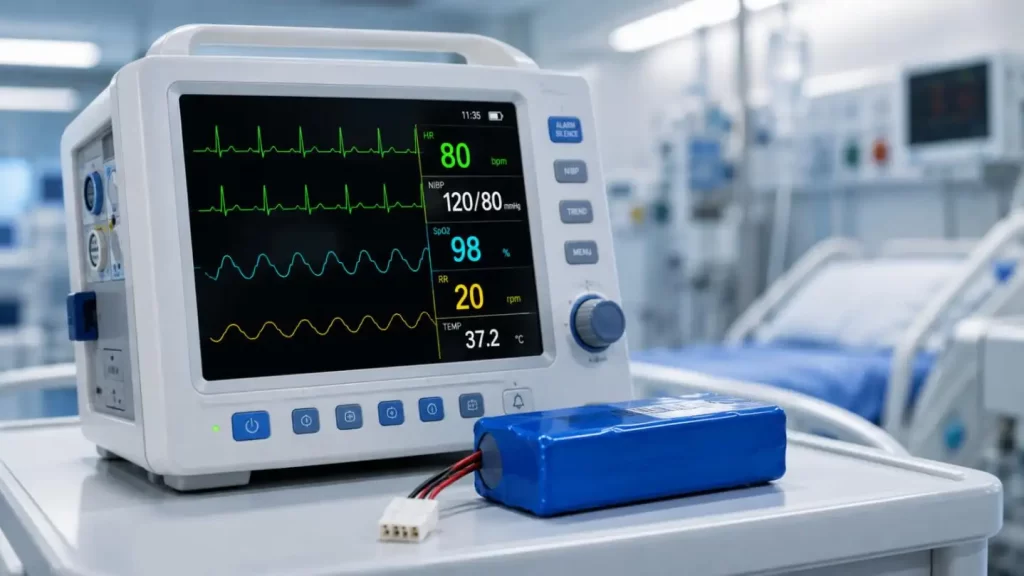
A qualified Custom Battery Pack Manufacturer for Medical Devices should verify retained energy at pack and system level—not simply quote a cell datasheet.
Low Self-Discharge Is a System-Level Metric
Cell self-discharge varies with chemistry, storage temperature, initial state of charge, aging, and manufacturing consistency. Once cells are assembled into a medical lithium battery pack, electronic loads create additional standby loss.
| Loss Source | What It Represents | Engineering Control |
| Cell self-discharge | Internal capacity loss | Chemistry, SOC, temperature |
| BMS quiescent current | Current used by protection electronics | Low-power ICs and sleep modes |
| Fuel-gauge load | Current used for SOC measurement | Sampling and shutdown logic |
| Communication load | Standby use by communication interfaces | Wake-on-demand operation |
| Cell imbalance | Uneven cells in a series string | Cell matching and balancing |
| Device standby draw | Current used while inactive | Battery-device co-validation |
The standby energy budget can be estimated as:
Capacity loss (mAh) = standby current (mA) × storage time (hours)
A continuous 20μA load consumes approximately 175mAh in one year, while 50μA consumes about 438mAh. In a 2,000mAh emergency battery, this is significant before cell self-discharge, low-temperature derating, or aging is included.
Why Emergency Medical Equipment Needs Tighter Control
A backup battery for medical equipment may experience long storage, irregular maintenance, cold transportation, and immediate startup loads. Poor standby design can cause:
•Insufficient energy for a monitoring or treatment cycle
•Voltage sag during pump, motor, display, or wireless startup
•Inaccurate SOC after calendar aging
•Failure to wake from deep sleep
•Premature low-voltage shutdown in cold conditions
Patient monitors need alarm reserve, infusion pumps require stable discharge, portable diagnostic devices need low sleep current and fast wake-up, and medical carts require accurate SOC, cell consistency, and thermal control.
A Custom Battery Pack Manufacturer for Medical Devices must convert these application risks into measurable electrical requirements.
Engineering Methods for Lower Standby Loss
Select Cells for Storage Stability
Nominal capacity alone does not indicate long-term storage performance. Cell qualification should examine:
• Capacity retention after room-temperature and elevated-temperature storage
• Open-circuit-voltage decline
• DC internal resistance growth
• Batch-to-batch self-discharge distribution
• Performance at different storage SOC levels
• Retention after cycle aging
Cells with abnormal voltage decline or increasing impedance can reduce startup capability even when measured capacity appears acceptable.
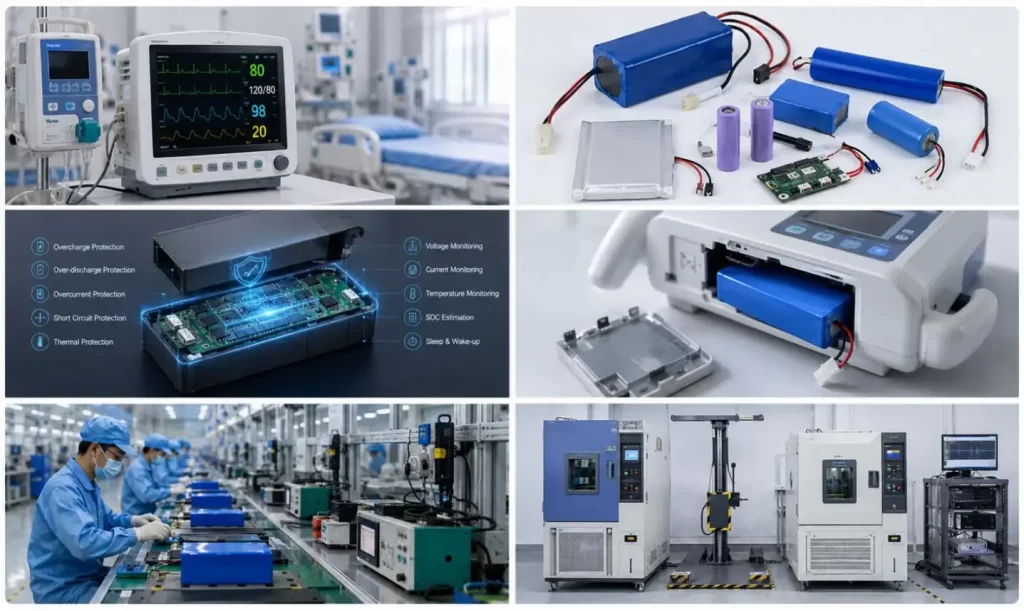
Reduce Smart BMS Consumption
A smart BMS for medical devices should provide protection while consuming as little standby current as practical. Design measures may include:
• Low-quiescent-current protection and monitoring ICs
• Deep-sleep or shipping modes
• Reduced sampling frequency during storage
• Automatic shutdown of nonessential LEDs and interfaces
• Wake-up through charger insertion, device command, or external signal
• Separate thresholds for sleep, recoverable protection, and permanent fault lockout
The battery must protect itself at low voltage while remaining recoverable through the approved charging path.
Reserve Capacity for Worst-Case Conditions
Emergency runtime should be calculated using end-of-life and worst-case conditions rather than new-cell nominal capacity. The energy budget should include:
• Calendar and cycle aging
• Low-temperature capacity reduction
• BMS and communication consumption
• DC/DC conversion losses
• Startup and wireless transmission peaks
• Minimum runtime after a low-battery alarm
Specify Retained Energy, Not Only "Low Self-Discharge"
A useful battery requirement should state that, after a defined storage period, temperature, and initial SOC, the pack must start the device and complete the specified emergency operating time.
| Requirement | Recommended Definition |
| Initial SOC | Charge level before storage |
| Storage duration | 30, 90, 180 days, or 12 months |
| Temperature profile | Warehouse, transport, and use conditions |
| Maximum pack drain | BMS, gauge, and interface current |
| Retained capacity | Usable capacity after storage |
| Startup capability | Peak-current and voltage-sag limit |
| Emergency runtime | Minimum operating time after storage |
| Wake-up behavior | Trigger, response time, and recovery method |
A Custom Battery Pack Manufacturer for Medical Devices should agree on these values before the electrical and mechanical design is frozen.
Long-Term Storage Verification
A practical validation program should include:
• Initial capacity, DC resistance, and cell balance
• Pack-level standby-current measurement
• 30-, 90-, and 180-day capacity-retention tests
• Elevated-temperature storage screening
• Post-storage wake-up and recharge recovery
• Startup pulse-load and low-temperature discharge testing
• SOC accuracy and low-voltage alarm verification
• Testing after cycle and calendar aging
• Drop, vibration, overcharge, over-discharge, and short-circuit evaluation
High-temperature storage can expose abnormal leakage, BMS current consumption, and material instability more quickly. However, accelerated testing should not replace real-time storage data through a simple linear conversion.
Standards and Certification Boundaries
IEC 62133-2 addresses the safety of portable sealed secondary lithium cells and batteries. IEC 60601-1 covers basic safety and essential performance at medical-equipment level, while IEC 60601-1-12 adds requirements for equipment used in emergency medical services environments. UN38.3 applies to lithium battery transport testing.
Battery-level compliance does not automatically establish compliance for the finished medical device. The test and certification plan must reflect the battery configuration, equipment category, target market, and transportation method.
China and Guangdong Industry Context in 2026
China approved 1,595 Class III medical devices during the first half of 2026, including 42 innovative devices. By the end of 2025, China had 2,082 effective medical-device standards, reflecting increasingly structured safety, performance, and quality requirements.
Guangdong's lithium-ion battery product output increased by 32.2% year over year during the first half of 2026. Shenzhen's medical-device output also increased from RMB 83.1 billion in 2020 to RMB 102.8 billion in 2024.
Guangdong provides a closely connected supply chain:
• Shenzhen: medical-device R&D and commercialization
• Huizhou: battery-pack engineering and volume production
• Dongguan: PCBA, components, tooling, and automation
• Guangzhou: medical research, testing, and regulatory resources
This regional structure can shorten prototype iteration, component coordination, testing, and production-transfer cycles.
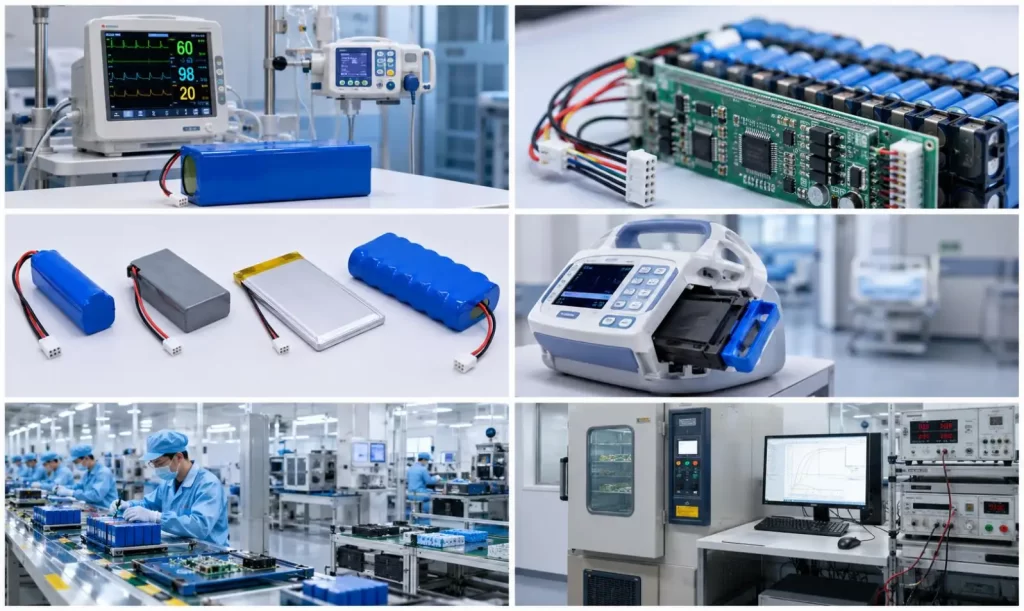
Gloflux Medical Battery Engineering
Located in Huizhou, Gloflux operates as a Custom Battery Pack Manufacturer for Medical Devices, supporting batteries for patient monitors, infusion pumps, diagnostic instruments, rehabilitation equipment, infrared thermometers, and medical carts.
Typical engineering capabilities include:
• Custom voltage from 3.7V to 48V
• Capacity from 500mAh to 50Ah
• Cylindrical, prismatic, and LiPo configurations
• Overcharge, over-discharge, overcurrent, short-circuit, and thermal protection
• Optional voltage, current, temperature, and SOC monitoring
• Cell selection, BMS, wiring, enclosure, and pack integration
Gloflux operates a 30,000㎡ manufacturing facility, applies more than 60 quality inspection checkpoints, and maintains an in-house battery safety laboratory.
Build Emergency Readiness into the Battery Specification
Low self-discharge depends on coordinated control of cell stability, BMS quiescent current, wake-up logic, storage conditions, capacity reserve, and system-level testing.
As a Custom Battery Pack Manufacturer for Medical Devices, Gloflux supports development from battery architecture and mechanical integration to validation and production. Medical device manufacturers can provide their voltage, peak current, standby period, required runtime, available space, operating temperature, and target certifications to evaluate a practical battery solution for long-term emergency readiness.
FAQs
Q1. Can Gloflux evaluate battery performance after long-term storage?
Yes. Validation can waver from standby-current measurements and open-circuit-voltage tests to retained-capacity tests, performance tests after a storage period, startup pulse tests, low-temperature discharge tests, cell balance inspections, and recharge recovery tests.
Q2. How does Gloflux mitigate self-discharge for medical battery packs?
Gloflux evaluates both self-discharge for the individual cells and standby consumption for the complete battery pack. Engineering mitigation for self-discharge may include: selection of cells with low-quiescent-current protection circuits, implementation of deep sleep mode, optimization of sampling intervals and control of communication, and application of wake-up logic.
Q3. What ranges of voltage and capacity can Gloflux customize?
Gloflux can work in the voltage range of 3.7V to 48V and in the capacity range of approximately 500mAh to 50Ah. The final numbers will depend on the medical device's specific runtime, peak current and size, charging type, and safety parameters.
Q4. What kinds of batteries for medical devices does Gloflux make?
Gloflux can make medical battery packs from all three standard forms of cells: cylindrical, prismatic, and LiPo. Pack configurations can be set up in multi-series, multi-parallel, both, or neither.
Q5. What protection functions can Gloflux BMS integrate?
Protection functions include: overcharge, over-discharge, overcurrent, short-circuit protection, thermal protection, voltage and current monitoring, as well as BMS peripheral functions that allow sleep and wake-up control and optional SOC communication.
Talk to the Manufacturer
Resources & Insights
High Capacity Lithium Battery for Wearables: High-Voltage LiPo Cell Design
2026-10-19
Cylindrical Battery Packs for Laptops: 2S vs 3S vs 4S Battery Design
2026-10-19
Stage Lighting Battery Pack: Prevent Voltage Drop & LED Flicker
2026-10-19
Best Rechargeable Batteries for Smart Devices: Performance, Safety, and Selection Guide
2026-10-19


