Home /
Custom Air Purifier Battery Packs: OEM Design Guide


Table of Contents
- Why Battery Design Matters in Portable Air Purifiers
- Choosing Lithium-Ion Cells for Air Purifier Batteries
- Understanding 4S1P and 4S2P Battery Configurations
- Calculating Battery Runtime for Different Fan Speeds
- BMS Protection and Charging Integration
- Mechanical Design and Battery Installation
- Testing and Certification Considerations
- Working With an OEM Battery Manufacturer
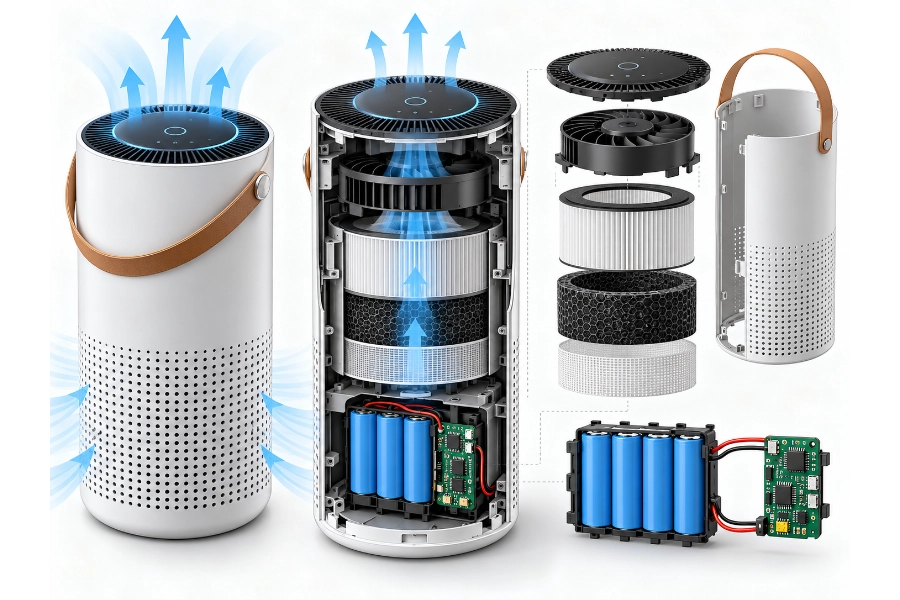
Portable air purifiers are designed to operate in environments where access to a fixed power supply may be limited. From personal desktop purifiers to compact filtration equipment used in vehicles and commercial spaces, rechargeable batteries provide the flexibility required for mobile operation.
For equipment manufacturers, selecting an air purifier battery pack involves more than choosing a cell with sufficient capacity. The battery must support fan operation, provide the required runtime, fit within the enclosure, and integrate safely with the device's charging and control electronics.
This guide examines the engineering considerations involved in developing custom lithium battery packs for portable air purification equipment.
- Why Battery Design Matters in Portable Air Purifiers
- Choosing Lithium-Ion Cells for Air Purifier Batteries
- Understanding 4S1P and 4S2P Battery Configurations
- Calculating Battery Runtime for Different Fan Speeds
- BMS Protection and Charging Integration
- Mechanical Design and Battery Installation
- Testing and Certification Considerations
- Working With an OEM Battery Manufacturer
Why Battery Design Matters in Portable Air Purifiers
An air purifier typically relies on an electric fan to move air through one or more filtration stages. Depending on the design, the filtration system may include a pre-filter, HEPA filter, and activated carbon.
The battery supplies power to the fan motor and supporting electronic circuits.
Unlike devices operating at a constant load, an air purifier with adjustable fan speeds may have significantly different energy consumption at each operating level.
For example, a low-speed setting may prioritize quiet operation and extended runtime, while a high-speed setting may require considerably more electrical power.
Battery capacity must therefore be evaluated against the complete operating profile rather than a single nominal power rating.
Choosing Lithium-Ion Cells for Air Purifier Batteries
Rechargeable lithium-ion cells are commonly considered for portable equipment because they offer practical energy density, established manufacturing processes, and multiple capacity options.
The cylindrical 18650 format is one option for devices with sufficient internal installation space.
The nominal dimensions of an 18650 cell are approximately 18 mm in diameter and 65 mm in length, although actual dimensions vary by manufacturer and cell construction.
Typical cell capacity options include:
- 2600mAh for applications prioritizing compact size and cost.
- 3000mAh or 3300mAh for a balance between energy capacity and packaging.
- 3500mAh for applications requiring greater energy storage, subject to current and cell qualification.
Higher capacity does not automatically mean better overall performance. Cell discharge characteristics, internal resistance, cycle life, and available installation space must also be evaluated.
Understanding 4S1P and 4S2P Battery Configurations
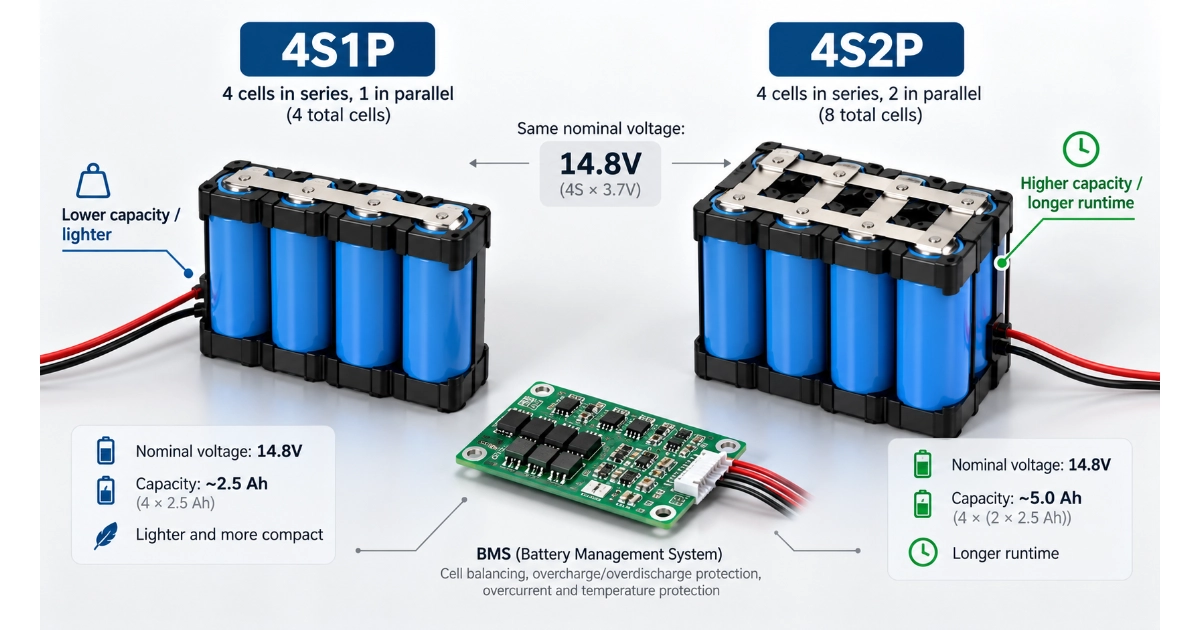
The number of cells connected in series determines the battery's nominal voltage, while the number connected in parallel determines its total capacity.
For standard lithium-ion cells with a nominal voltage of 3.7V, a four-series arrangement provides approximately 14.8V.
A 4S1P battery contains four cells. A 4S2P battery contains eight cells arranged as four series groups, each containing two parallel cells.
| Configuration | Cell Count | Nominal Voltage | Capacity Using 2600mAh Cells |
|---|---|---|---|
| 4S1P | 4 | 14.8V | 2600mAh |
| 4S2P | 8 | 14.8V | 5200mAh |
The 4S2P configuration provides approximately twice the nominal energy of 4S1P when using the same cell model.
However, it also requires additional installation space, increases battery weight, and raises material costs.
For a detailed comparison, read our 4S1P vs 4S2P Battery Packs: Capacity and Runtime guide.
Calculating Battery Runtime for Different Fan Speeds
Runtime is one of the most important specifications for a portable air purifier.
The basic calculation is:
Battery Energy (Wh) = Nominal Voltage (V) × Capacity (Ah)
Estimated runtime can then be calculated as:
Runtime (hours) = Usable Battery Energy (Wh) ÷ Average Device Power (W)
Consider a 14.8V, 2600mAh battery pack.
Its nominal energy is approximately 38.48Wh.
If the device consumes an average of 10W and a preliminary calculation assumes that 85% of nominal energy is available at the load, estimated runtime would be:
38.48 × 0.85 ÷ 10 = approximately 3.27 hours.
The 85% assumption is illustrative, not a universal battery efficiency specification.
Actual runtime depends on cell discharge curves, conversion losses, protection thresholds, operating temperature, aging, and the device's changing load.
Manufacturers should validate runtime at every fan-speed setting using the finished device.
BMS Protection and Charging Integration
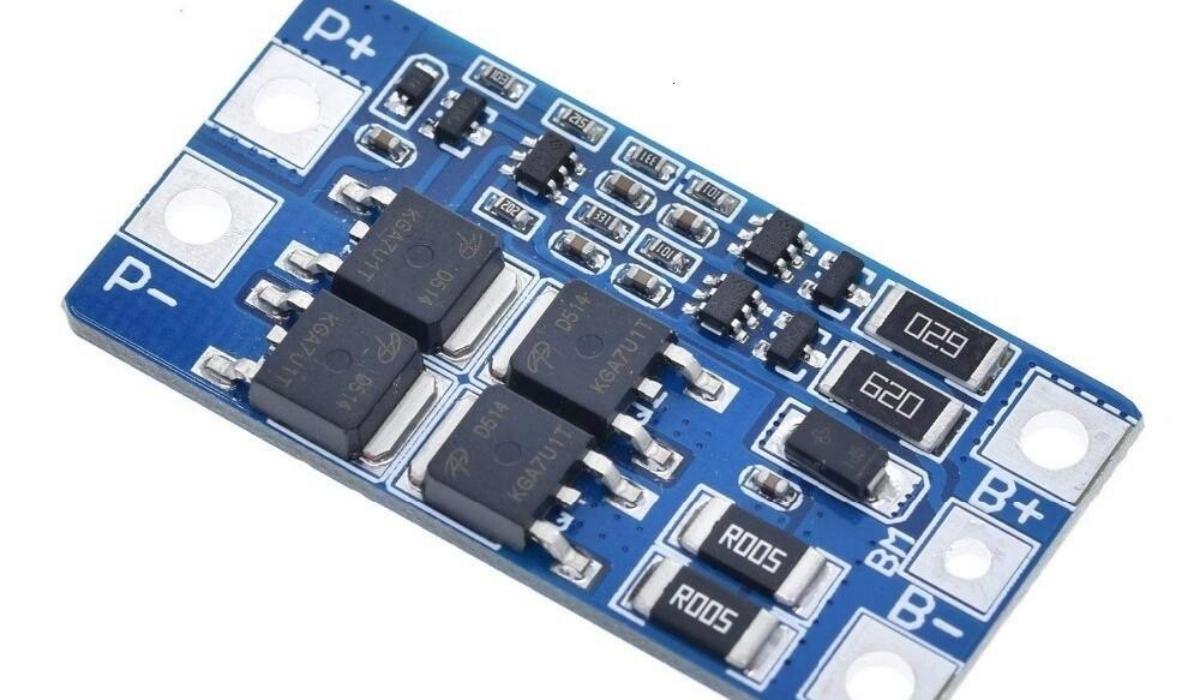
A custom lithium-ion battery pack requires appropriate electrical protection.
For a 4S air purifier battery, relevant functions may include:
- Individual series-group overvoltage monitoring.
- Undervoltage protection.
- Overcurrent and short-circuit protection.
- Temperature monitoring.
- Cell balancing where required.
- Appropriate charging and discharging control.
Charging architecture requires particular attention.
For conventional lithium-ion cells charging to 4.20V per cell, a four-series pack reaches 16.8V at full charge.
Some designs intentionally use a lower maximum charge voltage, such as 4.10V per cell, resulting in a 16.4V pack charging limit. This requires compatible cells and correctly configured charging electronics.
The charger must control current and voltage appropriately. A BMS should not be treated as a substitute for a properly designed charging circuit.
For more information, see our How to Choose a BMS for Lithium Battery Packs.
Mechanical Design and Battery Installation
Battery dimensions are especially important in compact air purification equipment.
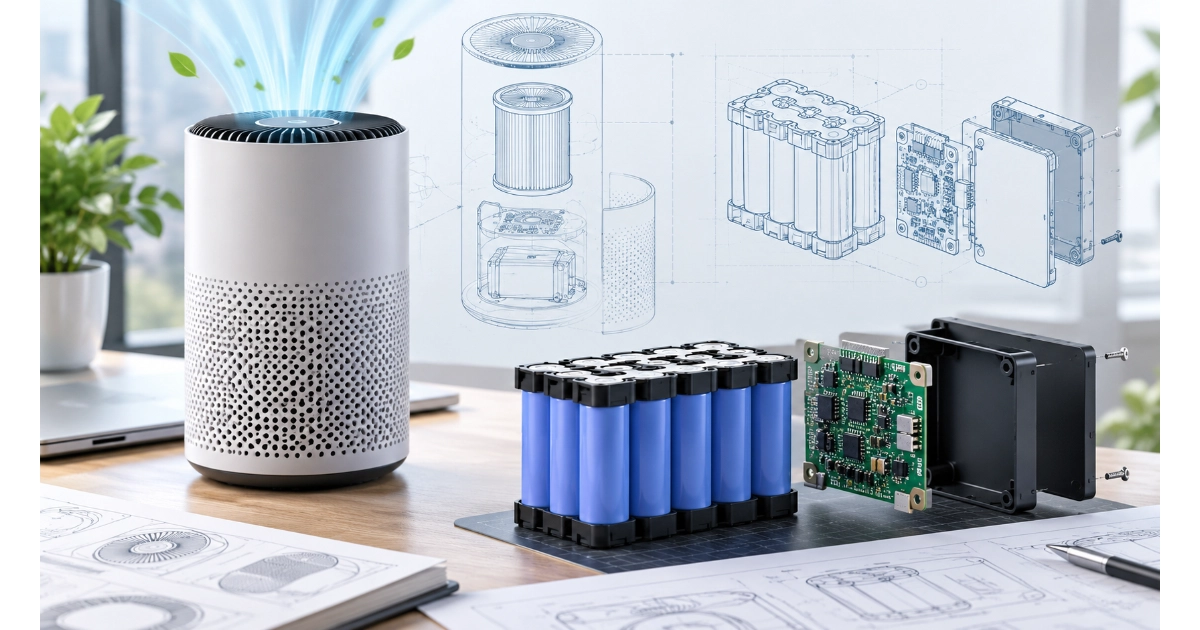
A battery compartment must accommodate not only the cells but also interconnections, insulating materials, the protection circuit, wiring, and mechanical clearance.
Engineers should consider:
- Available battery compartment dimensions.
- Cell orientation and pack arrangement.
- Connector type and cable exit direction.
- Protection against vibration and mechanical movement.
- Separation from fan motors and other heat-generating components.
- Serviceability and accessibility where applicable.
An eight-cell 4S2P assembly cannot be assumed to fit within an enclosure originally designed for four cells.
Mechanical feasibility should be confirmed before finalizing the battery configuration.
Testing and Certification Considerations
Battery validation must cover both electrical performance and product safety.
Depending on the market and application, relevant requirements may include IEC 62133-2, UN38.3 transportation testing, and applicable product-level standards.
Cell-level certificates do not automatically establish compliance for a newly assembled battery pack.
Custom pack construction, wiring, BMS selection, and enclosure integration may introduce additional verification requirements.
Production testing should also confirm pack voltage, capacity, functional protection, connector polarity, and performance under representative operating loads.
Working With an OEM Battery Manufacturer
An OEM air purifier manufacturer can simplify battery development by providing a clear technical specification.
Useful information includes nominal voltage, maximum charging voltage, discharge current, required runtime, enclosure dimensions, connector requirements, and expected production quantity.
At Gloflux, we support custom lithium battery pack development involving cell selection, series-parallel configuration, BMS integration, mechanical design, prototyping, and production.
Our 14.8V Lithium Battery Pack range provides a starting point for equipment designers evaluating four-series lithium-ion solutions.
The final battery should be selected through a combination of electrical calculations, mechanical review, prototype testing, and product-specific validation.
Frequently Asked Question
Can an air purifier manufacturer customize both battery capacity and BMS specifications?
Yes. Battery capacity, series-parallel configuration, protection thresholds, connectors, and mechanical dimensions can be customized according to the equipment's electrical and installation requirements. The design must be validated against the selected cells and finished device before production.
Developing a rechargeable air purifier? Contact Gloflux to discuss a custom OEM battery solution for your equipment.