Home /
4S1P vs 4S2P Battery Packs: Capacity and Runtime


Table of Contents
- What Does 4S1P Mean?
- What Does 4S2P Mean?
- 4S1P vs 4S2P: Technical Comparison
- How Does Cell Capacity Affect Runtime?
- Example: Battery Runtime in a Portable Air Purifier
- Does a 4S2P Battery Require a Different BMS?
- Battery Charging Voltage and Compatibility
- Mechanical Design: Will 4S2P Fit?
- Which Configuration Is Better for OEM Equipment?
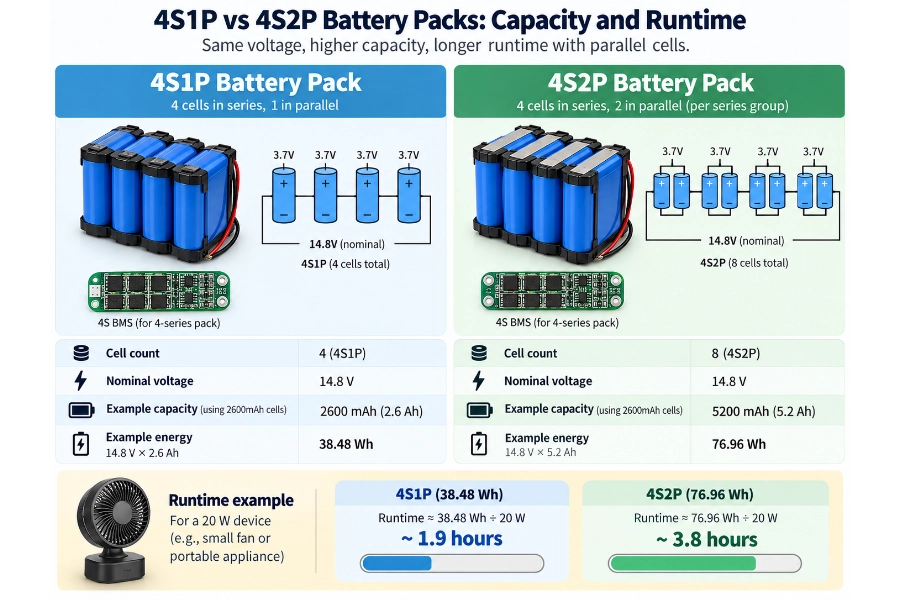
When developing rechargeable equipment, battery configuration affects operating time, enclosure dimensions, total weight, and manufacturing cost.
Two commonly considered arrangements for four-series lithium-ion systems are 4S1P and 4S2P battery packs.
Both configurations provide the same nominal voltage when built with equivalent cells, but their available capacities and energy storage are different.
Understanding these differences helps equipment manufacturers select an appropriate battery architecture for portable air purifiers, industrial electronics, monitoring devices, and other rechargeable products.
What Does 4S1P Mean?
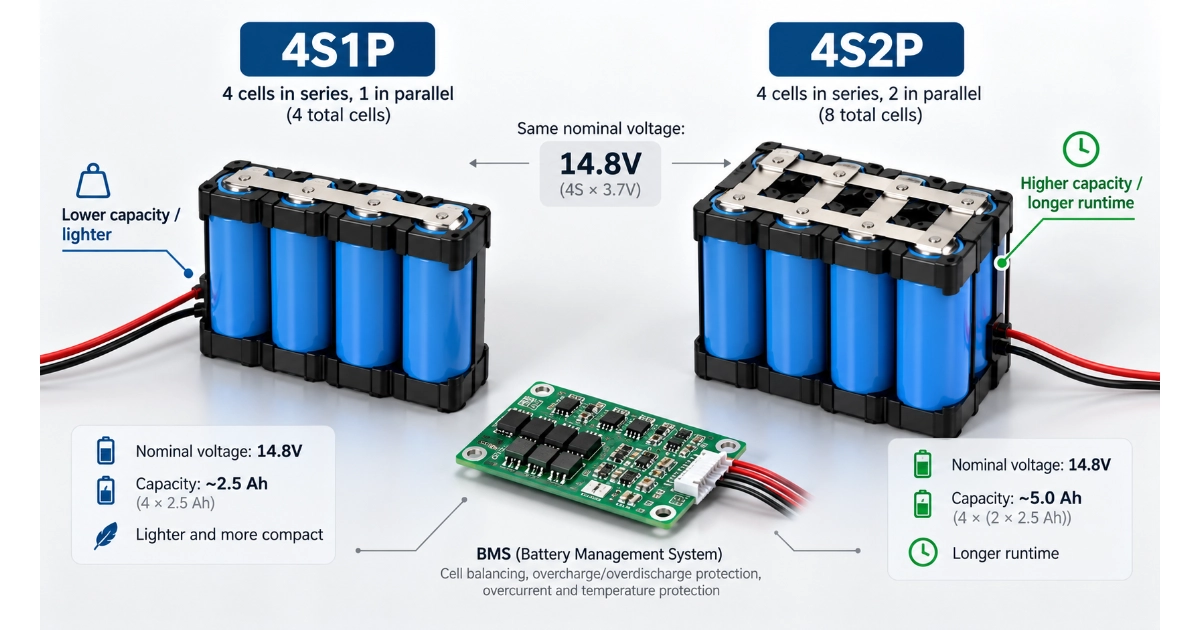
The designation 4S1P describes four lithium-ion cells connected in series, with one cell in each series group.
The series connection increases total voltage while capacity in ampere-hours remains equal to that of one cell.
For four 3.7V, 2600mAh cells:
- Nominal voltage: 14.8V
- Nominal capacity: 2600mAh
- Nominal energy: 38.48Wh
- Total cell count: 4
The actual usable energy depends on cell specifications, discharge conditions, operating temperature, and voltage limits.
A 4S1P arrangement is often considered when compact dimensions and reduced battery weight are important.
What Does 4S2P Mean?
A 4S2P battery contains four series-connected groups, with two cells connected in parallel within each group.
Compared with 4S1P, the nominal voltage remains unchanged, while capacity doubles when identical cells are used.
For eight 3.7V, 2600mAh cells:
- Nominal voltage: 14.8V
- Nominal capacity: 5200mAh
- Nominal energy: 76.96Wh
- Total cell count: 8
The additional parallel cells provide greater energy storage and may reduce the load current carried by each individual cell, assuming appropriate pack design and current sharing.
However, the arrangement also introduces additional cell connections, mass, material costs, and installation requirements.
4S1P vs 4S2P: Technical Comparison
| Parameter | 4S1P | 4S2P |
|---|---|---|
| Cell count | 4 | 8 |
| Nominal voltage | 14.8V | 14.8V |
| Capacity with 2600mAh cells | 2600mAh | 5200mAh |
| Nominal energy | 38.48Wh | 76.96Wh |
| Relative cell weight | Lower | Higher |
| Required installation space | Smaller | Larger |
| Relative cell material cost | Lower | Higher |
| Runtime potential | Standard | Approximately double |
The runtime relationship assumes identical cell models and comparable operating conditions. Finished-device performance may differ because of efficiency, voltage limits, and discharge behavior.
How Does Cell Capacity Affect Runtime?
Cell capacity is another important design variable.
For example, four-series packs built using 2600mAh, 3300mAh, or 3500mAh cells will have different energy storage values.
| Cell Capacity | 4S1P Energy | 4S2P Energy |
|---|---|---|
| 2600mAh | 38.48Wh | 76.96Wh |
| 3300mAh | 48.84Wh | 97.68Wh |
| 3500mAh | 51.80Wh | 103.60Wh |
These calculations use a nominal cell voltage of 3.7V.
They represent theoretical nominal energy, not guaranteed delivered energy or independently verified battery-pack ratings.
Cell capacity should also be checked against continuous current capability, cycle-life requirements, and approved charging conditions.
Example: Battery Runtime in a Portable Air Purifier
A battery-powered air purifier may offer several fan settings.
The lowest setting generally requires less power than the highest setting, although actual consumption depends on the fan motor and control electronics.
Consider a simplified design example using 2600mAh cells.
At a constant 10W device load:
4S1P battery
38.48Wh × 0.85 ÷ 10W = approximately 3.3 hours.
4S2P battery
76.96Wh × 0.85 ÷ 10W = approximately 6.5 hours.
For this calculation, 85% of nominal energy is assumed to be available at the device load.
Actual usable energy must be measured because voltage regulation, battery aging, discharge termination, and operating temperature influence runtime.
The comparison nevertheless demonstrates why parallel cell count is an important design decision.
For a broader application discussion, see our Custom Air Purifier Battery Packs: OEM Design Guide.
Does a 4S2P Battery Require a Different BMS?
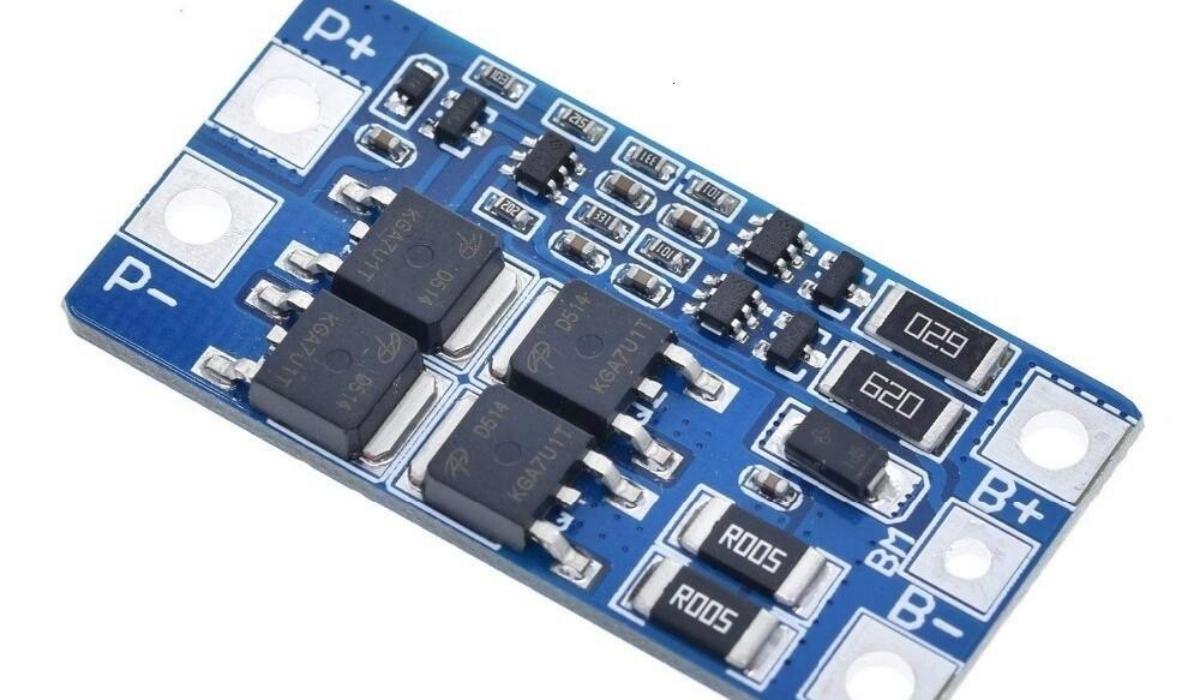
Both configurations require protection designed for four series-connected lithium-ion cell groups.
The BMS must be compatible with the selected cell chemistry and pack voltage.
Although the series count is the same, the current rating, balancing strategy, thermal behavior, and protection settings must be evaluated for each design.
A 4S2P battery may provide greater current capability because parallel cells share the load, but total pack current must remain within the ratings of the cells, interconnections, wires, connectors, and protection electronics.
A manufacturer should not automatically double the BMS rating merely because the battery contains twice as many cells.
For a detailed explanation of protection selection, refer to How to Choose a BMS for Lithium Battery Packs.
Battery Charging Voltage and Compatibility
A four-series lithium-ion pack using conventional 4.2V maximum-charge cells typically reaches 16.8V at full charge.
However, a manufacturer may intentionally specify a lower charging limit, provided the selected cells and charging system support it.
For example, 4.10V per cell corresponds to a maximum pack charging voltage of 16.4V.
Reducing the maximum charge voltage may reduce the available capacity and runtime. Any potential benefits for cycle life must be evaluated against the specific cell chemistry and operating conditions.
For equipment with charging electronics integrated into the main PCB, the battery pack and charger must be designed as a compatible system.
USB-C connectivity alone does not define the charging voltage, current regulation, or battery protection requirements.
Mechanical Design: Will 4S2P Fit?
An eight-cell battery requires more physical space than a four-cell battery of the same cell model.
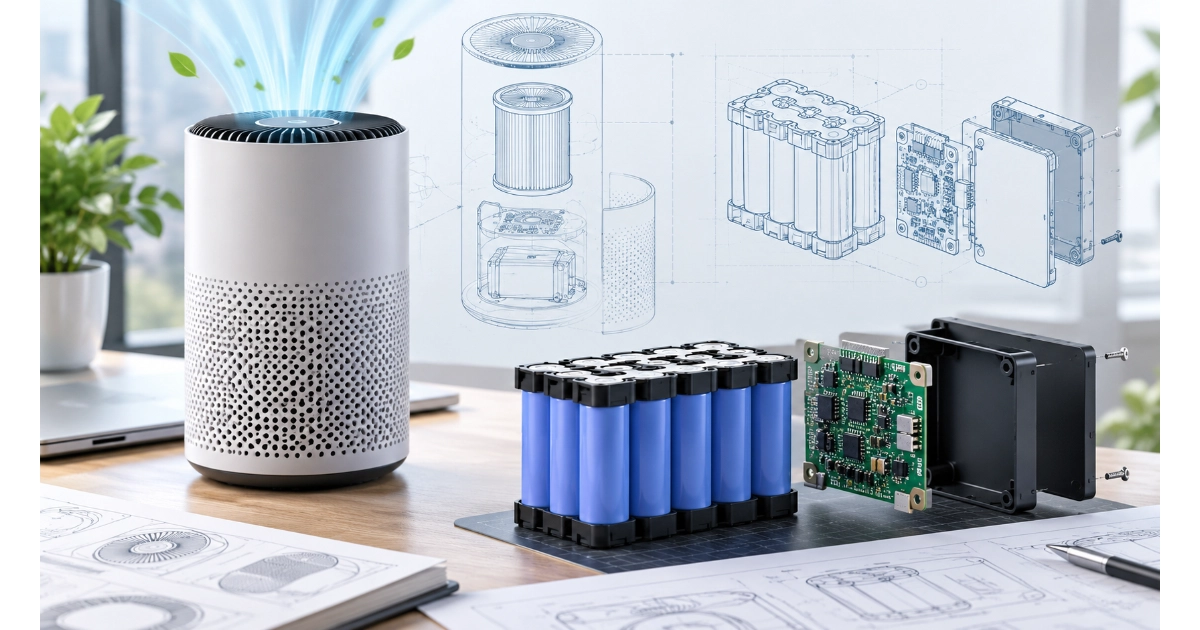
Engineers must consider the available cavity dimensions, cell orientation, insulating materials, BMS position, and connector arrangement.
For cylindrical 18650 cells, mechanical design also needs to account for manufacturing tolerances and protective construction.
A 4S2P arrangement may be unsuitable for an enclosure originally designed for 4S1P unless sufficient additional space is available.
Early mechanical drawings and battery compartment measurements can prevent costly redesign during prototyping.
Which Configuration Is Better for OEM Equipment?
The better configuration depends on the complete equipment specification.
Choose 4S1P when:
- Compact size is a major requirement.
- The required runtime can be achieved with four cells.
- Lower battery weight and cell cost are priorities.
- The selected cells can safely support the operating current.
Consider 4S2P when:
- Longer runtime is a primary design objective.
- The enclosure can accommodate eight cells.
- Additional battery weight is acceptable.
- Cell-level current sharing offers an engineering advantage.
Neither configuration is universally superior.
At Gloflux, we support OEM battery pack design through cell selection, configuration assessment, customized BMS integration, and prototype validation.
Manufacturers can also explore our 14.8V Lithium Battery Pack range for related four-series battery solutions.
Frequently Asked Question
Can a manufacturer switch from 4S1P to 4S2P without changing the device electronics?
Sometimes, but compatibility must be verified. Although both configurations have the same nominal voltage with equivalent cells, battery dimensions, charging behavior, protection settings, current capability, and device-level performance must be reviewed before making the change.
For custom battery development, contact Gloflux with your electrical specifications, enclosure dimensions, target runtime, and estimated production volume.
- PREV: Custom Air Purifier Battery Packs: OEM Design Guide
- NEXT: Null