


 Home /
 Custom Battery for Cold Chain Trackers: Long-Life IoT Power Design


Table of Contents
- What Information Is Needed to Size a Cold-Chain Tracker Battery?
- How Cold Affects Battery Performance and Why It Matters
- Choosing the Battery Chemistry and Form Factor
- Designing the Pack: Voltage, Architecture, and BMS
- Mechanical Integration: Connectors, Wiring, Enclosure, and Thermal Path
- Prototype, Testing, and Transport Documentation
- What to Ask a Battery Supplier Before Ordering
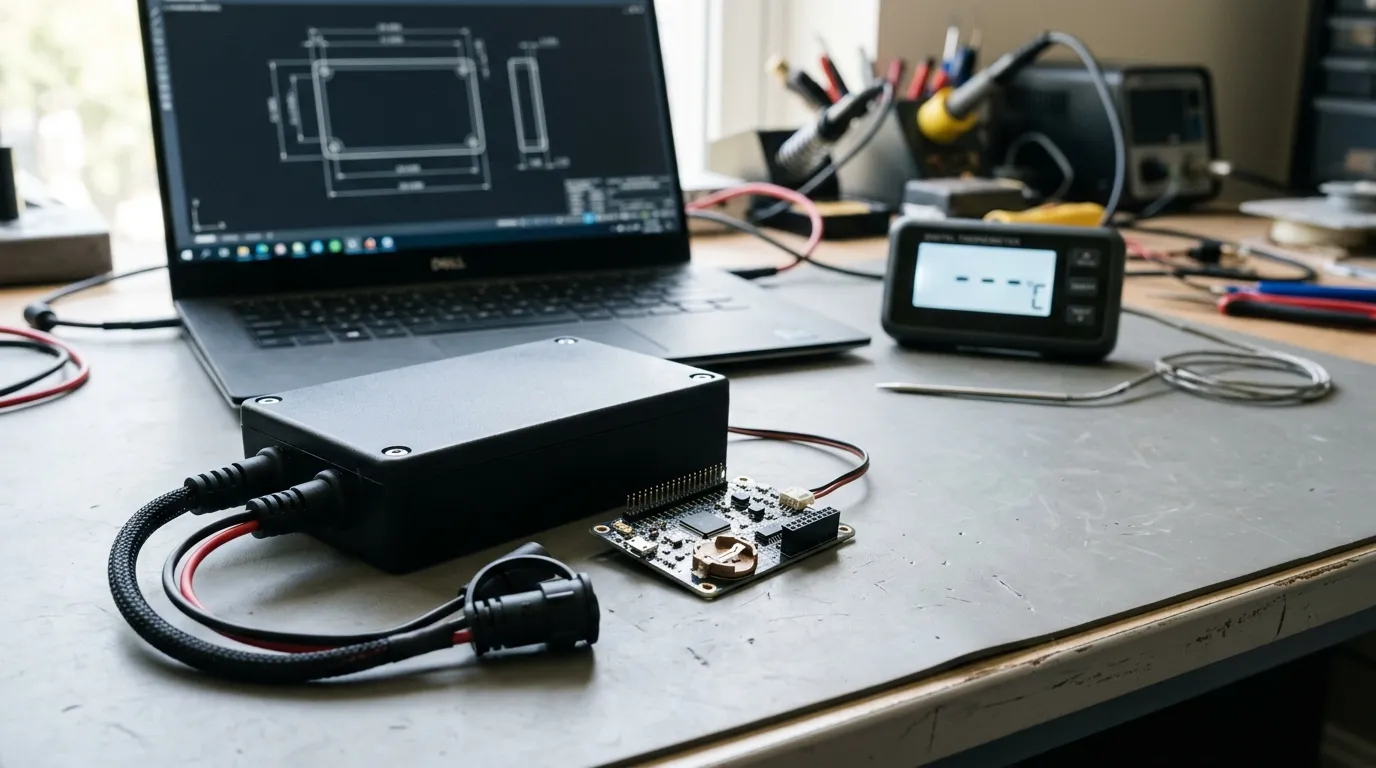
A custom battery for cold chain trackers must be engineered from the tracker's duty cycle, operating temperature range, peak-current demands, mechanical constraints, and transport requirements — not selected by capacity alone. Getting this right means the difference between a tracker that reports reliably for months and one that fails silently in the field.
Cold chain trackers present a unique power challenge. They combine low-power sleep states with intermittent high-current bursts from GPS fixes and wireless transmissions, all while operating in environments that can range from refrigerated storage to deep-freeze conditions. A standard battery pack designed for room-temperature consumer devices will not deliver the dependable long-term performance these deployments require.
This guide walks through the engineering and sourcing decisions involved in specifying a custom battery for cold chain tracking devices, from requirements capture through supplier qualification. It focuses specifically on the battery-pack design considerations that determine whether a tracker will meet its runtime target in real-world cold chain operations. For broader guidance on custom battery design for IoT hardware, see our custom battery for iot hardware overview.
What Information Is Needed to Size a Cold-Chain Tracker Battery?
Before any cell chemistry or pack architecture is chosen, the tracker's complete power profile must be understood. The battery is not an isolated component — it must be sized to match how the device actually behaves in the field.
The following inputs are required to define a cold-chain tracker battery specification:
- Duty cycle: how often the device wakes, measures, records, and transmits.
- Sensor sampling interval: temperature and humidity readings per hour or per day.
- GPS fix rate: how frequently the device acquires a location and for how long.
- Wireless transmission interval: how often data is sent via cellular, LoRaWAN, or Bluetooth.
- Network type and signal conditions: cellular networks consume more power during poor-signal retries; LoRaWAN typically uses less energy but depends on gateway availability. Where LoRaWAN is the chosen connectivity path, the design considerations align closely with those covered in our guide on Custom battery pack for LoRaWAN sensors.
- Sleep current: the baseline current draw between active events, often the largest contributor to total energy consumption over long deployments.
- Operating temperature extremes: both the minimum and maximum temperatures the battery will experience during discharge.
- Charging temperature range: whether the battery will be charged in cold environments, which imposes different constraints than discharging.
- Mechanical space: the physical envelope available inside the tracker enclosure.
- Connector and wiring requirements: how the pack connects to the device PCB.
- Deployment model: whether the battery is single-use for the tracker's life, replaceable, or rechargeable in the field.
The core principle is that runtime depends on total energy consumption, not on capacity alone. The energy requirement is calculated by summing the current draw of each operating mode over a full duty cycle:
Energy per cycle = (sleep current × sleep time) + (sensor current × active time) + (GPS current × fix duration) + (transmission current × transmit duration)
This result, expressed in milliwatt-hours (mWh) or watt-hours (Wh), is then multiplied by the number of cycles across the required deployment period. A reserve margin is added to account for cold-temperature derating, battery self-discharge, and capacity loss from aging.
Using watt-hours rather than milliamp-hours is important when comparing battery options at different voltages. A 3.7 V pack and a 7.4 V pack with the same milliamp-hour rating do not store the same amount of energy.
For trackers that operate on a rechargeable basis, the design process follows the same energy-budget logic but also includes cycle-life and charging considerations. Our guide on rechargeable battery for iot sensors explains how rechargeable architectures differ from single-use packs.
Step-by-Step: Translating Duty Cycle into Battery Hours
- Define the reporting schedule. Determine how many temperature readings, GPS fixes, and wireless transmissions occur per day.
- Measure or estimate sleep current. This is the steady-state draw between events, typically in microamps or low milliamps.
- Identify GPS and transmission burst currents. These are the highest-current events in the duty cycle, often several amps for cellular transmission.
- Sum energy over a full cycle. Multiply each current by its duration, then add all contributions.
- Multiply by deployment days. This gives the total energy the battery must supply over the tracker's service life.
- Add reserve margin. Cold temperatures reduce usable capacity, and battery aging reduces total energy over time. A common planning buffer is 20–30% above the theoretical requirement.
- Convert to watt-hours and review voltage. The energy requirement, together with the device's input voltage range, determines the necessary series/parallel configuration.
This process turns a vague requirement like "long battery life" into a measurable specification that a battery manufacturer can engineer against.
How Cold Affects Battery Performance and Why It Matters
Cold temperatures change how a lithium battery behaves, and these changes directly affect tracker reliability.
Low temperatures increase the internal resistance of a lithium cell. The electrolyte becomes less conductive, and the chemical reactions that release energy slow down. The practical result is that the cell's terminal voltage drops more under load than it would at room temperature.
This voltage sag can be severe enough to cause problems even when the battery still holds significant charge. If the voltage falls below the tracker's minimum operating threshold during a GPS fix or cellular transmission, the device can reset or shut down. In some cases, the battery's own protection circuit may interpret the low voltage as an over-discharge condition and disconnect the pack.
Cold also reduces the amount of usable capacity the cell can deliver. A cell rated for a certain capacity at 20°C may deliver considerably less at −20°C or −40°C, depending on the discharge rate and the specific cell chemistry. The capacity figure printed on a datasheet is not a guarantee of performance at cold temperatures.
The design implications are significant:
- The peak-current capability of the pack must be verified at the lowest expected operating temperature, not at room temperature.
- The usable capacity must be derated for cold conditions when calculating expected runtime.
- Voltage sag under load must be evaluated against the tracker's minimum input voltage and the BMS protection thresholds.
Temperature must also be considered separately for charging. A battery that is rated to discharge at very low temperatures is not necessarily safe to charge at those same temperatures.
Design Rule: Separate Discharge Capability from Charge Capability
Discharge capability and charge capability are different specifications.
Lithium-ion and lithium-polymer cells can typically discharge across a wider temperature range than they can charge. Charging below the cell manufacturer's specified minimum temperature can damage the cell, reduce its cycle life, and create safety risks.
This means the tracker's design must account for both conditions:
- Discharge temperature: the environment where the tracker operates while powered by the battery.
- Charge temperature: the environment where the battery receives energy, whether from a USB port, a docking station, or a replaceable-cell charging system.
If the tracker is charged in a cold environment, the pack design may require temperature-based charging control through the BMS, or the device may need a strategy to warm the battery before charging. The engineering team must confirm both temperature ranges during the specification phase, because they directly affect cell selection, BMS configuration, and charger design.
Choosing the Battery Chemistry and Form Factor
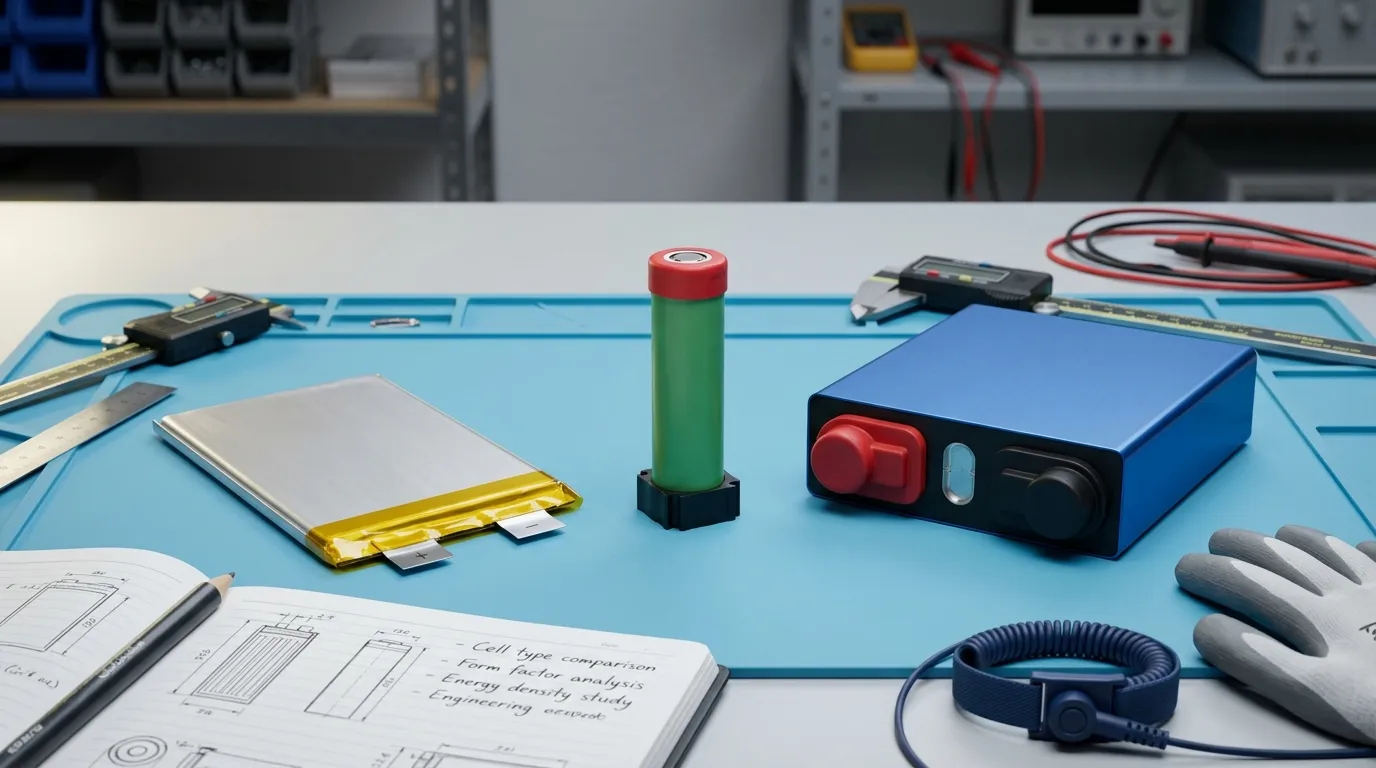
Cold-chain trackers are typically built around one of three lithium-based options, each with trade-offs that matter in different ways.
| Chemistry / Form Factor | Nominal Voltage | Advantages | Limitations | Typical Use in Trackers |
|---|---|---|---|---|
| Li-ion cylindrical (18650, 21700) | 3.6–3.7 V per cell | Mature supply chain; good energy density; proven mechanical robustness; strong datasheet availability | Fixed diameter and length; less flexible for thin enclosures | Trackers with adequate internal space and a need for certified, high-volume cells |
| Li-polymer / LiPo pouch | 3.7 V per cell | Flexible shape and thickness; low-profile design; can fit irregular enclosures | Requires mechanical protection; swelling management needed; less standardized than cylindrical | Compact and thin trackers where space is constrained |
| LiFePO4 | 3.2 V per cell | Good thermal stability; long cycle life; lower fire risk relative to some other lithium chemistries | Lower nominal voltage; lower energy density; may require more cells or higher capacity to match Li-ion energy | Specific cold-chain designs where thermal stability is prioritized, provided the voltage platform and energy targets can be met |
There is no universal "best" chemistry for cold-chain trackers. The correct choice depends on the mechanical envelope, the energy requirement, the peak-current demand, the temperature range, the charging model, and the cost target. A high-capacity cylindrical cell may be ideal for a large container tracker but impossible to fit in a small disposable logger.
The low-temperature performance of a cell also depends on the specific cell design, not just its chemistry family. Two 18650 cells from different manufacturers can behave very differently at −20°C. The cell datasheet must be reviewed for discharge curves at the actual operating temperature, not inferred from the chemistry name.
For trackers that use wireless monitoring systems and require a flexible, low-profile pack, the design approach for lipo battery for wireless monitoring systems provides useful parallels to cold-chain deployment.
Gloflux states that its custom battery offering includes both Li-polymer and cylindrical Li-ion configurations, including 18650 and 21700 formats. The appropriate choice is determined by the tracker's specific design constraints.
When LiPo Makes Sense for a Cold-Chain Tracker
LiPo pouch cells are often the right choice when the tracker enclosure is thin, curved, or otherwise limited in height. Temperature data loggers for pharmaceutical shipments, for example, are frequently compact devices that need the battery to fit within a slim housing.
LiPo cells can be manufactured in custom thicknesses and footprints, which gives the mechanical designer more freedom. However, pouch cells require careful handling:
- Mechanical protection is needed to prevent puncture or damage.
- Swelling management must be considered, as pouch cells can expand slightly over charge/discharge cycles and with age.
- The enclosure must accommodate the cell without applying excessive pressure.
Gloflux states that its LiPo customization can include adjusting the cell's thickness, width, and length to match the device's internal space. For a cold-chain tracker with a tight mechanical envelope, this flexibility can be the deciding factor.
When Cylindrical Li-Ion Cells Fit the Design
Cylindrical lithium-ion cells, particularly the 18650 and 21700 formats, are the most standardized and widely manufactured lithium cells in the world. They offer well-documented performance data, consistent quality from major cell manufacturers, and proven mechanical robustness.
For cold-chain trackers with adequate internal volume, cylindrical cells are often the most straightforward path to a reliable, certifiable pack. The rigid steel casing provides structural integrity, and the format's maturity means cell-level test data is widely available.
The trade-off is geometry. The cell's diameter and length are fixed, so the pack is limited to linear or side-by-side arrangements. A tracker with a compact, flat, or unusual enclosure shape may not accommodate cylindrical cells efficiently.
Where space permits, cylindrical cells provide a dependable foundation for a custom cold-chain tracker battery pack.
Designing the Pack: Voltage, Architecture, and BMS
Once the chemistry and form factor are selected, the pack architecture must be engineered to meet the tracker's electrical requirements.
Nominal Voltage and Charge Voltage
The pack's nominal voltage must fall within the tracker's input voltage range. The nominal voltage is determined by the number of cells connected in series:
- One cell in series (1S) provides approximately 3.7 V nominal for Li-ion or LiPo.
- Two cells in series (2S) provides approximately 7.4 V.
- Three cells in series (3S) provides approximately 11.1 V.
The maximum charge voltage is different from the nominal voltage. A typical Li-ion cell charges to 4.2 V, meaning a 1S pack charges to 4.2 V and a 2S pack charges to 8.4 V. The charger design and BMS charge-cutoff settings must be matched to the maximum charge voltage, not the nominal voltage.
Series and Parallel Configuration
The series count sets the pack's voltage. The parallel count sets its capacity and available current. For example, a 2S2P configuration uses two series groups, each with two cells in parallel, to deliver a higher voltage with increased capacity.
The choice of configuration depends on:
- The tracker's required voltage.
- The total energy requirement in watt-hours.
- The peak-current demand, which may require parallel cells to reduce current per cell and limit voltage sag.
- The physical arrangement inside the enclosure.
PCM vs. BMS
There is an important distinction between a basic protection circuit and a full battery management system.
A PCM (protection circuit module) provides basic protection against overcharge, over-discharge, overcurrent, and short-circuit conditions. It is a safety device, not a management system. A PCM does not typically measure state of charge, balance cells, or communicate with the host device.
A BMS (battery management system) includes protection features and adds monitoring and control capabilities. A BMS may provide:
- Cell balancing, which ensures cells in a multi-series pack stay at similar voltages. This is essential for pack consistency and usable cycle life.
- Fuel gauging, which estimates state of charge and remaining runtime.
- Communication, through protocols such as SMBus, I2C, UART, CAN, RS485, or Bluetooth, allowing the tracker to read battery status.
For a cold-chain tracker that must report its own battery level or operate reliably over a long deployment, a smart BMS is often necessary. For a simple disposable tracker with a fixed duty cycle, a well-configured PCM may be sufficient.
Gloflux states that its custom battery packs can include integrated BMS and customized communication protocols, depending on the project requirements.
Mechanical Integration: Connectors, Wiring, Enclosure, and Thermal Path
The battery must be integrated into the tracker's mechanical design, not treated as an isolated component.
Connector and wiring: The connector must be rated for the pack's maximum continuous and peak current, with proper polarity, locking mechanism, and strain relief. A connector that is too small for a cellular transmission burst can create resistance, heat, and voltage drop. The wire gauge must also be matched to the current and cable length.
Enclosure: The enclosure must protect the pack from physical damage, dust, and moisture while leaving room for the cell's normal dimensions and any expected swelling. IP ratings, where specified, apply to the complete device enclosure — not to the battery pack alone. The term "waterproof" should not be used to describe a battery that merely has some ingress protection.
Thermal path: The battery's operating temperature is influenced by its thermal contact with the enclosure and the environment. In a cold-chain tracker, the battery may be intentionally insulated to slow heat loss, or it may need a thermal path to dissipate heat generated during high-current transmission. Condensation inside the enclosure is a real risk when temperature cycles below and above freezing, and the pack design must account for moisture protection.
Mounting: The pack must be secured against vibration and shock, which are common in transport applications. Adhesive mounting, screw fixing, or a compression-fit cavity can all be appropriate, depending on the pack size and the expected mechanical stress.
Gloflux states that its customization can cover wiring, connectors, enclosures, and dimensions to match the tracker's mechanical design.
Prototype, Testing, and Transport Documentation
A custom battery pack for a cold-chain tracker requires verification before production, and the documentation that supports shipment and market access must be in place.
Prototype Validation
The prototype stage should validate the pack against the tracker's real behavior. This includes:
- Capacity testing under the actual duty cycle and temperature profile.
- Charge and discharge behavior across the operating temperature range.
- Peak-current tolerance, especially during GPS acquisition and wireless transmission.
- Sleep-current behavior to confirm the pack does not introduce unexpected drain.
- BMS behavior, including protection thresholds and, where applicable, fuel-gauge accuracy.
- Mechanical testing, including vibration, shock, and drop, reflecting the transport environment.
UN 38.3 Transport Testing
Lithium cells and batteries offered for transport must pass the design tests specified in Section 38.3 of the UN Manual of Tests and Criteria. According to the U.S. Department of Transportation's Pipeline and Hazardous Materials Safety Administration (PHMSA), transporting lithium batteries requires that lithium cells and batteries be tested in accordance with the UN Manual of Tests and Criteria, Part III, Subsection 38.3.
Manufacturers must make test summaries available to those who need them, demonstrating that the specific battery design has passed the required tests, which include altitude simulation, thermal test, vibration, shock, external short circuit, impact/crush, overcharge, and forced discharge, where applicable.
The test summary is a document specific to a battery design. It is not the same as a product-safety certificate, and it should not be treated as one.
Product Safety and Market Documentation
Separate from transport testing, the battery may require product-safety testing and market documentation depending on the device and its destination markets. This can include standards such as IEC 62133, UL, or CB, and market declarations such as CE, RoHS, or REACH.
The key distinction is scope. A UN 38.3 test summary demonstrates transport compliance for a defined battery design. An IEC 62133 or UL report demonstrates product safety for a defined model. A company's quality-system certification, such as ISO 9001, applies to the organization's processes — it does not certify an individual product.
Gloflux states that it provides certification support for custom batteries, meaning the company can assist with the documentation and testing pathway. This does not mean that every product is automatically certified to every standard, and buyers should request evidence specific to their battery design.
A recommended validation matrix for a cold-chain tracker battery includes:
| Test | What It Verifies |
|---|---|
| Capacity test at operating temperature | Runtime under the actual duty cycle |
| Peak-current pulse test | Voltage stability during GPS/cellular bursts |
| Sleep-current measurement | Quiescent drain of the pack and BMS |
| Charge test at low temperature | Safe charging behavior at the specified minimum |
| Vibration and shock | Mechanical integrity during transport |
| Drop test | Resistance to handling damage |
| BMS threshold verification | Protection settings match the specification |
| UN 38.3 test summary | Transport compliance for the battery design |
What to Ask a Battery Supplier Before Ordering

Choosing a custom battery manufacturer for a cold-chain tracker requires more than comparing prices and capacity figures. The buyer must verify that the supplier can actually deliver a pack engineered for the application's specific demands.
A complete RFQ should include:
- The tracker's duty cycle and energy requirement in watt-hours.
- The operating and charging temperature ranges.
- The peak-current demand and its duration.
- The mechanical envelope and connector requirements.
- The required BMS features and communication protocols.
- The documentation required, including datasheet, test reports, SDS/MSDS, and UN 38.3 test summary.
- The target timeline for samples and production.
Supplier questions that deserve specific attention:
- What exact cell model is proposed, and who manufactures it? The cell identity determines performance, safety, and supply-chain risk.
- How is cell traceability managed? Buyers need assurance that the pack uses the approved cell and not a substitute.
- What are the BMS protection thresholds? Overcharge, over-discharge, overcurrent, and temperature limits must match the specification.
- How is cell matching performed? For multi-cell packs, consistent cell characteristics are essential for pack performance and life.
- What validation data is available for this specific pack design? Request test reports for capacity, temperature, current, and mechanical tests.
- What documentation will be provided? Confirm the presence of a datasheet, test reports, SDS/MSDS, UN 38.3 test summary, and any market-specific declarations.
- How is change control managed? Any change to the cell, BMS, connector, or manufacturing process should require buyer notification and approval.
- What is the sample, pilot, and mass-production timeline? This affects the product launch schedule.
Gloflux's custom battery offering is an example of the scope a buyer should expect from a manufacturer. The company states that it can customize dimensions, capacity, voltage, discharge rate, wiring, connectors, enclosures, communication protocols, and integrated BMS to match the device's requirements. For a cold-chain tracker, these customization points cover the full range of design decisions described in this guide.
A complete battery specification, delivered with the right documentation and validation evidence, is the foundation of a reliable cold-chain tracking deployment. The time spent on requirements capture and supplier qualification is the best protection against field failures that are far more expensive to fix after deployment.
Talk to the Manufacturer
Resources & Insights
High Capacity Lithium Battery for Wearables: High-Voltage LiPo Cell Design
2026-10-19
Cylindrical Battery Packs for Laptops: 2S vs 3S vs 4S Battery Design
2026-10-19
Stage Lighting Battery Pack: Prevent Voltage Drop & LED Flicker
2026-10-19

Best Rechargeable Batteries for Smart Devices: Performance, Safety, and Selection Guide
2026-10-19


