


 Home /
 Rechargeable Battery for Aerospace Test Equipment: Portable Instrument Power


Table of Contents
- What is a rechargeable battery for aerospace test equipment?
- How to specify a rechargeable battery for aerospace test equipment
- Choosing the right chemistry and cell format
- Battery pack architecture and BMS
- Charger, connector, and mechanical integration
- Environmental and safety considerations
- What documentation and tests does the pack need?
- How to evaluate a battery supplier for aerospace test equipment
- Portable test equipment versus installed aircraft battery systems
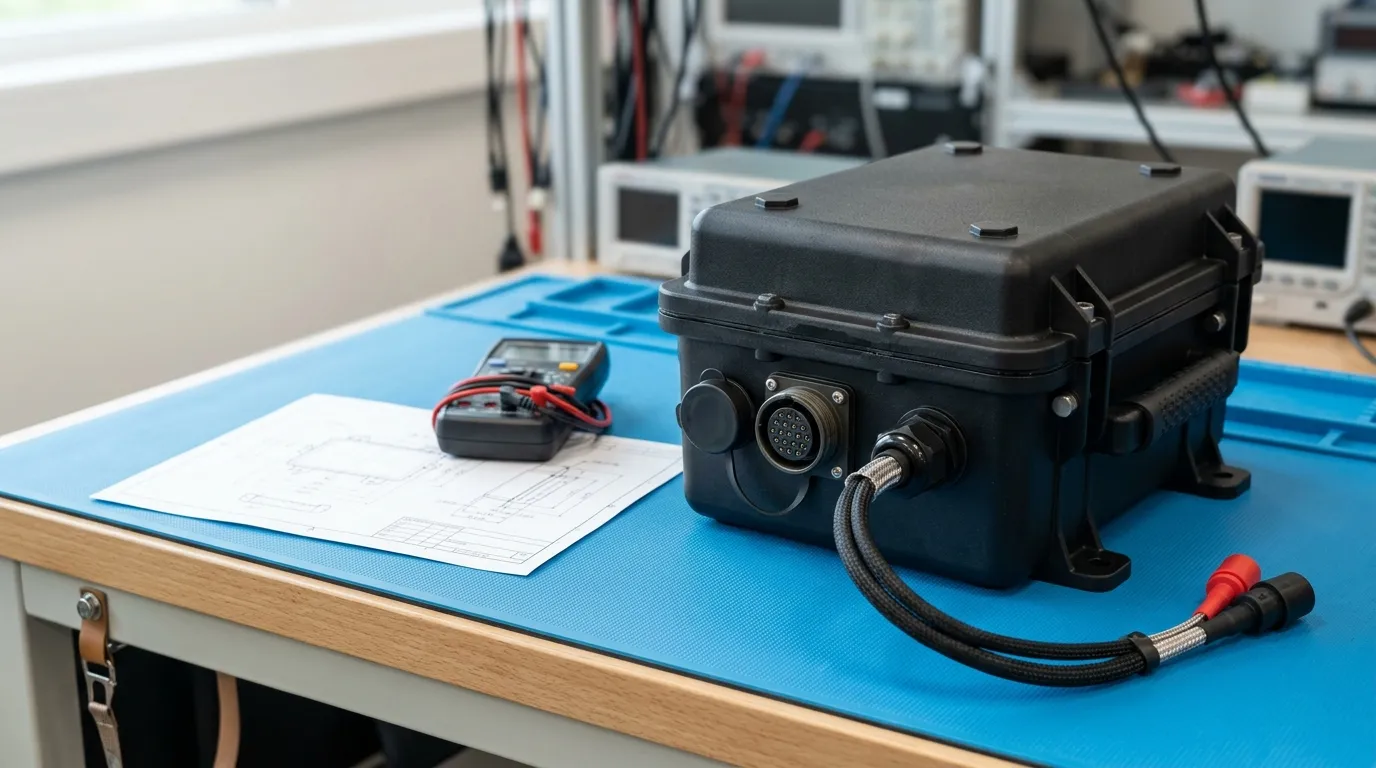
A rechargeable battery for aerospace test equipment is a custom-configured battery pack engineered to power portable test instruments used in aerospace development, production, and maintenance environments. It is selected from the instrument's voltage, energy and runtime requirements, continuous and peak current demand, physical envelope, charging interface, environmental conditions, protection system, and required documentation — not from a single cell specification or a generic "aerospace battery" label.
Portable aerospace test equipment — such as avionics testers, flight-line diagnostic units, GNSS survey tools, and portable calibration instruments — needs power that is dependable, field-serviceable, and safe to transport. This guide explains how to specify, select, and source the right rechargeable battery pack for these applications. For a broader view of lithium battery applications in aerospace, see the parent topic.
What is a rechargeable battery for aerospace test equipment?
A rechargeable battery for aerospace test equipment is a complete power system consisting of lithium cells, a protection circuit or battery management system (BMS), a mechanical enclosure, electrical connectors, and thermal management. It is designed specifically for the instrument it powers.
Three distinctions matter from the start:
- A cell is not a battery pack. A cell is a single electrochemical unit. A pack combines multiple cells in series and parallel configurations with protection, wiring, and enclosure.
- Portable test equipment is not the same as an installed aircraft battery system. Batteries installed on certified aircraft must meet airworthiness requirements such as FAA AC 20-184. A portable test instrument used on the ground may not need that level of qualification, but it still needs proper environmental and transport documentation.
- A generic lithium battery is not automatically suitable for aerospace test use. The pack must match the instrument's load profile, physical space, operating environment, and charging interface.
How to specify a rechargeable battery for aerospace test equipment
The specification process starts with the instrument, not the battery. Define each requirement before contacting a supplier.
Electrical requirements:
- Nominal voltage (V)
- Maximum charge voltage (V)
- Capacity (mAh or Ah)
- Energy (Wh)
- Continuous current (A)
- Peak current (A) and its allowed duration
- C-rate (current relative to capacity)
- Required runtime (hours)
- Charger voltage, current, and connector type
Mechanical requirements:
- Maximum dimensions (mm)
- Weight limit (g or kg)
- Connector type and pinout
- Cable length and wire gauge
- Mounting method
- Enclosure requirements, including ingress protection (IP) rating
Environmental requirements:
- Charge temperature range
- Discharge temperature range
- Storage temperature range
- Vibration, shock, and drop exposure
- Humidity or altitude conditions
- Electromagnetic compatibility where the instrument requires it
Documentation requirements:
- Datasheet or technical data sheet (TDS) for the exact pack model
- UN38.3 test summary for transport
- SDS/MSDS for handling and shipping
- Test reports covering electrical, mechanical, and environmental verification
Calculate your capacity and runtime requirement
Runtime is determined by energy, not capacity alone. Energy in watt-hours (Wh) is calculated as:
Energy (Wh) = Nominal voltage (V) × Capacity (Ah)
Runtime is then:
Runtime (hours) = Energy (Wh) ÷ Average load power (W)
Example: An instrument draws 25 W average from a 14.8 V pack. If you need 4 hours of runtime:
- Required energy = 25 W × 4 h = 100 Wh
- Required capacity = 100 Wh ÷ 14.8 V ≈ 6.8 Ah
Apply a safety margin for voltage sag, cold temperature, and battery aging. A pack sized exactly to the nominal runtime will fall short in real conditions.
Choosing the right chemistry and cell format
| Chemistry | Typical Nominal Voltage | Energy Density | Cycle Life | Key Trade-Offs |
|---|---|---|---|---|
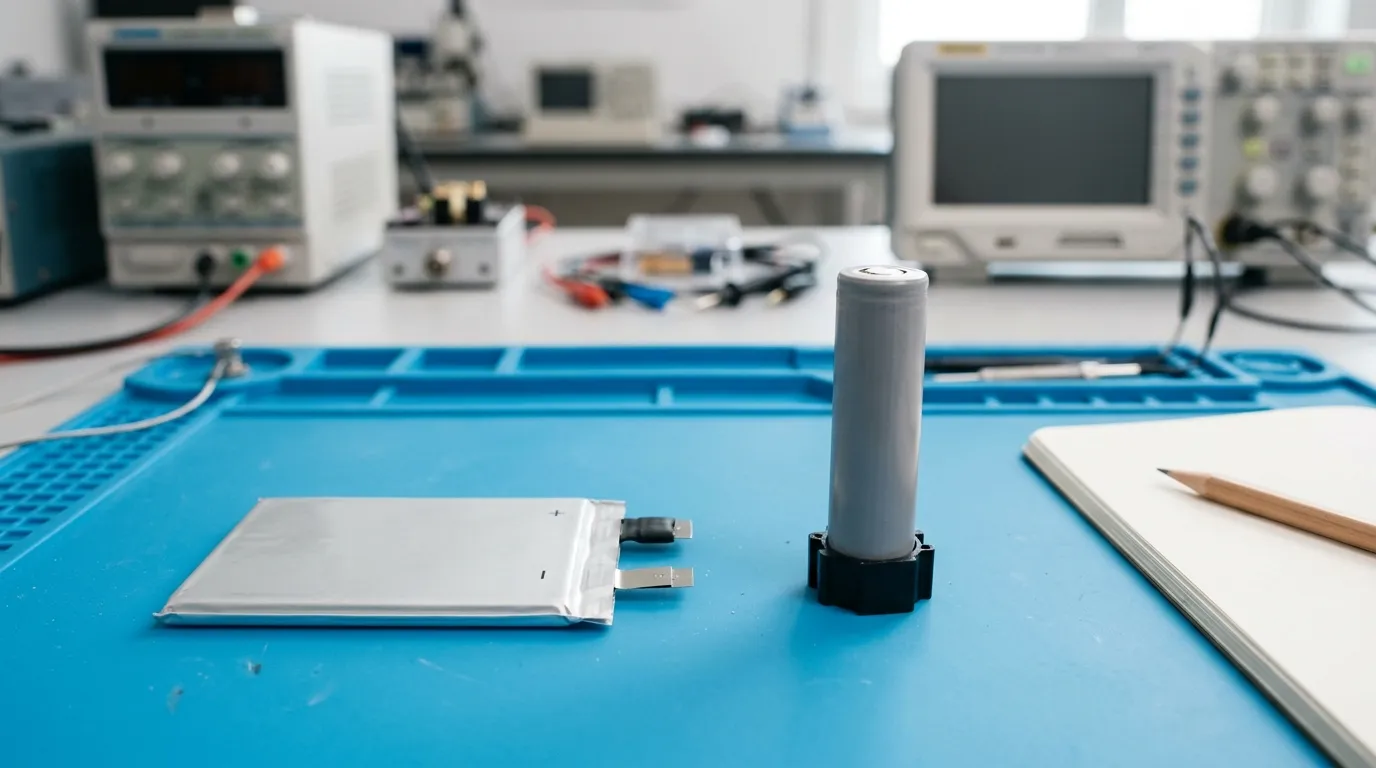
| Lithium-ion cylindrical (e.g., 18650, 21700) | 3.6–3.7 V per cell | High | Good | Standardized format; requires enclosure and cell holders |
| Lithium-polymer (LiPo) pouch | 3.7 V per cell | High | Good | Thin, custom shapes, low weight; requires mechanical protection |
| LiFePO4 | 3.2 V per cell | Lower | Longer | Lower energy density; different voltage platform; longer cycle life |
Lithium-ion cylindrical cells are a practical choice when the instrument has space for a rigid enclosure and the load profile is relatively stable. They offer high energy density, mature manufacturing, and predictable performance.
LiPo pouch cells suit instruments with tight or irregular interior space. Because the pouch is flexible and requires mechanical support, the pack design must include proper compression, insulation, and impact protection. Gloflux builds industrial lithium polymer battery (inferred) solutions for portable and industrial systems where thin geometry and custom shapes matter.
LiFePO4 offers longer cycle life and a more stable chemistry, but at a lower nominal voltage (3.2 V per cell) and lower energy density. It becomes attractive only when the instrument can accept the additional weight and the voltage platform can be designed around it.
The correct chemistry is the one that matches voltage, energy, weight, temperature, cycle-life, and cost targets for the specific instrument — there is no universal best choice.
Battery pack architecture and BMS
The pack architecture determines the voltage and capacity of the finished battery.
Series cells (S) set the voltage. Four 3.6 V cells in series (4S) produce a nominal voltage of approximately 14.4 V. The maximum charge voltage is set by the number of series cells and the cell chemistry.
Parallel cells (P) set the capacity and available current. Two cells in parallel (2P) double the capacity and current capability of a single cell.
A pack may be labeled, for example, as 4S2P — four cells in series, two cells in parallel.
Cell-level ratings are not pack-level ratings. A cell rated for 10 A continuous discharge does not make a 2P pack capable of 20 A unless the pack design, interconnects, and BMS are sized for that current. Always verify the pack rating, not the cell rating.
Protection, balancing, and monitoring
A basic protection circuit module (PCM) protects against overcharge, overdischarge, overcurrent, and short circuit. The Gloflux products page confirms that its rechargeable lithium batteries include these protection features, but the exact thresholds and features must be verified for any specific model.
A full battery management system (BMS) adds functions such as:
- Cell balancing to keep series cells at similar states of charge
- State-of-charge monitoring via a fuel gauge
- State-of-health tracking
- Communication through protocols such as SMBus, I2C, UART, CAN, RS485, or Bluetooth — but only where the specific pack supports it
A smart BMS is valuable when the instrument needs to display remaining runtime, log battery data, or communicate with charging and maintenance systems. For simpler instruments, a protection-only PCM may be sufficient.
Charger, connector, and mechanical integration
The charger must match the pack's chemistry, series count, charge voltage, charge current, and connector. Using an unmatched charger risks undercharging, overcharging, or cell damage.
The connector and wiring must match the instrument's polarity, current demand, retention requirements, and wire gauge. A connector sized for continuous current may not handle peak pulses without voltage drop or heating.
The enclosure must provide adequate mechanical protection, insulation, and a thermal path. Heat generated during discharge comes primarily from internal resistance. In compact portable instruments, heat must be conducted away from cells and the BMS to avoid accelerated aging or protection trips.
If the instrument requires a specific ingress protection rating, the enclosure, connector, and any venting must be designed to meet that rating. An IP rating applies to the complete assembled pack — not to the cells alone.
Environmental and safety considerations
Aerospace test equipment often operates in demanding environments. The battery pack must tolerate the full range of conditions the instrument will encounter.
- Charge temperature differs from discharge temperature, and storage temperature is different again. A pack that charges at 25 °C may deliver acceptable capacity at −20 °C, but the two conditions must be specified separately.
- Vibration, shock, and drop are common in field use. The pack's mechanical design must prevent cell movement, connector loosening, and internal short circuits.
- Thermal runaway is a system-level concern. While modern lithium cells are designed with safety features, the pack enclosure and the instrument's thermal management must prevent heat propagation from one cell to another.
- For sensitive measurement equipment, EMI/EMC behavior may need to be evaluated — especially if the BMS or fuel gauge operates at frequencies that could interfere with the instrument's measurement circuits.
No battery is "safe" in absolute terms. Safety is the result of correct cell selection, proper pack design, functioning protection, appropriate charging, and responsible handling.
For adjacent high-rate portable applications such as unmanned aircraft instrumentation, a drone battery manufacturer will face similar trade-offs between energy density, weight, and discharge capability. Likewise, readers working with unmanned systems may find the guidance on a lipo battery for drone useful when comparing pouch-cell behavior under pulsed loads. For high-rate UAV test applications specifically, an fpv drone battery manufacturer can provide additional context on peak-current pack design.
What documentation and tests does the pack need?
A professionally supplied battery pack should come with a defined set of documents. Each document serves a different purpose.
| Document | Purpose | Scope |
|---|---|---|
| Datasheet / TDS | Defines the exact pack model's electrical, mechanical, and environmental specifications | One model or product line |
| UN38.3 test summary | Demonstrates that the cells/batteries passed transport-safety tests | Specific cell or battery construction |
| SDS/MSDS | Provides handling, storage, and emergency information | Chemical/product classification |
| Test reports | Document electrical, mechanical, or environmental verification | Specific model, batch, or test campaign |
| Certificates (IEC/UL/CB, etc.) | Demonstrate compliance with defined product-safety standards | Specific model, construction, and standard scope |
UN38.3 versus IEC/UL versus aerospace standards
These documents are frequently confused.
- UN38.3 is a transport requirement. It confirms that lithium cells and batteries passed a defined series of tests for safe transport. PHMSA requires manufacturers and distributors to make test summaries available for applicable cells and batteries, and IATA's lithium battery guidance confirms that this requirement applies to cells and batteries manufactured after 30 June 2003.
- IEC/UL/CB reports apply to a defined product model and construction. A certification held by one model does not extend to another model or to an entire product line.
- DO-160 is an environmental test standard for airborne equipment. DO-311 provides test guidance specifically for rechargeable lithium batteries installed on aircraft. These are not automatically required for portable ground test equipment, but they may be specified by a customer or program.
A supplier should be able to identify exactly which documents apply to the proposed pack. If a claim cannot be backed by a document for that specific model, it is not a verified claim.
Traceability and change control
For production packs, the supplier should provide lot-level traceability so that a quality issue can be traced to a specific batch of cells and components. Change control matters just as much: a supplier must notify the customer before changing the cell supplier, BMS design, connector, or any component that affects fit, form, or function. Unannounced changes can invalidate the instrument's certification, test results, or performance.
How to evaluate a battery supplier for aerospace test equipment
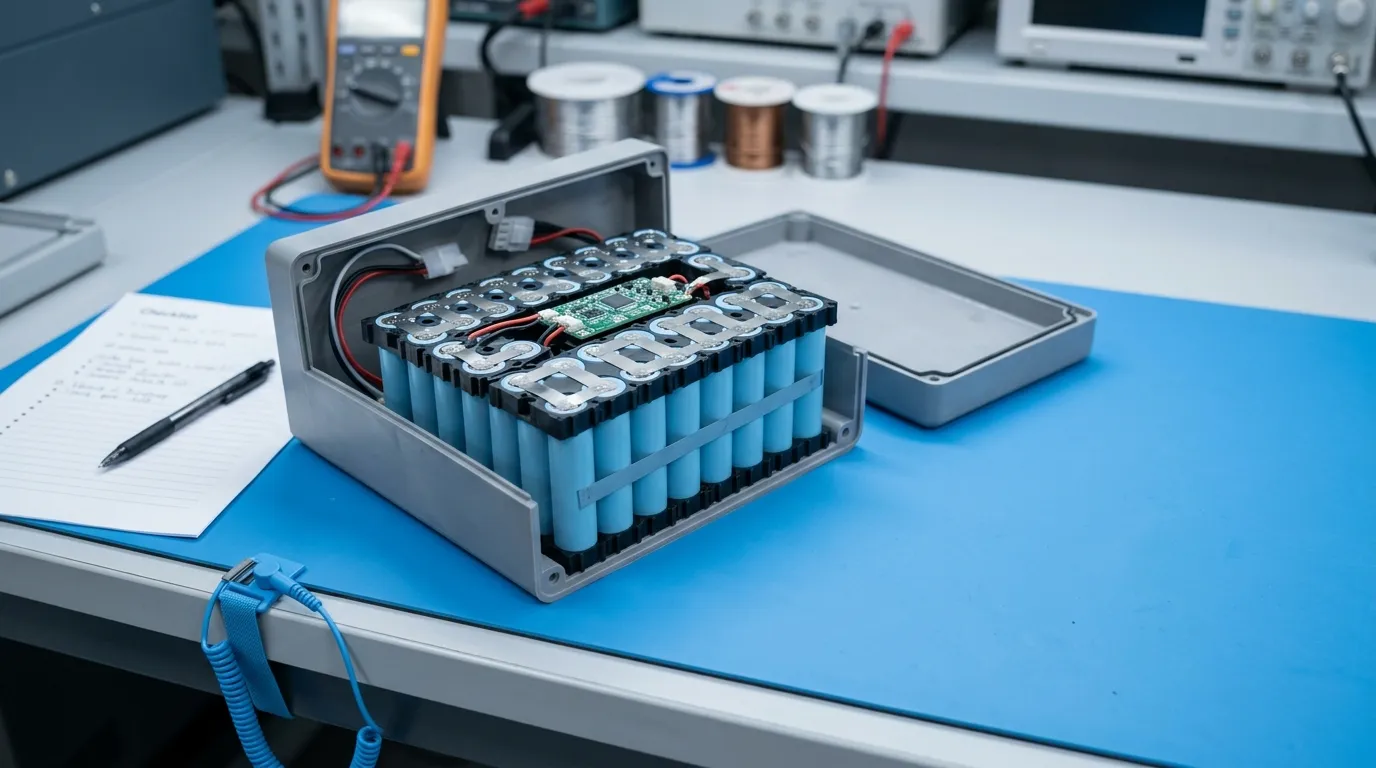
Use the specification and documentation requirements from this guide as the basis for a request for quotation (RFQ). A good RFQ includes:
- The instrument's electrical requirements (voltage, current, runtime)
- Physical space and weight limits
- Connector, cable, and mounting requirements
- Charging interface and protocol
- Environmental requirements and any specific test standards
- Required documentation and certificates
- Target quantity and timeline
During evaluation, ask for:
- A datasheet for the proposed pack
- A UN38.3 test summary for the proposed cell or pack construction
- An SDS for the product
- Test reports for electrical, mechanical, and environmental verification
- A sample for physical fit and functional testing before production
- A description of the supplier's traceability and change-control processes
- The supplier's warranty and after-sales support terms
Gloflux's battery development process — covering cell selection, BMS design, prototyping, testing, and mass production from the customer's product drawings — is designed to support this type of custom pack project, as described on the Gloflux website. The right supplier should be willing to work from your requirements and provide evidence for every claim.
Similarly, the engineering approach used to design a Custom battery pack for avionics backup systems demonstrates how pack architecture, BMS selection, and documentation requirements are handled for safety-critical avionics power — a useful reference point when evaluating suppliers for portable test equipment.
Portable test equipment versus installed aircraft battery systems
One boundary needs to be explicit. FAA AC 20-184 provides guidance for the testing and installation of rechargeable lithium battery and battery systems on aircraft. It applies to manufacturers, installers, maintenance personnel, and users of installed rechargeable lithium batteries on aircraft.
A portable aerospace test instrument is not the same as an installed aircraft battery system. A battery pack used inside a portable tester does not automatically need airworthiness approval, but it may need to meet customer-specific environmental or electromagnetic requirements, and it always needs proper transport documentation.
If your instrument is intended for use onboard an aircraft, or if it will be permanently mounted in an aircraft, the qualification path is different from the portable test-equipment path. Confirm with your customer or program office which standards apply before finalizing the battery specification.
If you are defining a rechargeable battery for a portable aerospace test instrument, the next step is to convert your instrument's electrical, mechanical, environmental, and documentation requirements into a pack specification. Gloflux's engineering team can review your product drawings and requirements, recommend a chemistry and pack architecture, and support the prototype, testing, and production process. Submit your project details for a technical review and quotation.
Talk to the Manufacturer
Resources & Insights

High Capacity Lithium Battery for Wearables: High-Voltage LiPo Cell Design
2026-10-19
Cylindrical Battery Packs for Laptops: 2S vs 3S vs 4S Battery Design
2026-10-19
Stage Lighting Battery Pack: Prevent Voltage Drop & LED Flicker
2026-10-19

Best Rechargeable Batteries for Smart Devices: Performance, Safety, and Selection Guide
2026-10-19


