


 Home /
 What Does Group Size Mean in Batteries? Complete 2026 Guide


Table of Contents
- What Is Battery Group Size?
- Why Battery Group Size Matters
- How Battery Group Sizes Are Numbered
- Does Group Size Affect Battery Performance?
- Group Size vs CCA vs Ah
- Common Automotive Battery Group Sizes
- Group 24 Batteries
- Group 27 Batteries
- Group 31 Batteries
- Group 35 Batteries
- Group 48 Batteries
- Why Marine and RV Systems Use Larger Group Sizes
- How Lithium Batteries Are Changing Group Size Expectations
- Can You Replace a Battery with a Different Group Size?
- Why Terminal Position Matters
- Battery Group Size and Weight
- Deep-Cycle Batteries vs Starter Batteries
- Portable Energy Systems and Modern Battery Design
- How to Find Your Battery Group Size
- Why Battery Sizing Still Matters in 2026
- Battery Group Sizes for Lithium Conversions
- Smart Battery Systems and Future Trends
- The Role of Gloflux in Portable Energy Solutions
- Final Thoughts
- FAQ About Battery Group Size
When shopping for automotive batteries, RV batteries, marine power systems, or backup energy storage solutions, one specification often causes confusion: battery group size. Many users mistakenly believe group size refers only to battery capacity or power output, but in reality, it mainly describes the physical dimensions and terminal configuration of the battery.
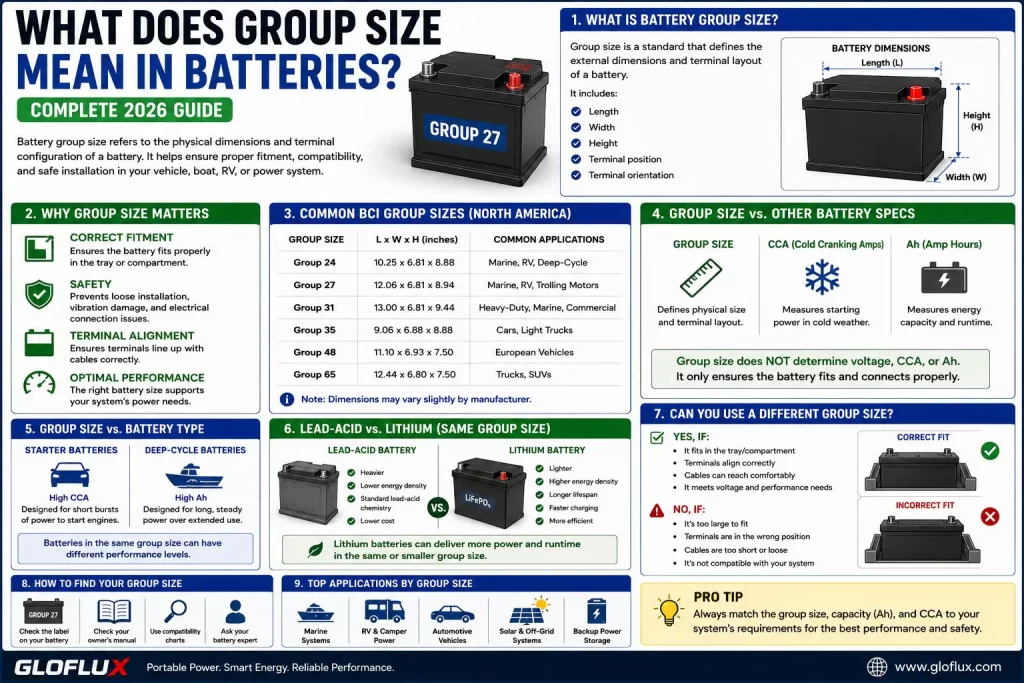
In 2026, battery technology continues evolving rapidly with the expansion of lithium battery systems, portable energy storage, and smart power applications. However, battery group sizing remains critically important for compatibility, installation safety, and system performance.
At Gloflux, we focus on portable energy solutions and advanced rechargeable battery technologies designed for modern energy applications. This guide explains what battery group size means, why it matters, and how to choose the correct group size for different applications.
What Is Battery Group Size?
Battery group size refers to a standardized classification system that defines the physical dimensions, terminal layout, and general fitment characteristics of a battery.
In North America, most automotive and marine batteries follow standards established by the Battery Council International (BCI).
A battery group size determines:
- Battery length
- Width
- Height
- Terminal position
- Terminal orientation
Group size does not directly determine:
- Battery chemistry
- Voltage
- Cold Cranking Amps (CCA)
- Amp Hours (Ah)
However, batteries within the same group size are generally designed to fit the same battery compartment or mounting tray.
Why Battery Group Size Matters
Choosing the wrong battery group size can create several problems.
Incorrect Fitment
A battery that is too large may not fit inside the battery tray or enclosure.
Loose Installation
A battery that is too small may move excessively during operation, increasing vibration and safety risks.
Terminal Alignment Problems
Incorrect terminal positioning may create cable tension or polarity issues.
Reduced Safety
Improperly mounted batteries may increase the risk of:
- Electrical shorts
- Vibration damage
- Heat buildup
- Connection failure
Proper battery sizing helps ensure reliable and safe system operation.
How Battery Group Sizes Are Numbered
BCI battery group sizes typically use numbers and letters.
Common examples include:
| Group Size | Common Applications |
|---|---|
| Group 24 | Marine & RV batteries |
| Group 27 | Deep-cycle marine systems |
| Group 31 | Heavy-duty marine & commercial |
| Group 35 | Passenger vehicles |
| Group 48 | European vehicles |
| Group 65 | Trucks & SUVs |
Each group size corresponds to standardized external dimensions.
For example:
- Group 24 batteries share similar physical sizing regardless of brand
- Terminal placement and mounting dimensions remain standardized
This helps simplify replacement compatibility.
Does Group Size Affect Battery Performance?
Indirectly, yes.
Larger battery groups often allow for:
- Higher capacity
- More battery cells
- Greater energy storage
- Higher CCA ratings
However, group size alone does not define battery performance.
For example:
- Two Group 27 batteries may have different Ah ratings
- Two Group 35 batteries may have different CCA values
Battery chemistry and internal design still play major roles.
Group Size vs CCA vs Ah
Many users confuse these battery specifications.
Group Size
Defines physical dimensions and fitment.
CCA (Cold Cranking Amps)
Measures starting power in cold temperatures.
Ah (Amp Hours)
Measures energy storage capacity and runtime.
Each specification serves a different purpose.
| Specification | Measures |
|---|---|
| Group Size | Physical dimensions |
| CCA | Starting current |
| Ah | Runtime capacity |
Understanding these differences helps users choose the correct battery.
Common Automotive Battery Group Sizes
Group 24 Batteries
Often used for:
- RV systems
- Marine batteries
- Backup power systems
Group 24 batteries generally provide balanced size and capacity.
Group 27 Batteries
Common in:
- Marine deep-cycle systems
- Trolling motor applications
- RV energy storage
These batteries often offer higher Ah capacity than Group 24.
Group 31 Batteries
Popular for:
- Commercial trucks
- Heavy-duty marine systems
- Large backup power applications
Group 31 batteries typically provide larger capacity and stronger performance.
Group 35 Batteries
Common in passenger vehicles and compact automotive systems.
Group 48 Batteries
Frequently used in European vehicle platforms with advanced electrical systems.
Why Marine and RV Systems Use Larger Group Sizes
Marine and RV applications often prioritize:
- Longer runtime
- Deep-cycle capability
- Higher Ah capacity
Larger battery groups help support:
- Trolling motors
- Lighting systems
- Portable electronics
- Solar energy storage
- Backup power systems
For extended off-grid use, larger battery capacity becomes especially important.
How Lithium Batteries Are Changing Group Size Expectations
Lithium battery technology is significantly changing battery sizing trends in 2026.
Compared to traditional lead-acid batteries, lithium batteries offer:
- Higher energy density
- Lower weight
- More compact design
- Better charging efficiency
- Longer cycle life
This allows lithium batteries to provide similar or better performance in smaller or lighter form factors.
At Gloflux, portable lithium battery systems are increasingly used across modern energy storage applications where portability and efficiency matter most.
Can You Replace a Battery with a Different Group Size?
Sometimes, but compatibility must be carefully checked.
Important considerations include:
- Tray dimensions
- Terminal placement
- Voltage compatibility
- Cable reach
- Mounting stability
Using a slightly different group size may work in some situations, but incorrect sizing may create installation or safety problems.
Always verify manufacturer recommendations before changing group sizes.
Why Terminal Position Matters
Battery terminals must align correctly with system cables.
Incorrect terminal placement may cause:
- Cable strain
- Reverse polarity risk
- Difficult installation
- Electrical connection issues
Battery group standards help ensure predictable terminal orientation.
Battery Group Size and Weight
Larger batteries are generally heavier because they contain:
- More internal material
- Additional battery cells
- Larger electrolyte volume
Heavy batteries may provide:
- Higher capacity
- Longer runtime
- Better starting power
However, larger batteries reduce portability.
This is one reason lithium batteries continue growing in popularity. They often provide strong energy storage while significantly reducing system weight.
Deep-Cycle Batteries vs Starter Batteries
Battery group size alone does not determine battery function.
Two batteries with identical group sizes may serve different purposes.
Starter Batteries
Designed for:
- High short-term current
- Engine starting
- High CCA output
Deep-Cycle Batteries
Designed for:
- Long-duration discharge
- Repeated charging cycles
- Energy storage applications
Always match battery type to the intended application.
Portable Energy Systems and Modern Battery Design
Portable power systems are becoming increasingly compact in 2026.
Applications include:
- Portable power stations
- RV energy systems
- Marine electronics
- Smart backup power
- Portable mobility products
Modern battery manufacturers increasingly optimize:
- Energy density
- Weight reduction
- Compact sizing
- Charging efficiency
This trend is accelerating the shift toward lithium battery platforms.
How to Find Your Battery Group Size
Battery group size is usually printed directly on the battery label.
You may also find it:
- In the vehicle owner’s manual
- On the original battery
- Through battery compatibility charts
- In manufacturer specifications
When replacing batteries, always confirm both:
- Group size
- Electrical specifications
Why Battery Sizing Still Matters in 2026
Even with advancing battery chemistry, physical compatibility remains critical.
Battery systems must still fit properly inside:
- Vehicles
- Boats
- Portable devices
- Backup systems
- Equipment housings
As portable energy solutions continue evolving, battery sizing precision becomes increasingly important for:
- Safety
- Cooling
- Weight balance
- Installation efficiency
- Portable system design
Battery Group Sizes for Lithium Conversions
Many users upgrading from lead-acid to lithium batteries try to match existing group sizes for easy replacement.
Common lithium replacements include:
- Group 24 lithium batteries
- Group 27 lithium batteries
- Group 31 lithium batteries
This simplifies installation while improving:
- Runtime
- Weight reduction
- Charging efficiency
- Battery lifespan
Smart Battery Systems and Future Trends
Battery technology continues evolving toward:
- Higher energy density
- Smaller form factors
- Modular battery systems
- Faster charging
- Smart Battery Management Systems (BMS)
- Lightweight portable energy solutions
Future battery systems may rely less on traditional sizing standards as modular and customizable energy systems become more common.
The Role of Gloflux in Portable Energy Solutions
At Gloflux, we focus on advanced battery technologies designed for modern portable power and energy storage applications.
Our battery solutions support:
- Portable electronics
- Replaceable battery systems
- Compact lithium battery packs
- Portable energy storage
- Smart battery integration
As energy systems continue evolving in 2026, battery sizing and portability remain critical parts of modern power design.
Final Thoughts
Battery group size refers to the standardized physical dimensions and terminal configuration of a battery. It helps ensure proper fitment, compatibility, and safe installation across automotive, marine, RV, and portable energy systems.
Although group size does not directly determine battery performance, it strongly influences:
- Compatibility
- Capacity potential
- Installation safety
- System integration
As lithium battery technology continues advancing, users increasingly benefit from lighter, more compact battery systems while still maintaining compatibility with traditional group sizing standards.
Understanding battery group size helps users choose safer, more reliable, and better-performing energy solutions for modern applications.
FAQ About Battery Group Size
What does battery group size mean?
Battery group size refers to standardized battery dimensions and terminal layout used for compatibility and installation purposes.
Does a larger group size mean more power?
Not necessarily, but larger batteries often allow higher capacity and stronger performance potential.
Can I use a different battery group size?
Only if the replacement fits properly and remains electrically compatible with the system.
Is battery group size the same as Ah?
No. Group size describes physical dimensions, while Ah measures energy capacity.
Are lithium batteries available in standard group sizes?
Yes. Many lithium batteries are designed to match common lead-acid group sizes for easier replacement compatibility.
Talk to the Manufacturer
Resources & Insights

High Capacity Lithium Battery for Wearables: High-Voltage LiPo Cell Design
2026-10-19
Cylindrical Battery Packs for Laptops: 2S vs 3S vs 4S Battery Design
2026-10-19

Stage Lighting Battery Pack: Prevent Voltage Drop & LED Flicker
2026-10-19

Best Rechargeable Batteries for Smart Devices: Performance, Safety, and Selection Guide
2026-10-19


