


 Home /
 Battery Management Systems (BMS): What They Really Manage


Table of Contents
As modern electric vehicles (EVs), energy storage systems, and high-performance portable electronics become increasingly common, the Battery Management System (BMS) has emerged as one of the most critical components in ensuring battery safety, longevity, and efficiency. But what exactly does a BMS manage, and why is it so essential for lithium-ion and advanced battery technologies? This article delves into the five core functions of BMS, its role in modern applications, and why every battery-powered system relies on it.
What Is a Battery Management System (BMS)?
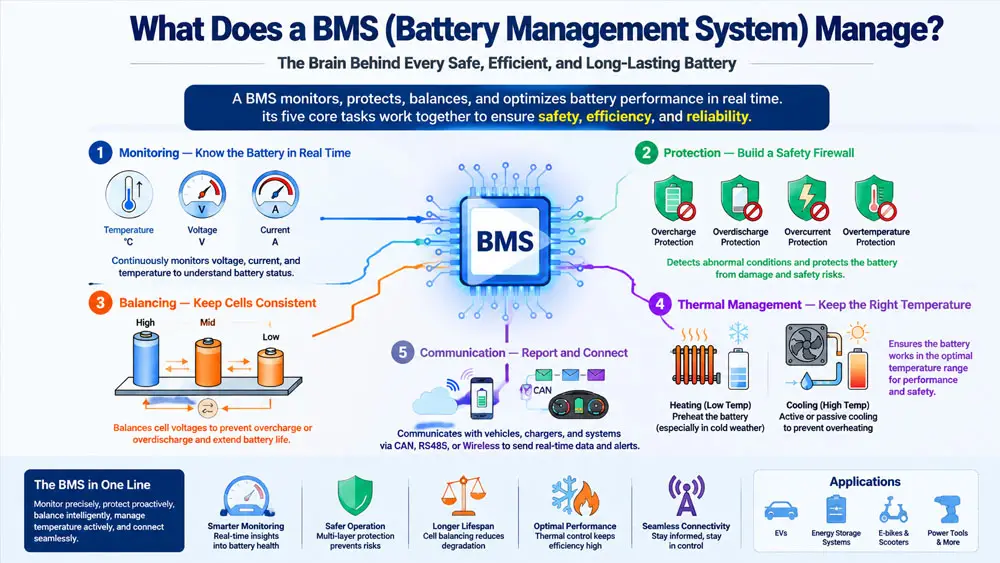
A Battery Management System (BMS) is an electronic system that monitors, manages, and protects rechargeable battery packs. Its primary goals are to ensure safe operation, maximize battery life, and optimize performance. While the term "BMS" may sound technical, its role is comparable to a human body's nervous system — continuously sensing, responding, and adjusting to maintain optimal function.
For lithium-ion batteries, a BMS is essential because of the inherent risks associated with high energy density cells. Overcharging, over-discharging, extreme temperatures, or imbalanced cells can lead to thermal runaway, reduced cycle life, and even safety hazards. The BMS mitigates these risks by actively monitoring key parameters and taking corrective actions.
The Five Core Functions of a BMS
According to research and practical applications, a comprehensive BMS performs five core tasks: sensing, protection, balancing, thermal management, and communication. Let’s examine each in detail.
1. Sensing: Monitoring Voltage, Current, and Temperature
The first task of a BMS is real-time sensing. This involves continuously measuring:
- Cell Voltage: Detecting under-voltage or over-voltage conditions to prevent damage.
- Current Flow: Monitoring charge and discharge currents to ensure safe operation.
- Temperature: Identifying thermal anomalies that could lead to overheating.
By accurately sensing these parameters, the BMS can determine the battery’s state-of-charge (SOC), state-of-health (SOH), and operational readiness. This information forms the foundation for all other functions, ensuring the system has a clear understanding of each cell’s condition.
In practice, high-end BMS systems integrate precision voltage and current sensors, often with millivolt and milliamp resolution, to guarantee accurate monitoring, even under dynamic load conditions.
2. Protection: The Four Layers of Safety
Safety is the second critical function of a BMS. Lithium-ion and solid-state batteries are highly sensitive to operational extremes. A well-designed BMS enforces a “four-shield protection” strategy:
- Overvoltage Protection: Prevents overcharging, which can degrade cell materials or cause thermal runaway.
- Undervoltage Protection: Prevents deep discharge that can irreversibly damage the cell.
- Overcurrent Protection: Safeguards against short circuits or excessive charge/discharge currents.
- Overtemperature/Under-temperature Protection: Ensures cells operate within safe thermal ranges.
By applying these protective measures, the BMS acts as a safety net, allowing high-performance batteries to operate efficiently without risking catastrophic failure. For EV manufacturers, these protective layers are crucial to meet regulatory safety standards and deliver consumer confidence.
3. Balancing: Keeping All Cells in Step
Even in well-manufactured battery packs, individual cells can exhibit slight differences in capacity, internal resistance, or self-discharge rates. Over time, these differences can lead to imbalances, reducing overall pack capacity and lifespan.
The BMS performs cell balancing to equalize voltages and SOC across all cells. This can be achieved through:
- Passive Balancing: Excess energy from higher-voltage cells is dissipated as heat via resistors.
- Active Balancing: Energy is redistributed from higher-charge cells to lower-charge cells, improving efficiency.
Balancing ensures that all cells “march in step,” optimizing battery capacity and prolonging pack life. Without this function, a few underperforming cells could limit the performance of the entire battery system.
4. Thermal Management: Keeping Batteries Comfortable
Batteries are highly sensitive to temperature. Cold environments reduce charging efficiency, while heat accelerates degradation. A BMS manages thermal regulation through:
- Active Heating: For low-temperature conditions, battery heaters improve charge efficiency and chemical kinetics.
- Cooling Systems: Fans, liquid cooling, or phase-change materials protect against overheating during high-current discharge or fast charging.
By maintaining the battery within an optimal temperature range, the BMS ensures peak performance, safety, and longevity, regardless of external conditions.
5. Communication: Reporting to Vehicle or System
The BMS is not a standalone system. It communicates critical data to external controllers or human interfaces:
- State-of-Charge (SOC) Reports: Let users or controllers know how much energy remains.
- State-of-Health (SOH) Alerts: Warn of aging or degraded cells.
- Fault Notifications: Indicate overvoltage, overcurrent, temperature anomalies, or balancing issues.
Modern BMS systems use communication protocols such as CAN bus, SMBus, or Modbus, ensuring seamless integration with electric vehicles, energy storage systems, and smart grid applications. This real-time reporting enables operators to take informed actions, from reducing load to activating cooling systems.
Why BMS Is Critical for EVs and Energy Storage
In electric vehicles, a BMS is indispensable. It not only protects the battery pack but also maximizes driving range and enables fast charging safely. For stationary energy storage, a BMS ensures long-term reliability and stability, which is essential for grid applications or backup power systems.
By combining sensing, protection, balancing, thermal management, and communication, a BMS allows batteries to operate at peak efficiency while minimizing safety risks. In a sense, it is the brain and nervous system of modern battery technology.
Advanced Features in Modern BMS
Recent advancements in BMS technology include:
- AI-Powered SOC Estimation: Machine learning algorithms predict accurate battery charge status under complex load conditions.
- Predictive Maintenance: Advanced analytics can forecast degradation trends, enabling proactive interventions.
- Cloud Integration: Fleet operators can remotely monitor battery packs, optimize performance, and reduce downtime.
These innovations are particularly relevant for EV fleets, drones, and large-scale energy storage, where reliability and uptime are critical.
Key Benefits of a Robust BMS
A well-implemented BMS provides several advantages:
- Enhanced Safety: Prevents dangerous conditions such as thermal runaway, overcharging, and short circuits.
- Longer Battery Life: Cell balancing and temperature management minimize degradation, extending cycle life.
- Optimized Performance: Maintains voltage, current, and temperature within ideal ranges, maximizing energy output.
- User Confidence: Real-time monitoring and reporting ensure users and operators can trust battery systems.
Applications Across Industries
BMS technology is essential across a wide range of battery-powered systems:
- Electric Vehicles (EVs): Ensures safe, high-performance battery packs for cars, buses, and trucks.
- Energy Storage Systems: Maintains reliability for residential, commercial, and utility-scale storage.
- Drones & Aerospace: Guarantees safe operation under high-demand and extreme environmental conditions.
- Wearables & Medical Devices: Protects sensitive electronics that rely on compact lithium-ion packs.
- Robotics & Industrial Equipment: Supports autonomous machines and heavy-duty devices with stable energy delivery.
In each application, the BMS adapts to unique operational conditions, providing customized protection and efficiency optimization.
Conclusion
The Battery Management System (BMS) is much more than a monitoring tool; it is the cornerstone of modern battery technology. Through its five core functions — sensing, protection, balancing, thermal management, and communication — a BMS ensures that batteries operate safely, efficiently, and with extended longevity.
Whether powering an electric vehicle, a home energy storage system, or industrial robotics, the BMS guarantees optimal performance and reliability. As battery technology advances, BMS systems are becoming increasingly intelligent, integrating AI, predictive analytics, and cloud connectivity to meet the demands of a rapidly growing energy ecosystem.
For anyone involved in EV manufacturing, energy storage, or electronics development, understanding and implementing robust BMS technology is critical. It not only safeguards investments but also drives the next generation of high-performance, safe, and sustainable battery-powered applications.
Talk to the Manufacturer
Resources & Insights

High Capacity Lithium Battery for Wearables: High-Voltage LiPo Cell Design
2026-10-19
Cylindrical Battery Packs for Laptops: 2S vs 3S vs 4S Battery Design
2026-10-19

Stage Lighting Battery Pack: Prevent Voltage Drop & LED Flicker
2026-10-19

Best Rechargeable Batteries for Smart Devices: Performance, Safety, and Selection Guide
2026-10-19


