


 Home /
Rechargeable Battery for Medical Equipment: Low Self-Discharge Design


Table of Contents
- Why Low Self-Discharge Requires System-Level Design
- Low-Power BMS Design without Compromising Emergency Startup
- Calculating Retained Energy and Emergency Runtime
- Validation Testing for Low Self-Discharge Medical Batteries
- Medical Battery Safety and Risk Management
- GLOFLUX Manufacturing Precision and Medical Battery Engineering
A Rechargeable Battery for Medical Equipment must retain useful energy after extended periods of standby and quickly provide power when needed. For emergency patient monitors, portable suction devices, and diagnostic equipment, nominal battery capacity by itself, does not ensure readiness for use.
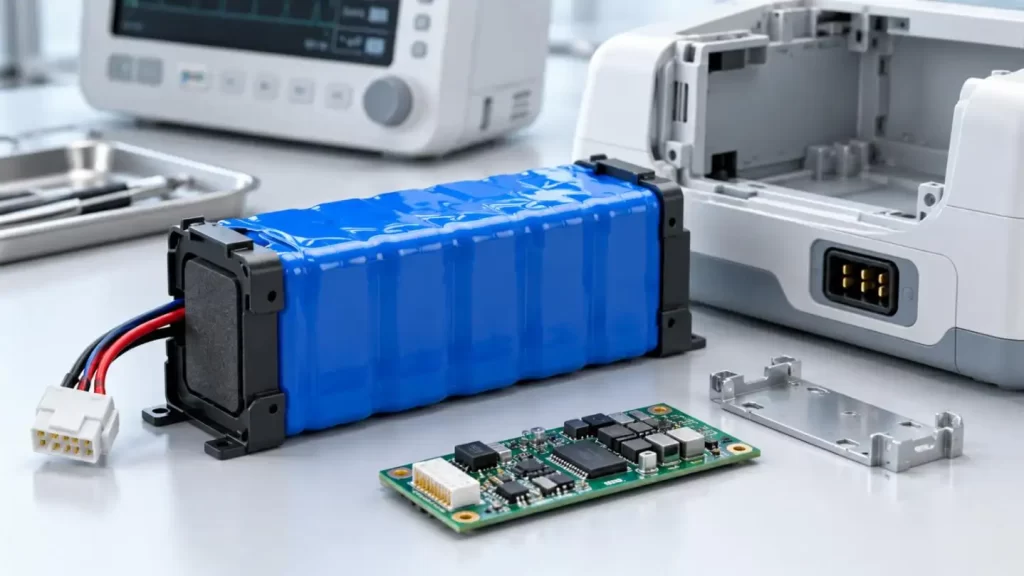
Cell self-discharge, BMS quiescent current, storage temperature, and aging collectively determine whether an emergency medical device can start and complete its required operating cycle.
Why Low Self-Discharge Requires System-Level Design
Self-discharge is not simply a cell characteristic. Once a lithium battery becomes an integrated medical power module, several mechanisms contribute to energy loss.
| Energy Loss Source | Technical Cause | Design Consideration |
| Cell self-discharge | Internal electrochemical reactions | Chemistry and cell screening |
| BMS standby current | Protection ICs and monitoring circuits | Low-quiescent-current components |
| Communication drain | SMBus, fuel gauge, and interface activity | Duty-cycled communication |
| Cell imbalance | Uneven cell characteristics | Cell matching and balancing |
| Calendar aging | Temperature, SOC, and storage duration | Storage-condition control |
Calendar aging must be distinguished from reversible charge loss because it reduces recoverable capacity even after recharging.
Calculating BMS Standby Consumption
The approximate capacity consumed by electronic standby loads is:
Qloss (mAh) = Istandby (mA) × Storage Time (h)
For example, a 50 µA standby load consumes approximately 216 mAh over 180 days, excluding intrinsic cell self-discharge.
This would be approximately 6.5% of the rated capacity for a 3300 mAh battery. Actual retained energy is also impacted by other factors such as age and the electrical configuration.
Low-Power BMS Design without Compromising Emergency Startup
Protection circuits for batteries in Medical Equipment must be fully functional during storage, and not unnecessarily waste energy.
Balance Quiescent Current and Protection Response
Some important factors to consider are:
• Protection ICs: Select protection ICs to minimize the continuous current to monitor voltage and/or fault status.
• Sleep Mode: Turn off indicators and communication circuits.
• Wake-Up Architecture: Define an activation mechanism using a command from the device, external signals, and/or approved charging paths.
• Undervoltage Protection: Prevent deep discharge of battery and allow a controlled recovery of the battery.
• NTC Monitoring: Provide charging and discharging protection of the battery, based on temperature.
| BMS Mode | Standby Consumption | Emergency Application Concern |
| Active monitoring | Relatively high | Continuous battery drain |
| Deep sleep | Reduced | Wake-up latency |
| Shipping mode | Very low | External activation may be required |
For emergency equipment, the lowest-power mode is not necessarily the safest configuration. A battery requiring charger insertion to exit shipping mode may be unsuitable for immediate deployment.
That means these functions need to be verified under actual product conditions.
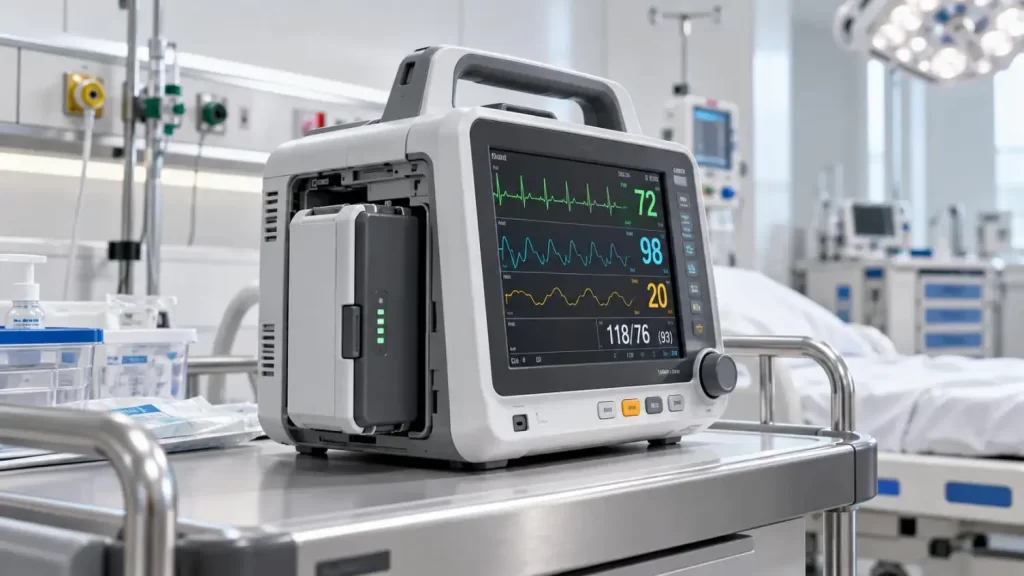
Battery Chemistry and Storage Stability
Selection of battery does impact both energy retention and emergency power delivery.
| Battery Type | Primary Advantage | Engineering Limitation |
| Cylindrical Li-ion | Established cell formats and capacity | Fixed mechanical dimensions |
| LiPo pouch | Flexible packaging geometry | Swelling and enclosure constraints |
| LiFePO4 | Improved thermal stability and cycle life | Lower energy density |
LiPo describes cell construction, whereas LiFePO4 refers to cathode chemistry. Performance should be compared by actual cell data.
For long-term standby, we evaluate:
• Capacity retention at specified storage SOC
• Open-circuit voltage decline
• DC internal resistance growth
• Cell-to-cell consistency
• Storage-temperature sensitivity
High SOC and elevated temperatures can accelerate calendar aging. However, reducing storage SOC excessively may compromise emergency runtime. Deployed devices therefore require an application-specific charging and maintenance strategy.
Calculating Retained Energy and Emergency Runtime
A Rechargeable Battery for Medical Equipment should be evaluated using end-of-life usable energy rather than beginning-of-life nominal capacity.
A practical energy budget is:
Available Energy = Retained Usable Energy − Required Safety Reserve
Retained usable energy must account for standby consumption, self-discharge, aging, temperature, and voltage cutoff.
Startup Voltage Sag and Peak Current
Even when measurable capacity remains, increased internal resistance can cause shutdown during high-current startup.
Vload ≈ Voc − Ipeak × Rtotal
Where:
• Voc: Open-circuit voltage
• Ipeak: Startup peak current
• Rtotal: Effective resistance of the discharge path
Low temperatures and aging can increase voltage sag. A portable suction device, for example, may encounter substantially higher current during motor startup than during steady operation.
Runtime validation should include:
• End-of-life capacity
• DC-DC conversion losses
• Minimum operating temperature
• Startup and transient current profiles
Alarm operation and shutdown reserves
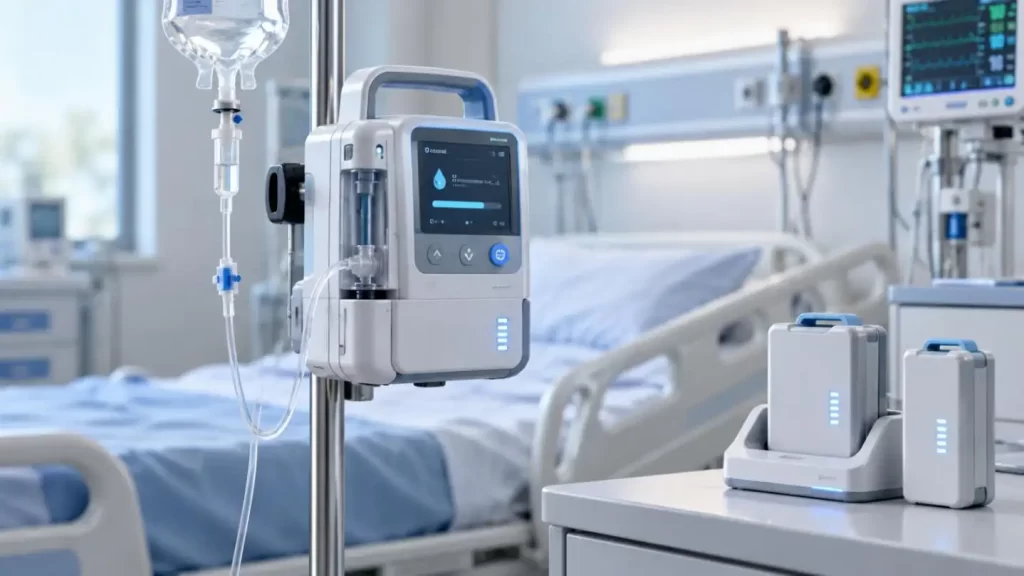
Validation Testing for Low Self-Discharge Medical Batteries
A low self-discharge claim becomes meaningful only when supported by defined testing conditions.
For a Rechargeable Battery for Medical Equipment, tests to qualify the battery must assess the performance at the cell level, the pack level, and the device level.
| Validation Test | Measurement | Engineering Purpose |
| Storage retention | Capacity after 30/90/180 days | Quantify stored-energy loss |
| Standby current | Current measured in µA | Verify BMS power budget |
| DCIR measurement | Resistance before and after storage | Evaluate voltage sag |
| Cold-start testing | Startup voltage and response | Confirm emergency activation |
| Cycle/Calendar aging | Capacity and resistance change | Evaluate end-of-life reliability |
| Wake-up verification | Activation time and success | Validate sleep mode recovery |
Energy efficiency requires consideration of a device's self tests as well as the normal operation of the device.
Self tests must also be incorporated into the energy balance equation and the maintenance schedule for the device.
Medical Battery Safety and Risk Management
Low self-discharge does not replace electrical safety verification.
Relevant standards include:
• IEC 62133-2: Safety of applicable rechargeable lithium cells and batteries.
• IEC 60601-1: Medical electrical equipment safety and essential performance.
• IEC 60601-1-12: Additional requirements for equipment intended for emergency medical services environments.
• ISO 14971: Medical device risk management.
• UN 38.3: Lithium battery transport testing.
Certification applicability depends on the battery configuration, device classification, intended use, and target market.
GLOFLUX Manufacturing Precision and Medical Battery Engineering
At GLOFLUX, we support Rechargeable Battery for Medical Equipment development through cell selection, BMS configuration, mechanical integration, and prototype testing.
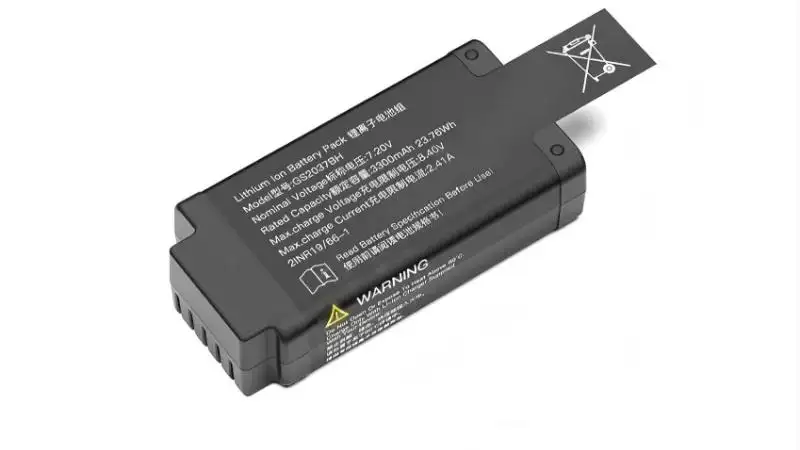
Our KYS2037BH medical battery provides a published engineering reference:
| Technical Parameter | Specification |
| Configuration | 2S1P Lithium-ion |
| Nominal voltage | 7.2 V |
| Rated capacity | 3300 mAh |
| Internal impedance | <200 mΩ at 1 kHz, 25°C |
| Maximum discharge current | 4.0 A |
| Dimensions | 84.5 × 42.0 × 22.4 mm |
| Dimensional tolerance | ±0.3 mm per dimension |
These specifications apply to this product rather than every custom battery. The 1 kHz impedance value is not interchangeable with DC resistance under startup loads.
Our 30,000 m² manufacturing facility incorporates more than 60 quality inspection checkpoints, supported by in-house safety testing.
For custom medical battery projects, our engineering review covers:
• Cell consistency and voltage matching
• BMS protection thresholds and standby consumption
• NTC placement and thermal monitoring
• Mechanical tolerances and connector integration
• Pack traceability and production verification
OEM Battery Selection and Engineering Support
Before choosing a Rechargeable Battery for Medical Equipment, manufacturers should identify the following: standby duration, startup current, minimum runtime, environmental exposure, installation dimensions, and applicable safety requirements.
At GLOFLUX, we help our customers refine their specifications and create innovative solutions for medical equipment batteries using our experience with the architecture and design of low-power BMS. We provide prototype evaluation and support for manufacturing integration. We are dedicated to providing our customers battery solutions for medical equipment that ensures emergency readiness.
FAQs
Q1. Does GLOFLUX manufacture custom rechargeable batteries for medical equipment?
Yes. We provide OEM/ODM lithium battery solutions for patient monitors, diagnostic instruments, infusion pumps, and other medical devices.
Q2. What battery chemistries does GLOFLUX offer for medical applications?
We support cylindrical Li-ion, LiPo pouch, prismatic lithium batteries, and LiFePO4 configurations based on application requirements.
Q3. Can GLOFLUX customize battery voltage and capacity?
Yes. Our published customization range includes 3.7–48 V and 500 mAh–50 Ah, subject to engineering evaluation.
Q4. Can GLOFLUX design a low-power BMS for emergency medical equipment?
Yes. We support customized BMS configurations, including standby power management, protection thresholds, and wake-up requirements.
Q5. What battery protection functions can GLOFLUX integrate?Our solutions support overcharge, over-discharge, overcurrent, short-circuit, and temperature protection.
Talk to the Manufacturer
Resources & Insights
High Capacity Lithium Battery for Wearables: High-Voltage LiPo Cell Design
2026-10-19
Cylindrical Battery Packs for Laptops: 2S vs 3S vs 4S Battery Design
2026-10-19
Stage Lighting Battery Pack: Prevent Voltage Drop & LED Flicker
2026-10-19
Best Rechargeable Batteries for Smart Devices: Performance, Safety, and Selection Guide
2026-10-19


