


 Home /
Eco Friendly Lithium Polymer Battery: Water-Based vs Solvent-Based Electrode Manufacturing


Table of Contents
Manufacturing Eco Friendly Lithium Polymer Batteries means balancing the right amount of electrode materials, solvents, consistency of coatings, and battery service life. Electrode manufacturing is the most critical step in battery manufacturing as slurry and drying conditions affect the environment and the electrochemical reliability of the battery.
For conventional cathodes, polyvinylidene fluoride (PVDF) is dissolved in a N-methyl-2-pyrrolidone (NMP) organic solvent. For a water-based process, an organic solvent is replaced with an aqueous-compatible binder. Even though an emphasis is placed on reducing the environmental impact of battery manufacturing, improving battery performance and reducing the overall energy consumption of the battery manufacturing process is still important.
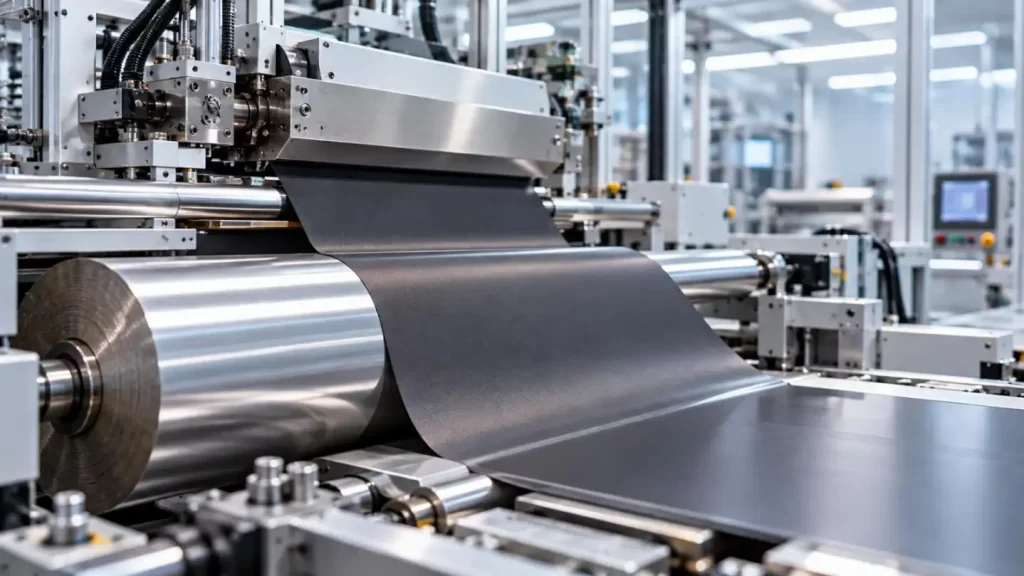
Water-Based vs Solvent-Based Electrode Manufacturing
How the Two Processes Differ
The solvent and binder system determine how active particles disperse and adhere to the current collector and how they hold up through subsequent processing.
| Parameter | Water-Based Processing | NMP-Based Processing |
| Solvent | Water | NMP |
| Binder system | CMC, SBR, PAA or other aqueous binders | PVDF |
| Cathode compatibility | Depends on material stability | Established for many cathodes |
| Drying | Water evaporation and moisture control | NMP evaporation and recovery |
| Main technical risks | Corrosion, cracking, binder migration | Solvent handling, emissions, recovery energy |
| Environmental consideration | Wastewater and drying energy | Solvent recovery and energy consumption |
An important distinction: Water-based electrode processing does not mean the finished lithium polymer cell uses an aqueous electrolyte.
Graphite anodes commonly use aqueous CMC/SBR systems, while water-based cathode manufacturing requires more careful material compatibility assessment.
Critical Challenges in Aqueous Electrode Manufacturing
Cathode Stability and Aluminum Corrosion
Certain nickel-rich NMC cathodes react with water through surface reactions and lithium-ion/proton exchange.
Slurry treatment may increase alkalinity and disrupt protective oxide layers. Some possible effects include:
•Lithium loss: Decreased lithium available for cycling
•Aluminum corrosion: Weakened electrode adhesion and increased interfacial resistance
•Hydrogen Evolution: Coating defects and disrupts charge transfer
•Reconstruction of surface: Alters charge transfer and cycling stability
Some manufacturers incorporate pH adjustment, surface treatments, or use carbon-coated aluminum collectors.
LFP cathodes are usually more tolerant to water processing than moisture sensitive nickel-rich cathodes. However, this is process and formulation dependent.
Rheology of Slurry and Distribution of Binders
For Eco-friendly Lithium polymer batteries, the focus is on enhancing the process for coating the aluminum current collectors.
There are three critical elements:
•Viscosity of Slurry: controls leveling and coating flow.
•Solid content: determines drying time and electrode loading
•Binder distribution: Determines adhesion, cohesion and stability of conductive network
Not enough binder distribution may cause particle agglomeration and cracking of the electrode due to excessive drying.
How Manufacturing Precision Influences Cell Reliability
Electrode Coating and Calendering Control
Water-based and solvent-based systems require different coating and drying conditions. Neither process can compensate for inconsistent electrode geometry.
| Control Parameter | Technical Importance | Verification |
| Coating thickness (μm) | Electrode geometry and uniformity | Thickness measurement |
| Areal loading (mg/cm²) | Capacity distribution | Coating-weight inspection |
| Peel strength (N/m) | Electrode adhesion | Adhesion testing |
| Electrode porosity (%) | Electrolyte transport and resistance | Density/porosity analysis |
| Residual moisture (ppm) | Electrolyte compatibility | Karl Fischer testing |
Calendering must consider the balance between compacting the electrodes and allowing adequate transport of ions. Too much compaction can leave areas of the electrolyte unable to penetrate. Too little compaction can result in increased contact resistance.
Of particular concern with the use of moisture sensitive electrolytes is the presence of residual water. Water can cause degradation of the electrolyte and lead to early failure of the cell.
In compact pouch batteries, these variables impact other factors such as uniform thickness of the electrodes, alignment of the electrodes, and the internal resistance of the battery.
Does Water-based Processing Significantly Decrease Environmental Impact?
Without NMP in the aqueous coating step, NMP recovery is also no longer needed. When evaluating the environmental impact of battery manufacturing, other factors must be considered, too, for example:
•Energy consumption: How many kWh of energy are needed to make 1 kWh of battery capacity?
•Solvents: How much NMP is consumed, how much is recovered, how much Volatile Organic Compounds (VOCs) are emitted?
•Raw materials and waste: Scrap coating, defective or low-yield electrodes, wastewater treatment.
•Battery performance: Retention of battery capacity under specified use conditions.
A fair Lithium Polymer Battery assessment should compare lifecycle carbon emissions under equivalent chemistry, capacity and cycle-life.
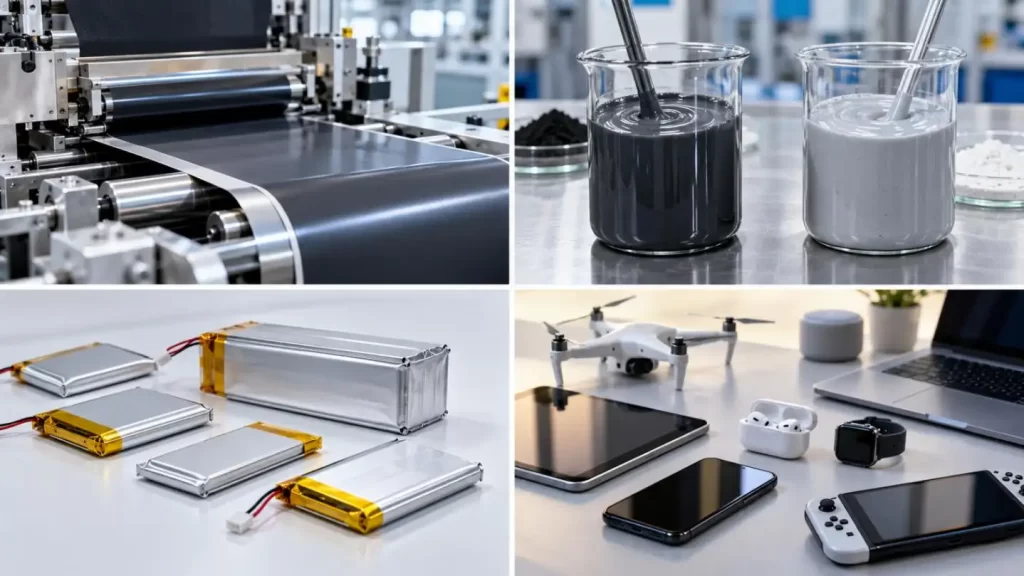
How OEM Buyers Should Evaluate Battery Quality
When assessing batteries, the electrical performance, safety and how it fits in the application must all be considered with the environment in mind.
Before deciding on a battery manufacturing route, OEM engineers should examine:
- Material compatibility: Selection of cathode chemistry, type and amount of binder, and moisture sensitivity.
- Electrode uniformity: Coating thickness and adhesion, and uniform loading.
- Cell performance: Capacity, DC internal resistance, impedance and retention of cycling.
- System compatibility: Thresholds of protection, NTC, discharge, and charging.
- Supplier information: batch traceability, process validation, and environmental records.
IEC 62133 and UN38.3 address safety and transport, and do not provide an independent environmental assessment.
For moisture-sensitive cathodes, a more mature, solvent-based method may be more preferable, until an aqueous method provides the same reliability.
GLOFLUX Manufacturing Capabilities and Dimensional Control
At GLOFLUX, our OEM/ODM lithium battery development covers cell selection, pouch-cell customization, BMS integration, prototyping, and quality verification.
Our published manufacturing capabilities include:
•30,000 m² manufacturing facility with automated production equipment.
•350,000 batteries/day stated production capacity.
•60+ inspection checkpoints from incoming materials to finished products.
•Custom LiPo thickness down to 3 mm under supported design configurations.
•In-house safety testing for electrical, mechanical, and thermal conditions.
Battery Dimensions and Electrical Specifications
| GLOFLUX Model | Nominal Cell Size | Finished Size | Internal Resistance |
| KYS 101550 | 10 × 15 × 50 mm | 10 × 15 × 52 mm | 50 mΩ |
| KYS 503450 | 5 × 34 × 50 mm | 5 × 34 × 52 mm | 45 mΩ |
The following illustrates our dimensional options as well as cell level electrical parameters. These are nominal product specifications. Published manufacturing tolerances are typically less than the nominal product specifications.
For any custom Eco-Friendly Lithium Polymer Battery project, acceptable dimensional tolerances, capacity variation and resistance limits should be established through approved drawings and sample qualification.
Choosing the Right Manufacturing Approach
Electrodes processed in aqueous media should be considered in instances where material and coating stability is of primary concern and environmental impact is of significance. For cases where electrochemical stability and validated production are of concern, the conventional solvent approach is of primary relevance.
GLOFLUX aids OEM customers evaluate custom Eco Friendly Lithium Polymer Batteries by means of application-specific cell assessments, engineering validations and quality-controlled production. Reach out to discuss battery specifications, dependability and sustainability requirements.
FAQs
Q1. Does GLOFLUX offer custom lithium polymer batteries?
Yes. GLOFLUX provides OEM/ODM lithium polymer battery solutions, including cell selection, custom dimensions, BMS design, prototyping, and mass production.
Q2. Does GLOFLUX use water-based electrode manufacturing?
GLOFLUX has not publicly confirmed the use of aqueous cathode coating. OEM buyers should request project-specific manufacturing process documentation.
Q3. What is the minimum LiPo battery thickness GLOFLUX supports?
GLOFLUX offers custom lithium polymer batteries with thicknesses down to 3 mm, depending on cell specifications and design requirements.
Q4. How does GLOFLUX control battery manufacturing quality?
GLOFLUX applies more than 60 inspection procedures, covering incoming materials, production processes, electrical performance, and finished batteries.
Q5. Can GLOFLUX customize battery dimensions and electrical specifications?
Yes. GLOFLUX supports custom thickness, width, length, voltage, capacity, connectors, wiring, and battery protection configurations.
Talk to the Manufacturer
Resources & Insights
High Capacity Lithium Battery for Wearables: High-Voltage LiPo Cell Design
2026-10-19
Cylindrical Battery Packs for Laptops: 2S vs 3S vs 4S Battery Design
2026-10-19
Stage Lighting Battery Pack: Prevent Voltage Drop & LED Flicker
2026-10-19

Best Rechargeable Batteries for Smart Devices: Performance, Safety, and Selection Guide
2026-10-19


