


 Home /
 Custom Battery for Portable Label Printers: Runtime and Pack Options


Table of Contents
- Why Portable Label Printer Batteries Are Different
- How to Estimate Runtime for a Portable Label Printer
- Choosing the Right Cell and Pack Architecture
- Should the Printer Battery Be Removable or Swappable?
- Connecting, Protecting, and Charging the Printer Pack
- Validating the Prototype and Confirming Supplier Documentation
- What to Send to a Custom Battery Supplier
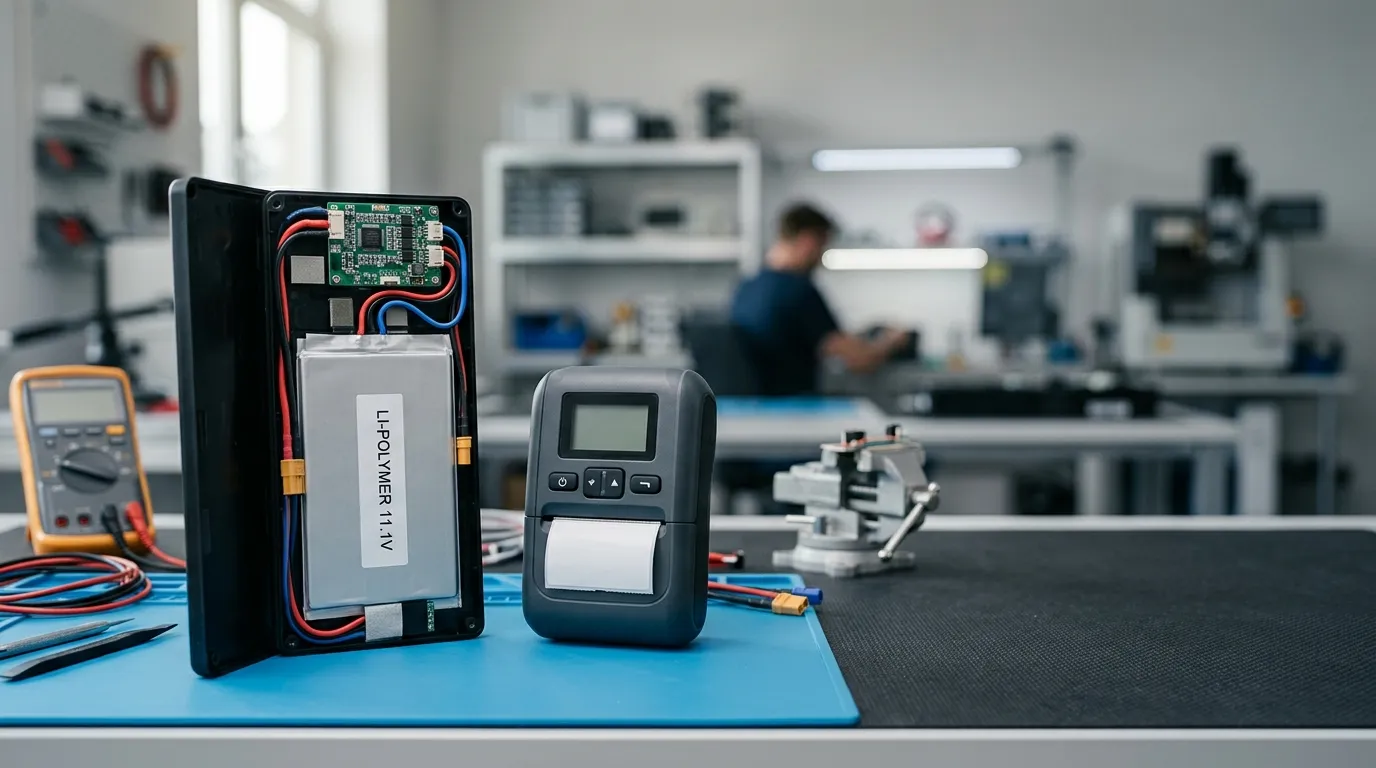
A custom battery for a portable label printer must be selected from the printer's operating voltage, print-burst current, runtime target, physical envelope, connector type, charger profile, and required protection—not from capacity alone. A pack specified only by milliamp-hours (mAh) will likely fail in the field because thermal printheads draw short, high-current bursts that a poorly matched pack cannot support without voltage sag.
This guide explains how portable label printers create a unique battery-load profile, how to estimate runtime correctly, and what pack architecture, protection, and validation steps an OEM should specify before sourcing a custom lithium-ion pack.
Why Portable Label Printer Batteries Are Different
Portable label printers do not draw a steady current like a simple sensor or radio device. They alternate between low-power idle states, backlight and radio operation, and short but intense print events. The thermal printhead is the dominant load during each label pass, and it demands current far above the printer's average draw.
If a battery pack is specified from average current alone, the pack may deliver enough total energy for the shift but sag under the printhead's peak demand. That sag can reset the printer's logic board, interrupt the print job, or produce poor print quality near the end of the charge—even when the battery's remaining charge appears acceptable.
The electrical specification for a custom printer pack must therefore define two current values, not one:
- Continuous current: the sustained load the printer draws during normal operation, including idle, radio, motor, and print cycles averaged over time.
- Peak (pulse) current: the short-duration current drawn during an individual print event, usually the thermal printhead's heating pulse plus any motor or radio activity that overlaps it.
Print Bursts and Voltage Sag
Every lithium cell and battery pack has an internal resistance. When the printer demands peak current, that resistance causes a voltage drop at the pack terminals—known as voltage sag. If the sag drops below the printer's minimum operating voltage, the device resets or stops mid-print.
A pack with low internal resistance and an adequate C-rate rating can support the printhead's burst demand without excessive sag. A pack with high internal resistance—or one specified only by mAh—may hold enough charge but still be unable to deliver current fast enough. The C-rate of the cells, the series/parallel configuration, and the pack's total internal resistance are as important as the capacity number.
For this reason, the load profile of the printer—not a generic capacity estimate—should be the starting point for the battery specification.
How to Estimate Runtime for a Portable Label Printer
Runtime should be calculated from energy in watt-hours (Wh), not from capacity in milliamp-hours alone. Wh accounts for both the battery's voltage and its charge capacity, which makes it the correct unit for comparing packs that may operate at different voltages.
A pack's energy in watt-hours is calculated as:
Watt-hours (Wh) = rated capacity in ampere-hours (Ah) × nominal voltage (V)
For example, a 2,600 mAh (2.6 Ah) pack at 7.4 V nominal provides about 19.2 Wh of stored energy. The same capacity at 3.7 V would provide only about 9.6 Wh, even though both packs are still described as "2,600 mAh." Runtime comparisons made by mAh alone are meaningless across different voltages.
To estimate runtime, use the printer's actual operating profile:
Estimated runtime ≈ Pack energy (Wh) ÷ Average system load (W)
The average system load should include:
- average print current over a full label cycle (print bus, motor, logic);
- idle current between labels;
- wireless radio activity if enabled;
- conversion and system losses;
- battery aging over the intended service life;
- operating temperature, which affects discharge efficiency.
"Labels per charge" is also a useful field metric, but it depends on label length, print density, radio use, temperature, and battery age. No label-count figure is meaningful without those conditions stated. A specification that says "3,000 labels per charge" without a test condition should be treated as a marketing estimate, not an engineering specification.
A practical approach is to define the printer's average load at a stated duty cycle—for example, 20% printing, 30% idle, 50% radio-enabled—and then size the pack to deliver the required Wh with a margin for aging and temperature.
Choosing the Right Cell and Pack Architecture
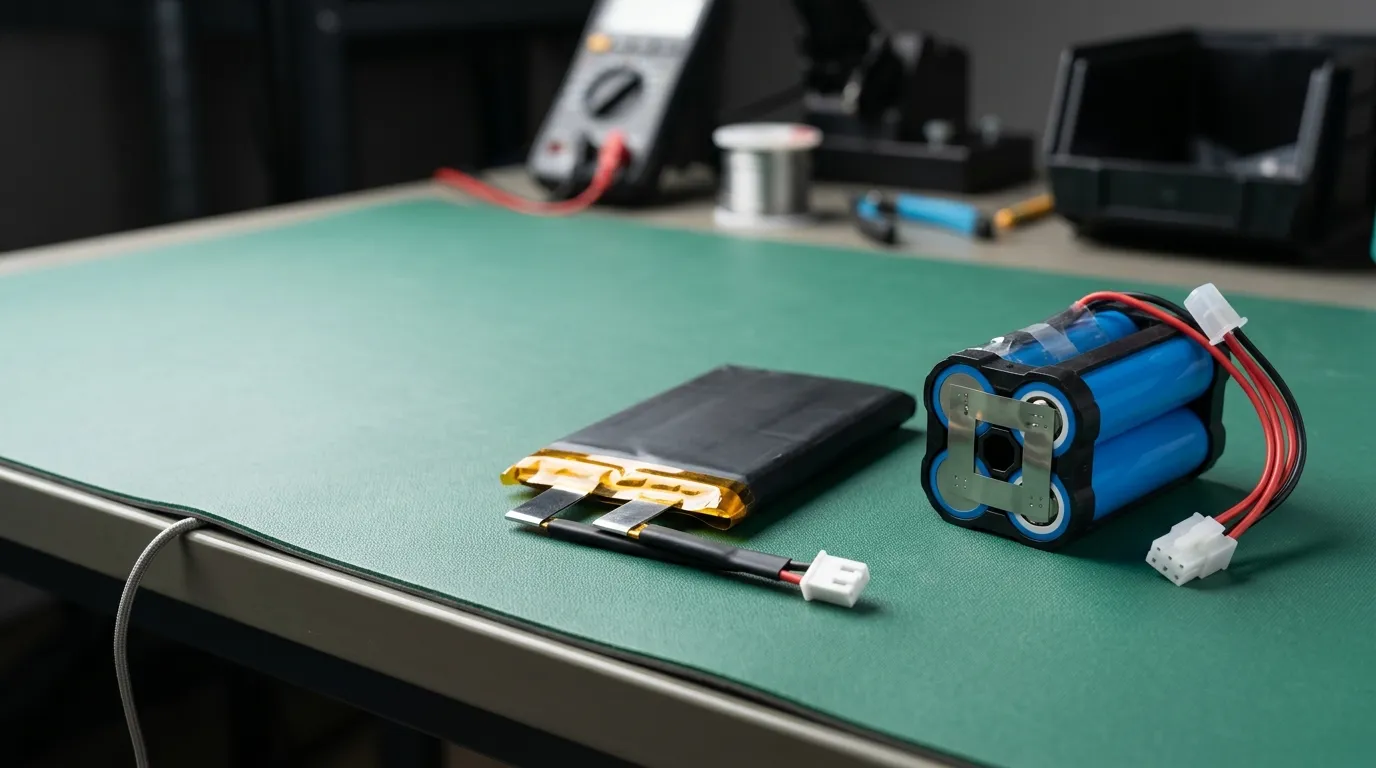
Once the electrical requirement is defined, the next decision is cell chemistry and form factor. Portable label printers commonly use rechargeable lithium-ion packs, which offer a good balance of energy density, cycle life, and cost. Within that category, the two most relevant options are Li-polymer pouch cells and cylindrical cells.
| Option | Advantages | Limitations | Best Fit |
|---|---|---|---|
| Li-polymer pouch cell | Flat, thin, flexible shape options; efficient use of compact printer volumes | Requires swelling management and enclosure design; less standardized than cylindrical cells | Slim printer housings, custom internal dimensions |
| Cylindrical cell (e.g., 18650, 21700) | Standardized sizes, robust construction, widely available, easy to configure in series/parallel | Round shape wastes space in thin housings; may require more internal volume for the same energy | Printers with larger battery compartments, swappable or serviceable designs |
The series (S) and parallel (P) configuration determines the pack's voltage and capacity:
- Series count (S) sets the pack's nominal voltage. For example, two 3.7 V Li-ion cells in series create a 7.4 V pack.
- Parallel count (P) increases capacity and available current. Two cells in parallel double the pack's mAh capacity and increase the total current the pack can deliver without exceeding each cell's rated C-rate.
A printer designed for a 7.4 V rail needs a 2S pack. If the runtime target requires more capacity than one 18650 cell can provide, a 2S2P configuration—two series groups, each with two cells in parallel—provides the same 7.4 V with doubled capacity.
For field-printing workflows where operators also carry a portable pos device battery, the same design logic applies: voltage first, then capacity, then peak-current capability.
LiFePO4 is sometimes considered as an alternative because of its long cycle life and strong safety characteristics. However, its lower nominal voltage (about 3.2 V per cell) and lower energy density mean that a printer pack may need more cells and more volume to reach the same voltage and runtime. LiFePO4 is a reasonable option only if the printer's voltage rail, physical envelope, and weight targets allow for it.
Li-Polymer vs Cylindrical Cells for Compact Printer Bodies
The choice between Li-polymer pouch and cylindrical cells depends on the printer's internal volume.
A Li-polymer pack can be shaped to fit inside a thin, dense printer housing. It uses space efficiently and allows the pack to follow the contour of the device. The trade-off is that pouch cells can swell slightly over charge/discharge cycles, so the enclosure must provide room for expansion and mechanical restraint without compressing the cell.
A cylindrical-cell pack is easier to build from standard cells and offers good mechanical robustness. It is an excellent choice for printers with a larger battery compartment, especially when the pack is designed to be removed and replaced in the field. The round cells require more unused volume in a square housing, but the pack is easier to source, replace, and quality-verify.
For either format, the pack design must be validated for the printer's specific current profile—especially the print-burst current—because cell ratings alone do not guarantee pack-level performance.
Should the Printer Battery Be Removable or Swappable?
The pack architecture decision is not only about cells. It is also about how the pack is installed and serviced.
| Option | Description | Advantages | Limitations |
|---|---|---|---|
| Internal pack | Permanently installed in the printer housing | Compact; protected from removal; lower mechanical complexity | Requires service center access for replacement; downtime during battery changes |
| Removable pack | User-replaceable battery door and connector | Easy replacement; supports multi-shift operation with spare batteries | Requires a mechanical latch, connector, and protective enclosure; increases device size slightly |
| Swappable pack | Hot-swappable design with external charger and spare batteries | Enables continuous operation in shift work | Requires spare-pack investment and charging infrastructure; requires battery management for stored packs |
For a fleet of field printers used across shifts, a removable or swappable pack design is usually the better choice. Operators can swap a depleted pack for a charged one without taking the printer out of service.
For a compact consumer or light-duty printer, an internal pack reduces physical complexity and cost. The trade-off is that battery replacement becomes a service event.
From a battery-sourcing perspective, a removable pack also changes the mechanical specification: the pack now needs a durable enclosure, a connector rated for repeated cycles, and a design that can survive handling and drops. An internal pack can be lighter and cheaper but must still manage heat, swelling, and charging inside the sealed device.
When operators also rely on a rechargeable pos terminal battery for companion handheld devices, a removable pack design makes it easier to coordinate spares and charging across the whole equipment fleet.
Connecting, Protecting, and Charging the Printer Pack
A custom printer pack is not just a cell arrangement. It is an integration of cells, protection electronics, connector, wiring, enclosure, and thermal design.
Connector and wiring. The connector must match the printer's interface in polarity, current rating, mechanical retention, and physical fit. A connector rated only for continuous current may overheat during the print burst if its rating does not cover the peak current. Wire gauge must also be sized for the peak current, not the average.
BMS and protection. A basic PCM (protection circuit module) typically provides overcharge, over-discharge, overcurrent, and short-circuit protection. A more advanced BMS may add cell balancing for multi-series packs, a fuel gauge for accurate state-of-charge reporting, and a communication interface (such as I²C, SMBus, or UART) so the printer can display remaining runtime. The protection thresholds must be matched to the printer's operating window so that the BMS does not trip during a legitimate print burst.
The complete protection and enclosure design—including BMS selection, connector choice, and mechanical integration—is part of the broader custom battery pack design (inferred) process, which starts with the device's electrical and mechanical constraints.
Charger compatibility. The charger must match the pack's chemistry, series count, and charge profile. A 7.4 V Li-ion pack, for example, requires a charger that supplies the correct maximum charge voltage (about 8.4 V for a 2S Li-ion pack) and follows a CC/CV profile. Using an incorrect charger risks under-charging, over-charging, or reducing cycle life.
Enclosure and thermal path. The pack enclosure protects cells from impact, dust, and moisture, and it defines the interface with the printer housing. The thermal path matters because both charging and discharging generate heat. The pack must be designed so that heat can spread or escape without raising cell temperature above the safe operating range.
An IP rating may be specified if the printer operates in dusty or damp conditions, but an IP rating should not be confused with generic "waterproof" language. Each rating has a defined test level and a defined scope.
Validating the Prototype and Confirming Supplier Documentation
A custom pack design must be validated before production. The prototype stage should confirm fit, electrical behavior, and documentation.
A validation matrix for a portable printer pack should include at minimum:
- Mechanical fit: dimensions, connector alignment, mounting, and clearance in the printer housing.
- Peak-current behavior: verify the pack does not sag below the printer's minimum voltage during a full print burst.
- Runtime check: verify the measured runtime against the calculated estimate at a defined duty cycle and temperature.
- Charging check: confirm the pack accepts charge at the specified voltage and current and terminates correctly.
- Protection check: confirm the BMS/PCM thresholds are set above the printer's maximum legitimate current draw.
- Temperature check: confirm the pack surface temperature stays within the specified limit during a representative print cycle.
- Cycle-life check, if claimed: test at the same depth of discharge and temperature that the end customer will use.
Documentation requirements. A supplier should provide at minimum:
- A datasheet/TDS stating voltage, capacity, Wh, continuous/peak current, temperature range, and dimensions for the exact pack model.
- An SDS/MSDS for handling and logistics.
- A UN38.3 test summary for lithium-battery transport.
UN38.3 is a transport test framework, not a product-safety certification. It confirms that the battery design passed specified transport tests. It is distinct from an IEC 62133 product-safety test, which applies to a defined model and construction, and distinct from a company-level ISO 9001 quality-system certificate. Do not confuse a transport test summary with a safety certification.
What to Send to a Custom Battery Supplier

To get a useful quote and a manufacturable design, an OEM should send a structured requirements list to the battery supplier. The more precise the electrical and mechanical data, the faster the supplier can propose a pack architecture.
A complete RFQ for a custom portable-label-printer battery should include:
| Category | Information to provide |
|---|---|
| Electrical | Nominal voltage, charge voltage, continuous current, peak current and duration, runtime target, allowable voltage sag, C-rate requirement |
| Mechanical | Maximum available dimensions, weight limit, connector type and pinout, wire gauge, mounting method, enclosure requirement, IP rating if required |
| Environmental | Operating temperature range, storage temperature range, humidity/dust exposure, drop/vibration requirements |
| Charging | Charger voltage/current, charge time target, fast-charge requirement, charge termination method |
| BMS/Protection | Required protection functions, balancing, fuel gauge, communication protocol, state-of-charge reporting |
| Documentation | Datasheet/TDS, SDS/MSDS, UN38.3 test summary, product-safety test reports if applicable |
| Validation | Sample-approval process, pilot-run requirement, test matrix, acceptance criteria |
| Supply | Projected annual volume, target lead time, MOQ, change-control policy, batch traceability |
The supplier should respond with a pack-level specification, not just a cell-level recommendation. If the supplier cannot document the pack's continuous and peak current ratings, temperature limits, and protection thresholds for the exact configuration proposed, the design is not yet ready for production.
A custom battery for a portable label printer is a system decision. It starts with the printhead's burst current and the duty cycle, then moves through cell selection, S/P architecture, BMS, connector, charging, validation, and documentation—not with a capacity number pulled from a marketing page.
For operators who also use field ticketing and payment workflows, the same power-sourcing principles apply to a Lithium battery for mobile ticketing terminals, where runtime and swappable-pack requirements often mirror those of portable printers.
To develop a custom pack for your portable label printer, contact the Gloflux engineering team with your printer's voltage, current profile, mechanical envelope, and runtime target for a feasibility review.
Talk to the Manufacturer
Resources & Insights
High Capacity Lithium Battery for Wearables: High-Voltage LiPo Cell Design
2026-10-19
Cylindrical Battery Packs for Laptops: 2S vs 3S vs 4S Battery Design
2026-10-19

Stage Lighting Battery Pack: Prevent Voltage Drop & LED Flicker
2026-10-19

Best Rechargeable Batteries for Smart Devices: Performance, Safety, and Selection Guide
2026-10-19


