


 Home /
 Comprehensive Analysis of Lithium Battery Winding and Stacking Processes


Table of Contents
- What Is the Lithium Battery Winding Process?
- Main Components of a Lithium Battery Winding Machine
- Key Control Points in the Winding Process
- What Is the Lithium Battery Stacking Process?
- Main Components of a Battery Stacking Machine
- Advantages of the Lithium Battery Winding Process
- Disadvantages of the Winding Process
- Advantages of the Lithium Battery Stacking Process
- Disadvantages of the Stacking Process
- Winding Tension and Stacking Tension Control
- Winding and Stacking Alignment Control
- Which Process Is Better for Large-Capacity Batteries?
- Application Trends in Large Energy Storage Cells
- Thermal Composite Stacking and Flying Stacking
- Why Stacking Is Important for Solid-State Batteries
- Quality Inspection Requirements
- Winding and Stacking Will Continue to Coexist
- Conclusion
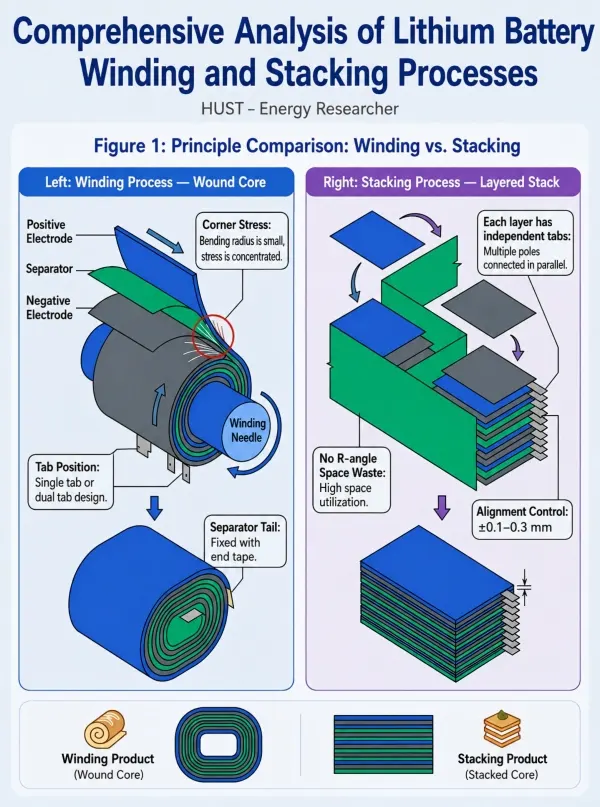
The internal structure of a lithium-ion battery is largely determined by how the cathode, anode, and separator are assembled. This manufacturing step directly affects battery capacity, internal resistance, cycle life, safety, energy density, production efficiency, and overall cost.
At present, the two most widely used cell assembly methods are the winding process and the stacking process.
Winding technology has long been used for cylindrical batteries, consumer lithium batteries, and many prismatic cells because it offers high production efficiency, mature equipment, and relatively low manufacturing costs. Stacking technology provides better space utilization, more uniform internal construction, lower resistance potential, and greater suitability for large-capacity cells. It is becoming increasingly important in electric vehicle batteries, energy storage systems, and solid-state batteries.
Equipment speeds, alignment accuracy, and efficiency figures mentioned in this article are representative values. Actual performance depends on cell size, electrode materials, equipment design, quality standards, and production conditions.
What Is the Lithium Battery Winding Process?
The winding process continuously feeds the cathode sheet, anode sheet, and separator into a winding machine. These materials are rolled around a winding needle to form a complete electrode roll, commonly called a jelly roll.
A typical internal sequence is:
Separator – cathode – separator – anode
The separator completely isolates the positive and negative electrodes, preventing direct electrical contact and reducing the risk of an internal short circuit.
During production, tension-control rollers, alignment systems, servo motors, and winding mechanisms work together to create a cylindrical, oval, or flattened electrode roll. After winding is completed, the electrodes and separator are cut, and termination tape is applied to prevent the structure from loosening during handling, insertion, electrolyte filling, and transportation.
Depending on the battery design, a wound cell may use single-tab, dual-tab, or multi-tab construction. Tab position, winding turns, separator overlap, and electrode alignment must be carefully controlled. Poor control can lead to uneven current distribution, local heating, inconsistent capacity, and reduced cycle life.
Main Components of a Lithium Battery Winding Machine
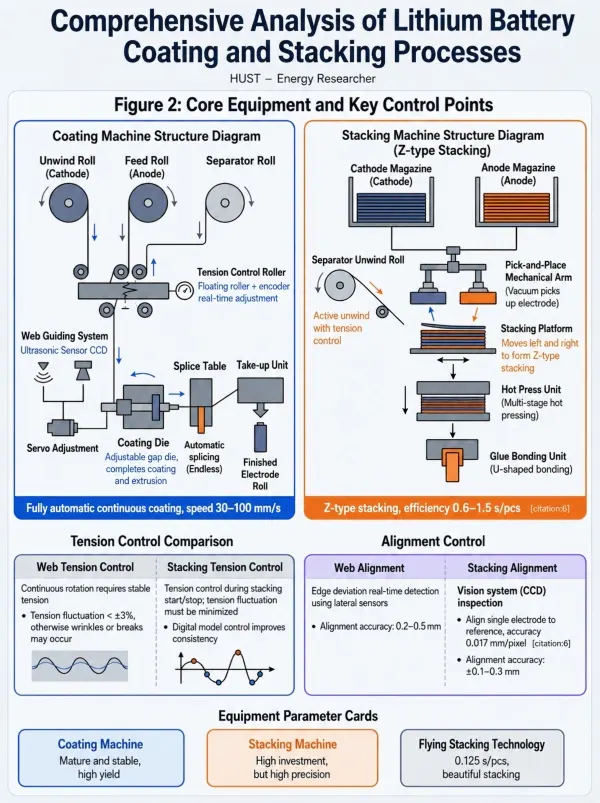
A fully automatic winding machine normally includes electrode unwinding units, separator feeding systems, tension-control rollers, alignment devices, winding needles, taping stations, and finished-cell unloading mechanisms.
Electrode and Separator Unwinding
The cathode, anode, and separator rolls are installed on separate feeding units. Each material must be supplied at a stable speed while maintaining consistent tension.
Tension-Control System
Floating rollers, tension sensors, servo drives, and encoders continuously regulate material tension. Excessive tension may stretch the separator or damage the electrode coating, while insufficient tension can cause wrinkles, loose layers, or internal gaps.
Some winding processes require tension variation to remain within approximately ±3%, although the actual tolerance depends on the battery design and equipment specification.
Alignment and Correction System
Ultrasonic sensors, edge detectors, or CCD cameras monitor the position of the electrodes and separator. Servo-controlled correction mechanisms adjust the feeding path to prevent side-to-side movement.
Winding Mechanism
The winding needle rotates according to the programmed speed and forms the electrode assembly. Retractable or replaceable winding needles may be used for different cell sizes and shapes.
Taping and Unloading Unit
After winding, the materials are cut automatically. Termination tape is then applied, and the finished electrode roll is transferred to the next production stage.
For mature automatic equipment, the material feeding speed may range from approximately 30 to 100 millimeters per second. Larger cells, thicker electrodes, and complicated multi-tab structures may require lower speeds to maintain accuracy and product quality.
Key Control Points in the Winding Process
Winding is not simply a matter of rolling several layers together. Its major technical challenges involve tension stability, electrode alignment, corner stress, and dimensional consistency.
Tension Stability
The cathode, anode, and separator have different thicknesses, strengths, and elastic properties. Their tension settings must therefore be controlled independently.
Excessive separator tension may cause stretching, deformation, or pore damage. Excessive electrode tension may crack the coating or deform the current collector. Low tension can produce loose winding, wrinkles, uneven compression, and gaps between layers.
Stable tension is especially important for high-speed production and long electrode sheets.
Electrode and Separator Alignment
The separator must completely cover the electrode edges. The negative electrode is generally designed to extend beyond the positive electrode within a controlled safety margin.
If the separator shifts, the risk of direct contact between the positive and negative electrodes increases. If the negative electrode does not provide sufficient coverage, lithium plating and local electrochemical imbalance may occur.
The alignment accuracy of conventional winding equipment may be approximately ±0.2 to ±0.5 millimeters. Advanced machines using CCD inspection and closed-loop correction can achieve tighter control.
Corner Stress
One of the main disadvantages of winding is the mechanical stress created at the curved corners of a flattened electrode roll.
The electrode coating, current collector, and separator are repeatedly bent around a relatively small radius. These curved areas may experience coating separation, particle shedding, cracking, uneven compression, or electrochemically inactive regions.
Corner stress becomes more significant when thick electrodes and large-format cells are used. This is one reason why many very large-capacity batteries are moving toward stacking technology.
Thickness Uniformity
The corners and flat sections of a wound cell experience different pressure distributions. This can result in uneven thickness, inconsistent electrolyte penetration, and variations in electrode contact.
Precise winding tension, roller pressure, electrode thickness, and final compression must be coordinated to produce a stable cell structure.
What Is the Lithium Battery Stacking Process?
The stacking process assembles individually cut cathode sheets, anode sheets, and separator layers one by one to create a flat, layered electrode structure.
Common stacking methods include:
- Z-fold stacking
- Pouch stacking
- Thermal composite stacking
- Flying stacking
- Electrode-separator pre-lamination
In a typical Z-fold process, the separator moves back and forth in a continuous zigzag pattern. A robotic arm alternately places cathode and anode sheets between the separator folds.
The final repeating structure is:
Cathode – separator – anode – separator
After all layers are assembled, the electrode stack is normally compressed through a hot-pressing process. Adhesive tape is then applied to maintain the cell shape and prevent layer movement during subsequent production stages.
Main Components of a Battery Stacking Machine
A stacking machine usually consists of positive and negative electrode trays, a separator unwinding system, robotic pick-and-place arms, a stacking platform, a visual inspection system, a hot-pressing unit, and a taping station.
Electrode Feeding
The positive and negative electrode sheets are stored in separate trays. Vacuum grippers or robotic arms pick up each sheet and place it on the stacking platform.
The system must detect missing sheets, double sheets, damaged electrodes, dust, burrs, and incorrect orientation.
Separator Tension Control
In a conventional Z-fold process, the separator moves repeatedly from side to side. This frequent motion may cause tension fluctuations, wrinkles, stretching, and positional errors.
Active unwinding and closed-loop tension control are therefore important for maintaining separator stability.
CCD Visual Alignment
Stacking machines commonly use CCD cameras to inspect electrode edges, corners, and reference points.
A representative vision system may provide a resolution of approximately 0.017 millimeters per pixel. In practical production, stacking alignment accuracy may be controlled within approximately ±0.1 to ±0.3 millimeters, depending on the equipment and cell size.
Hot-Pressing Unit
After stacking, controlled heat and pressure are applied to stabilize the electrode assembly and reduce movement between layers.
The pressing temperature, pressure, and duration must be carefully optimized. Excessive heat may cause separator shrinkage or changes in pore structure, while inadequate pressure may leave internal gaps.
Taping Unit
The finished stack may be secured using U-shaped tape, side tape, or surrounding tape. This prevents the layers from shifting during tab welding, insertion, electrolyte filling, and sealing.
Advantages of the Lithium Battery Winding Process
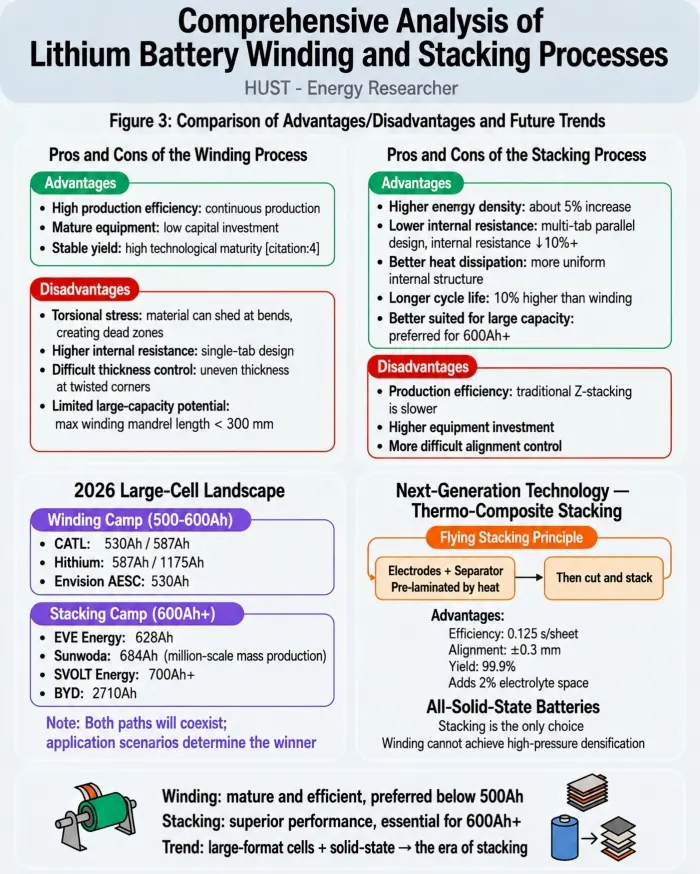
The greatest advantage of winding is its continuous production capability. Long electrode and separator rolls can be fed without repeatedly stopping for individual sheet placement.
Its major advantages include:
- High production efficiency
- Mature manufacturing technology
- Stable mass-production performance
- Relatively low equipment and operating costs
- Good compatibility with cylindrical cells
- Strong suitability for small and medium-capacity batteries
- Easier integration into highly automated production lines
Winding machines have been used in the lithium battery industry for many years. Their processes, equipment structures, and quality-control methods are highly developed.
For cylindrical batteries, the winding process remains the dominant manufacturing method because it matches the round metal housing and supports efficient continuous production
Disadvantages of the Winding Process
Despite its efficiency, winding has several structural limitations.
The curved sections of the electrode roll experience concentrated mechanical stress. Electrode bending may lead to coating cracks, material shedding, uneven compression, and inactive regions.
In addition, a traditional single-tab wound structure may have a relatively long current path. This can increase internal resistance and create uneven heat distribution during high-rate charging or discharging.
Other limitations include:
- Difficult thickness control around curved areas
- Uneven pressure distribution
- Possible separator stretching
- Greater challenges with thick electrodes
- Limitations related to winding-needle length
- Reduced suitability for extremely large-capacity cells
- Possible internal gaps and lower space utilization
These challenges become more noticeable as battery dimensions and capacities increase.
Advantages of the Lithium Battery Stacking Process
A stacked cell consists of flat electrode sheets arranged in a regular layered structure. Because there are no tightly curved corners, the electrodes experience more uniform mechanical pressure.
The main advantages of stacking include:
- Better internal space utilization
- Greater potential for higher energy density
- Shorter current paths with multi-tab designs
- Lower internal resistance potential
- More uniform heat distribution
- Improved high-rate performance
- Better suitability for thick electrodes
- Strong compatibility with large-format prismatic cells
- Potentially longer cycle life
- Better compatibility with solid-state batteries
Under the same external cell dimensions and material system, an optimized stacking design may increase usable capacity or energy density by approximately 5%. However, the actual improvement depends on electrode design, inactive material content, tab configuration, housing structure, and manufacturing precision.
Stacking also supports multi-tab parallel connections more easily. Increasing the number of tabs can shorten electron transport paths, reduce resistance, and improve current distribution.
Because the electrode layers remain flat, internal heat may be distributed more evenly, making stacking attractive for high-power and large-capacity battery applications.
Disadvantages of the Stacking Process
Traditional stacking equipment operates through repeated electrode pickup, placement, positioning, and separator movement. These frequent start-stop operations can limit production speed.
The main disadvantages include:
- Lower production efficiency than mature winding lines
- Higher equipment investment
- More complicated mechanical and software control
- Accumulated alignment errors across many layers
- Strict electrode cutting requirements
- Greater sensitivity to burrs and dust
- More demanding visual inspection
- Increased difficulty in handling thin electrode sheets
- More complicated maintenance and calibration
Traditional Z-fold stacking may operate at approximately 0.6 to 1.5 seconds per sheet. Actual production speed varies significantly depending on electrode dimensions, layer count, equipment design, and quality requirements.
Winding Tension and Stacking Tension Control
The winding and stacking processes require different tension-control strategies.
During winding, the electrodes and separator move continuously. The main objective is to maintain highly stable tension throughout the process. Sudden changes may produce wrinkles, stretching, or uneven roll tightness.
During stacking, especially Z-fold stacking, the separator moves back and forth while the electrodes are placed individually. Frequent acceleration and deceleration can produce larger tension fluctuations.
Advanced stacking systems use digital motion models, active unwinding, tension sensors, and real-time servo correction to improve synchronization.
Winding focuses on continuous tension stability, while stacking focuses on controlling tension during repeated changes in motion.
Winding and Stacking Alignment Control
In the winding process, alignment is commonly monitored continuously through edge sensors or visual inspection. The system adjusts the feeding direction while the materials are moving.
In the stacking process, each electrode sheet can be photographed individually by a CCD camera. This allows the equipment to measure electrode position and correct the placement angle before stacking.
Typical winding alignment accuracy may be approximately ±0.2 to ±0.5 millimeters. Stacking equipment can often achieve approximately ±0.1 to ±0.3 millimeters.
However, stacking accuracy must be maintained across dozens or even hundreds of layers. A small placement error can accumulate and affect the final electrode stack.
Which Process Is Better for Large-Capacity Batteries?
The choice between winding and stacking depends on battery capacity, cell shape, electrode thickness, production volume, cost targets, and application requirements.
Winding remains highly competitive for cylindrical batteries, consumer electronics batteries, mature prismatic cells, and small to medium-capacity products.
Stacking is increasingly preferred for large prismatic batteries, energy storage cells, high-power electric vehicle batteries, long-life batteries, and solid-state batteries.
A general comparison can be described as follows:
- For many mature cells below approximately 500Ah, both processes may be technically possible. Winding often provides better production efficiency and cost control.
- For cells above approximately 600Ah, stacking may provide stronger advantages in space utilization, current distribution, thermal uniformity, and structural stability.
- Cylindrical cells mainly use winding.
- Large prismatic and solid-state cells are more compatible with stacking.
These capacity ranges are not absolute technical limits. Battery manufacturers must also consider the material system, electrode loading, current-collector thickness, tab design, cell housing, cooling system, and manufacturing equipment.
Application Trends in Large Energy Storage Cells
Large energy storage cells are developing toward higher capacity, longer cycle life, improved safety, and lower cost per kilowatt-hour.
Some large-cell product platforms use winding structures in the range of approximately 500Ah to 600Ah. Stacking is increasingly used in cells above 600Ah because the flat electrode structure offers better compatibility with large cell dimensions.
For very high-capacity cells, stacking may reduce inactive internal space, improve tab distribution, and support more uniform current flow.
However, battery performance cannot be judged by capacity alone. A well-designed wound cell may outperform a poorly manufactured stacked cell. Material quality, process control, thermal management, and safety design remain essential.
Thermal Composite Stacking and Flying Stacking
To solve the efficiency limitations of traditional stacking, equipment manufacturers are developing thermal composite stacking and flying stacking technologies.
Thermal composite stacking first bonds or laminates the electrode and separator together. The composite material is then cut, transported, and stacked at high speed.
Pre-lamination reduces relative movement between the electrode and separator, improving alignment stability during rapid production.
Flying stacking reduces the time required for robotic arms to stop, pick up, move, and place each sheet. The electrode can be positioned and stacked during continuous or semi-continuous motion.
Some advanced equipment platforms target speeds of approximately 0.125 seconds per sheet while maintaining alignment accuracy around ±0.3 millimeters. These figures normally represent specific equipment designs and operating conditions rather than universal industry performance.
Future high-speed stacking lines are expected to combine:
- Continuous electrode feeding
- Electrode-separator thermal lamination
- High-speed cutting and positioning
- CCD closed-loop alignment
- Artificial intelligence defect detection
- Online burr and dust inspection
- Parallel multi-station production
- Precise pressure and temperature control
Why Stacking Is Important for Solid-State Batteries
Solid-state batteries replace conventional liquid electrolyte systems with solid or semi-solid electrolyte materials.
Many solid-state electrolyte layers are relatively rigid and may not tolerate tight bending radii. Winding can produce excessive mechanical stress, cracking, delamination, or poor contact between layers.
Stacking keeps the electrode and electrolyte layers flat, making it easier to apply uniform pressure and maintain stable interfacial contact.
For this reason, stacking is widely considered one of the most suitable assembly methods for large-format solid-state batteries.
Thermal composite stacking may become particularly important because it can combine electrode, separator, and solid electrolyte layers before final assembly.
Quality Inspection Requirements
Both winding and stacking processes require strict online quality control.
Important inspection items include:
- Electrode edge alignment
- Separator coverage
- Electrode burrs
- Coating cracks
- Particle contamination
- Separator wrinkles
- Tab position
- Electrode count
- Final cell thickness
- Internal short-circuit risk
- Tape position
- Structural deformation
Winding lines generally emphasize continuous edge detection, tension monitoring, and roll-diameter control.
Stacking lines require accurate sheet counting, individual electrode inspection, positioning verification, and cumulative alignment monitoring.
Advanced production lines increasingly use machine vision, artificial intelligence, and real-time data analysis to identify defects before the electrode assembly enters the next manufacturing stage.
Winding and Stacking Will Continue to Coexist
Winding and stacking should not be viewed as technologies in which one must completely replace the other. They serve different battery formats, production requirements, and market applications.
Winding is mature, efficient, stable, and cost-effective. It will remain highly important for cylindrical batteries, consumer products, and many small or medium-capacity cells.
Stacking provides greater potential for high energy density, low resistance, uniform heat distribution, long cycle life, large capacity, and solid-state battery production.
As energy storage cells continue to increase in capacity and electric vehicle batteries require faster charging, longer service life, and improved safety, the use of stacking technology is expected to expand.
At the same time, thermal composite stacking, flying stacking, high-speed visual inspection, and intelligent process control will help reduce stacking costs and improve production efficiency.
Conclusion
The winding process offers mature equipment, continuous production, high efficiency, and competitive manufacturing costs. It is especially suitable for cylindrical batteries and established small-to-medium-capacity cell designs.
The stacking process offers better space utilization, flatter electrode construction, shorter current paths, improved thermal consistency, and greater compatibility with large-capacity and solid-state batteries.
There is no single process that is ideal for every lithium battery. Manufacturers must select the appropriate technology according to cell size, battery chemistry, target capacity, electrode thickness, production scale, performance requirements, and cost.
Ultimately, successful lithium battery manufacturing depends not only on choosing winding or stacking, but also on controlling electrode quality, material tension, alignment accuracy, cutting burrs, hot-pressing conditions, cleanliness, and online inspection. A well-designed and precisely controlled production process is essential for producing safe, reliable, and competitive lithium batteries.
Talk to the Manufacturer
Resources & Insights
High Capacity Lithium Battery for Wearables: High-Voltage LiPo Cell Design
2026-10-19
Cylindrical Battery Packs for Laptops: 2S vs 3S vs 4S Battery Design
2026-10-19
Stage Lighting Battery Pack: Prevent Voltage Drop & LED Flicker
2026-10-19

Best Rechargeable Batteries for Smart Devices: Performance, Safety, and Selection Guide
2026-10-19


