


 Home /
 Custom LiPo Battery for Smartwatches: Solutions for Irregular and Ultra-Thin Battery Shapes


Table of Contents
- Why Standard Battery Shapes Limit Smartwatch Design
- What Is an Irregular-Shaped LiPo Battery?
- Ultra-Thin LiPo Battery Engineering
- Thickness, Footprint, and Capacity
- Engineering Challenges of Irregular Battery Shapes
- Balancing Shape, Capacity, and Runtime
- High-Voltage LiPo Chemistry
- PCM, Fuel Gauge, and Pack Integration
- Safety and Compliance Considerations
- Gloflux Custom Battery Development
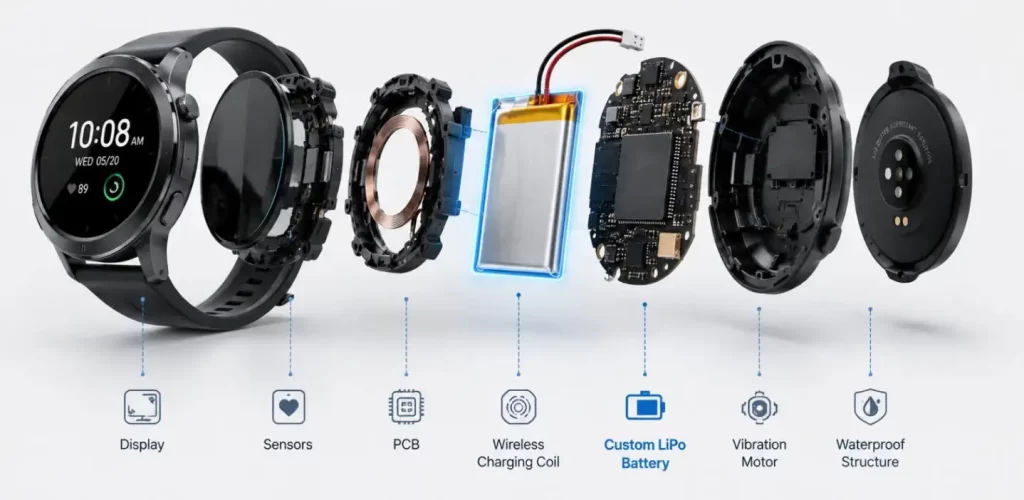
Smartwatch battery engineering is a space-allocation problem as much as an energy-storage problem. Inside a compact enclosure, the battery must compete with the display, PCB, optical sensors, antenna, vibration motor, speaker, wireless charging coil, and waterproof sealing structure.
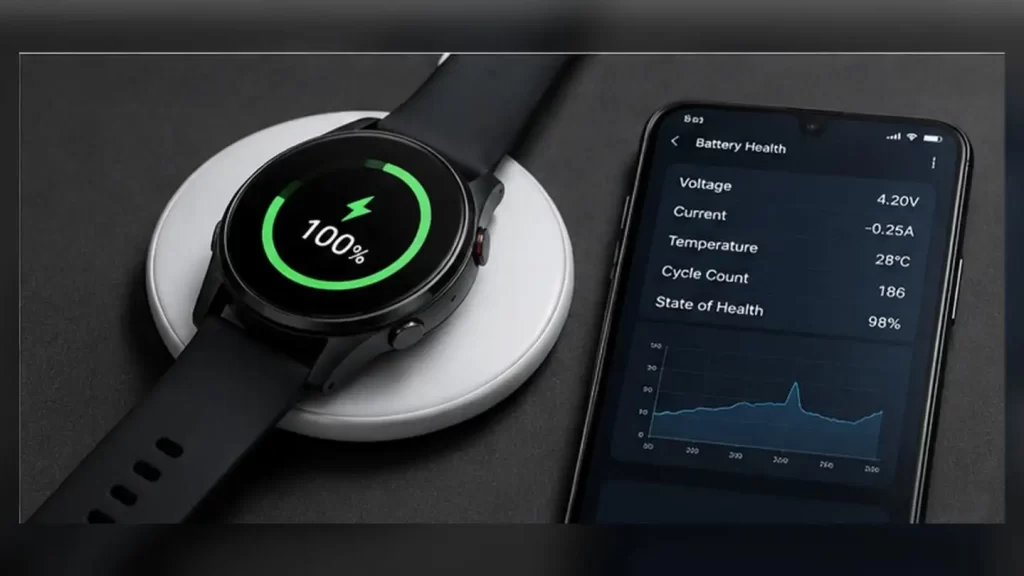
A Custom LiPo Battery for Smartwatches can be engineered with application-specific dimensions, tab locations, wiring, connectors, and selected non-standard outlines. The objective is not simply to make the battery thinner. It is to use the available internal volume efficiently while maintaining capacity, peak-current performance, cycle life, and safety.
Why Standard Battery Shapes Limit Smartwatch Design
Standard rectangular cells are convenient to manufacture, but they may leave unused space around circular displays, curved housings, sensor assemblies, or stacked circuit boards.
At the same time, smartwatch power demand continues to increase because of:
•Always-on AMOLED displays
•Continuous heart-rate and SpO₂ monitoring
•GPS and motion tracking
•Bluetooth, Wi-Fi, or LTE communication
•Voice calling and audio playback
•Wireless charging losses
•Background health-data processing
A properly designed Custom LiPo Battery for Smartwatches can use otherwise inaccessible areas of the enclosure, helping improve runtime without unnecessarily increasing watch thickness.
What Is an Irregular-Shaped LiPo Battery?
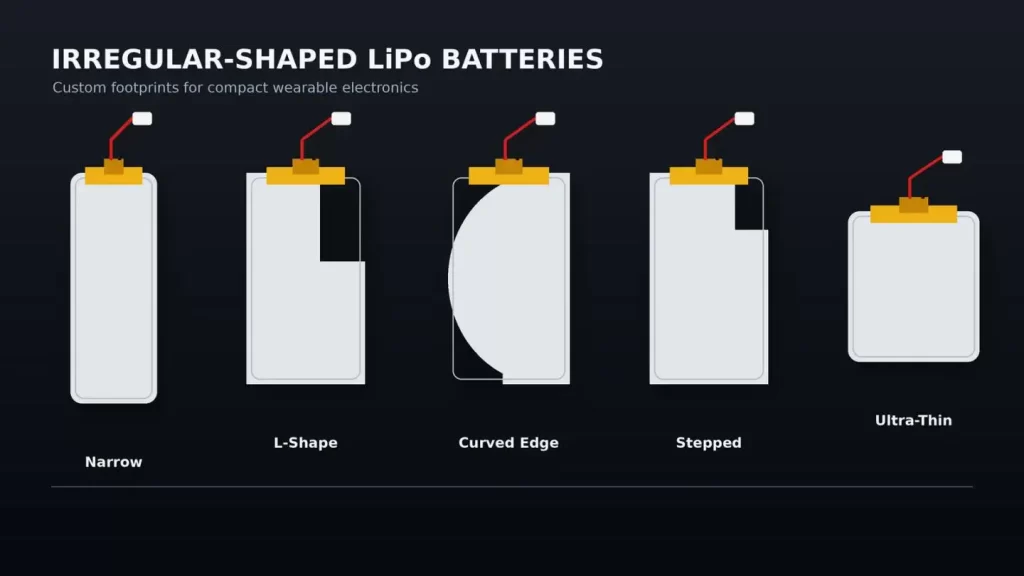
An irregular-shaped LiPo battery is a rechargeable pouch cell with a footprint developed around the internal geometry of a device. Unlike cylindrical cells or rigid metal-can batteries, LiPo cells use an aluminum-laminated pouch, allowing greater dimensional flexibility.
Possible customization elements include:
•Thickness, width, and length
•Narrow, stepped, L-shaped, or curved-edge outlines
•Positive and negative tab positions
•Wire length and exit direction
•Connector type and pin definition
•PCM and NTC placement
•Insulation and cushioning materials
However, a LiPo pouch cannot be manufactured in any arbitrary shape. Every outline must preserve sufficient electrode overlap, separator coverage, pouch-sealing width, and mechanical stability.
The design must also support repeatable production. A shape that works in a single prototype may still be unsuitable for volume manufacturing if sealing, electrode alignment, or dimensional tolerances cannot be controlled consistently.
Ultra-Thin LiPo Battery Engineering
The minimum thickness of a Custom LiPo Battery for Smartwatches depends on more than the pouch material. It is determined by the complete electrochemical and mechanical stack:
•Electrode coating thickness
•Number of electrode layers
•Separator structure
•Electrolyte volume
•Aluminum-laminate thickness
•Required capacity
•Discharge-current demand
•Manufacturing tolerance
•Swelling and compression allowance
Gloflux can evaluate ultra-thin pouch-cell solutions starting from approximately 1.5 mm. This capability does not mean that every capacity or footprint can be produced at that thickness.
| Parameter | Reference Capability |
| Cell chemistry | Rechargeable lithium polymer |
| Nominal cell voltage | Typically 3.7V |
| High-voltage options | 4.35V or 4.4V systems |
| Ultra-thin profile | Starting from approximately 1.5 mm |
| Capacity range | 50mAh to 20Ah+ |
| Standard charging temperature | 0°C to 45°C |
| Standard discharging temperature | -20°C to 60°C |
These values represent general customization capabilities. Final specifications must be verified according to the selected dimensions, load profile, charging system, and safety requirements.
Thickness, Footprint, and Capacity
Battery capacity is mainly influenced by usable active-material volume. Reducing thickness normally reduces capacity unless the footprint is increased or a higher-energy-density chemistry is selected.
For smartwatch projects, designers must balance:
•Battery thickness against enclosure height
•Footprint against PCB and sensor placement
•Capacity against charging time
•Energy density against cycle-life targets
•Peak-current capability against heat generation
•Mechanical protection against usable battery volume
An ultra-thin battery should therefore be treated as a system-level design, not as a compressed version of a standard cell.
Engineering Challenges of Irregular Battery Shapes
Electrode and Current-Path Design
Irregular electrode geometries can create longer current paths and increase internal resistance. Internal resistance can result in localized heating during high-load operations (e.g., GPS activation, LTE transmission, display wake-up, voice calling, etc.).
There are several parameters used for controlling electrical losses, such as:
•Geometry of electrodes
•Width and position of tabs
•Layout of current collectors
•Limits of peak currents
•Internal resistance
Reliability of Sealing in Pouches
Complex edges can reduce the available area for heat sealing. Inadequate sealing can negatively affect the moisture barrier, the containment of the electrolyte, and stability.
A production-ready design requires:
•Sufficient sealing width
•Stable heat-sealing parameters
•Controlled pouch alignment
•Protection against folded or stressed edges
•Consistent dimensional inspection
Swelling and Housing Pressure
LiPo cells may expand slightly because of normal cycling, elevated temperature, prolonged high state of charge, or aging. The smartwatch enclosure should not be designed around the cell's initial thickness alone.
Space calculations should include:
•Cell thickness tolerance
•Adhesive and insulation thickness
•Cushioning materials
•Expected cycle-related expansion
•Display and rear-cover deflection
•Assembly compression force
Continuous pressure from the display, screws, brackets, or rear housing can accelerate degradation and create additional safety concerns.
Balancing Shape, Capacity, and Runtime
A battery supplier needs more than a target capacity to engineer a reliable Custom LiPo Battery for Smartwatches.
| Design Input | Engineering Importance |
| Average current | Determines normal runtime |
| Peak current | Defines voltage-drop and heating requirements |
| Standby current | Influences multi-day standby performance |
| Charging current | Affects charging time and temperature rise |
| Wireless charging efficiency | Determines actual heat generated inside the watch |
| Operating temperature | Influences capacity, impedance, and aging |
| Runtime target | Establishes minimum usable energy |
| Cycle-life target | Guides chemistry and charging-voltage selection |
Runtime calculations should use the actual device duty cycle rather than dividing nominal capacity by one fixed current value. Sensors, radios, processors, and displays operate intermittently, creating a dynamic load profile with short current peaks.
High-Voltage LiPo Chemistry
A 4.35V or 4.4V cell can provide more usable energy within a similar volume than a conventional cell charged to 4.2V. This can benefit applications where the battery compartment cannot be enlarged.
However, high-voltage chemistry requires:
•A compatible charging IC
•Accurate charge-voltage control
•Correct PCM thresholds
•Thermal validation
•Fuel-gauge calibration
•Cycle-life testing at the intended charge limit
Higher voltage is not automatically the best choice. Energy gain must be evaluated against temperature, charging architecture, capacity retention, and required service life.
PCM, Fuel Gauge, and Pack Integration
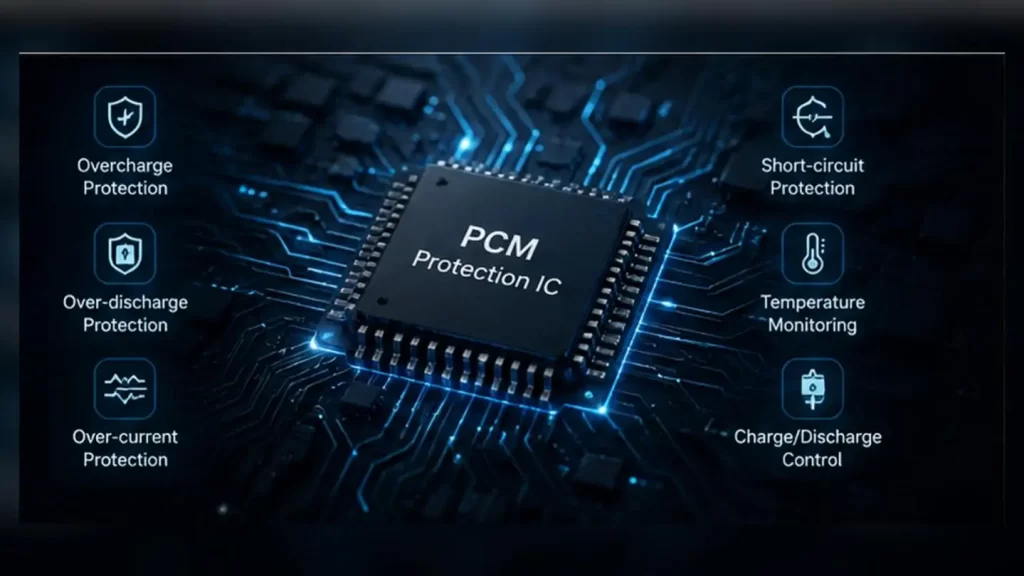
Although smartwatches commonly use a single LiPo cell, the battery pack still requires electrical protection. A compact PCM may provide:
•Overcharge protection
•Over-discharge protection
•Over-current protection
•Short-circuit protection
•Charge and discharge control
Additional integration options can include an NTC temperature sensor, fuel-gauge circuit, and I²C, SMBus, or HDQ communication.
Connector, wire, and tab placement should be defined early. Poor routing can occupy valuable space, cross sensor areas, increase assembly difficulty, or place mechanical stress on the pouch tabs.
Safety and Compliance Considerations
Because a smartwatch is worn directly against the body, battery evaluation should cover electrical, thermal, mechanical, and transportation risks.
Relevant requirements may include:
•UL1642 for cell-level safety evaluation
•IEC 62133 for portable sealed secondary cells and batteries
•UN38.3 for lithium battery transportation
•CB certification support for international market access
•RoHS material restrictions
•CE requirements applicable to the finished device
The compliance plan must be confirmed according to the cell, completed battery pack, final smartwatch, target market, and shipping configuration.
Gloflux Custom Battery Development
Gloflux develops Custom LiPo Battery for Smartwatches solutions around the device's available space, electrical load, charging architecture, and assembly method.
Engineering support can include:
•Ultra-thin and irregular cell evaluation
•3.7V, 4.35V, or 4.4V chemistry selection
•Compact PCM and NTC integration
•Tab, wire, and connector customization
•Prototype and dimensional validation
•Capacity, resistance, and cycle testing
•Compliance and transportation-test preparation
Selected designs can retain at least 80% of their original capacity after 500 or more full cycles, depending on charging voltage, temperature, depth of discharge, and operating conditions.
Selecting the Right Smartwatch Battery Shape
Achieving a good design for irregularly shaped batteries uses the internal space with the benefits of maintaining sealing reliability, electrical performance, and mechanical protection. As capacity, peak-current output, thermal behavior, swelling allowance, and cycle life are all factors to consider in the design of an ultra-thin battery, designing for optimal capacity is always a challenge.
Designing a Custom LiPo Battery for Smartwatches means evaluating multiple sub-systems as a complete system and includes smart selection of cells, protection circuits, chargers, housings and the profile of the device for which the battery is being developed. Gloflux offers services in cell selection, battery pack prototyping and compliance testing. Your available battery space, required voltage/current and the targeted market are good starting points for discussing the possible smart battery pack design for your smartwatch.
FAQs
Q1. Can Gloflux modify the PCM, connectors, and wire?
Gloflux is able to offer PCM customization, wire length, wire exit instruction, connector type, pin arrangement, tab arrangement, NTC sensors, insulation, and communication function selection.
Q2. Can Gloflux accommodates irregular-shaped LiPo batteries for smartwatches?
Gloflux has the ability to check narrow, stepped, curved edge, L shaped, and other forms of non-standard pouch-cell configurations. The ultimate conclusion on feasibility will hinge on electrode geometry, sealing width, tab position, allowable swelling, and mass-production consistency.
Q3. What protection functions can Gloflux integrate?
Depending on the project, Gloflux can integrate protection against overcharge, over-discharge, over-current, and short circuits. Temperature sensing, charge control, fuel-gauge functions, and communication interfaces may also be considered.
Q4. Can Gloflux adjust battery voltage and capacity?
Yes, Gloflux has the capacity to build batteries from about 3.7V to 48V+ with custom capacities from 50mAh to 20Ah+. Most smartwatch battery configurations are single cell and compact.
Q5. Does Gloflux have high-voltage LiPos for smartwatch batteries?
Gloflux is able to offer high-voltage LiPos (4.35V and 4.4V) for smartwatches to provide a smartwatch that offers the highest volumetric battery capacity. It is also necessary for the battery protection IC to
Talk to the Manufacturer
Resources & Insights
High Capacity Lithium Battery for Wearables: High-Voltage LiPo Cell Design
2026-10-19
Cylindrical Battery Packs for Laptops: 2S vs 3S vs 4S Battery Design
2026-10-19
Stage Lighting Battery Pack: Prevent Voltage Drop & LED Flicker
2026-10-19
Best Rechargeable Batteries for Smart Devices: Performance, Safety, and Selection Guide
2026-10-19


