
 Home /
 What Is the Difference Between Continuous Current and Pulse Current?


Table of Contents
- What Is Continuous Current?
- What Is Pulse Current?
- What Is the Main Difference Between Continuous and Pulse Current?
- Why Does Pulse Duration Matter?
- How Does Internal Resistance Affect Current Capability?
- What Role Does the BMS Play?
- How Do Parallel Cells Affect Continuous Current?
- How Should Engineers Specify Battery Current Requirements?
- Is a Higher Current Rating Always Better?
- How Does GLOFLUX Evaluate Continuous and Pulse Current?
When selecting or designing a lithium battery pack, two current ratings are especially important: continuous current and pulse current.
They describe different operating conditions, and confusing them can lead to poor runtime, voltage drop, overheating, BMS shutdown, or even premature battery failure.
For engineers working with portable electronics, medical devices, communication equipment, robotics, power tools, or industrial systems, understanding the difference between continuous and pulse current is essential for selecting the right battery cell and BMS.
What Is Continuous Current?
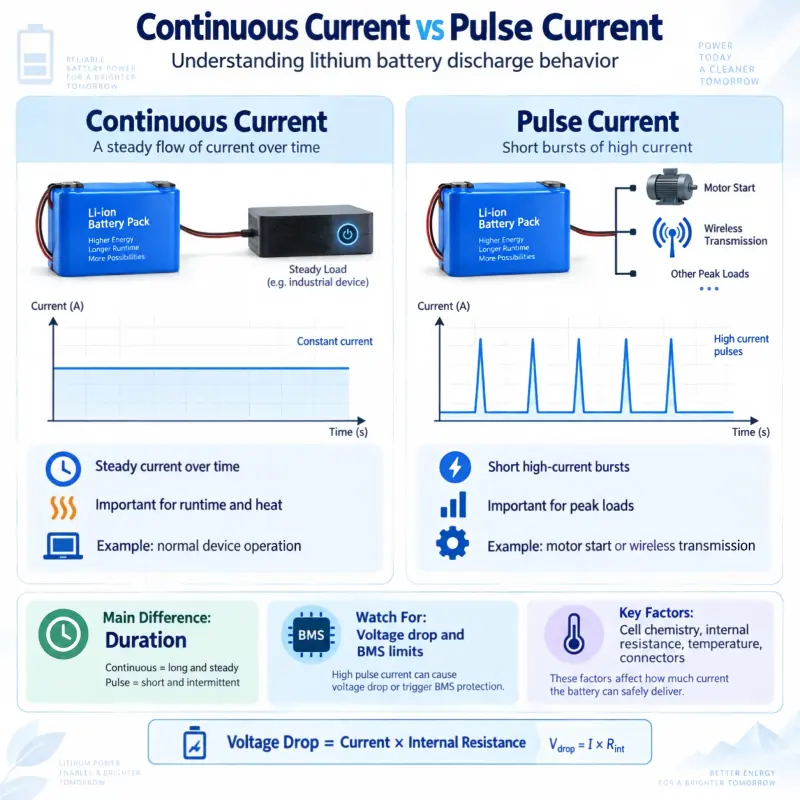
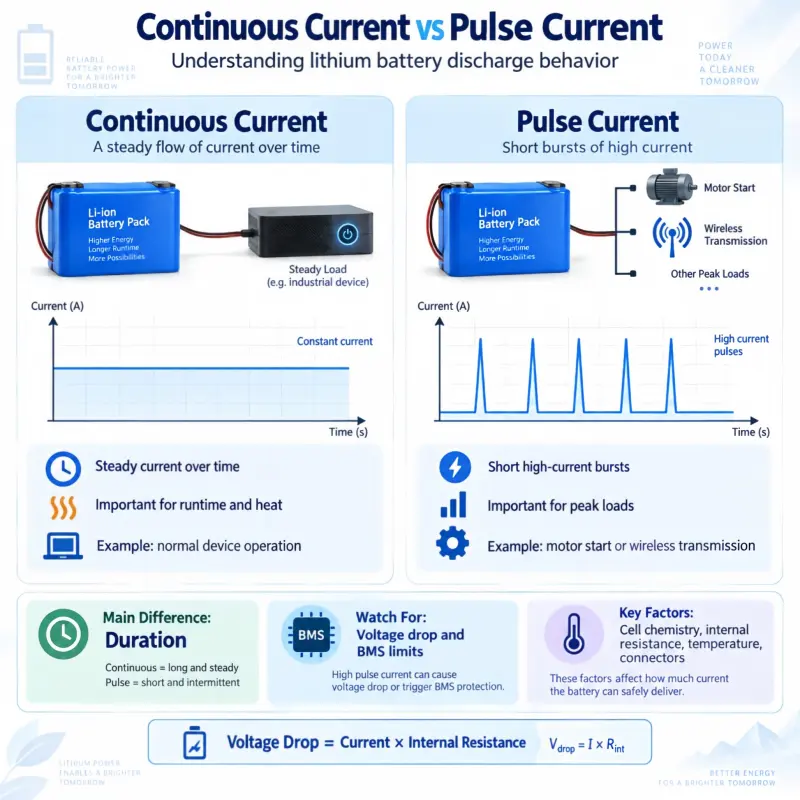
Continuous current is the amount of current a battery can safely supply for an extended period without exceeding its thermal or electrical limits.
For example, if a battery pack is rated for a maximum continuous discharge current of 5A, it means the pack can theoretically deliver up to 5A continuously under specified operating conditions.
Continuous current is influenced by several factors:
- Cell chemistry
- Cell capacity
- Internal resistance
- Number of cells in parallel
- BMS current rating
- Wire and connector size
- Ambient temperature
- Cooling conditions
A battery should not be selected only by capacity. Two batteries with the same Ah rating may have very different continuous-current capabilities.
For example, one 3000mAh cell may be optimized for high energy density, while another 3000mAh cell may be designed for high-rate discharge.
What Is Pulse Current?
Pulse current is a higher current that the battery can supply for a short period.
It may also be called:
- Peak current
- Burst current
- Peak discharge current
- Short-duration discharge current
Pulse loads occur when a device briefly requires more power than during normal operation.
Typical examples include:
- Motor startup
- Wireless transmission
- Cellular or LTE communication
- Pump activation
- Compressor startup
- High-brightness display activation
- Solenoid operation
- Audio amplifier peaks
For example, a device may normally consume 500mA, but during wireless transmission it may briefly draw 1.5A for 200 milliseconds.
In this case, the average current is relatively low, but the battery must still be capable of handling the short pulse without excessive voltage drop or triggering protection.
What Is the Main Difference Between Continuous and Pulse Current?
The main difference is duration.
Continuous current is sustained for a long period, while pulse current is temporary.
| Parameter | Continuous Current | Pulse Current |
|---|---|---|
| Duration | Long-term | Short-term |
| Current Level | Usually lower | Usually higher |
| Main Limitation | Heat generation | Voltage drop and short-term stress |
| Typical Example | Device operating normally | Motor startup or wireless transmission |
| Design Importance | Runtime and temperature | Stability during peak loads |
A battery may support 2A continuously but perhaps tolerate 4A for a few seconds.
However, pulse-current capability should never be assumed. It must be verified from the cell design, BMS limits, wiring, connector, temperature, and pulse duration.
Why Does Pulse Duration Matter?
Pulse current without a time value is incomplete information.
For example:
5A pulse current
does not tell an engineer enough.
A 5A load lasting 50 milliseconds is very different from a 5A load lasting 10 seconds.
As pulse duration increases, the battery generates more heat and experiences greater voltage drop.
Therefore, when defining pulse-current requirements, engineers should provide:
- Peak current
- Pulse duration
- Frequency of the pulse
- Time between pulses
- Battery state of charge
- Operating temperature
A battery manufacturer can then determine whether the selected cell and protection system can support the load reliably.
How Does Internal Resistance Affect Current Capability?
Internal resistance is one of the most important factors in battery discharge performance.
When current increases, voltage drop also increases.
A simplified relationship is:
Voltage Drop = Current × Internal Resistance
For example, if a battery has an internal resistance of 100mΩ and the load suddenly rises to 3A:
3A × 0.1Ω = 0.3V voltage drop
That voltage drop can be significant in a low-voltage electronic device.
If the voltage falls below the system's minimum operating voltage, the device may reset or shut down even though the battery still has remaining capacity.
This is why pulse-current performance can be critical in wireless, medical, IoT, and communication devices.
What Role Does the BMS Play?
The battery management system must also support both continuous and pulse current.
A BMS may include:
- Over-current protection
- Short-circuit protection
- Overcharge protection
- Over-discharge protection
- Temperature protection
- Cell balancing
If the battery cells can deliver 10A but the BMS is designed for only 5A, the complete battery pack is still limited by the BMS.
Similarly, a current pulse may trigger over-current protection if the BMS threshold or delay time is not properly designed.
For custom battery packs, the cell and BMS should therefore be evaluated as one system.
How Do Parallel Cells Affect Continuous Current?
Connecting cells in parallel can increase both capacity and current capability.
For example, if one cell can safely provide 5A continuously, a properly designed 2P configuration may theoretically support approximately 10A.
A 3P configuration may support even more.
However, real pack performance also depends on:
- Cell matching
- Nickel or copper interconnections
- Welding quality
- BMS design
- Thermal management
- Connector rating
Simply adding parallel cells does not guarantee safe current performance unless the complete pack is engineered correctly.
How Should Engineers Specify Battery Current Requirements?
When requesting a custom battery pack, avoid sending only one value such as:
Current: 2A
Instead, provide a complete current profile.
A better specification would be:
- Typical operating current: 500mA
- Maximum continuous current: 1.2A
- Peak current: 3A
- Pulse duration: 500ms
- Pulse interval: every 10 seconds
- Required runtime: 8 hours
This information allows the battery manufacturer to select suitable cells, BMS components, wiring, connectors, and battery configuration.
Is a Higher Current Rating Always Better?
Not necessarily.
High-rate cells may sacrifice some energy density compared with cells designed primarily for capacity.
If a device requires only low current, using a high-discharge cell may increase cost or reduce available capacity without providing a real benefit.
The ideal battery should balance:
- Capacity
- Current capability
- Size
- Weight
- Temperature
- Cycle life
- Cost
For this reason, battery selection should be based on the actual device load profile rather than choosing the highest possible discharge rating.
How Does GLOFLUX Evaluate Continuous and Pulse Current?
For custom lithium battery projects, GLOFLUX evaluates the battery cells, BMS, wiring, connectors, mechanical structure, and current profile together.
Depending on the application, solutions can include LiPo, 18650, 21700, LiFePO4, and other lithium-ion battery configurations.
For an initial engineering evaluation, customers should ideally provide:
- Voltage
- Capacity
- Maximum battery size
- Continuous current
- Peak current
- Pulse duration
- Operating temperature
- Connector requirements
- Expected quantity
With these details, the battery can be designed around the real electrical demands of the device rather than relying only on capacity or nominal voltage.
- PREV: How to Choose a Custom Lithium Battery Pack for Medical Devices?
- NEXT: Null