


 Home /
What Size BMS Do I Need for My Lithium Battery Pack?


Table of Contents
- What Does “BMS Size” Mean?
- How Do I Match the BMS to Battery Voltage?
- How Much BMS Current Do I Need?
- Should I Choose a BMS Based on Continuous or Peak Current?
- Is a Higher-Amp BMS Always Better?
- Does Battery Capacity Determine BMS Size?
- What Other BMS Specifications Should I Check?
- What Information Should I Send to a Battery Manufacturer?
- Final Answer: What Size BMS Do I Need?
- FAQ
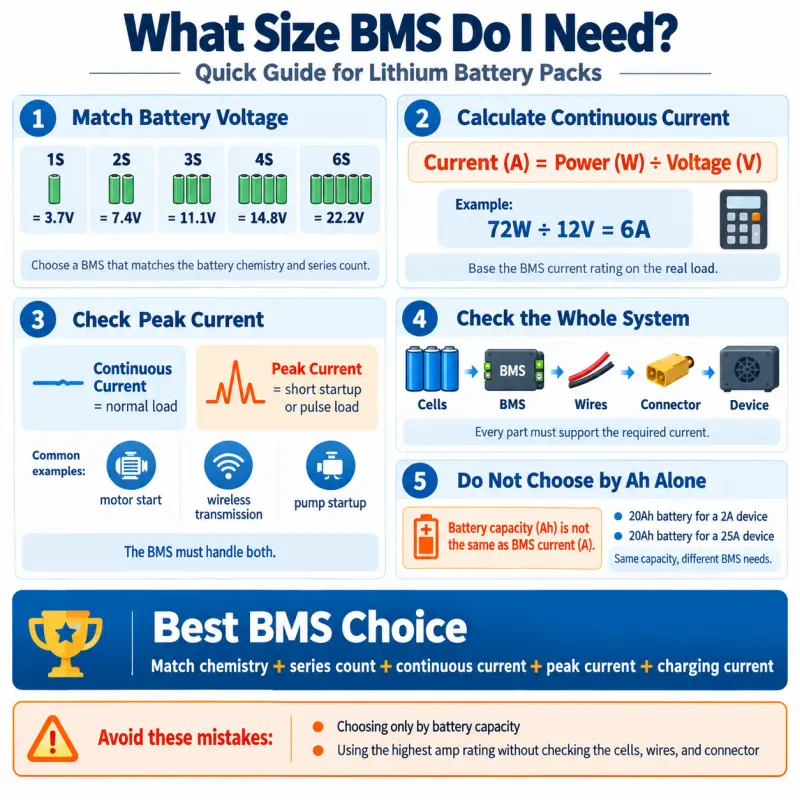
What size BMS do I need for my lithium battery pack? The answer depends on more than battery capacity. A BMS should match the battery chemistry, series configuration, continuous discharge current, peak current, charging current, and the actual operating conditions of the device.
Below are the main questions engineers and product developers should consider before selecting a BMS.
What Does “BMS Size” Mean?
When people talk about BMS size, they usually mean two things: voltage and current rating.
The voltage rating must match the battery’s series configuration. For example, a 3S lithium-ion battery uses three cells in series, while a 4S pack uses four.
A suitable BMS must therefore match both the battery voltage and the real electrical load.
Choosing the wrong specification may result in overcurrent protection being triggered during normal operation or may prevent the battery pack from working correctly with the intended device.
How Do I Match the BMS to Battery Voltage?
Start with the number of cells connected in series.
For common lithium-ion or lithium-polymer cells with a nominal voltage around 3.6–3.7V:
| Cell Configuration | Nominal Pack Voltage |
|---|---|
| 1S | 3.6–3.7V |
| 2S | 7.2–7.4V |
| 3S | 10.8–11.1V |
| 4S | 14.4–14.8V |
| 6S | 21.6–22.2V |
The BMS should support the same series count and chemistry as the battery cells.
Battery chemistry is also important. Li-ion, LiPo, and LiFePO4 batteries use different voltage ranges and protection thresholds, so a BMS should not be selected only by the number of cells.
How Much BMS Current Do I Need?
The BMS current rating should be based on the actual current drawn by the device, not simply on battery capacity.
For a basic DC load:
Current = Power ÷ Voltage
For example, if a 12V battery powers a 72W device:
72W ÷ 12V = 6A
The approximate load current is 6A.
If the maximum continuous current is 8A, selecting a BMS rated exactly at 8A may leave very little operating margin.
The final BMS current rating should also consider:
- PCB temperature
- Wire size
- Connector current rating
- Battery enclosure
- Operating temperature
- Actual duty cycle
For a more detailed explanation, you can internally link this section to How to Calculate BMS Current for a Lithium Battery Pack.
Should I Choose a BMS Based on Continuous or Peak Current?
You need to check both.
Continuous current is the current required during normal operation for an extended period.
Peak current is a higher current that may occur briefly during:
- Motor startup
- Wireless transmission
- LTE or 5G connection
- Pump startup
- Compressor startup
- Servo movement
For example, a device may draw 5A continuously but require 12A for two seconds during startup.
In this situation, the BMS must support the normal 5A load and also tolerate the 12A peak without triggering overcurrent protection.
Peak current, peak duration, protection threshold, and detection delay should all be checked.
You can internally link this section to What Is the Difference Between Continuous Current and Pulse Current?
Is a Higher-Amp BMS Always Better?
No.
A 30A BMS does not automatically mean that the complete battery pack can safely deliver 30A.
The battery cells may only support 10A, or the connector and wires may have lower current limits.
The complete current path should be considered:
Cells → BMS → Wires → Connector → Device
Every part must support the required current.
For this reason, simply choosing the highest BMS current rating available is not a good battery design strategy.
Does Battery Capacity Determine BMS Size?
Not directly.
Battery capacity is measured in amp-hours, or Ah, while BMS current is measured in amps, or A.
Two 20Ah batteries can require completely different BMS designs.
One 20Ah battery may power a monitoring device that only draws 2A.
Another 20Ah battery may power a motor requiring 25A continuously.
The battery capacity is the same, but the current requirement is completely different.
This is also why a 100Ah battery does not automatically require a 100A BMS.
What Other BMS Specifications Should I Check?
Voltage and current are only part of BMS selection.
| Parameter | What to Confirm |
|---|---|
| Battery chemistry | Li-ion, LiPo, LiFePO4 |
| Series count | 1S, 2S, 4S, 16S, etc. |
| Continuous current | Maximum normal load |
| Peak current | Maximum temporary load |
| Charging current | Maximum charger output |
| Temperature sensing | NTC quantity and location |
| Cell balancing | Whether balancing is required |
| Communication | UART, SMBus, CAN, RS485 |
| Connector | Current rating and pin definition |
For more information about BMS protection and monitoring functions, you can link to What Does a BMS Do in a Lithium Battery Pack?
What Information Should I Send to a Battery Manufacturer?
For a custom battery project, provide the manufacturer with the actual battery and load requirements.
Useful information includes:
- Battery voltage
- Required capacity
- Continuous current
- Peak current
- Peak duration
- Charging current
- Operating temperature
- Connector type
- Communication requirements
- Available battery dimensions
Providing this information early makes it easier to match the BMS, battery cells, wires, connector, and protection settings correctly.
At GLOFLUX, the cells, BMS or protection circuit, wires, connector, NTC, mechanical structure, and load requirements can be evaluated together when developing a custom lithium battery pack.
Final Answer: What Size BMS Do I Need?
The correct BMS should first match the battery chemistry and series configuration.
It should then support the required continuous current, peak current, and charging current with suitable operating margin.
Do not select a BMS only by battery capacity or simply choose the largest amp rating available.
A reliable battery design should consider the complete system, including the cells, BMS, wires, connector, charger, thermal conditions, and actual load behavior.
If these parameters are clear, choosing the right BMS becomes much easier.
FAQ
Can I use a 20A BMS for a 10A load?
Yes, if the voltage, chemistry, protection settings, cells, wires, and connector are compatible.
What happens if my BMS current rating is too low?
The BMS may overheat or trigger overcurrent protection during normal use.
Does a 100Ah battery need a 100A BMS?
No. Battery capacity and BMS current are different parameters.
Do I need to include motor startup current?
Yes. Startup current can be much higher than normal running current and should be checked separately.
Can I use the same BMS for Li-ion and LiFePO4 batteries?
Usually not, unless the BMS is specifically designed or configurable for both battery chemistries.
Should charging current also match the BMS?
Yes. The BMS must support the required charging current as well as the discharge current.
Talk to the Manufacturer
Resources & Insights
High Capacity Lithium Battery for Wearables: High-Voltage LiPo Cell Design
2026-10-19
Cylindrical Battery Packs for Laptops: 2S vs 3S vs 4S Battery Design
2026-10-19

Stage Lighting Battery Pack: Prevent Voltage Drop & LED Flicker
2026-10-19

Best Rechargeable Batteries for Smart Devices: Performance, Safety, and Selection Guide
2026-10-19


