


 Home /
What Is the Difference Between a BMS and a PCM?


Table of Contents
- What Is a PCM in a Lithium Battery Pack?
- What Is a BMS?
- What Is the Main Difference Between a BMS and a PCM?
- Is a PCM the Same as a Simple BMS?
- When Should I Use a PCM?
- When Should I Use a BMS?
- Which Is Better for a Custom Lithium Battery Pack?
- What Information Should I Give a Battery Manufacturer?
- Final Answer: BMS vs PCM
- FAQ
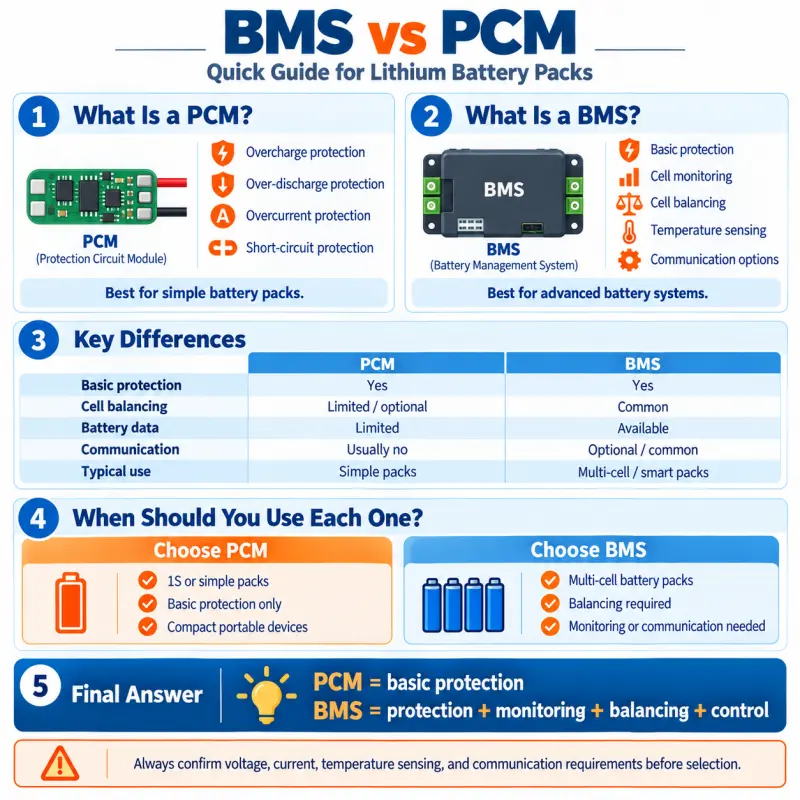
BMS vs PCM is a common question when selecting a protection solution for a lithium battery pack. Both can protect cells from unsafe voltage or current conditions, but they differ in function, complexity, and application.
In simple terms, a PCM usually focuses on basic battery protection, while a BMS can provide broader monitoring, balancing, communication, and control. Because suppliers sometimes use these terms differently, the actual circuit functions should always be checked.
What Is a PCM in a Lithium Battery Pack?
PCM stands for Protection Circuit Module. It is commonly used in small or relatively simple lithium-ion and lithium-polymer battery packs.
A PCM typically provides protection against:
- Overcharge
- Over-discharge
- Overcurrent
- Short circuit
Some designs also support temperature protection when an NTC sensor is included.
The PCM disconnects the charge or discharge path when the battery reaches an unsafe limit. This makes it suitable for many compact devices where advanced battery data or communication is not required.
What Is a BMS?
BMS stands for Battery Management System. It normally includes protection functions but can also monitor and manage more information about the battery pack.
Depending on the design, a BMS may include:
- Overcharge and over-discharge protection
- Overcurrent and short-circuit protection
- Temperature monitoring
- Cell voltage monitoring
- Cell balancing
- State of charge estimation
- Charge and discharge control
- CAN, UART, SMBus, RS485, or other communication
Not every BMS includes every feature. A simple BMS may only provide protection and balancing, while a smart BMS may communicate with the host device or charger.
For more detail, see What Does a BMS Do in a Lithium Battery Pack?.
What Is the Main Difference Between a BMS and a PCM?
| Function | PCM | BMS |
|---|---|---|
| Basic protection | Yes | Yes |
| Overcurrent / short circuit | Yes | Yes |
| Temperature monitoring | Optional | Common |
| Cell balancing | Limited or optional | Common in multi-cell packs |
| Battery data monitoring | Usually limited | Often available |
| Communication | Usually no | Optional or common |
| SOC estimation | Usually no | Possible |
A PCM is often enough when the battery only needs reliable basic protection. A BMS is more suitable when the device requires balancing, battery information, communication, or more detailed control.
Is a PCM the Same as a Simple BMS?
Sometimes the difference is mainly terminology.
Some battery suppliers may call a protection board a “BMS” even when it only provides basic protection. Others may call a similar circuit a “PCM.”
For this reason, engineers should check the actual specification instead of relying only on the name.
Important items include series count, protection thresholds, continuous current, peak current, temperature sensing, cell balancing, and communication functions.
When Should I Use a PCM?
A PCM can be a good choice when the battery pack is small, the electrical system is simple, and the device does not need battery data.
For example, a single-cell 3.7V lithium-polymer battery used in a portable product may only need overcharge, over-discharge, overcurrent, and short-circuit protection.
However, the PCM still needs to match the battery chemistry, voltage, charging current, and load current.
When Should I Use a BMS?
A BMS is generally more suitable for multi-cell packs or applications that require more detailed battery control.
Examples include:
- Higher-voltage battery packs
- Multiple cells connected in series
- Packs requiring cell balancing
- Devices that communicate with the battery
- Medical or industrial equipment
- Energy storage systems
- Smart chargers
The BMS current rating must also match the real load. See How to Calculate BMS Current for a Lithium Battery Pack for a practical calculation guide.
Which Is Better for a Custom Lithium Battery Pack?
Neither is automatically better. The correct choice depends on the application.
| Application Need | Typical Choice |
|---|---|
| Simple 1S portable device | PCM |
| Basic protection only | PCM |
| Multi-series battery pack | BMS |
| Cell balancing required | BMS |
| Battery communication required | BMS |
| SOC monitoring required | BMS |
Before selecting either one, define the battery voltage, capacity, continuous current, peak current, charging method, connector, temperature range, and communication needs.
You can also read What Size BMS Do I Need for My Lithium Battery Pack? to understand BMS voltage and current selection.
What Information Should I Give a Battery Manufacturer?
For a custom battery project, provide the manufacturer with:
- Battery chemistry
- Nominal voltage
- Cell configuration
- Required capacity
- Continuous discharge current
- Peak current and duration
- Charging current
- Operating temperature
- Connector requirements
- Communication protocol, if needed
At GLOFLUX, these requirements can be considered together during custom lithium battery pack development.
Final Answer: BMS vs PCM
BMS vs PCM comes down to how much protection, monitoring, and control the battery system requires.
A PCM is usually suitable for simpler packs that mainly need basic protection. A BMS can add functions such as cell balancing, monitoring, communication, and system-level control.
Because terminology is not always standardized between manufacturers, do not choose a circuit by name alone. Confirm its real protection thresholds, current capability, balancing, temperature monitoring, and communication features before making the final selection.
FAQ
Can a PCM protect a lithium battery from overcharging?
Yes. Overcharge protection is a standard function of many lithium battery PCM designs.
Can a PCM be used for a multi-cell battery pack?
Yes, some PCM designs support multiple cells, but more complex packs often use a BMS.
Does every BMS communicate with the device?
No. Some BMS designs only provide protection and balancing, while smart BMS units may include communication.
Is a BMS safer than a PCM?
Not automatically. Safety depends on the circuit design, cells, protection settings, current rating, and application.
Can I replace a PCM with a higher-current BMS?
Possibly, but voltage, chemistry, protection settings, cell capability, and charging system must all remain compatible.
How do I know whether my battery project needs a BMS or PCM?
Start with voltage, series count, current, charging method, balancing needs, and communication requirements. These usually determine the right solution.
Talk to the Manufacturer
Resources & Insights
High Capacity Lithium Battery for Wearables: High-Voltage LiPo Cell Design
2026-10-19
Cylindrical Battery Packs for Laptops: 2S vs 3S vs 4S Battery Design
2026-10-19

Stage Lighting Battery Pack: Prevent Voltage Drop & LED Flicker
2026-10-19

Best Rechargeable Batteries for Smart Devices: Performance, Safety, and Selection Guide
2026-10-19


