


 Home /
 Custom 3.7V Curved Li-Polymer Battery for Smart Ring Wearable Devices


Table of Contents
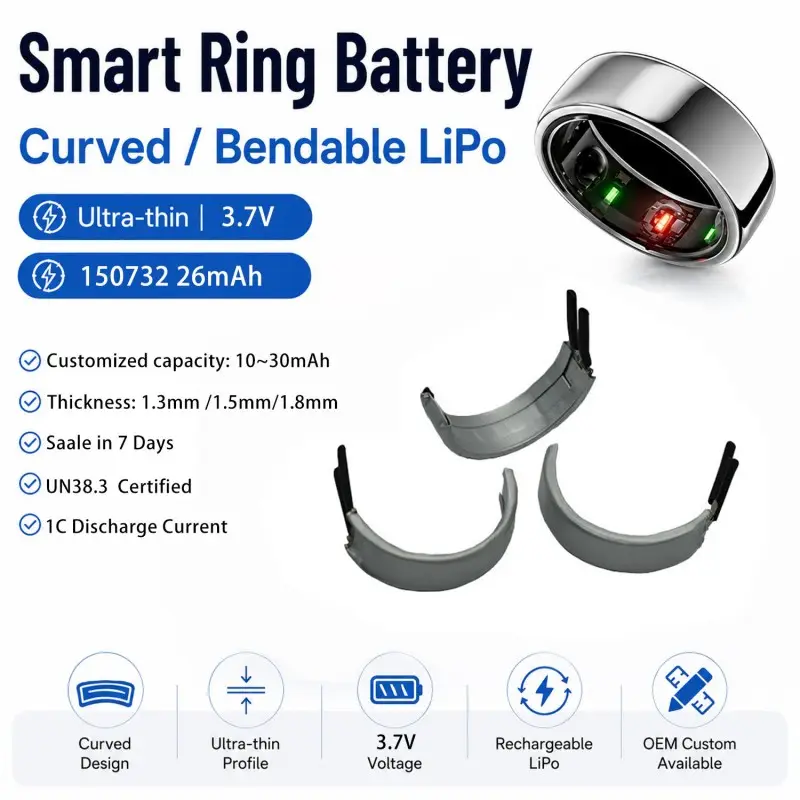
Custom 3.7V curved Li-polymer battery solutions are becoming increasingly important as smart ring wearable devices continue to grow in popularity. Unlike traditional watches or fitness bands, smart rings have extremely limited internal space. They need a battery that can fit a compact circular structure while still supporting stable power for sensors, Bluetooth communication, health monitoring, and daily user interaction. A curved lithium polymer battery helps solve this challenge by matching the shape of the device more naturally than a standard flat cell.
Smart rings usually focus on comfort, lightweight design, and continuous performance. Users wear them throughout the day and often during sleep, so every internal component must remain small, safe, and reliable. The battery plays a key role in this design. A custom curved Li-polymer battery allows engineers to use the available space more efficiently and reduce wasted internal volume. This helps the final product maintain a slim appearance without sacrificing basic power performance.
Why Smart Rings Need Curved Batteries
A smart ring has a very different structure from a smartwatch or earbud. Its inner space follows a rounded shape, and the battery must work around sensors, circuit boards, antennas, and charging components. If designers use a flat battery, they may lose valuable space or need to increase the thickness of the ring. A curved battery can better follow the product shape, making the design more compact and ergonomic.
The 3.7V voltage platform is commonly used in small rechargeable electronics. It can support low-power chips, optical sensors, motion sensors, Bluetooth modules, and small indicator systems. For smart rings, this voltage offers a practical balance between compact size and stable output. With the right battery design, manufacturers can improve runtime while keeping the ring comfortable for daily wear.
Customization Options for Different Product Designs
Every smart ring project may have different requirements. Some products focus on sleep tracking, while others support heart rate monitoring, activity tracking, temperature sensing, NFC functions, or Bluetooth data transmission. These functions affect battery capacity, discharge performance, size, thickness, and protection design.
A custom 3.7V curved Li-polymer battery can be adjusted according to the device structure. Common customization options include battery length, width, arc shape, thickness, capacity, tabs, wires, connectors, and PCM protection board. Engineers can also adjust the cell layout to match the available space inside the ring. This flexibility helps product developers move from prototype testing to mass production more smoothly.
For early-stage product development, battery samples can help engineers test fit, charging behavior, discharge performance, and device runtime. After confirming the structure, the battery design can be optimized for production consistency, safety, and assembly efficiency.
Key Benefits of Curved Li-Polymer Battery Design
The biggest advantage of a curved Li-polymer battery is space utilization. It helps designers place the power source inside a rounded product without forcing a bulky structure. This matters because wearable devices must feel light and natural on the body.
Another benefit is design freedom. With a customized battery shape, manufacturers can create more attractive wearable products instead of building the entire structure around a standard battery. This supports more innovative industrial design and improves the user experience.
Li-polymer chemistry also suits compact wearable electronics because it supports thin, lightweight, and rechargeable battery formats. When designed properly, it can deliver stable power for low-current applications and repeated daily charging cycles. For smart rings, this makes Li-polymer batteries a practical choice for compact and comfortable products.
Applications Beyond Smart Rings
Although this battery type is ideal for smart rings, it can also support other compact wearable devices. Many mini electronic products require non-standard battery shapes because their internal space is limited. Curved Li-polymer batteries can be used in health monitoring devices, wearable sensors, mini Bluetooth trackers, compact IoT terminals, medical wearable prototypes, and other small smart electronics.
As wearable technology continues to develop, more products will need batteries that fit the product design instead of forcing the design to fit the battery. Curved and customized batteries help manufacturers build smaller, smarter, and more comfortable devices.
Important Design Considerations
When choosing a custom curved battery, manufacturers should consider several technical factors. The first is the available internal space. Engineers need to provide accurate dimensions, including length, width, thickness, and curvature. The second factor is the required runtime. Battery capacity should match the device’s power consumption and expected use time.
Charging method also matters. Smart rings may use magnetic charging, wireless charging, or special charging pins. The battery and protection circuit must match the charging system to support safe operation. Developers should also consider discharge current, operating temperature, connector type, and certification requirements for target markets.
Reliable battery production requires strict quality control. For wearable devices, safety and consistency are especially important because the product stays close to the body. Manufacturers should evaluate cell performance, protection design, insulation, cycle life, and production stability before moving to large-scale orders.
Conclusion
A custom 3.7V curved Li-polymer battery provides an effective power solution for smart ring wearable devices. Its curved structure helps maximize limited internal space, while its lightweight design supports better comfort and product appearance. With customizable size, capacity, tabs, connectors, and protection circuits, it can meet the needs of different smart wearable projects.
For companies developing smart rings, health trackers, mini sensors, or compact IoT wearables, choosing the right battery is a critical step. A well-designed curved Li-polymer battery can improve product integration, support stable performance, and help bring innovative wearable devices to market more efficiently.
Talk to the Manufacturer
Resources & Insights
High Capacity Lithium Battery for Wearables: High-Voltage LiPo Cell Design
2026-10-19
Cylindrical Battery Packs for Laptops: 2S vs 3S vs 4S Battery Design
2026-10-19

Stage Lighting Battery Pack: Prevent Voltage Drop & LED Flicker
2026-10-19

Best Rechargeable Batteries for Smart Devices: Performance, Safety, and Selection Guide
2026-10-19


