


 Home /
 Fast Charge Technology in USB Rechargeable AAA Batteries


Table of Contents
- 1. System Architecture of a USB Rechargeable AAA Battery
- 2. Fast Charging Mechanism: Why "80% in 30 Minutes" is Achievable
- 3. Charging Time Profile (System-Level Reference)
- 4. Engineering Optimization Behind Fast Charging
- 5. Safety and Compliance Considerations (Corrected and Aligned)
- 6. Dedicated Charger Design: Important for Fast Charging
- 7. Examples of Where Fast Charge AAA Batteries are Beneficial
- 8. Trade-off of Fast Charging vs Cycle Life
- 9. Key Technical Specifications (Reference Summary)
USB rechargeable AAA batteries are increasingly replacing alkaline cells in compact electronics, offering both higher lifecycle efficiency and improved usability. Among modern solutions, the USB Rechargeable AAA Battery developed by Gloflux is designed with a fast-charging capability that can reach approximately 80% state of charge in around 30 minutes under a dedicated charging system.
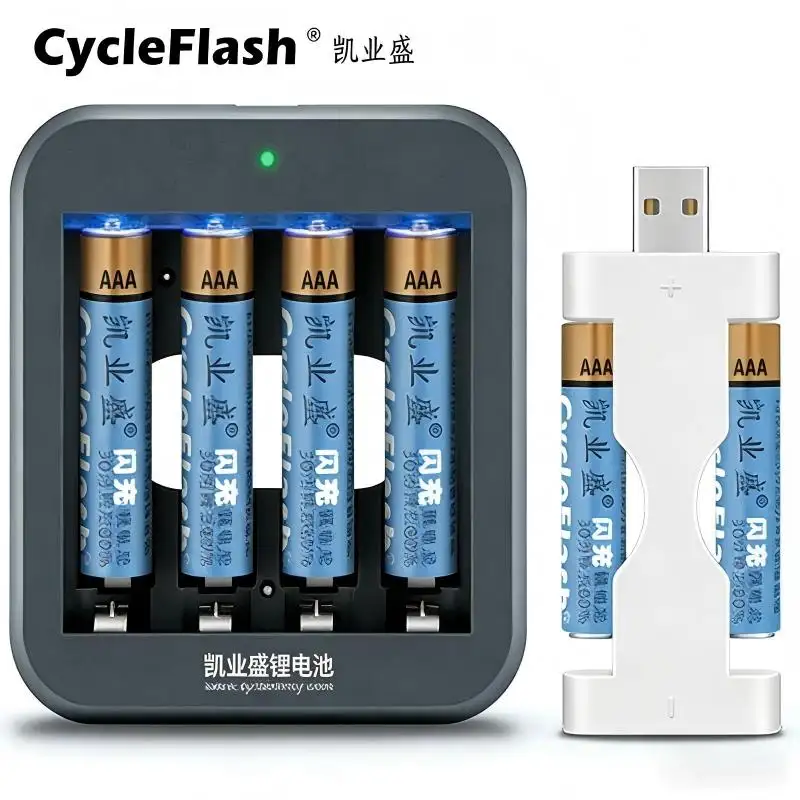
This article explains the engineering structure behind this fast-charging behavior, the role of the charger–battery system interaction, and the practical implications for end-use scenarios.
1. System Architecture of a USB Rechargeable AAA Battery
A USB rechargeable 1.5V AAA battery is a compact energy system designed with multiple components—not merely an electrochemical cell—such as:
1.1 Cell Core
•Cylindrical lithium-ion cell (LCO-based or high-energy chemistry equivalents)
•Voltage conversion module with internal circuitry for constant output regulation to 1.5V
•Designed capacity: energy storage of ~900 mWh class
1.2 Protection & Control Circuit (PCM/BMS-lite)
•Overcharge protection, over-discharge protection, short-circuit protection
•Charge current regulation for constant current / constant voltage (CC/CV) phases
•Cell balancing (for internal multi-cell configurations)
1.3 Low-Impedance Design
•Internal paths for current optimized via precision welding, copper, or aluminum
•Typical internal resistance of ~ 60 mΩ (varies by design)
•Minimizes ohmic heating during fast charging
1.4 USB Direct Charging Interface
•Standard 5V USB source for charging; compatible with wall chargers, power banks and USB ports
•Charging circuitry within the dedicated charger; not within the cell
2. Fast Charging Mechanism: Why "80% in 30 Minutes" is Achievable
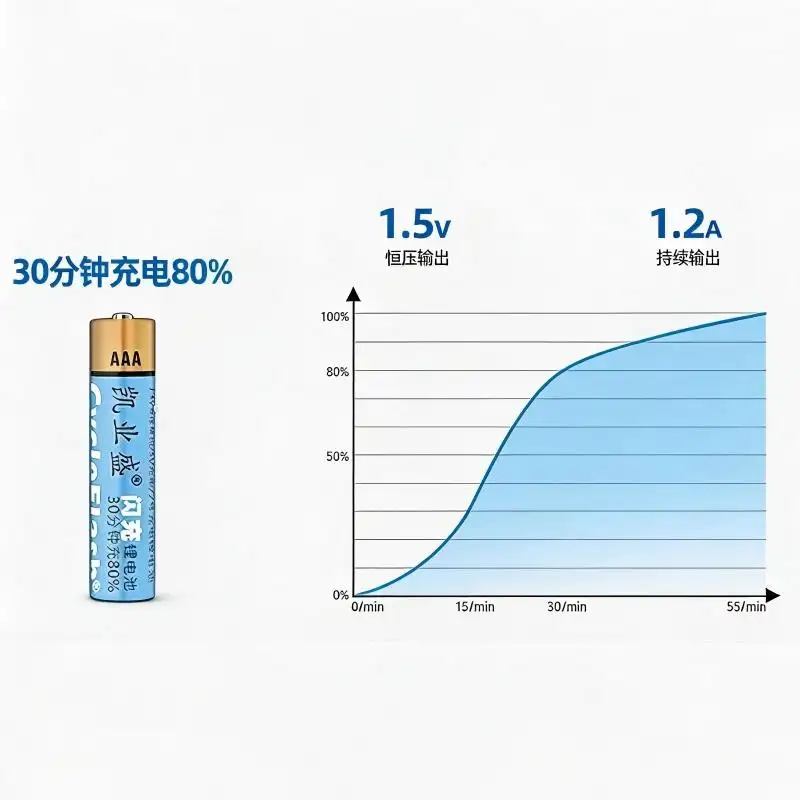
Fast charging in lithium-ion systems is governed by a constant-current / constant-voltage (CC/CV) charging profile. The behavior is not linear and is strongly influenced by thermal conditions and internal resistance.
2.1 Constant Current (CC) Phase — Rapid Energy Injection
•The charger holds current regulation at an elevated level
•Battery voltage increases linearly
•Energy gain for the battery occurs at the highest rate in this phase
•Typically, a battery reaches approximately 70 to 80 percent state of charge (SOC) within about 30 minutes (depending on the particular system)
2.2 Constant Voltage (CV) Phase — Controlled Saturation
•Charging voltage is near the upper cutoff limit
•Charging current begins to decrease linearly
•Over-stressing the Lithium-ion battery structure is avoided
•The last 20 percent of the charge takes considerably longer (approximately 20 to 30 minutes)
2.3 Thermal Behavior and Stability
The fastest possible charging is primarily a function of the heat management system
•Thermal dissipation is improved via a metal case
•Maintaining a low internal resistance minimizes Joule heating
•A protection circuit avoids overheating by current spike control
3. Charging Time Profile (System-Level Reference)
| Charging Stage | Approx. Duration | Capacity Level | Behavior |
| Constant Current Phase | ~0 to 30 minutes | ~0 to 80 percent | Charging phase with high efficiency and speed |
| Constant Voltage Phase | ~30 to 55 minutes | 80 to 100 percent | Charging phase with controlled speed |
| Total Charge Time | ~55 minutes | Full System-balanced Charge | Completed charging cycle for the system |
Values can change depending on external temperature, battery age, and limitations of the charger
4. Engineering Optimization Behind Fast Charging
For fast charging, Gloflux employs several system-level optimizations to achieve a desirable balance between charge time and long cycle life.
4.1 Cell Selection and Matching
The following criteria are analyzed and evaluated during the selection of cells.
•Voltage stability
•Consistency of internal resistance
•Reduction of imbalance of multi-component internal assembly
•Improvement of charging efficiency among various production batches
4.2 Controlling Conductive Path and Precision Welding
•Welding with low resistance and stable current distribution allows even greater thermal uniformity
•This is especially important for fast-charge stability in compact designs
4.3 Charging Algorithm Calibration
•A smart USB charger is the key component of a controlled charging algorithm
•This ensures that there will not be a large current spike during the first charging
•This facilitates the smooth charging process
4.4 Cycle Life Engineering Target
•An approximate cycle life of ~1000 cycles is desirable
•This is based on empirical testing with controlled charge/discharge
•The main factors that affect this are temperature and depth of discharge
5. Safety and Compliance Considerations (Corrected and Aligned)
For lithium ion USB rechargeable batteries, compliance typically involves:
•UN38.3: Safety of lithium batteries transport
•CE: Conformity in the European Union
•RoHS: Restriction of Hazardous Substances
6. Dedicated Charger Design: Important for Fast Charging
To some extent, fast charging performance is influenced by the design of the charger as much as by the design of the cell.
Charger Features (Gloflux System)
•5V / 1A–2A USB power input
•2-slot and 4-slot versions
•CC/CV charging curve with programmable cut-off
•Thermal and time cut-off included
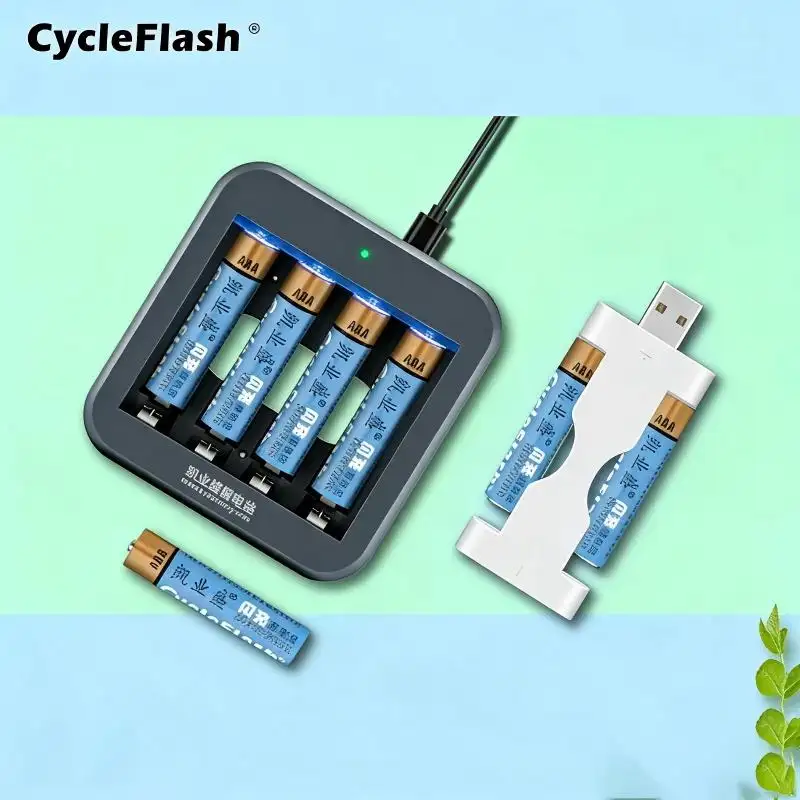
Compact Design Example
•2-slot Charger
•Approx. 85 × 35 × 15 mm
•Light weight travel friendly design (~17 g)
7. Examples of Where Fast Charge AAA Batteries are Beneficial
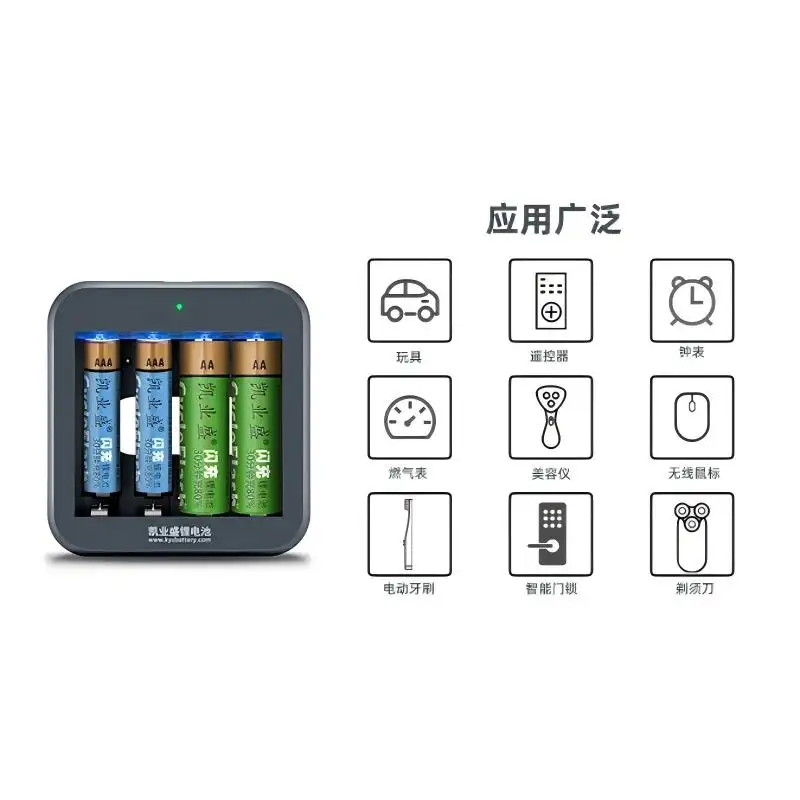
Fast charging is beneficial for the design of products that are used frequently and or used intermittently. Examples of such products are:
•Wireless devices (mouse, keyboard, controller)
•Portable lighting (LED flashlights, inspection lighting)
•Portable POS terminals and handheld devices
•Smart home devices (sensors, remotes)
•Travel and field use equipment that needs to be fast charge
8. Trade-off of Fast Charging vs Cycle Life
The charging speed of lithium-ion batteries and the long-term effects of battery degradation is one of the main compromises of lithium battery design.
In controlled fast charging systems, balance is achieved by:
•Limiting high current duration using control (CC phase control)
•Reducing current during the constant current (CC) phase of charging when temperature increases
•Precision of voltage cut-off during constant voltage (CV) phase
•Protection against deep discharge stress
Although the lab rating approaches ~1000 cycles, the real life lifespan is impacted by:
•Frequency of charging
•Temperature of the environment
•Discharge depth behavior
•Consistency of the charger quality
9. Key Technical Specifications (Reference Summary)
| Parameter | Specification |
| Form Factor | AAA (10.5 × 44.5 mm) |
| Rated Energy | ~900 mWh |
| Output Voltage | 1.5V regulated |
| Fast Charge Capability | ~80% in ~30 minutes (with dedicated charger) |
| Full Charge Time | ~55 minutes |
| Standard Charge Current | ~0.5A (system-dependent) |
| Internal Resistance | ~60 mΩ (typical design value) |
| Cycle Life | Up to ~1000 cycles (controlled conditions) |
| Net Weight | ~12 g |
| Certifications | UN38.3 / CE / RoHS |
Conclusion
The "80% in 30 minutes" fast-charging capability of USB Rechargeable AAA batteries is not the result of a single parameter, but a system-level coordination between cell chemistry, internal resistance control, and charger-side CC/CV algorithm design.
In the solution developed by Gloflux, fast charging is achieved through carefully balanced electrical, thermal, and structural optimization—ensuring that speed, safety, and cycle life remain within a controlled engineering envelope.
As compact rechargeable power systems continue to evolve, this type of integrated fast-charging architecture is becoming a key benchmark for modern small-format lithium-ion batteries.
FAQ
Q1: Are AAA USB rechargeable batteries capable of charging 80% in 30 minutes?
A: Yes, with a dedicated fast charger and appropriate conditions.
Q2: Is fast charging safe with lithium AAA batteries?
A: Yes, but requires appropriate management of both current and temperature.
Q3: What charger is necessary to achieve fast charging?
A: A dedicated 5V USB smart charger for lithium cells.
Q4: Does fast charging negatively affect the longevity of the battery?
A: Only within the limits of the battery's design.
Q5: How long does it take for a full charge?
A: It is around 55 minutes but is also contingent on a few other variables.
Talk to the Manufacturer
Resources & Insights
High Capacity Lithium Battery for Wearables: High-Voltage LiPo Cell Design
2026-10-19
Cylindrical Battery Packs for Laptops: 2S vs 3S vs 4S Battery Design
2026-10-19
Stage Lighting Battery Pack: Prevent Voltage Drop & LED Flicker
2026-10-19

Best Rechargeable Batteries for Smart Devices: Performance, Safety, and Selection Guide
2026-10-19


