

 Home /
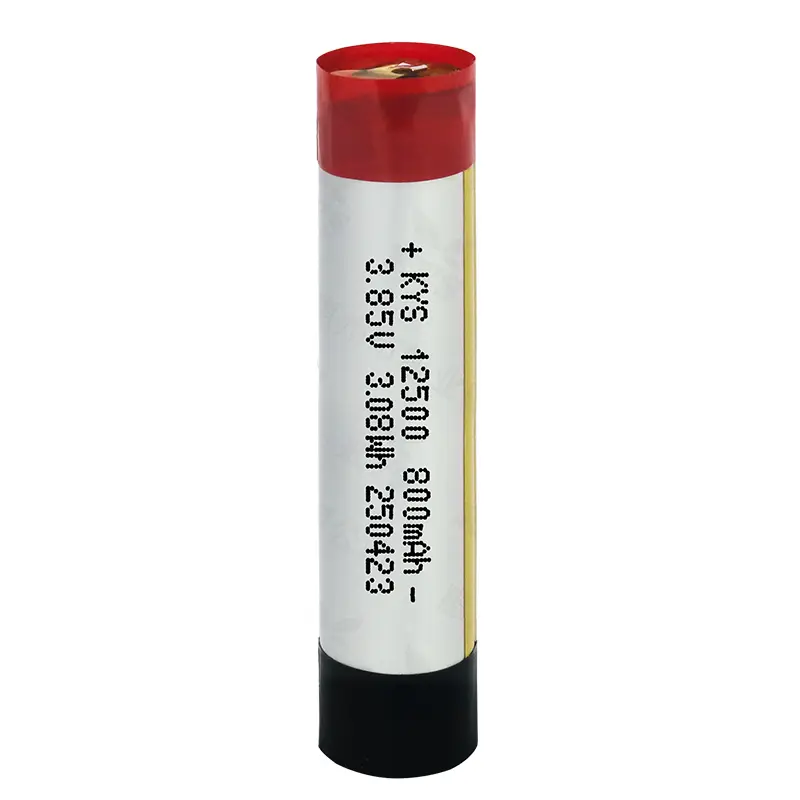
 12500 3.85V Li-ion Cylindrical Battery
This 12500 3.85V lithium battery offers high capacity and low self-discharge. Supports custom 20C discharge rates with LCO/NCM/NCA/LFP options. Built-in protection board ensures overcharge, over-discharge, overcurrent, and short circuit safety. Ideal for e-cigarettes, medical devices, POS terminals, headphones, toys, and beauty instruments.
- Model: KYS 12500
- Cell Size: 12.5×12.5×50.5 mm
- Nominal Voltage: 3.85 V
- Max Discharge Current: 3 A
- Capacity: 800 mAh
- Internal Resistance: 60 mΩ
- Application Scope: Electronic Products
- Charging Voltage: 4.4 V
 Get Free Quote
Back to Product List
Overview
Li-ion Cylindrical Battery Cell Structure Overview
The Li-ion cylindrical battery is made by manufacturers by tightly rolling a jelly-roll architecture within a rigid metal shell. They roll the assembly of cathode, anode, and separator layers into a small cylindrical core first. Meanwhile, engineers fit the rolled structure into a machined steel or aluminum casing. They then stabilize internal alignment and set up the cell to undergo further processing of electrolytes under controlled environmental conditions.
Material Composition and Electrode System
To create the cathode layer, producers spray lithium metal oxide compounds on aluminum foil, and to create the anode layer, they spray graphite-based slurry on copper foil. Moreover, they add a microporous polyethylene-polypropylene separator to ensure ionic conduction and avoid direct contact between electrodes. In addition, they choose a lithium salt electrolyte like LiPF6, which is dissolved in organic carbonate solvents, and they maintain chemical stability in the system. In the meantime, the cylindrical housing is made of high-strength steel or aluminum alloy to ensure structural integrity under pressure.
Electrode Winding and Assembly Process
Technicians cut electrodes into fine strips and then insert them into automated winding machines. They then roll the multilayer stack into a uniform jelly-roll cylindrical shape and regulate tension and alignment. Then, they insert the wound core into the metal can and connect the bottom electrode to the casing base. Then they fit the top cap assembly and weld it with a laser or resistance welding process. Meanwhile, they check internal positioning to prevent deformation during sealing.
Formation Cycling and Industry Standards Compliance
Formation cycling is a process performed by engineers to initiate electrochemical reactions and stabilize solid electrolyte interphase layers within the cell. Then, they perform aging tests at controlled temperatures to test the voltage consistency and impedance stability. Lastly, quality teams conduct dimensional inspection, internal resistance measurement, and safety verification. During production, they adhere to IEC 62133 and UN38.3 standards, and they certify the mechanical strength, electrical reliability, and transport safety of Li-ion cylindrical battery production.
Product Details
Product Features
- 🛠️ Customizable
Customizable to meet customer requirements - ⚡ High Power
Max. 20C discharge rate available - ⏱️ Long Cycle Life
Meets long-term product usage needs - 🛡️ High Safety
Passed comprehensive safety tests - 🔋 True Rated Capacity
Matches the product design capacity - ⚛️ Multi-Chemistry Options
Covers LCO, NCM, NCA and LFP systems - 🧰 Multi-Protection Mechanism
Built-in protection board with overcharge, overdischarge, overcurrent and short-circuit protection
Product Application Areas
This product is suitable for a variety of portable and powered electronic devices, with typical applications including:
-
Personal Care & Health: Electric Toothbrushes, Beauty Devices, Fitness Trackers, Medical Devices
-
Smart Digital & Audio: Headphones, Speakers, Nebulizers, Toys, Lights
-
Financial Payment & Office: POS Machines, USB Tokens, Portable Printers
Technical Parameters
| Model | KYS 12500 |
| Cell Size | 12(Diameter)×50 mm |
| Max Discharge Current | 8 A |
| Operating Voltage | 3.85 V |
| Capacity | 800 mAh |
| Internal Resistance | 60 mΩ |
| Processing Method | Customized As Required |
| Application Scope | Electronic Products |
| Charging Voltage | 4.4 V |