


 Home /
 4S1P Low-Temperature Li-Polymer Battery, 14.8V 4250mAh, Reliable Discharge at -40°C, for Cold-Climate Exploration Equipment


Table of Contents
- Understanding the 4S1P Battery Configuration
- Why Ordinary Batteries Struggle in Cold Environments
- Reliable Discharge Performance at -40°C
- 4250mAh Capacity for Portable Field Equipment
- Compact and Lightweight Li-Polymer Construction
- Applications in Exploration and Surveying
- Custom Battery Pack Design Options
- Charging Requirements in Cold Conditions
- A Dependable Solution for Cold-Climate Equipment
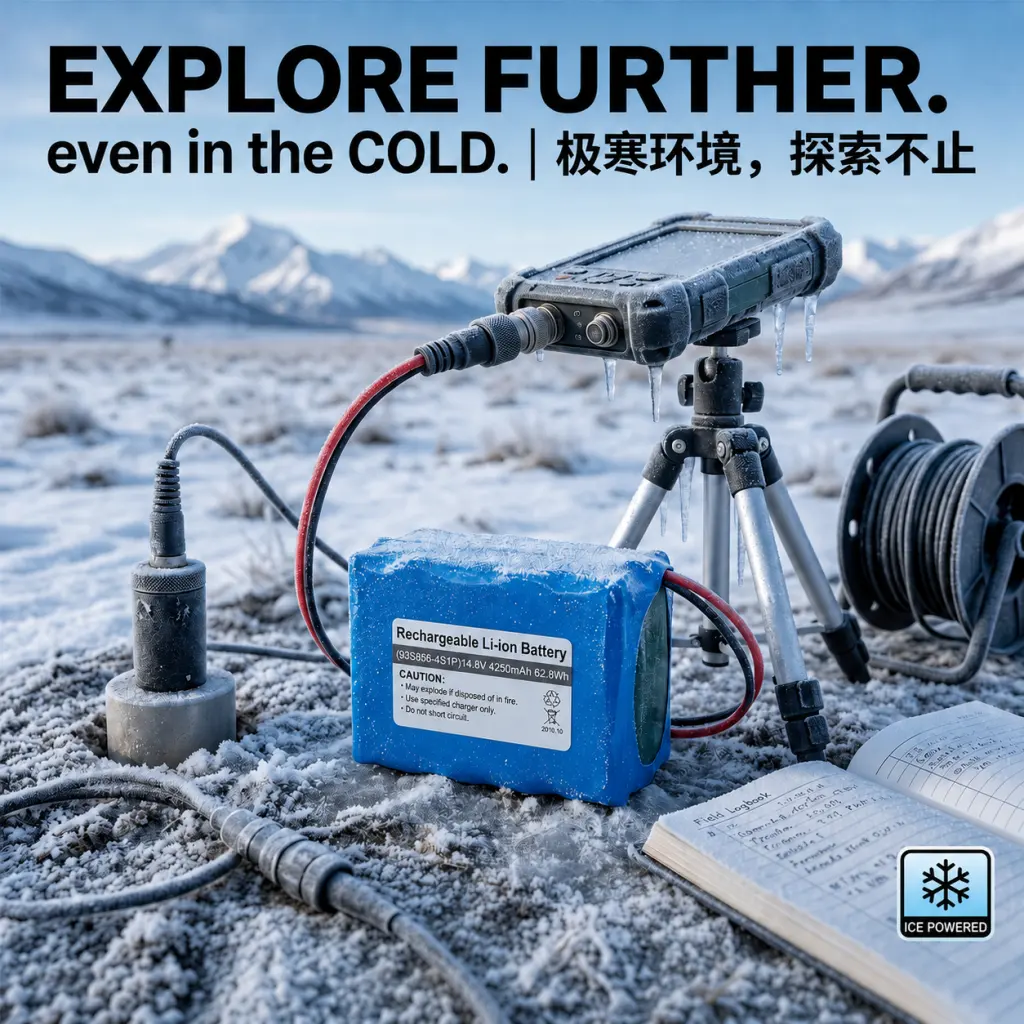
Exploration equipment often operates far from conventional power sources and under environmental conditions that challenge ordinary batteries. Geological surveys, polar research, mountain mapping, environmental monitoring, and remote field inspections all require dependable energy systems. When temperatures fall below freezing, standard lithium-polymer batteries may lose usable capacity, experience greater voltage drop, or struggle to power connected devices.
The 4S1P low-temperature lithium-polymer battery provides a specialized solution for cold-climate exploration equipment. It offers a nominal voltage of 14.8V, a capacity of 4250mAh, and reliable discharge performance at temperatures down to -40°C. Its compact construction, practical energy capacity, and customizable design make it suitable for portable instruments used in remote and demanding environments.
Understanding the 4S1P Battery Configuration
The term 4S1P describes the electrical arrangement of the battery pack. Four lithium-polymer cells are connected in series, while only one parallel group is used. Connecting four cells in series increases the total nominal voltage to 14.8V while maintaining the 4250mAh capacity of the individual cell group.
This configuration is suitable for equipment that requires more voltage than a single lithium-polymer cell can provide. Surveying instruments, communication devices, monitoring systems, and portable detectors often use a 14.8V power source to operate processors, sensors, displays, transmitters, and data-storage components.
The 4S1P design also keeps the battery pack relatively compact because it does not require multiple parallel cell groups. This feature is valuable for portable exploration equipment with limited installation space.
Why Ordinary Batteries Struggle in Cold Environments
Low temperatures slow the electrochemical reactions inside a lithium battery. As the temperature decreases, internal resistance generally increases and ion movement becomes less efficient. These changes can reduce usable capacity and cause the voltage to fall more quickly when the connected equipment draws current.
A device may appear fully charged indoors but deliver much shorter runtime after exposure to extreme cold. In some cases, the battery may not provide enough voltage to start the equipment or support functions that require higher current.
These problems can interrupt important field operations. A geological detector may stop during a survey, a monitoring station may lose data, or a communication device may fail when workers need it most. Using a battery specifically designed for low-temperature discharge helps reduce these risks and improves operational reliability.
Reliable Discharge Performance at -40°C
The main advantage of this 4S1P battery pack is its ability to deliver power at temperatures as low as -40°C. This capability makes it suitable for polar regions, high-altitude locations, winter construction sites, frozen landscapes, and refrigerated industrial environments.
Low-temperature performance is particularly important for devices that must remain outdoors for long periods. Remote sensors, data loggers, positioning systems, and environmental monitoring instruments may be installed in locations that are difficult to access. A battery with dependable cold-weather discharge can reduce equipment downtime and the need for frequent maintenance visits.
Actual runtime at -40°C will still depend on the current demand, discharge rate, voltage cutoff, insulation, equipment efficiency, and duration of cold exposure. Battery testing under the intended operating conditions remains an important part of product development.
4250mAh Capacity for Portable Field Equipment
With a capacity of 4250mAh, the battery pack provides a practical balance between runtime, weight, and physical size. This capacity can support portable exploration instruments without making the equipment unnecessarily large or difficult to carry.
The energy requirement of each device varies. A sensor that collects data periodically may operate much longer than a device with a bright display, continuous wireless transmission, or a built-in motor. Engineers should calculate the expected load profile rather than relying only on the rated capacity.
The battery may also be combined with energy-saving software, standby modes, insulated enclosures, and efficient electronics to extend operating time in cold environments. Proper system design allows manufacturers to make better use of the available 4250mAh capacity.
Compact and Lightweight Li-Polymer Construction
Lithium-polymer batteries can be produced in flat and space-efficient shapes. This design flexibility allows the 4S1P battery pack to fit into portable equipment where cylindrical cells may not be suitable.
A compact battery is especially valuable for handheld surveying devices, portable analyzers, field communication terminals, and scientific instruments carried over long distances. Reducing battery weight can improve user comfort and help manufacturers create more practical equipment for field teams.
The battery dimensions, wire length, connector, protective materials, and external enclosure can be adjusted according to the available installation space. This flexibility supports new product development as well as replacement battery projects.
Applications in Exploration and Surveying
The 14.8V 4250mAh low-temperature battery can support many types of professional equipment. Common applications include geological detectors, mineral exploration instruments, surveying devices, mapping systems, portable GPS equipment, data loggers, environmental sensors, and remote communication units.
It can also power instruments used in polar research, mountain expeditions, tunnel inspection, pipeline monitoring, infrastructure assessment, and emergency field operations. Scientific teams may use similar batteries in weather stations, sampling devices, tracking systems, and portable diagnostic equipment.
For unattended installations, the battery pack may be combined with external charging equipment or renewable energy systems. The complete system must include suitable charging controls and protection against environmental exposure.
Custom Battery Pack Design Options
Exploration equipment manufacturers often need battery packs tailored to a specific device. The 4S1P battery can be customized with different connectors, cable lengths, terminals, labels, insulation materials, protective housings, and mounting structures.
A protection circuit or battery management system can provide safeguards against overcharging, excessive discharge, overcurrent, short circuits, and abnormal temperatures. A temperature sensor may also be included to help the equipment monitor battery conditions.
Before designing a custom pack, the supplier needs to understand the equipment’s nominal voltage, maximum current, continuous load, peak load, expected runtime, installation dimensions, operating temperature, charging method, and environmental protection requirements.
Charging Requirements in Cold Conditions
The ability to discharge at -40°C does not necessarily mean the battery can be charged safely at the same temperature. Charging lithium batteries below the approved charging range may cause lithium plating, permanent capacity loss, internal damage, or safety problems.
The battery should be warmed to an acceptable temperature before charging. The charging system must use the correct voltage, current, and termination method for the battery chemistry. In outdoor equipment, designers may add temperature monitoring, heating elements, or charging lockout functions.
Users should always follow the specified charging and storage conditions rather than assuming that the discharge temperature range also applies to charging.
A Dependable Solution for Cold-Climate Equipment
The 4S1P low-temperature lithium-polymer battery combines a 14.8V nominal voltage, 4250mAh capacity, and reliable discharge performance down to -40°C. It provides a compact rechargeable power source for exploration, monitoring, surveying, communication, and scientific equipment used in demanding environments.
With the correct protection system, connector, enclosure, and charging design, the battery can be customized for many field applications. Selecting a purpose-designed low-temperature battery helps equipment operate more consistently, reduces interruptions, and supports dependable data collection in remote cold-climate locations.
Talk to the Manufacturer
Resources & Insights

High Capacity Lithium Battery for Wearables: High-Voltage LiPo Cell Design
2026-10-19
Cylindrical Battery Packs for Laptops: 2S vs 3S vs 4S Battery Design
2026-10-19
Stage Lighting Battery Pack: Prevent Voltage Drop & LED Flicker
2026-10-19

Best Rechargeable Batteries for Smart Devices: Performance, Safety, and Selection Guide
2026-10-19


